
You usually start looking for a CPA in Delaware when something stops feeling simple.
Maybe payroll is fine, bills are paid, and tax season has always been a scramble you survive. Then one day you need a clean answer to a bigger question. Can you afford another hire? Why is revenue up but cash still tight? Which service line really makes money? Why did your banker ask for financials your current accountant never prepares?
That’s the point where “I need someone for taxes” turns into “I need someone who understands my business.” Those are not the same hire.
A lot of Delaware business owners make the same mistake. They search for the nearest firm, ask about price, and assume all CPAs do roughly the same work. In practice, the right fit depends on your industry, your stage of growth, and whether you need compliance, insight, or both. If you run a healthcare practice, a construction company, or a professional services firm, the wrong advisor can miss the details that affect billing, margins, compliance, and cash flow every month.
Why Finding the Right CPA in Delaware is Different
A Wilmington law firm adds a second partner. A Newark medical practice opens another location. A Sussex County contractor lands larger jobs and suddenly cash gets tighter, not looser. In each case, the owner starts looking for a CPA and runs into the same problem. Plenty of firms can file returns. Far fewer can speak to the operating issues behind the numbers.

Delaware creates a special version of that hiring decision. The state attracts a high concentration of entities, holding companies, closely held businesses, and multi-state activity, so owners often need more than baseline tax prep. They need a CPA who understands how Delaware entity structures, state filing obligations, owner compensation, and out-of-state operations affect reporting and planning.
That distinction gets missed all the time.
Owners often start with the obvious filter. Who is nearby, who answers fast, and who charges a reasonable fee. Those factors matter, but they do not tell you whether the CPA can help with the issues that drive profit and risk in your industry.
The better filter is industry fit.
- Professional services firms need a CPA who understands realization, utilization, partner compensation, project margins, and the difference between revenue growth and healthy cash flow.
- Healthcare groups need help with provider compensation, billing lag, payer mix, payroll complexity, and financial reporting that supports operational decisions.
- Construction companies need accurate job costing, work-in-progress reporting, change order discipline, and close tracking of when cash comes in versus when costs hit.
I have seen good business owners hire technically capable accountants who were suited for a different kind of client. The result is predictable. Reports arrive late, advice stays generic, and nobody connects the numbers to the decisions management has to make every month.
Licensure alone does not solve that problem. A CPA can be fully qualified and still be the wrong choice if most of their work centers on individual returns or very small businesses with simpler needs.
Local knowledge still matters. Delaware business owners benefit from advisors who know the market, the banking relationships, the pace of regional growth, and the practical issues that come up across state lines. This explanation of why hiring local certified public accountants matters covers that side of the decision well.
The key is to combine local context with sector-specific judgment. The right CPA in Delaware should be able to explain your revenue model, spot the pressure points in your cash cycle, and tell you where weak reporting is likely to cost you money before tax season exposes it.
CPA vs Bookkeeper vs Fractional CFO Which Do You Need
A Delaware owner hires a “finance person” to solve the problem. Six months later, the books are cleaner, but cash is still tight, taxes still feel reactive, and nobody can answer whether the business can afford the next hire. That usually means the role was wrong, not that the person was bad.
These three jobs overlap, but they are not interchangeable. The right choice depends on what is breaking in your business.
The short version
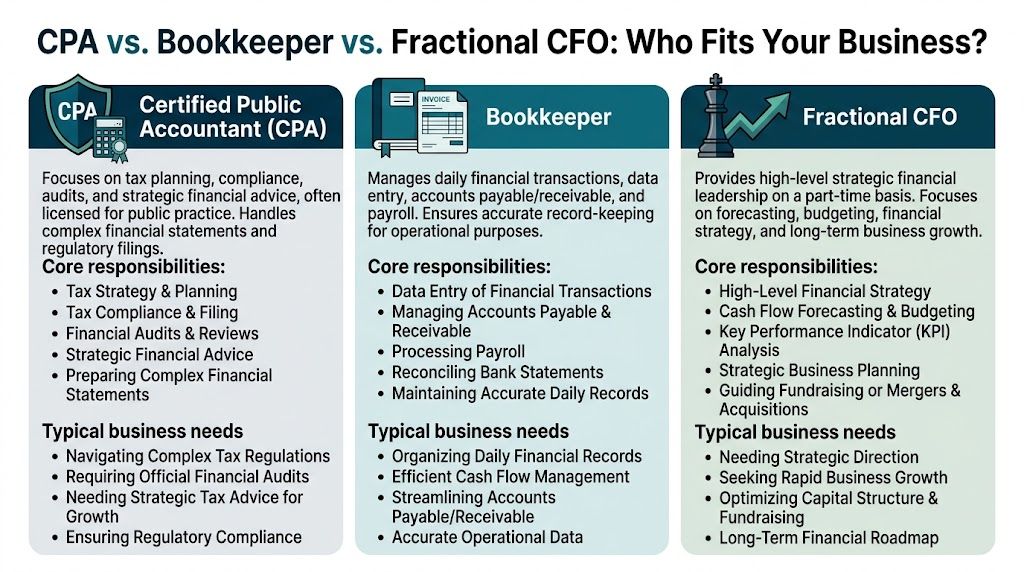
A bookkeeper keeps the records current.
A CPA applies accounting judgment, handles tax and compliance issues, and helps you understand the financial consequences of decisions.
A fractional CFO focuses on planning, forecasting, and operating decisions before they show up in the financials.
Choosing Your Financial Pro Bookkeeper vs CPA vs Fractional CFO
| Role | Primary Job | Best For |
|---|---|---|
| Bookkeeper | Records transactions, reconciles accounts, manages payables and receivables, supports payroll records | Businesses that need accurate monthly books and day-to-day financial order |
| CPA | Handles tax planning, tax filings, financial statement issues, higher-level compliance, and accounting judgment | Businesses facing tax complexity, ownership changes, lender requests, or public-facing accounting needs |
| Fractional CFO | Leads budgeting, forecasting, pricing analysis, cash planning, and financial decision support | Owners who need strategy, better decisions, and forward-looking financial leadership |
What makes a CPA different
A CPA license signals training, testing, and professional standards that go well beyond basic bookkeeping. It also gives the business access to work a bookkeeper usually should not be handling, such as tax planning, financial statement judgment, and more complex reporting questions.
That still does not answer the hiring question by itself.
I have seen Delaware owners assume a CPA will automatically function as a strategist. Some do. Some are excellent technicians who stay focused on returns, compliance, and year-end cleanup. If you run a professional services firm, a medical practice, or a construction company, the better test is whether the CPA understands your operating model well enough to advise on decisions, not just record the outcome after the fact.
Here is where the lines usually fall:
- Bookkeepers keep transactions organized and help close the books on time, but they usually are not the right fit for tax strategy or higher-level accounting judgments.
- CPAs can address tax, compliance, and more complex accounting issues, but not every CPA is built to lead planning conversations.
- Fractional CFOs help with forecasting, margins, cash planning, and decision support, but many do not want to own day-to-day bookkeeping or tax compliance.
Match the role to the problem
Start with the pain point.
If your reconciliations are behind, accounts are messy, and reports arrive late or not at all, bookkeeping is the first fix. Clean books are the foundation for everything else.
If the books are reasonably accurate but you are guessing on taxes, entity structure, owner pay, or how to present financials to a lender, bring in a CPA. That becomes even more important if your business has industry-specific pressure points. A healthcare practice may need help tying compensation, billing, and cash timing together. A construction company may need a CPA who can review job costing and work-in-progress reporting, not just file the return.
If you already have books and tax work covered but still cannot answer questions about pricing, hiring pace, margin targets, or cash runway, that is fractional CFO territory.
One warning. Asking one person to serve as bookkeeper, CPA, controller, and strategist often sounds efficient and ends up expensive. In very small businesses, one provider can sometimes cover several functions. Once the business adds complexity, that setup usually creates blind spots.
For a plain-English explanation of the first layer, this guide on what a bookkeeper does for a small business shows where bookkeeping support ends and higher-level advisory work begins.
A quick self-check
You probably need a bookkeeper if:
- You are behind on reconciliations: The numbers change month to month and no one is confident in them.
- Bills, invoices, and payroll inputs feel disorganized: The process is weak, even if revenue is healthy.
- You need monthly discipline: You cannot manage the business well if the financials are always late.
You probably need a CPA if:
- Taxes are handled reactively: You hear from your accountant once a year and make decisions without tax input.
- A lender, investor, or partner wants stronger reporting: Credibility and accounting judgment matter now.
- The business has become more complicated: More entities, more owners, state issues, or industry-specific accounting questions are showing up.
You probably need a fractional CFO if:
- Major decisions are still based on instinct: Hiring, pricing, and expansion are not tied to a model.
- Cash flow keeps surprising you: Revenue looks solid, but timing gaps keep causing stress.
- You want a financial partner in the room: Someone needs to translate the numbers into operating decisions before problems get expensive.
Where to Actually Find Your Next CPA
Google is where most searches begin, but it shouldn’t be where your decision ends.
The problem with online search results is that every firm looks capable on the surface. Most sites list the same services. Most bios sound polished. Very few tell you whether the firm is strong in your industry or whether they’ll be responsive once you sign the engagement letter.
Start with people who already know your business
The best referrals usually come from professionals who see good and bad financial work up close.
Ask these people first:
- Your business attorney: They often know which CPAs are solid during transactions, disputes, and ownership changes.
- Your banker or lender: They see who delivers financials on time and who causes delays.
- Your payroll provider or benefits advisor: They know which firms stay organized and which firms create cleanup work.
- Other owners in your industry: A construction owner should ask other contractors. A practice owner should ask other operators, not just any business friend.
A referral is useful when it comes with context. “They’re great” doesn’t help much. “They helped us clean up reporting after a messy handoff and they understand project-based billing” does.
Look for industry signals, not just service lists
Most firms say they serve everyone. That’s rarely true in a meaningful way.
When reviewing websites or introductions, pay attention to signs of actual focus:
- Relevant examples: Do they speak naturally about your type of business?
- Useful questions early: Do they ask about utilization, provider mix, retainage, WIP, or recurring revenue, depending on your industry?
- Clear process: Can they explain how they work month to month, not just at tax time?
If you’re comparing nearby options, this list of accounting firms in PA can also help regional businesses think beyond state lines without losing practical proximity.
Local office or remote-friendly regional firm
For many owners in Wilmington and the surrounding region, this is the key decision.
A local Delaware office may be a strong fit if you want frequent in-person meetings or your business has a long-standing local network. But a remote-friendly firm in the greater Philadelphia area can also be a smart choice if they know your industry well and communicate clearly.
The better test is simple. Ask yourself which matters more:
- seeing someone across a conference table, or
- getting faster answers from a team that understands your business model
For specialized companies, I’d choose expertise and responsiveness over ZIP code every time.
How to Properly Vet a CPA in Delaware
A polished website does not mean a CPA is cleared to serve the public in Delaware.
This is one area where business owners need to slow down and verify what they’re being told. It takes a few minutes, and it can save you from hiring someone who isn’t properly set up to do the work you need.
Check both credentials
In Delaware, a CPA must hold both a CPA Certificate and a separate Permit to Practice to legally offer services to the public, and business owners should verify both through DELPROS, as explained in this Delaware CPA licensing guide.
That second part gets missed all the time.
A person may have passed the exam and hold a certificate, but if the Permit to Practice is not active, you should ask more questions before moving forward. If you’re hiring for work that touches public practice, this is not a technicality.
Best check to make: Ask for the exact name under which the CPA is licensed, then confirm both credentials in DELPROS before you sign anything.
What to ask beyond the license
Licensing is the floor, not the finish line. Once that’s confirmed, move into practical vetting.
Use this short checklist:
Ask who will do the work.
The partner you meet may not be the person closing your books or reviewing your file.Ask how they communicate.
Some firms are responsive during sales and hard to reach after onboarding.Ask what they expect from you.
Good firms have a clear document process, timeline, and responsibility split.Ask how they handle mistakes.
Every firm eventually runs into one. You want honesty and a fix process, not defensiveness.
Read reviews like an operator, not a shopper
Online reviews help, but only if you read them carefully.
Useful signs:
- Specific comments: Mentions of responsiveness, cleanup work, tax planning, or industry knowledge.
- Long-term relationships: Clients who stayed for years usually tell you more than first impressions.
- Operational detail: Reviews that mention deadlines, clarity, and follow-through tend to be more credible.
Red flags:
- Only vague praise: “Amazing service” tells you almost nothing.
- Repeated comments about delays: That often points to process issues.
- Bait-and-switch patterns: Strong sales experience, weak delivery team.
You can also look for signs that the firm takes risk management seriously. For example, if you want to understand what protection responsible firms often carry, this overview of CPA professional liability insurance gives helpful context on why these safeguards matter.
References should sound real
When you ask for references, don’t just ask “Would you hire them again?”
Ask:
- What kind of work did they handle for you?
- Were they proactive or mostly reactive?
- How did they do when something got complicated?
- Did you get access to senior people when needed?
Short, generic answers usually mean you’re not learning much. The best references tell a concrete story.
Interview Questions That Reveal the Truth
Most CPA interviews are too soft.
Owners ask about fees, turnaround time, and software. Those matter, but they don’t tell you whether this person can help you run the business better. The better questions force a CPA to show how they think.

There’s a real gap here. Business owners in professional services, healthcare, or real estate often need industry-specific knowledge around billing, compliance, and cash flow, but much of the CPA marketing they see is generic, as discussed in this note on the market gap for specialized accounting guidance.
Questions every business owner should ask
Start with these:
What types of businesses do you serve most often?
Listen for a clear pattern, not “we work with everyone.”What problems do clients usually hire you to solve?
Strong answers mention situations, not just services.How do you spot issues before year-end?
This shows whether they think proactively or live in cleanup mode.What reports do you review with clients regularly?
If they can’t name reports and decisions tied to them, they may be too compliance-focused.How do you handle messy books when taking over a client?
Their answer tells you a lot about process discipline.
If a CPA answers every question by listing deliverables, keep pushing. You want to hear how they think, what they notice, and how they advise.
Questions by industry
For professional services firms
Ask:
- How do you help firms understand profitability by client, project, or service line?
- What do you look for when labor is the biggest cost?
- How do you think about owner compensation versus business profit?
A strong answer should show comfort with utilization, margins, pricing pressure, and uneven project timing.
For healthcare practices
Ask:
- How do you help clients manage the gap between work performed and cash collected?
- What operating reports do you look at in a practice?
- How do you think about payroll, provider productivity, and overhead control?
You want someone who understands that revenue timing can be messy and that operational insight matters as much as tax work.
For construction companies
Ask:
- How do you approach job costing?
- What do you review when a contractor says profit looks fine but cash is tight?
- How do you handle WIP reporting and project overruns?
If they struggle here, keep looking. A contractor does not need a generalist who is learning construction accounting on the job.
A simple scorecard
After each interview, rate the CPA on these five points:
| Area | What good looks like |
|---|---|
| Industry fit | They speak comfortably about your business model |
| Clarity | They explain ideas without jargon |
| Proactivity | They talk about catching issues early |
| Process | They have a clear workflow and timeline |
| Chemistry | You’d actually trust them with hard decisions |
One question that cuts through the script
Ask this near the end:
“If you took over our account tomorrow, what would you want to review first?”
A strong CPA will answer with a sequence. They might mention prior returns, financial statements, entity structure, payroll setup, revenue flow, or balance sheet accounts that tend to hide problems. A weak one will give you a sales answer.
That difference matters.
Hiring and Onboarding Your New Financial Partner
Once you’ve chosen someone, don’t treat the hire like the finish line.
A good CPA relationship starts with a clean handoff, clear scope, and agreed expectations. Without that, even a strong advisor can get stuck chasing missing documents, fixing old errors, and guessing who owns what.
Understand the pricing model
CPA pricing usually falls into a few buckets.
- Hourly billing: Good for one-off projects or uncertain scope. Harder to budget if things get messy.
- Fixed monthly or fixed project pricing: Better when the work is recurring and clearly defined.
- Value-based pricing: More common when the work includes advisory, planning, or decision support, not just compliance.
None of these is automatically right or wrong. What matters is whether the scope matches the fee. Cheap bookkeeping with constant cleanup bills is not cheap.
Read the engagement letter carefully
A lot of owners sign this without reading it closely. That’s a mistake.
Check for these items:
- Scope of services: Tax return only? Monthly accounting? Advisory meetings?
- Deadlines and client responsibilities: What do you need to provide, and by when?
- Response expectations: How the firm handles questions during the year
- Out-of-scope work: What triggers extra fees
- Data access and document handling: Who gets access to what systems
If anything feels vague, ask for it to be clarified before signing.
A clean onboarding checklist
The fastest way to start strong is to give your new CPA complete, organized access from day one.
Provide:
- Financial systems: Accounting software, payroll platform, bill pay tools, banking access as appropriate
- Prior documents: Tax returns, financial statements, general ledger exports, payroll reports
- Ownership and entity info: Legal structure, partner agreements, prior elections if relevant
- Current pain points: Late closes, cash issues, messy reconciliations, unclear reporting
- Primary contacts: One internal owner for approvals and document follow-up
A simple first email you can send
Use something like this:
Hi [Name],
We’re ready to begin. Our main priorities are [tax planning / clean monthly reporting / cash flow visibility / industry-specific guidance].
Please send your first-request list and let us know which systems and documents you want access to first. Our internal point person will be [Name].
We’d also like to schedule an initial review meeting once you’ve had time to assess the current setup.
Short, clear, and useful.
What good onboarding looks like
A strong CPA won’t just collect documents. They’ll create order.
They’ll tell you what they’re reviewing first, what they think is urgent, and where they see risk. They’ll also explain what they need from you to keep the relationship productive. If that structure never shows up, you may have hired a preparer when you needed a partner.
Your CPA Is More Than a Tax Preparer
The best CPA in Delaware won’t just help you file on time. They’ll help you think better.
That means cleaner decisions about hiring, pricing, cash flow, reporting, and growth. It also means fewer surprises, because someone is paying attention before small issues turn into expensive ones. If you’re evaluating a firm, think like a buyer doing diligence. This financial due diligence checklist is a useful way to frame the kind of financial clarity a strong advisor should support.
Don’t hire based on proximity alone. Don’t hire based on the lowest fee. And don’t assume every CPA who shows up in a search for “cpa in delaware” brings the same value.
The right one should make the business feel clearer, calmer, and easier to run.
If you want a team that can support your books, reporting, and higher-level financial decisions without burying you in jargon, MyOfficeOps is a practical place to start. They work with small and midsize businesses across professional services, healthcare, construction, and real estate, with remote-friendly support built for owners who want clarity and follow-through.