
Let's be real: running the books for a construction company is a totally different ballgame than accounting for the coffee shop down the street. It's a special skill for a reason. Construction jobs are long, messy, and have a lot of money moving around in weird ways. The usual accounting methods just don't work.
If you want to know where your money is going and if you're actually making a profit on a job, you need to play by a different set of rules.
Why Construction Accounting Is So Different

Think about a simple store. They buy a shirt for $10, sell it for $30, and they know right away they made $20. The deal is quick, the profit is clear, and regular accounting works just fine.
Now, think about building a custom home. That project could take a year. You're paying for lumber, concrete, and your crew for months before you get the final check from the client.
How do you know if you're making money in month three when the job is only 25% done? That’s the big question that makes accounting for construction companies so unique. You have to track your spending and count your income over a long time, not just in one clean sale.
The Big Picture Challenges
This key difference creates a few big challenges that normal accounting wasn't made for:
- Project-Based Work: Every single job is its own little business with its own budget, timeline, and profit. You have to track each one separately.
- Long Timelines: When jobs last for more than a year, figuring out how much money you really have at any moment gets tough.
- Upfront Costs: You often spend a ton of money on materials and labor way before you get paid, which can create cash flow problems that sink a good company.
- Complex Billing: You don't just send one invoice. You deal with progress payments, retainage (money the client holds back), and change orders.
This is only getting more complex. The global construction industry is expected to hit about $17.05 trillion by 2025. You can read more about this growth at Bizplanr.ai. Trying to manage that kind of business without the right accounting is a recipe for trouble.
Here's the bottom line: regular accounting looks at your whole business at once. Construction accounting has to look at your whole business and each individual job at the same time.
To really make it clear, let’s compare them side-by-side.
Construction vs. Standard Accounting at a Glance
This table shows the main differences between how a normal business and a construction company handle their money. It shows why one-size-fits-all accounting just doesn't work for contractors.
| Accounting Area | Standard Business (e.g., Retail Store) | Construction Company |
|---|---|---|
| Revenue Timing | Money is counted right when a sale is made. | Money is counted over the life of a long-term project. |
| Cost Tracking | Costs are for general things (rent, inventory). | Costs must be tracked for each specific job (materials, labor). |
| Main Focus | Tracking overall company profit each month. | Tracking the profit of each individual project. |
| Billing Process | Simple, one-time invoices at the time of sale. | Complex progress billing, retainage, and change orders. |
As you can see, everything is different, from when you count your money to how you bill for it. This is why getting construction accounting right isn't just a good idea—it's what you need to do to survive and grow.
Job Costing: The Heart of Construction Finances
If you only remember one thing from this guide, make it this: job costing is the most important thing you can do for your construction company. It's the difference between guessing if you’re making money and knowing for sure on every single job.
Think of it this way: your main business bank account is the whole bank. But each job you take on gets its own separate bank account. Every dollar for lumber on that kitchen remodel, every hour your electrician bills to the new office, and every equipment rental for that specific job gets tracked in its own little book.
This isn't just about being organized. It's the only way to get a real-time financial x-ray of a project. Without it, all your costs get thrown into one big pile, making it impossible to see which jobs are winners and which ones are secretly losing you money.
Why Flying Blind is a Terrible Business Strategy
When you don't track costs for each job, you're flying blind. You might feel like you had a good month because your bank account looks good, but that number can fool you. One very profitable job could be hiding the fact that two other projects are losing thousands.
With good job costing, you can suddenly see things clearly and:
- Bid Smarter, Not Harder: When you know exactly what a similar job cost you before—down to the last screw—your future quotes become much more accurate. No more guessing.
- Spot Problems Before They Explode: Is the labor budget for the Johnson house already at 75% when the framing is only half done? Job costing yells this at you now, not when it’s too late.
- Do More of What Works: By looking at your reports, you can see which types of jobs bring in the most profit. This helps you focus on getting more of that kind of work.
Let's look at a simple, real-world example.
Job Costing in Action: Building a Backyard Deck
Let's say you're hired to build a simple backyard deck. You quoted the client $10,000. To find out if you actually make a profit, you need to track every penny for this specific deck project.
You’ll break your costs into two main groups: direct costs and indirect costs.
Direct Costs are all the expenses you can easily tie directly to building that deck.
- Materials: All the wood, screws, concrete, and stain.
- Labor: The wages for the two people who are on-site building the deck.
- Subcontractors: The bill from the electrician you hired to install the lights.
- Equipment: The rental fee for the big drill you used to dig the post holes.
Indirect Costs (also called overhead) are a bit trickier. These are the real costs of being in business that don't belong to any single job. Think of things like your office rent, your insurance, or the salary of your project manager who oversees five different jobs.
To get a true picture of the deck's profit, you need to assign a fair piece of these indirect costs to the job. A common way to do this is to add a percentage based on the project's total direct costs.
The whole point of job costing is to create a mini-Profit & Loss (P&L) report for every single project. It changes the question from "Did my company make money this month?" to "Did the Miller deck project actually make us money?"
By tracking every direct cost and adding a fair share of your overhead, you might find that the deck's true cost was $8,200. This means you made a real profit of $1,800. Now you have clear information. Maybe for the next deck job, you can find a cheaper lumber supplier or schedule your crew better to make that profit even bigger.
That's the power of job costing.
How to Recognize Revenue on Long Projects
https://www.youtube.com/embed/uZ6Le4Kgh74
If you run a coffee shop, accounting is easy. You sell a coffee, you get paid, and that money is yours. But what happens when your "product" is a building that takes 18 months to build?
This is one of the biggest puzzles in construction accounting. When do you actually earn the money in your books? A single job can stretch across multiple tax years, making this a very important question for your financial reports and your taxes. You can’t just wait until a two-year project is done to show any income.
This is where a key idea in accounting for construction companies comes in: revenue recognition. Let's break down the two main ways to do it.
The Completed-Contract Method
First is the simple way. The Completed-Contract method is just what it sounds like: you wait until the job is 100% done, the keys are handed over, and the client signs off before you record any revenue or profit.
Imagine you're building a new home. For months, you're spending money on materials and labor. With this method, your books show all those costs but zero income from that job. It looks like you're losing money until the very last day.
- Who uses it? Mostly smaller contractors doing short jobs that start and end in the same year.
- The upside: It’s very simple. No complicated monthly math.
- The downside: It gives a crazy, up-and-down view of your company’s finances. You could look unprofitable for nine months and then suddenly show a huge profit. Good luck getting a loan or making good decisions with numbers like that.
Because of that big downside, most growing construction companies use a much better method.
The Percentage-of-Completion Method
The Percentage-of-Completion (POC) method is what most companies use, and for good reason. Instead of waiting for the end, you count your income in stages, based on the progress you've made on a job. It’s a way of matching the income you record with the work you’ve actually done.
Let's go back to that new home build. The total contract is for $500,000, and you've estimated your total costs to be $400,000.
At the end of the first quarter, you check your job costs and see you’ve spent $100,000 so far. That's 25% of your total estimated cost ($100,000 ÷ $400,000). So, you can "recognize" 25% of the total revenue on your books.
You would record $125,000 (25% of $500,000) as earned money for that quarter, even if the client's payments don't match that amount exactly.
This method gives a much smoother, more realistic picture of your company's finances. It shows a steady stream of income that reflects your team's hard work—which is exactly what banks, investors, and bonding agents want to see.
To make the POC method work, you have to be great at tracking your progress. This simple workflow shows how quoting, tracking, and reporting all work together.
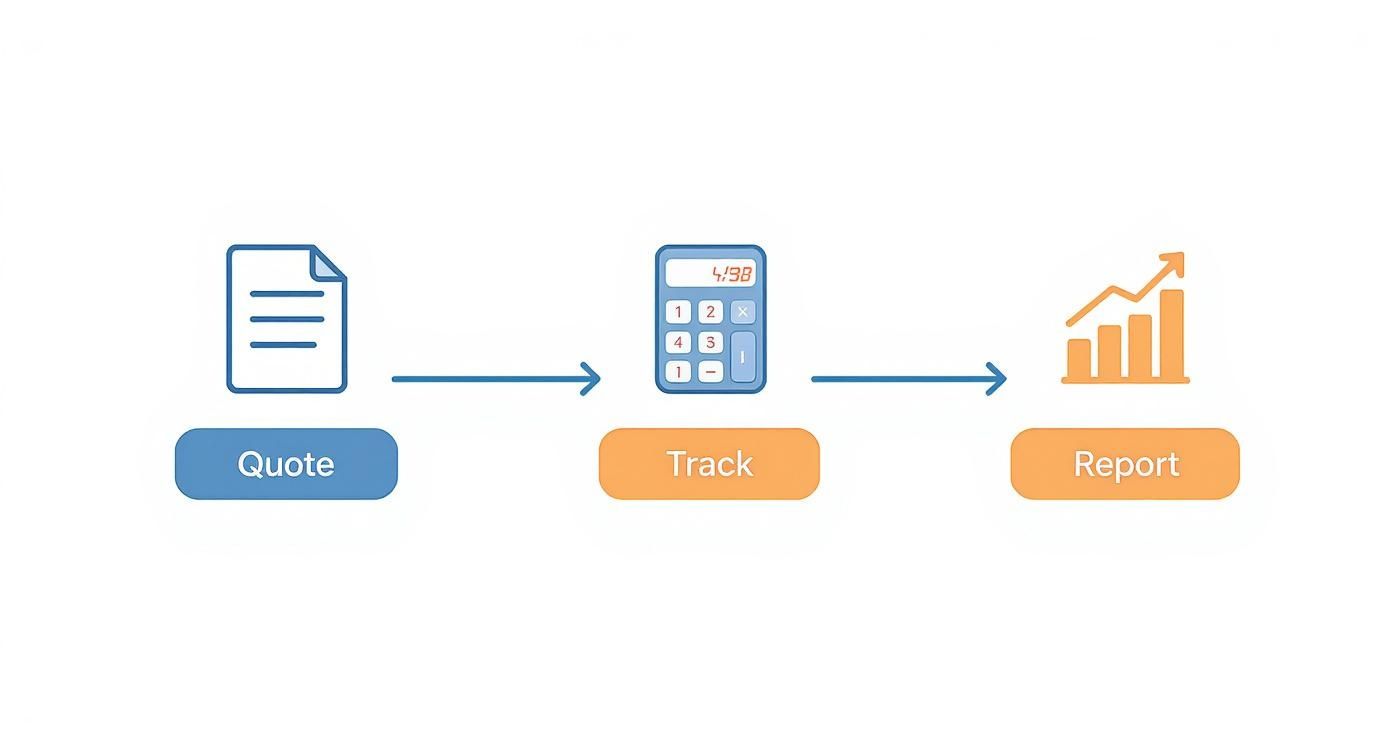
This cycle—from the first quote to tracking every cost and reporting on progress—is what makes accurate revenue recognition possible.
Choosing the right method is a big business decision. The POC method is required by the official accounting rules (called GAAP) for most long-term jobs because it gives a more honest picture of a company's financial health. It makes sure your financial statements aren't misleading, which is key for making smart decisions and keeping trust with lenders.
For any contractor who wants to grow, using the Percentage-of-Completion method isn't just an option—it's a must.
Managing Cash Flow with Construction Billing

In construction, getting paid isn't just one event; it's a whole process. Unlike a store that gets cash on the spot, contractors have to turn completed work into money in the bank through a special billing cycle. Getting this right is the key to healthy cash flow.
Bad billing can stop a project in its tracks, even if the work is perfect. You need to understand the main parts of construction billing—progress billing, retainage, and change orders—to survive and grow. These aren't just fancy words; they're the tools you use to keep your business financially healthy.
The Foundation: Progress Billing
For any job that takes weeks or months, the most common way to get paid is progress billing. Think of it like sending invoices in chapters instead of waiting for the end of the book. You bill the client regularly, usually once a month, based on how much work you've finished.
This is a lifesaver for your cash flow. It helps pay for the ongoing costs of labor and materials without forcing you to fund the whole project yourself. A standard progress bill shows the total contract amount, the value of work done so far, and how much you're asking for now.
Progress billing connects your hard work on the job site to your bank account. It turns completed work into the cash you need to pay your people, order materials, and keep the job going.
Let's walk through a real-world example.
An Example: A Commercial Office Renovation
Imagine you have a $200,000 contract to renovate an office. The project will take four months. At the end of the first month, you've finished all the demolition and framing, which is 25% of the total job.
Your first "payment application"—which is just a fancy name for a construction invoice—would show that $50,000 (25% of $200,000) worth of work is done. This is the amount you bill for, but it's not quite what you’ll get paid. And that brings us to the next piece.
The "Insurance Policy": Retainage
Retainage is a common practice where the client holds back a small percentage of each payment. It's like their insurance policy to make sure you finish the job right and fix any small problems at the very end.
The retainage amount is usually between 5% and 10% of the invoice. This money is held until the project is completely finished.
Let’s go back to our office renovation. The client is holding back 10% retainage.
- Your first bill: $50,000
- Retainage held (10%): $5,000
- Cash you actually get: $45,000
While that $5,000 is your money, you won't get it until the job is 100% done. Tracking retainage is a huge part of accounting for construction companies because it can add up to a lot of cash tied up across all your jobs.
The Inevitable Curveball: Change Orders
No project goes exactly as planned. The client might decide they want to add a conference room or change the flooring after you've started. When this happens, you need a formal way to get paid for the extra work: the change order.
A change order is a written agreement that explains the new work, the extra cost, and any extra time needed. Most importantly, it must be signed by you and the client before you start the new work.
In our office project, the client decides they want built-in bookshelves—an extra $8,000 job. You create a change order, they sign it, and your total contract is now $208,000. This new total is what you'll use for all future progress bills. Skipping this formal step is one of the fastest ways to lose money.
Managing these moving parts—billing for progress, tracking retainage, and documenting change orders—takes real attention to detail. Having an expert guide your money strategy, like the pros who offer virtual CFO services, can make all the difference in keeping cash coming in and making sure you get paid for every bit of work you do.
Key Financial Reports Every Contractor Must Watch

You don’t need a finance degree to know if your construction business is doing well. You just need to know which numbers to look at. A standard Profit & Loss (P&L) statement gives you a basic idea, but for a contractor, it doesn't tell the whole story.
To get the real picture, you have to look at reports made just for construction. These reports are like a GPS for your business—they show you where you are, where you’re going, and how to avoid financial trouble. The most important of these is the Work in Progress report.
The Most Valuable Report in Your Toolbox
The Work in Progress (WIP) report is the single most powerful financial tool a contractor has. Think of it as a real-time scorecard for every single one of your active jobs, all on one page. It’s where job costing and revenue recognition come together to give you an honest look at your company’s financial health.
A good WIP report pulls together the key numbers for each project:
- The original contract price
- Any approved change orders
- Your total estimated costs
- Costs you've actually paid so far
- How much you've billed the client so far
But this isn't just a list of numbers. The WIP report uses this data to show you two of the most important things in your business: overbillings and underbillings.
"A WIP report tells you if your jobs are making money long before they're done, helping you fix problems early. Banks often ask for a WIP report because it shows the true financial health of a construction business."
Overbilling vs. Underbilling: What It Means for You
The WIP report figures out if you are ahead or behind on your billing compared to the work you've actually done. This is the secret to understanding where you really stand on any given day.
Underbilling is when your costs are higher than what you've invoiced. You've done the work and paid for it, but you haven't billed the client yet. On paper, it looks like an asset ("costs in excess of billings"), but it's a huge warning sign for your cash flow. You're basically giving your client a free loan.
Overbilling is the opposite. You've billed for more than the work you've done so far. This shows up as a liability ("billings in excess of costs") because you technically owe the client that work. While it can give your cash flow a nice boost, always overbilling can be a sign that you're using cash from one job to cover problems on another. Bonding companies watch this very closely.
Understanding this balance is a key part of staying financially healthy. If you want to learn more, our guide on business bookkeeping services for strong financial health offers more basic tips.
Other Key Performance Indicators to Track
Besides the WIP report, a few other key performance indicators (KPIs) can give you a quick look at how you're doing. Instead of getting lost in spreadsheets, just focus on a few numbers that really matter.
- Gross Profit Per Job: This is the simplest measure of a project’s success. It’s just the total money from the contract minus all the direct costs. Tracking this helps you see which types of jobs are actually making you money.
- Days of Cash on Hand: This tells you how long your business could survive if all your income suddenly stopped. It’s a key measure of your financial safety net.
- Change Order Rate: This tracks what percentage of your total income comes from change orders. A high rate might mean you’re great at selling more work, or it could mean your first bids aren't accurate enough.
Watching these key reports and KPIs is a core part of accounting for construction companies. It moves you from reacting to problems to actively managing your business with the clarity you need.
Common Financial Mistakes to Avoid
Even the best builders can stumble on the money side of the business. Let's be honest: running a successful construction company is as much about managing your money as it is about managing your projects. Avoiding a few common money traps can be the difference between a great year and a constant struggle.
Many of these mistakes are simple, but they can do real damage. They almost always come down to not having clear systems for tracking the details that matter most in construction.
Let's walk through the most common mistakes I see and how you can build simple habits to avoid them.
Sloppy Job Costing and Inaccurate Bids
The single biggest mistake is failing to track job costs well. When you don't know the true cost of a job, your future bids are just guesses. You might win a lot of work, but you could be winning jobs that are set up to lose money from the start.
This problem is getting worse as costs go up. For instance, construction wages rose about 4.2% year-over-year as of August 2025, but crews aren't getting work done much faster. That gap means you can't afford to be sloppy. As a Deloitte industry outlook report shows, tracking labor costs carefully is key to protecting your profits.
Not tracking job costs is like trying to build a house without a tape measure. You might end up with something that looks okay, but the foundation will be weak and things won't line up right.
Poor Documentation of Change Orders
Another classic mistake is doing extra work without a signed change order. It happens all the time. A client asks for "one small thing," and to keep them happy, you just do it. But those small things add up fast and eat into your profit. If it's not in writing and signed, you have very little power to get paid for that extra work and material.
Here’s a simple system to protect yourself:
- Stop Work: When a change is requested, pause that specific part of the job.
- Document Everything: Immediately create a change order explaining the new work, the cost, and any extra time needed.
- Get a Signature: Don't order materials or start work until the client has signed the paper.
This isn't about being difficult; it's about being a professional. It makes sure everyone is on the same page and that you get paid for your work.
Mismanaging Cash Flow
Finally, many contractors get into trouble by mismanaging their cash flow. You can have profitable jobs on paper but still not have enough cash in the bank to pay your crew or suppliers. This often happens from not sending bills on time or not following up on unpaid invoices.
Healthy cash flow requires good habits. It means sending out progress bills on a strict schedule and having a clear process for collecting what you're owed. Strong bookkeeping is the foundation of this. If you're new to this, checking out some basic bookkeeping tips for business owners can be a great place to start building better financial habits.
Answering Your Top Construction Accounting Questions
Jumping into the world of construction finances always brings up a few key questions. Let’s get you some straight answers to the things contractors like you ask most often.
What Is the Best Accounting Method for a Small Construction Company?
If you're a smaller contractor doing quick jobs, the Completed-Contract method is usually the easiest way to go. You don’t worry about income or costs until the project is totally finished. It's simple and clean for jobs that are done in just a few months.
But as soon as you start taking on bigger, longer projects, the Percentage-of-Completion method is a must. This approach gives you a real-time, accurate picture of your company's finances by counting income as you actually earn it. It’s much better for managing cash flow, getting loans, and making smart business decisions. Honestly, almost all modern construction software is built to work this way.
How Is Construction Accounting Software Different from QuickBooks?
Look, standard software like QuickBooks is great for a lot of businesses, but it just can't handle the special needs of construction. The biggest difference comes down to one thing: job costing.
Construction-specific software is built to track every single cost—every hour of work, every box of nails, every subcontractor bill—and tie it directly to a specific project. It also has tools built right in to handle things like change orders, retainage, and progress billing without needing messy workarounds.
You can try to make QuickBooks do the job, but it will never be as easy or as accurate as a system made for construction. Good construction software connects your accounting directly to your project management, saving you a ton of time and giving you reports you can actually trust.
What Is a WIP Report and Why Is It So Important?
A Work in Progress (WIP) report is one of the most powerful financial tools a construction company has. Think of it as a complete financial snapshot of all your active projects on a single page. It shows the contract price, how much you've spent, and the income you've earned for every single job.
More importantly, it shows you if you are "underbilled" (meaning you've done work you haven't billed for yet) or "overbilled" (you've billed for more work than you've actually finished). This report is the only real way to know if your projects are truly profitable long before they're done, which lets you spot and fix problems before they get out of hand. It's no surprise that banks and bonding companies almost always ask for a WIP report—it shows the true financial health of a construction business.
Trying to navigate the maze of construction accounting on your own can be tough, but you don't have to. The team at MyOfficeOps specializes in giving contractors clear, actionable financial guidance. We help you get your books clean, truly understand your job profitability, and make the data-driven decisions that fuel real growth.
Visit us at https://myofficeops.com to see how we can help.