
So, you've built a business. That's a huge deal. But have you thought about what happens when you're ready to leave? Business exit planning is just a fancy way of saying "getting your company ready to sell or pass on." It's about making sure you get the most money for all your hard work. Think of it like a plan that takes you from being the boss to whatever you want to do next, like retiring or starting a new project. You should start this plan years before you want to leave.
Why Your Exit Plan Is Your Most Important Business Strategy

It’s easy to get caught up in running the business every day. You're busy with employees, customers, and putting out fires. The idea of selling your business feels like a problem for "future you."
But what if "later" shows up tomorrow? An unexpected health problem, a family issue, or a surprise offer could force you to sell. If you don't have a plan, you're not in control.
The Reality of Business Exits By the Numbers
The numbers show why you need to plan your exit. These aren't just stats; they're about real owners like you.
| Statistic | What It Means For You |
|---|---|
| 75% of US business owners plan to exit in the next 10 years. | A lot of businesses will be for sale. A prepared one will stand out and get a better price. |
| This wave represents $14 trillion in changing business wealth. | This is a huge opportunity, but only for people who are ready with a good plan. |
| 45% of owners say they're "too busy" to plan their exit. | Being "too busy" is the biggest risk to your money. Planning isn't a distraction; it's a top priority. |
| Roughly 80% of businesses listed for sale never actually find a buyer. | The main reason deals fail is a lack of planning. A good plan makes it much more likely you'll sell. |
This isn't just about numbers; it's about your future. A good exit plan isn't just a "nice thing to have." It's a key part of your business strategy. Want to learn more? You can explore more surprising business plan statistics to see the full picture.
Your exit plan isn't you giving up. It's the sign of a smart leader who wants to make sure their hard work pays off.
Good Planning vs. No Planning: A Tale of Two Owners
Let’s imagine two business owners, Sarah and Tom.
Sarah started planning her exit five years before she wanted to sell. She hired people to help clean up her money records, wrote down how to do things, and trained a manager to run the daily stuff. When she put the business up for sale, buyers saw a company that worked well and didn't need her for everything. She got several offers and sold for 20% more than she asked for.
Tom, on the other hand, decided to sell when he was tired of it all. His money records were a mess, and he was the only one who had relationships with key customers. He was the only one who knew how everything worked. Buyers saw a risky business that would be a lot of work. After a year, his only offer was a low one he had to take.
The difference wasn't the quality of their businesses. It was the quality of their exit planning.
Planning ahead doesn't just get your company ready for a sale. It makes you build a stronger and more valuable business today.
Defining What a Successful Exit Looks Like for You
Before you make a plan to exit your business, you need to know where you're going. It sounds simple, but I’ve seen so many owners focus only on the business and not on what they want for themselves.
A good exit isn’t just about the final sale price. It’s about having enough money to live the life you want after you're no longer in charge.
So, what does that life look like? Do you want to buy a house by the beach and relax? Or do you want to help other new businesses? There's no right answer, but you need to know your answer.
What Is Your Freedom Number?
Let's keep it simple. Your “freedom number” is the amount of money you need to live the life you want without ever having to work again. It’s the magic number that lets you walk away from the business without any worries.
To figure this out, you need to do some honest math. Start by writing down what you'll spend each year after you exit.
- Your Lifestyle Budget: Think about housing, travel, hobbies, and family. Be specific. "Travel more" isn't a number. "$30,000 a year for trips" is.
- Big One-Time Costs: Do you want to buy a vacation home? Help your kids with a house?
- A Safety Net: Always add extra for surprises and because things get more expensive over time. A good rule is to have enough to cover 25 times what you want to spend each year. So, if you want to live on $150,000 per year, your freedom number is around $3.75 million.
This number is the most important part of your personal exit plan. It turns a vague goal like "sell for a lot of money" into a clear target. This number will guide all your choices.
Your business is the car, but your personal goals are the destination. If you don’t have a destination, you’re just driving around.
Setting Your Exit Timeline
Your timeline is as personal as your money goal. Do you feel burned out and want to leave in two years? Or are you preparing a family member to take over in ten years? Your timeline changes your whole plan.
A short-term exit (1-3 years) means you have to focus on quick fixes. You have to clean up the money records, make as much profit as possible, and make the business look good, right now. There isn't time for big changes.
A long-term exit (5-10+ years) gives you more time. You can work on bigger plans to grow the business, build a strong management team so the company doesn't need you, and wait for the right time to sell.
I once worked with a construction company owner who wanted to retire in three years. He knew his freedom number, but his business wasn't ready. We spent those three years writing down every single work process so his main guy could take over. When he was ready, he sold the business to his key employees. It went smoothly because he had a plan.
Making Your Business an Asset Someone Wants to Buy
When it’s time to sell, a buyer will look at everything. They'll check your money, talk to your team, and look at how you do things. Your job is to make your business something they really want to buy.
Think of it like getting a house ready to sell. You'd fix things, paint the walls, and make it look nice. You do the same thing for your business.
This is how you turn your company from a job into a valuable thing you can sell. You want to make it shine so you get the best price.
The first steps are personal, and they guide how you'll prepare your business for the big day.
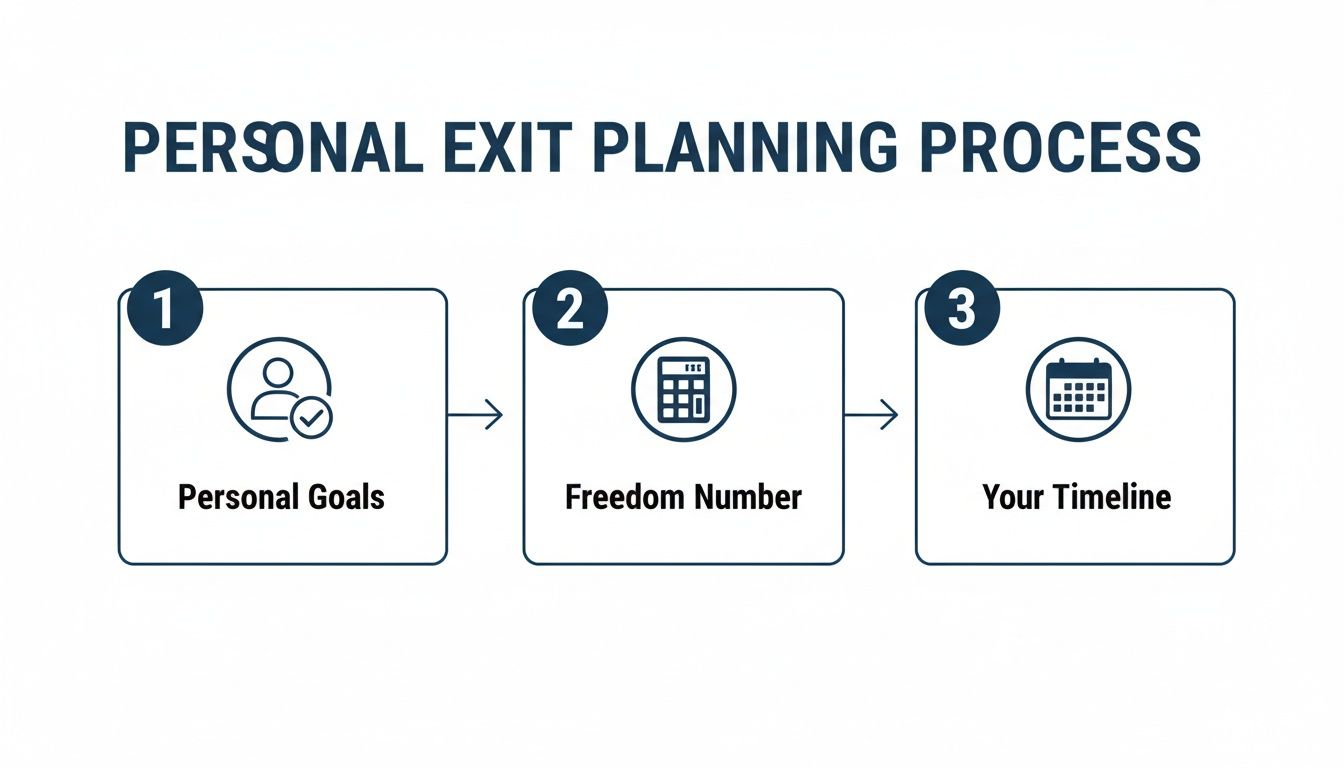
As you can see, a great exit starts with you: figuring out your personal goals, your "freedom number," and a timeline. These personal choices drive every business decision you make next.
Get Your Financial House in Order
The very first place a buyer will look is your money records. If your books are messy or confusing, it’s a huge red flag. It tells a buyer you either don’t know what's going on or you're hiding something. Neither is good.
Clean money records build trust. They prove your company is healthy and makes money. This is why good bookkeeping isn't just a chore; it’s a key part of your exit plan.
When you can show clear numbers, a buyer will feel good about making a strong offer. It also makes the whole process faster and avoids surprises that can ruin a deal.
Simple Ways to Boost Your Profitability
More profit usually means a higher price. It’s simple math. Buyers often figure out a business's value based on a multiple of its profit (EBITDA), so even a small increase in profit can have a big effect on your sale price.
Here are a few easy ways to make your numbers look better:
- Review Your Pricing: When was the last time you raised your prices? Many owners are afraid to, but a small increase goes right to your profit.
- Trim Unnecessary Expenses: Look at everything you spend money on. Are you paying for software you don't use? Can you get a better deal from a supplier?
- Focus on High-Margin Services: Find out which products or services make the most profit. Can you sell more of those? It might be time to stop offering things that don't make much money.
These small changes, made over a year or two, really add up. They show a buyer a healthy, well-run business. For more ideas, check out our guide on building and measuring the value of a business.
Showcasing the Hidden Gems
Your business's value isn't just about the numbers. Buyers also look for "intangible assets"—the hidden good stuff that makes your company special.
The most important thing is proving the business can run without you. If you make every decision and have every customer relationship, a buyer will worry the company will fall apart when you leave.
A business that depends on its owner is just a job you can't quit. A business that runs on systems and a strong team is a valuable, sellable asset.
Write down your processes. Give other people responsibility. Build a management team that can handle things without you.
Other hidden gems include:
- A Loyal Customer Base: Do you have customers who pay you every month or have long-term contracts? This is very valuable.
- A Strong Brand Reputation: If people in your town know and trust your brand, that's a big plus.
- Efficient Operations: Smooth, written-down processes show a buyer they won't have to figure everything out themselves.
With more sales possibly happening soon, having your business information in order is very important. In fact, studies show that just having clean records can raise the price you get. It tells a good story for buyers, which is key since 80% of businesses listed for sale never actually sell.
To get a real idea of what your company is worth, it’s smart to use professional business valuation services.
Choosing Your Exit Path and Building Your A-Team

After you've worked hard to get your business ready, you have to make a big decision. Who are you going to sell it to?
There's no single "right" way to exit. The best path for you depends on what you care about most. Do you want the highest possible price? Or do you want to make sure your employees are taken care of? Your answer will show you the right way to go.
Exploring Your Main Exit Options
Let's look at the most common ways to exit. Each one has good and bad sides. The goal is to find the best fit for you.
Selling to an Outside Buyer: This is what most people think of. The buyer might be a bigger company or an investment group. This way often gets you the most money, but it usually means you lose control over the company's future.
Internal Transfer to Family or Key Employees: This option is about keeping the business's spirit alive. Passing it to your kids or selling it to the managers who helped you build it can feel great. It keeps things stable for your team and customers. The downside? These buyers usually don't have a lot of cash, so you might get a lower price or get paid over many years.
Employee Stock Ownership Plan (ESOP): An ESOP is a special way to sell the business to all of your employees through a trust. It’s a great way to reward your team and can have big tax benefits. But setting one up is complicated and costs a lot, so it's usually for bigger companies.
I once knew the owner of a plumbing company. A big competitor made him a huge offer, but he knew they would probably fire his workers and change the company name he'd built for 30 years. Instead, he sold it to his two top managers over five years. He got less money upfront, but he saved the business he loved. For him, that was the right exit.
You Can’t Do This Alone: The A-Team You Need
Trying to sell your business by yourself is a big mistake. It's a maze of money, legal, and business details. Trying to handle it all is a recipe for disaster. It’s like trying to be the captain, navigator, and engineer of a ship all at once.
Putting together a team of expert advisors early on is one of the smartest things you can do. This isn't just about paperwork; it's about getting expert help to avoid mistakes and get the most money.
Your exit team is your brain trust. They give you the clear advice you need during what can be a very emotional time.
So, who should be on this "A-Team"?
1. The Financial Quarterback (CFO/Advisor): This is the person who gets your numbers ready and tells a financial story that buyers want to hear. A part-time CFO can be perfect for this. Wondering if it’s time? Our guide explains when to hire a CFO for your business.
2. The Tax Guru (CPA): How the deal is set up can make a huge difference in your tax bill. A CPA who knows about business sales will help you find ways to pay less in taxes. This alone can save you a lot of money.
3. The Legal Guardian (Attorney): The sale process is full of legal papers. A good lawyer who specializes in sales will protect you, negotiate for you, and make sure there are no legal problems later.
4. The Deal Maker (Business Broker or M&A Advisor): If you're selling to an outsider, a good business broker is a must. They find and check potential buyers and handle the talks. Their job is to get you the best price and terms.
You should get this team together three to five years before you plan to sell. This gives them time to understand your business and help you make a plan that works for you. Waiting until the last minute is one of the biggest and most expensive mistakes you can make.
This is where things get serious. Getting the legal and tax parts of your exit right can be the difference between a great retirement and leaving a lot of your hard-earned money for the taxman.
The choices you make here have huge financial results. I've seen owners lose 30% or more of their sale price to taxes they could have avoided, just because they didn't plan ahead.
Think of this as your checklist before the big day. We're not trying to make you a tax expert, but we want to give you the right questions to ask your team so you can avoid big mistakes.
Asset Sale vs. Stock Sale: Why It Matters to You
One of the first big choices is how the deal is structured. Will it be an asset sale or a stock sale? Buyers and sellers usually want different things here, so it's a big part of the negotiation.
Imagine you own a local brewery.
In an asset sale, the buyer goes shopping in your business. They buy the equipment, the furniture, and your brand name. You, the owner, are left with the legal company and any debts the buyer didn't take. Buyers like this because it gives them tax advantages.
In a stock sale, the buyer purchases your entire company, shares and all. They get everything—the good and the bad. For you, the seller, this is usually better. It’s a cleaner break, and you often pay less in taxes.
A stock sale is often the best-case scenario for a seller, with a simpler process and a smaller tax bill. An asset sale is what the buyer usually wants because it lowers their risk and gives them tax benefits. This one decision is a major point in any negotiation.
To give you a clearer picture, here’s a quick comparison of how these two work for you, the seller.
Asset Sale vs Stock Sale At a Glance
| Aspect | Asset Sale | Stock Sale |
|---|---|---|
| What's Sold? | Specific business items (equipment, etc.) | The whole company (all shares) |
| Liabilities | Seller usually keeps most debts | Buyer takes on all debts, known and unknown |
| Tax Impact | Often means higher taxes for the seller | Usually taxed at lower capital gains rates |
| Complexity | More complex; need to value and transfer each item | Simpler; ownership transfers via stock |
| Seller Preference | Usually not the first choice | Usually the first choice |
This table makes a complicated topic simple, but it shows the main differences. The key thing to remember is that the deal structure isn't a small detail—it can be a multi-million dollar decision.
Simple Tax Strategies to Discuss With Your Team
Taxes will be the biggest check you write after you sell. A 30% tax bill on a big deal is a lot of money. The good news? With smart planning, you can lower that number. This is a talk to have with your CPA years, not weeks, before a sale.
Here are a few ideas to bring up with your CPA:
- Structure the Payout: Instead of getting all the money at once, the buyer could pay you over several years. This is called an installment sale. It can spread out your taxes and maybe keep you in a lower tax bracket.
- Hunt for QSBS: If your company is a C-corp and meets certain rules, you might be able to use the Qualified Small Business Stock (QSBS) rule. This is the best-case scenario for taxes, as it could let you avoid paying federal taxes on up to $10 million (or more) of your profit.
- Get Charitable: If you like to give to charity, you can donate some of your company stock to a trust before the sale. This can give you a huge tax deduction while helping causes you care about.
The idea is simple: start these talks now. For more information, our firm has resources on tax and business services that reduce tax burden to help you prepare.
Key Legal Documents You'll Encounter
As you get closer to a deal, you'll see a lot of legal paperwork. Knowing what the key documents are for will help you stay on track.
Two of the most important early documents are the NDA and the LOI.
- Non-Disclosure Agreement (NDA): This is your first protection. Before you show a buyer any secret information, they have to sign an NDA. It’s a legal promise not to share your information or even tell people your business is for sale.
- Letter of Intent (LOI): Once a buyer is serious, they will send an LOI. This is a non-binding paper that outlines the basic deal: the price, the structure (asset vs. stock), and other main points. It’s like an "agreement to agree" and sets the stage for the final, more detailed contract.
Handling the legal side of a business transfer is a maze of contracts. For a good overview, this legal guide on how to transfer business ownership is a helpful resource.
Common Questions About Planning Your Business Exit
When you start thinking seriously about selling your business, a lot of questions come to mind. It’s a big step, and it’s normal to feel a little lost. I've had this chat with many founders, and the same questions always come up. Let's get you some clear answers.
How Long Does It Really Take to Plan a Business Exit?
Honestly, the more time you have, the better. You can always sell quickly if you have to, but a smart plan that gets you the most money needs time. The best time to start is three to five years before you want to leave.
Why so long? Because it's not just about paperwork. A longer timeline lets you do things right—clean up your money records, make smart moves to grow your company's value, and look at all your options without feeling rushed.
Starting early lets you find and fix problems that a smart buyer will find anyway. Most importantly, it gives you time to prove the business can run without you, which makes it worth a lot more. A rushed exit almost always means leaving money on the table.
What Is the Biggest Mistake Owners Make in Exit Planning?
The biggest mistake I see all the time is just waiting too long to start. Most owners are so busy running their company that they think of the exit as something far away. It's not. It's a key part of your business strategy.
The other big mistake is not thinking about the emotional side of selling. For years, your identity has been tied to this business. I’ve seen owners get a great price for their company and end up unhappy because they weren't ready for what comes next.
A successful exit is about more than just the money. It's about being financially and emotionally ready for the next chapter of your life. Ignoring the emotional side can lead to deep regret, even with a full bank account.
Can I Sell My Business if It's Not Very Profitable?
Yes, you can, but it’s a different kind of sale. While making a lot of profit is the easiest way to sell, it’s not the only thing that makes a business valuable. Your company might have other good things that don't show up on a profit report.
Think about what else you've built. Do you have any of these?
- A die-hard customer list: Loyal customers who keep coming back are very valuable.
- Unique technology or IP: Maybe you have a special way of doing things or your own software.
- A killer brand name: Is your company the most well-known in your area? That’s a huge plus.
- A rockstar team: A talented team that can work on its own can be the main reason a buyer is interested.
In this case, a buyer isn't just buying your current profits; they're buying potential. The key is to know what these hidden good things are and then find a buyer who sees the long-term value in what you’ve created.
How Do I Keep My Exit Plan a Secret from Employees?
This is a big—and real—worry for most owners. The last thing you want is for your best people to get scared and leave. Keeping it a secret is very important, especially at the beginning.
You start by building a small, trusted group of advisors. Your lawyer, CPA, and financial advisor are all required to keep things secret. When you do need to tell key team members, you do it carefully, often with a bonus to keep them focused and with you through the sale.
This is also where a professional business broker is a huge help. They are experts at keeping things quiet. They know how to show your business to good buyers without saying who you are until the time is right. Any serious buyer will be checked out and have to sign a strong non-disclosure agreement (NDA) before they learn anything that could identify your company.
Planning your exit is the final, most important step of your journey as a business owner. It’s what makes sure all your years of hard work pay off and prepares you for what's next. At MyOfficeOps, we help owners through this whole process, from cleaning up the books to getting ready for a successful sale.
If you’re ready to start building a more valuable business and planning for a profitable future, let's talk. Schedule a free discovery call with us today.