
Wondering about business valuation services near me? You're in the right place. Getting your business valued is like getting a doctor's check-up for your company. It tells you exactly what your business is worth, giving you a real number you can use for big decisions.
What Is a Business Valuation?
Think about it like this: you wouldn't sell your house without knowing its value, right? A business valuation does the same job for your company. It’s a full, honest look at your company's health and its place in the market.
This isn't just adding up the cost of your computers and office chairs. A real valuation looks at everything—how much money you make, what you owe, how loyal your customers are, and your reputation. It also looks at how much your business could grow and how it compares to others like it. The whole point is to get a clear, solid number that shows what your business is worth today.

Why a Simple Guess Isn't Good Enough
A lot of business owners have a "gut feeling" about what their company is worth. But that feeling isn't usually based on facts. A professional valuation swaps that guesswork for real data. It gives you a number that banks, investors, and buyers will actually believe.
There's a reason more people are getting valuations. The business valuation market is expected to grow from about $203.7 billion to over $1,380 billion by 2033. This is happening because more businesses are being sold, merging, or getting investments.
A valuation isn’t just a number. It’s the story of your business—where it’s been and where it’s going. It helps you plan your next step, whether that’s selling, growing, or bringing on a partner.
It's helpful to know some of the terms, like post-money valuation, especially if you're thinking about getting investors. Knowing your company's true value is the first step to making smarter choices. You can learn more about the role of business valuations in our guide.
When You Really Need a Professional Valuation
Most of the time, you're just busy running your business, not trying to figure out its exact price tag. But every now and then, something big comes up where knowing your company's worth is a must-have, not a nice-to-have.
These are the times when a quick guess just won't work. You need a professional number you can stand by.
Think of it like this: you don't need a map of your property to mow the lawn. But you'd be silly to build a fence or sell the land without one. A business valuation is that map for your company's big moments.
Planning to Sell Your Business
This is the most common reason people look for business valuation services near me. If you're getting ready to sell, you need a realistic asking price. A professional valuation gives you that starting point. It helps you negotiate with buyers and makes sure you don't sell for less than you should.
For example, imagine you own a popular local coffee shop. A valuation would look at more than just your coffee machines. It would check your profits, how many customers you get, and the value of your brand in the West Chester community to find a price that reflects its true success.
Bringing on a Partner or Investor
Changing who owns your business is another big deal. Let's say your company is growing fast and you want to bring in a partner who will invest money. How much of the company should they get?
A valuation gives you the answer. It tells you what 10%, 20%, or 50% of your business is really worth. This makes sure the deal is fair for both you and your new partner. Without it, you’re just guessing, which can lead to arguments later.
Other Times You'll Need a Valuation
Selling and adding partners are common, but there are other times when you need to know your company's value. Knowing when these moments are can save you a lot of trouble.
- Getting a Loan: When you ask a bank for a big business loan, they often want a valuation to see what they are lending against.
- Estate and Gift Planning: To plan for your family's future, you need to know your business's value for tax reasons and to pass it on smoothly.
- Disagreements Between Owners: If you and a co-owner can't agree and one wants to leave, a fair valuation helps you figure out a buyout price without a big fight.
- Employee Stock Plans (ESOPs): If you want to let your employees own a piece of the company, the law says you need a valuation to set a fair price for the stock.
Each of these moments is like a fork in the road. A professional valuation is your guide, helping you choose the right path.
How Experts Figure Out Your Business's Value
Figuring out what a business is worth isn't magic, but it's not simple math either. It's like a detective using clues and facts to solve a case. When you hire an expert, they use a few main methods to find the real number.
Each method looks at the business from a different angle. This gives a full picture of its health and what it could do in the future. Knowing these methods helps you understand where the final number comes from. It’s not just about what the business did in the past; it’s about what it’s worth today and what it can earn tomorrow.
The Three Main Ways to Value a Business
A professional valuation isn't just one simple formula. Experts usually mix three main methods to get a number that is realistic and can be defended. Here's a quick look at how each one works.
| Valuation Method | What It Measures | Best For Businesses That Are… |
|---|---|---|
| Asset-Based Approach | The value of everything a company owns, minus what it owes. | Full of physical things, like construction, manufacturing, or real estate companies. |
| Market-Based Approach | The company's value based on what similar businesses recently sold for. | In fields where lots of businesses are sold, like restaurants, shops, or local services. |
| Income-Based Approach | How much profit and cash the company is expected to make in the future. | Based on services, have strong brand names, or make money consistently. |
A good expert knows that using just one method can give a crooked picture. By using a mix, they can count everything from your equipment to your good name, giving a much more accurate idea of your company's value.
The Asset-Based Approach: What You Own
This is the easiest one to understand. It’s like making a list of everything you own. The Asset-Based Approach adds up the value of everything the company owns—cash, equipment, buildings, and products. Then, it subtracts everything the company owes, like loans.
What’s left is the company’s "net asset value." This method is really useful for businesses that have a lot of physical stuff, like a construction company with big trucks. A deep dive into a business's financial health involves scrutinizing all expenses, particularly the often-overlooked inventory carrying costs.
The Market-Based Approach: What Others Are Worth
This method is a lot like how a real estate agent prices a house. The Market-Based Approach looks at what similar businesses in your area have sold for recently. It works because the market usually sets the price for things.
An expert will find "comps," or sales of similar businesses, and use those prices to estimate your company's value. For example, if three coffee shops like yours in the Philadelphia area all sold for around $500,000, that’s a strong hint about what your business might be worth. This is where having someone who knows the local area really helps.
The Income-Based Approach: What You Will Earn
Last, there’s the Income-Based Approach. This one is all about the future. It doesn't look at what you own or what your competitor sold for. Instead, it looks at how much money your business is likely to make in the years ahead.
This method is great because it values your business based on the cash it can bring in. An expert predicts future profits and then figures out what that money is worth today. This is often the best method for service businesses or companies that have steady income.
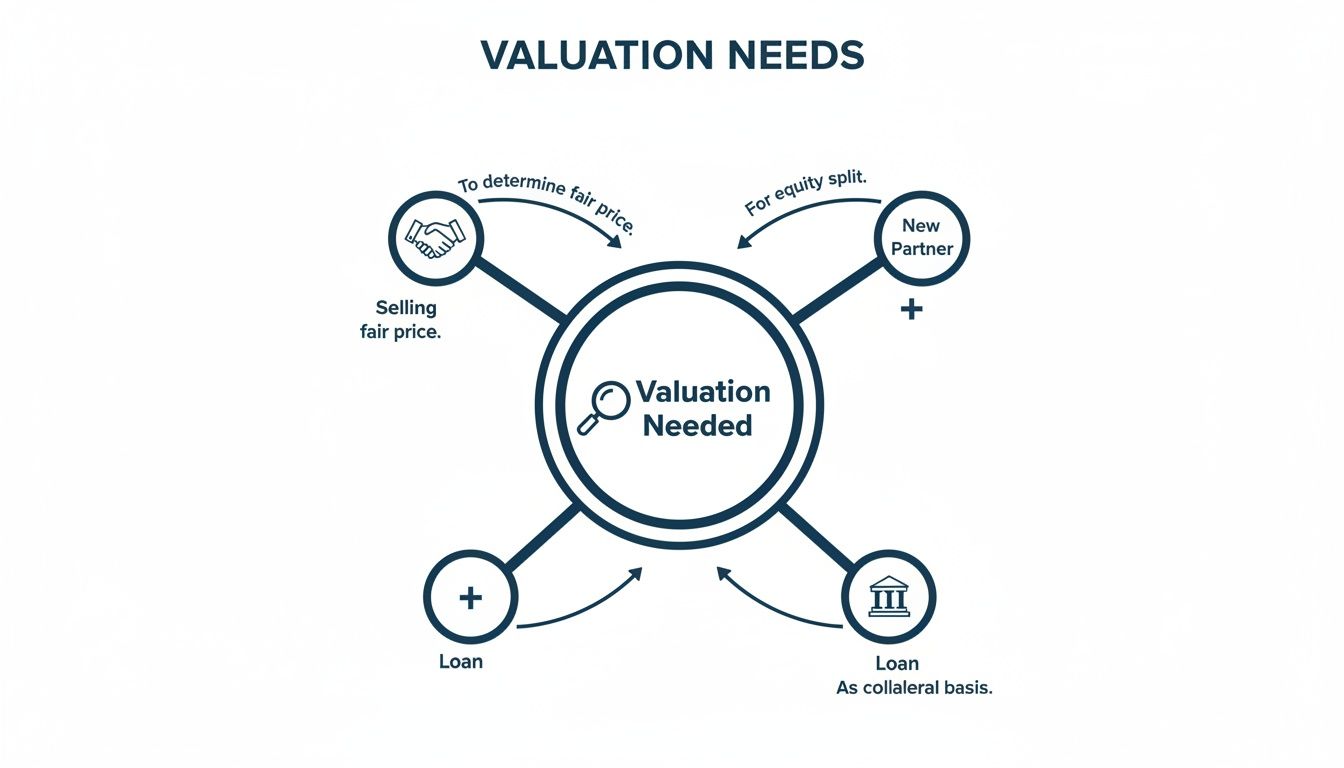
As this graphic shows, business owners need valuations for all sorts of reasons—whether they are selling, bringing on a new partner, or applying for a loan.
The key thing to remember is that a valuation is a tool for big financial moments, not just a number for fun.
A professional will rarely use just one of these methods. They almost always use a mix to get a balanced number that truly shows what your company is worth. To get a better feel for the math, you can learn more about how to calculate the valuation of a company in our detailed guide.
How to Choose the Right Local Valuation Expert
Finding the right person to value your business is a big decision. You’re trusting them with a lot of private information, and their final number will guide some of your most important choices. The good news is, with a little checking, you can find the perfect person for the job.
The first thing to do is look for proof that they know what they're doing. You wouldn't let a mechanic with no training work on your car, would you? The same idea applies here. You want a certified expert.

Look for the Right Certifications
When you search for business valuation services near me, look for a few specific certifications. They show that the person has had special training and passed hard tests.
Two of the best ones are:
- CVA (Certified Valuation Analyst): This shows an expert really understands how to value a business.
- ABV (Accredited in Business Valuation): This is for CPAs who are specialists in this area.
Seeing these letters after someone's name means you’re working with a real professional who follows strict rules. It's a great way to start narrowing down your choices.
Why Knowing the Local Area Matters
You might wonder if it matters if your expert is in West Chester or somewhere else. It really does. A local professional knows your area in a way a big national company just can't.
Think about it: someone who lives and works in the Greater Philadelphia area knows the local economy, the other businesses, and what buyers around here really want. They know that a restaurant on the Main Line has different problems than one in the middle of the city. That local knowledge leads to a more realistic valuation.
A local expert doesn’t just see your numbers. They see your business as part of the community, and that local connection is often a big part of its real value.
Smart Questions to Ask Before You Hire Someone
Once you have a short list of good, local experts, it's time to talk to them. This is just to make sure they're a good fit for you. A good expert will be happy to answer your questions.
Here’s a simple list of what to ask:
- Have you valued businesses like mine before? Experience with your type of business—like construction, healthcare, or consulting—is a huge bonus.
- What methods do you usually use? They should be able to explain how they work in a simple way, mentioning the asset, market, and income methods.
- What will the final report look like? Ask for a sample so you know what you're getting. A good report has a lot of detail but is still easy to read.
- How long will it take? This helps you plan for what's ahead.
- What do you need from me? Knowing what paperwork they need from the start makes everything go smoother.
Choosing the right expert is about finding someone with the right training, local knowledge, and a process that makes you feel comfortable. Taking time to ask these questions helps you find a real partner who can help you understand your business's true worth.
What You Get and What It Costs
So, the expert has finished their work. What's next? You don't just get a single number. You get a detailed valuation report.
Think of this report as the complete story of your business's value. It’s not just about the final number; it’s about why that's the number. A good report is clear and simple, even if you’re not a numbers person. It breaks everything down so you understand it all.
What’s Inside a Valuation Report
The final report is more than just a summary. It explains everything the expert found, and it's built to be trusted by banks, lawyers, and buyers.
Here’s what you should expect to find inside:
- The Final Value: Of course, the report will tell you the final value of your company right at the start.
- The Methods Used: It will explain which methods—asset, market, or income—were used and why they were the right ones for your business.
- The Data: The report includes the financial records, market info, and all the other key facts that were looked at.
- Assumptions Made: It lists any important guesses made during the process, like ideas about future growth.
This openness is what makes a professional valuation so useful. It gives you a solid number you can use with confidence.
Understanding the Cost
Now for the big question: how much does this cost? The price for business valuation services near me can be very different from one business to the next. It’s not a one-price-fits-all service, because every business is unique.
The cost of a business valuation depends on how complicated it is. A simple business with perfect books will cost less to value than a big company with many locations and messy records.
Think of it this way: valuing a small one-person consulting business is much easier than valuing a construction company with lots of equipment, many projects, and complex deals.
A basic valuation report might start in the $3,000 to $5,000 range. For a more detailed report—the kind you need to sell your business or get a big loan—you should expect to pay between $5,000 and $10,000. For really complicated situations like fights between owners or big company sales, the cost can be higher.
While it is an investment, the peace of mind it gives you is almost always worth it. It’s the best way to avoid leaving money on the table or making a bad deal.
Get a Clear Picture of Your Business's Future
Knowing what your business is worth is the first step in almost every big decision you'll make. It’s not just a number; it’s the starting point for your future plans, whether you're thinking about selling, finding a partner, or just want to see the value of your hard work. This is where professional business valuation services are so important.
Getting a clear, honest valuation from a local expert who knows the Greater Philadelphia market gives you the confidence to move forward. It replaces guesswork with a real, solid number that banks, buyers, and partners will take seriously. That financial clarity is what makes a good plan great.
Your Local Partner in West Chester
At MyOfficeOps, we think every business owner should know what their company is worth. We don't just crunch numbers; we're your local team of advisors right here in West Chester, PA. Our goal is to give you the financial knowledge you need to plan your next move. To see how this works, check out our guide on building and measuring the value of a business.
Making big decisions without a clear valuation is like trying to find your way in a new city without a map. You might get there, but you’ll probably make some wrong turns.
If you’re ready to get a clear picture of your company's financial future, let's talk. Schedule a no-obligation consultation with our team today.
Frequently Asked Questions About Business Valuation
You probably have some questions, and that's good. Thinking about your business's value brings up a lot of important stuff. Here are simple answers to the questions we hear the most.
How Long Does a Business Valuation Take?
The timeline depends on how complex your business is. For a smaller, simple company with good financial records, it can often be done in two to three weeks.
But for a bigger business with more moving parts—like a few locations or lots of equipment—it might take closer to four to six weeks or more. A big part of it is how fast you can give them the paperwork they need. The sooner they get it, the faster it goes.
Can I Just Use an Online Calculator?
Online valuation calculators can be fun to play with, but you should never use them for real business decisions. Think of them like a game, not a professional tool.
Why? They are just too simple. A calculator can't understand how good your team is, your reputation in the Philadelphia area, or what the local market is like right now. For big things like selling your business or getting a loan, you need a detailed report from a real professional.
An online calculator gives you a guess. A professional valuation gives you a credible, fact-based number that banks, buyers, and the IRS will respect. It’s the difference between a rough drawing and a real blueprint.
What Papers Will I Need to Get Started?
The person valuing your business will give you a specific list, but you can get a head start by gathering a few key things. Having these ready will speed things up.
- Financial Statements: You’ll usually need three to five years of your income statements and balance sheets.
- Tax Returns: Business tax returns for the same three-to-five-year period.
- Lists of Assets and Debts: A clear list of what the company owns and what it owes.
- Key Agreements: Important papers like building leases or big customer contracts can also be helpful.
Ready to stop guessing and get a clear, professional answer on what your business is worth? The team at MyOfficeOps is here to provide the financial clarity you need to make your next move. Schedule a no-obligation consultation today.