
Ever feel like you're running your business but the money part is a total mystery? You're amazing at what you do—whether that's building houses, helping patients, or creating cool products—but the finances feel like a guessing game.
You know you need more than just someone to track where your money went. You need a plan for where it's going. That’s where CFO services for small businesses come in.
What Are CFO Services and Why Do They Matter?
Let's get one thing straight: this isn't about hiring a fancy executive for a corner office you don't have. An outsourced Chief Financial Officer (CFO) is like a financial co-pilot. They help you look at the road ahead, not just in the rearview mirror at last month's numbers.
While your bookkeeper is great at recording what already happened, a CFO helps you figure out what to do next. They help you get clear, simple answers to the big questions that might keep you up at night:
- When is the right time to hire another person?
- Can we really afford that new piece of equipment?
- Are our prices actually high enough to make a good profit?
- How do we manage our cash so we don't run out during a slow month?
From Job Site Chaos to Financial Control
I know a local construction contractor who is a master at his trade. His crews do amazing work. But he was always stressed about money. He'd finish a big job, get a huge check, and feel like he was rich—only to be scrambling to pay his team two weeks later. He had no idea which jobs were actually making him money and which ones were secretly costing him.
This is a classic cash flow problem, and it's super common.
By using a fractional CFO service, he finally got a clear picture. His new financial partner helped him create a simple cash flow forecast and look at his job costs. It turned out some of his "best" clients were the least profitable. With that knowledge, he learned how to price his bids to make more money.
Soon, he wasn't just getting by; he was planning to expand his business with confidence. He could finally get back to focusing on building, knowing his money was under control.
A CFO's real magic is turning confusing numbers into a simple story. It stops being a list of numbers and becomes a map you can actually use to steer your business.
This switch from reacting to your money problems to planning ahead is what these services are all about. And it’s not just for giant companies anymore. A huge 83% of small and midsize businesses now use outside firms for important jobs, including managing their finances.
A full-time CFO can cost $300,000 or more per year. Fractional CFO services give you the same expert brainpower, but only for the hours you need. You get the expert help you need at a price that makes sense for your business. Want to learn more? Check out this article on the growth of fractional CFO services.
The Key Financial Jobs a CFO Handles for You
So, what does an outsourced CFO actually do? Think of them as the money brain for your business. While you're busy running the show, they’re looking ahead, making sure the financial engine is running smoothly so you don’t hit any surprise roadblocks.
They don’t just count the money; they help you make smarter decisions with it. Let's look at the main jobs they handle.
Financial Forecasting and Planning
Running a business without a financial forecast is like driving across the country without a map or GPS. A CFO builds that map for you—a clear forecast that shows where your money will likely come from and where it will go over the next few months.
This isn't about predicting the future. It’s about spotting possible problems before they happen. For example, the forecast might show that cash will be tight in three months. That gives you plenty of time to run a sale, ask clients to pay up, or wait on a big purchase. You stop reacting to money surprises and start planning for them.
Cash Flow Management
Let's be clear: profit and cash flow are two different things. Cash flow is the actual money moving in and out of your bank account. It's the lifeblood of your business. You can be profitable on paper but still run out of cash if customers pay late or you get hit with unexpected bills.
A CFO’s job is to manage this flow. Think of cash as the gas in your car's tank. It doesn't matter how great the car is—if the tank is empty, you're not going anywhere. A CFO makes sure you always have enough gas to pay your team, your suppliers, and yourself on time.
This picture shows how CFO services turn common business problems into real growth.
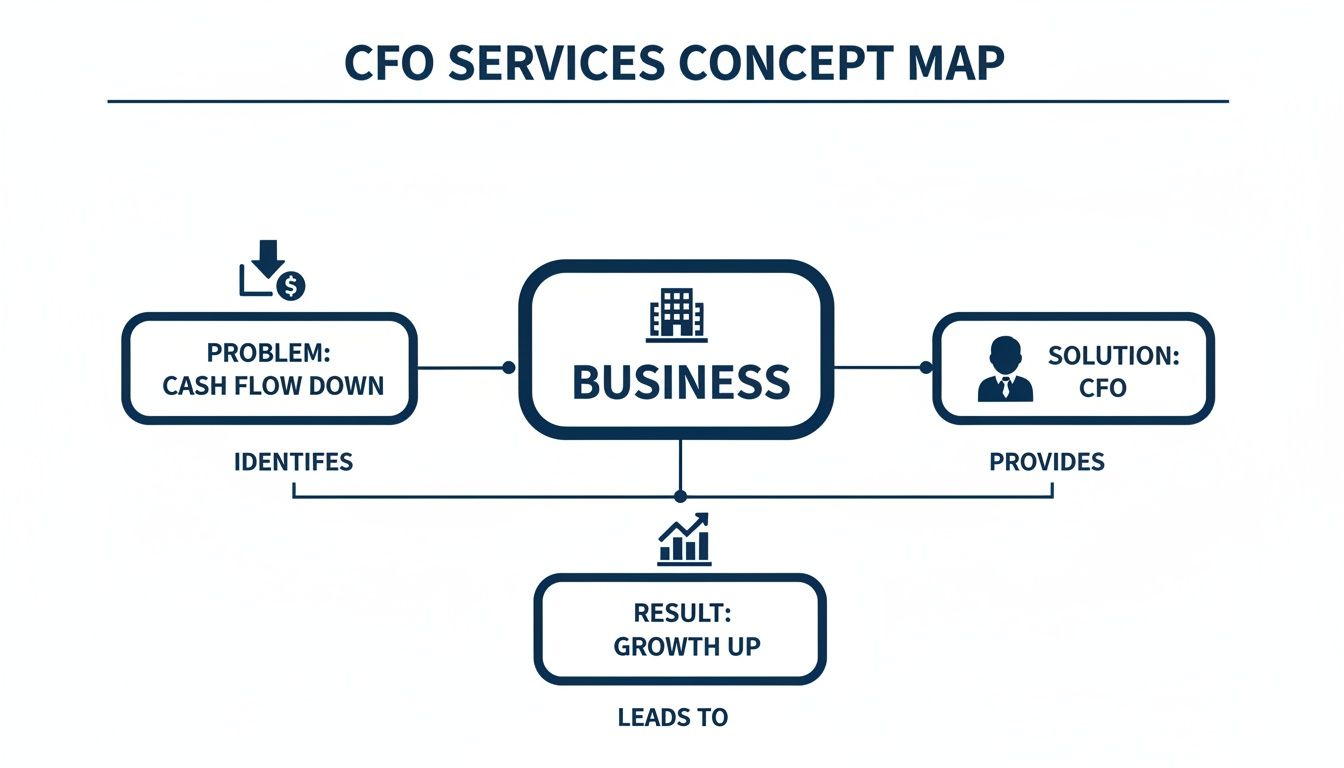
As you can see, the path from a money problem to real growth starts with having an expert to guide you.
Tracking the Right Metrics
How do you really know if your business is healthy? A CFO helps you figure this out by tracking Key Performance Indicators (KPIs). These are just a few important numbers that act like a doctor's checkup, giving you a quick, accurate look at your company’s health.
Instead of drowning in spreadsheets, you focus on the handful of numbers that actually move your business forward. A CFO helps you pick the right KPIs, like your profit margin on a specific service or how much it costs you to get a new customer.
Improving Your Profitability
Have you ever wondered which of your services or products makes you the most money? It’s easy to think that your most popular service is also your most profitable one. That's often not true.
A CFO digs into your numbers to find out. They might find that one of your services has a 40% profit margin, while another is barely making 10%. With this information, you can focus your sales and marketing on the work that actually makes you more money. It’s about working smarter, not just harder.
Planning with a CFO isn't about creating a huge, complicated document you'll never read. It's about having clear, simple goals and a money plan to back them up, so you can make big decisions with confidence.
How a CFO Partner Helps Your Business Grow Faster
Having a clear financial picture does more than just organize your numbers—it gives you the confidence to make big moves. A true CFO partner is a growth partner. They take those confusing financial reports and turn them into a simple, clear story that tells you exactly when to take smart risks and when to wait.
For example, I've seen clinic owners get that gut feeling that it’s time to open a second location. Instead of just going on that feeling, a CFO partner looks at the data. They can show the owner exactly how much cash is needed for the down payment, what the new monthly costs will be, and how many patients the new clinic needs to see each month just to break even.
With that kind of plan, the decision is no longer scary. It becomes a smart choice based on facts, not just hope.
Freeing You Up to Lead
Let's be honest: your time is the most valuable thing you have as a business owner. Every hour you spend fighting with spreadsheets or worrying about cash flow is an hour you’re not spending on what you do best—serving your customers, improving your products, and leading your team.
This is where CFO services for small businesses really shine. By handing off the high-level money strategy, you get that time back. You can finally focus on the parts of the business you love, knowing an expert is watching over the financial health of your company. It’s about building a business that supports your life, not one that takes it over.
A CFO’s help is also key for big decisions, like the strategic decision of whether to incorporate your business, which has a huge impact on your taxes, liability, and future growth.
A Clear Path from Hope to Reality
At the end of the day, a CFO partner isn’t just a number cruncher; they are your growth partner. Businesses with this kind of help don’t just hope for growth—they build a real plan to make it happen.

This smart advantage gets real results. With nearly 7 in 10 owners (69%) feeling good about their finances and 78% planning to expand, having a virtual CFO gives you the clarity to grow with confidence. Smart planning and easy-to-read reports can cut financial waste by 20–40% in just a few months, turning that saved money into fuel for your next big move.
Finding the Right Financial Partner for Your Business
Choosing someone to handle your company’s money is a big deal. This isn't just about hiring someone to do math; it’s about finding a true partner who understands your vision and can help you get there. You need someone who feels like part of your team, not just another bill to pay.
This search is more important than ever. In the corporate world, big-shot CFOs are changing jobs all the time. In fact, global CFO turnover hit roughly 15% in 2024. For a small business, losing a key money person is a huge headache that costs time and money. Outsourced CFO services offer a steady, reliable option, giving you expert help without the risks of a full-time hire.
When you start talking to different firms, it’s easy to get lost in fancy presentations and confusing money talk. The key is to cut through the noise and figure out if they are the right fit for your business.
Key Questions to Ask Any Potential CFO Partner
Treat this like you're interviewing someone for a job. Your goal is to get a feel for how they work, how they think, and most importantly, how they’ll talk to you.
Here are a few good questions to start with:
- Do you have experience in my industry? A CFO who knows the money ups and downs of a construction company will be way more helpful than a generalist if you're a builder.
- How will you explain complicated money topics to me? You want a partner who can break down the numbers in plain English, not someone who makes you feel like you need a finance degree to understand your own business.
- Who will I actually be working with? Find out if you'll have one dedicated person who knows your business, or if you'll be passed around to a different person every month.
- How often will we talk? Ask how often you’ll meet and if they’re available for a quick call when something urgent comes up. You need someone in your corner.
And if you’re trying to figure out the right time to get this kind of help, our guide on when to hire a CFO can give you some ideas.
Watch Out for These Red Flags
Knowing what to look for is only half the battle. Knowing what to avoid can save you a lot of headaches. A bad financial partner will cost you more than just money—it will cost you time, energy, and peace of mind.
A great financial partner makes you feel smarter and more confident about your business. A bad one just makes you feel confused.
Be careful if a potential provider:
- Uses a lot of jargon: If you can't understand what they're saying when they're trying to get your business, it’s not going to get any clearer later.
- Pushes a one-size-fits-all plan: Your business is unique. Your financial plan should be too. Run from anyone trying to fit you into a pre-made box.
- Is hard to get a hold of: If they’re slow to respond when they’re trying to sell you something, imagine what it will be like when you’re a client with a real problem.
At the end of the day, you're looking for a partner. You need a firm that picks up the phone, listens to your goals, and actually cares about helping you succeed.
A Look Inside Our CFO Service Process
Theory is nice, but what does getting help with your finances actually look like? It shouldn't be complicated. Our goal is to make expert financial guidance feel simple and truly helpful, so you always know what’s going on.
We have a simple, four-step process to make sure we understand your business, which lets us start helping you from day one. There are no confusing hoops to jump through—just a clear path to getting the financial control you need.

Step 1: The Discovery Call
Everything starts with a friendly chat. This isn't a sales pitch; it's a chance for us to learn about you and for you to learn about us. We'll talk about your goals, the money questions that worry you, and what you hope to do in the next few years.
We want to hear your story. This first call is all about making sure we’re the right fit to help you.
Step 2: Your Custom Plan
After our call, we create a financial plan that fits your business. Your company isn't the same as anyone else's, so your plan shouldn't be either. We map out a clear plan that tackles your biggest challenges and opportunities first.
This plan becomes our shared roadmap. It shows you the exact steps we'll take to clean up your books, improve your cash flow, or get you ready for your next big growth move.
The right financial plan isn't about complicated spreadsheets. It's about a simple, actionable strategy that gives you the confidence to make smart decisions.
Step 3: Smooth Onboarding
Getting started shouldn't be a pain. Our setup process is designed to be as smooth as possible. We’ll handle the technical stuff, like connecting systems and organizing data, so you don't have to worry about it.
Our team works with you to get what we need, making sure we don't interrupt your daily work. We get you set up quickly so we can move on to the important part: helping you grow.
Step 4: The Growth Partnership
This is where the real work—and the real value—begins. We become part of your team, giving you ongoing support, advice, and accountability. This includes regular meetings to review your progress, talk through problems, and plan for the months ahead.
You get a dedicated financial partner who is always on your side. Our different virtual CFO services are built to support you at every stage, whether you're just starting out or planning a big exit. It’s a true partnership focused completely on your success.
Still Have a Few Questions?
That’s a good thing. Choosing a financial partner is a big decision, and it's smart to have questions. You deserve clear, simple answers.
Let's tackle some of the most common ones we hear from business owners. We'll skip the fluff and get right to the point.
How Much Do Outsourced CFO Services Cost?
This is always the first question, and for good reason. The cool thing about outsourced services is you aren't paying for a six-figure executive salary plus benefits, bonuses, and everything else that comes with a full-time hire.
Instead, you get a predictable monthly cost that’s set for exactly what your business needs right now. The price depends on how much support you need—whether that’s a monthly check-in or a deep-dive planning partnership. You pay for the expert advice you need, when you need it, making it one of the smartest investments you can make in your company's future.
Is My Business Too Small for a CFO Service?
Let's bust this myth right now. In fact, getting expert financial guidance early is one of the best things a small business can do. Think about it like building a house—you wouldn't wait until the walls are crooked to check if the foundation is solid, would you?
Having a financial pro on your team from the start helps you avoid the expensive mistakes that trip up so many new businesses. It sets up a strong financial system and good habits you can build on as you grow. This is what separates the businesses that grow strong from those that just get by.
What Is the Difference Between a Bookkeeper, an Accountant, and a CFO?
I love this question because the jobs are so different, but all are important. Let's use a simple car analogy.
- Your bookkeeper is the one who logs every gallon of gas you buy and every mile you drive. They focus on recording everything that has already happened—every dollar in and every dollar out. Their job is to keep accurate records of the past.
- Your accountant is the mechanic. They take the data from the bookkeeper, check under the hood, and put together your official reports and tax returns. They’re focused on making sure you follow the rules and report on the car's current condition.
- Your CFO is your GPS and co-pilot. They use the information from the bookkeeper and the accountant to map out the best and fastest route to your destination. They help you see traffic jams ahead, plan your next turn, and ultimately reach your long-term goals.
A bookkeeper records the past, an accountant organizes the present, and a CFO plans the future. You need all three, but the CFO is the one who helps you steer.
How Do I Get Started?
This is the easiest part. Everything starts with a simple, no-pressure chat to see if we're a good fit for each other. We’ll talk about your business, what you’re trying to do, and what’s been worrying you about your finances.
There's no hard sell or confusing talk. It's just a real conversation about where you want to go. We’re here to help you get the clarity and confidence you need to take your business to the next level.
Ready to stop guessing and start planning? The team at MyOfficeOps is here to give you the financial clarity you need to grow with confidence. Let's build a smarter financial future for your business, together. Schedule your free discovery call with us today!