
Think of your dental practice like a car. Dental practice accounting is the dashboard. It tells you how fast you’re going, how much gas is in the tank, and if the engine is running right. It’s more than just counting money at the end of the day; it’s the system that shows you how healthy your practice really is.
What Is Dental Practice Accounting Anyway?

A lot of practice owners think accounting and bookkeeping are the same thing, but they have different jobs.
Bookkeeping is writing down all the money stuff that happens each day—every patient payment, every box of gloves you order, every paycheck you write. It’s like keeping a log of every mile you drive on a road trip. It’s just a record of what already happened.
Accounting, on the other hand, is using that information to make smart choices for the future. It’s like the GPS on your road trip. It looks at the log and shows you the best way to go, warns you about traffic jams, and helps you decide when to stop for gas.
Basically, accounting turns numbers into a story about your practice, so you can stop guessing and start planning.
Good accounting answers the big questions that bookkeeping can’t. It tells you which services make the most money, when it’s a good time to hire another hygienist, or if buying that new scanner is a good idea.
Beyond Just Tracking Transactions
Good dental practice accounting helps you see what’s really going on with your money. For example, you might feel busy all month, but did you actually make a profit? A month with lots of patients doesn’t mean much if your expenses were even higher.
This is where accounting really helps. You can see exactly where your money is going and find ways to be smarter about it.
- Cost Analysis: Figure out what it really costs to do a procedure, from the materials and lab fees to your team’s time.
- Performance Insight: See which days of the week are your busiest or which dentist is bringing in the most money.
- Strategic Planning: Use financial information to plan for the future, whether you want to open another office or save for retirement.
This big-picture view is what smart financial management is all about. You wouldn’t treat a patient without a proper diagnosis, and you shouldn’t run your practice without a clear financial picture. If you’re looking to build a stronger financial foundation, our guide to business bookkeeping services for strong financial health is a great place to start. It all begins with having clean, organized, and understandable financial data.
Your Financial Toolbox: Core Reports Explained

If your accounting system is the dashboard, then financial reports are the gauges. They tell the story of your practice’s money, and each one has a specific job. Think of them like tools in a toolbox—you wouldn’t use a wrench for a screwdriver’s job.
Getting to know these reports is the first step to making smart business decisions. Let’s break down the big three so they feel less like homework and more like a guide to your finances.
Your Report Card: The Profit and Loss Statement
The Profit and Loss (P&L) statement is probably the report you’ve heard of. It’s your practice’s report card for a certain time—like a month, a quarter, or a year. Its job is simple: to tell you if you made or lost money.
The P&L does this by adding up all your revenue (money you earned) and then subtracting all your expenses (everything you spent). The number at the bottom, your net income, is your final score.
A P&L statement answers questions like:
- How much did we earn last month? This shows what you billed and what you collected.
- What are our biggest expenses? You can see right away if lab fees or payroll costs are getting too high.
- Are we making more money than last year? Looking at P&Ls from different years makes it easy to see your growth.
For example, your P&L for March might show $70,000 in revenue. Then it would list expenses like $20,000 for salaries, $8,000 for dental supplies, and $5,000 for rent. After subtracting all the costs, you might see a net profit of $15,000. That number tells you exactly how you did that month.
Your Financial Snapshot: The Balance Sheet
While the P&L tells a story over time, the Balance Sheet is a snapshot. It shows the financial health of your practice on one single day. It’s like pausing time and taking a picture of what you have and what you owe.
The Balance Sheet is based on a simple formula that always has to balance: Assets = Liabilities + Equity.
Let’s break that down:
- Assets: These are the things your practice owns that have value. This includes cash in the bank, your dental equipment, and money patients owe you.
- Liabilities: These are the things your practice owes. Think of loans for equipment, credit card debt, and bills you need to pay suppliers.
- Equity: This is what’s left over after you subtract what you owe from what you own. It’s your actual ownership stake in the practice.
Think of it like buying a house. The house’s value is the asset. The mortgage is the liability. Your down payment and what you’ve paid off is your equity. The Balance Sheet does the same thing for your practice.
The Story of Your Cash: The Cash Flow Statement
The last key report is the Cash Flow Statement, and it might be the most important. Why? Because you can’t pay bills with profit—you need cash. This report shows you exactly how cash moves into and out of your practice.
It tracks money from three main areas:
- Operating Activities: Cash from your normal business of treating patients. This is patient payments coming in and cash going out for payroll and supplies.
- Investing Activities: Cash used to buy big things like equipment. Buying a new CT scanner would show up here as cash going out.
- Financing Activities: Cash from taking out or paying down loans, or money an owner puts into or takes out of the business.
A practice can look profitable on its P&L but still struggle because of bad cash flow. Maybe you had a huge month, but most of the money is stuck waiting for insurance payments. The Cash Flow Statement shows you this, helping you make sure you always have enough cash to pay your team and keep the lights on. It’s a vital piece of successful dental practice accounting.
Checking Your Practice’s Pulse with Key Metrics

Running a busy practice feels good, but busy doesn’t always mean profitable. So, how do you know if you’re on the right track? You check your practice’s pulse by tracking a few important numbers called Key Performance Indicators, or KPIs.
Think of KPIs as a health check-up for your business. Instead of checking blood pressure, you’re looking at numbers that tell you if your practice is financially healthy. You don’t need to track dozens of things; focusing on a few key ones will tell you what you need to know.
These numbers help you make smart decisions based on facts, not just feelings. Let’s look at the ones that really matter for dentists.
Your Production Powerhouse
The first set of numbers tells you how well you’re turning chair time into money. These show how efficiently your team is working.
- Production per Hour: This is a simple but powerful number. It measures how much money you make for every hour a patient is in the chair. To find it, just divide your total production by the number of hours worked. A low number might mean you have too many gaps in your schedule.
- Collection Percentage: This one is super important because making money means nothing if you don’t collect it. It measures how much of the money you’re owed you actually get. You want this number to be as close to 100% as possible, but 98% or higher is a good goal. A low number points to problems with your billing or insurance process.
Watching these two KPIs gives you a clear look at your practice’s ability to make money. They are a core part of good dental practice accounting.
Understanding Your Costs
Knowing what you earn is only half the story. You also need to know what you’re spending. This is where cost-focused KPIs help, showing you exactly where your money is going.
The most important one is your Overhead Percentage. This tells you what percentage of your money goes to expenses before you get paid.
To calculate it, you divide your total practice expenses by your total revenue. For example, if you earned $80,000 last month and spent $60,000 on everything from payroll to rent, your overhead is 75% ($60,000 / $80,000). That means for every dollar you bring in, 75 cents goes right back out to cover costs.
A good overhead for a general practice is usually between 55% and 65%. If yours is higher, it’s a sign to look at your expenses and see where you can cut back without hurting patient care.
Another key number is the Patient Acquisition Cost (PAC). This tells you how much you spend, on average, to get a new patient. If you spent $5,000 on marketing last quarter and got 25 new patients, your PAC is $200 per patient. This helps you decide if your marketing is worth it.
Of course, how much a patient is worth can vary a lot. General practices often make less than specialized ones. For instance, a general practice might bring in between $700,000 and $941,600 a year, while a top cosmetic practice can make much more. The best-run practices have an operating margin of 39%, with income per patient 80% higher than average. You can explore more about dental revenue benchmarks on Overjet.com.
By keeping an eye on these KPIs, you turn your financial data into a helpful guide. You can spot small problems before they become big ones and find ways to make your practice more profitable.
Here’s a quick table of the KPIs we’ve talked about and a few others to watch.
Essential KPIs for Dental Practices
| KPI (Key Performance Indicator) | What It Measures | Healthy Benchmark |
|---|---|---|
| Production per Hour | The revenue generated for each hour a provider is seeing patients. | Varies by specialty; track your own trend. |
| Collection Percentage | The percentage of produced revenue that is actually collected. | 98% or higher |
| Overhead Percentage | The percentage of revenue consumed by practice expenses. | 55% – 65% for general practices |
| Patient Acquisition Cost (PAC) | The average cost to acquire a single new patient. | Depends on your marketing strategy. |
| Accounts Receivable (A/R) Aging | How long it takes to collect payments from patients and insurance. | Less than 5% of A/R over 90 days. |
| New Patients per Month | The number of new patients your practice attracts each month. | 25-50 new patients per month (for established practices) |
| Case Acceptance Rate | The percentage of proposed treatment plans that patients accept. | 85% or higher |
| Hygiene Reappointment Rate | The percentage of hygiene patients who schedule their next visit. | 90% or higher |
Tracking these numbers might seem like extra work, but it’s the only way to really understand your practice’s success. It helps you lead with confidence.
Managing Payroll and Taxes Without the Headache
Paying your team and handling taxes are two things you absolutely have to get right. If you mess them up, you could have unhappy staff and big problems with the IRS. For most dentists, this is a huge headache, but it doesn’t have to be.
Let’s break down payroll and taxes into simple parts. The goal is to make them less scary so you can stay on track and keep your focus on patients.
Employees vs. Independent Contractors
One of the first big questions is how to classify the people who work for you. It might seem small, but the difference between an employee and an independent contractor is a big deal to the IRS.
Think about your full-time hygienist. You set their schedule and provide their tools. They are an employee. This means you have to withhold taxes from their paycheck and pay employer taxes for them.
Now, think about an endodontist who comes in once a month. They probably bring their own gear, set their own fees, and decide how they do their work. They are an independent contractor. You just pay them for their services, give them a Form 1099 at the end of the year, and they handle their own taxes.
Getting this wrong can cost you a lot of money. If the IRS says someone you called a contractor is actually an employee, you could owe back taxes and big penalties. If you’re not sure, it’s always best to ask an accounting pro.
Understanding Payroll Taxes
Payroll taxes can feel tricky because the money goes to a few different places. There are taxes you take out of your employee’s check, and then there are taxes you pay as the employer.
Here’s a simple way to think about it:
- What You Withhold from Your Team: This is the employee’s part. You take this money out of their pay for things like federal and state income tax, Social Security, and Medicare.
- What You Pay as the Employer: This is your part. You have to pay a matching amount for Social Security and Medicare, plus federal and state unemployment taxes.
Trying to manage all this by hand is tough and risky. This is where payroll bookkeeping services can be a lifesaver. They make sure everyone gets paid right and all taxes are filed on time.
Tax Deductions Just for Dentists
Now for the good part: tax deductions. These lower the amount of income you have to pay taxes on. As a dentist, you have a number of business expenses you can deduct.
Common deductions for a dental practice include:
- Dental Supplies and Lab Fees: Everything from gloves and masks to the fees for crowns and bridges.
- New Equipment Purchases: That new sterilizer or scanner can often be deducted. The rules can be a bit complex, but it’s a major tax benefit.
- Continuing Education: The money you spend on courses and travel to keep your skills up to date is usually deductible.
- Staff Salaries and Benefits: Wages, bonuses, and what you pay for your team’s health insurance or retirement plans are deductible.
- Professional Dues and Subscriptions: Your ADA dues and subscriptions to dental journals all count.
Keeping good records of these expenses is a key part of smart dental practice accounting. When you track every dollar, you make sure you aren’t paying more in taxes than you need to.
Boosting Your Profitability and Cash Flow
High production numbers are nice, but profit is what keeps the lights on and helps you grow. This is where we stop just tracking money and start making the numbers better. Don’t worry, this isn’t about some huge change. Real profit comes from making small, smart adjustments over time.
The most important thing to understand here is cash flow. Think of it as the oxygen for your practice. It’s the money moving in and out of your bank account every day—the cash you have to make payroll, pay rent, and order supplies. I’ve seen practices that looked profitable on paper go out of business because they didn’t have enough cash to pay their bills.
Creating a Simple Budget
A budget isn’t meant to hold you back; it’s a roadmap for your money. It gives you control by showing you where your cash is going and helping you plan for it. Making a basic budget is easier than you think.
Just look at your financial reports from the last six months. Your Profit & Loss statement is a great place to start.
- List Your Income: Use your average monthly collections to get a realistic income number. Don’t use your production number—use what you actually collect.
- Identify Fixed Costs: These are the bills that are the same every month, like rent and insurance.
- Estimate Variable Costs: List the expenses that change, like dental supplies, lab fees, and maybe payroll if you have hourly staff.
- Find the Difference: Subtract your total costs from your income. Whatever is left is your real profit.
This quick exercise gives you a clear picture of your finances and shows you where you might be overspending.
Smart Inventory and Payment Management
Two of the biggest cash problems in a practice are a messy supply closet and slow patient payments. If you get these two things under control, you’ll see a big difference in your bank account.
Think about all those supplies on your shelves. Every unused box of gloves is cash that’s just sitting there. Ordering supplies only when you need them, instead of stocking up, can free up a lot of cash.
Good cash flow management means not letting your money sit on a shelf or in someone else’s pocket. The goal is to get cash working for your practice as fast as possible.
The same goes for patient payments. You have to make it easy for patients to pay you. Offering options like online payments or payment plans helps you get paid faster. The faster you collect, the better your cash flow.
Analyzing Procedure Profitability
Here’s something many dentists miss: not all procedures are equally profitable. Do you know which services make you the most money? A root canal might have a high fee, but what’s the profit after you pay for the specialist’s time, materials, and multiple appointments?
Figuring out the profitability of each procedure helps you make smart business decisions. To do this, you need to calculate:
- Total Revenue: The fee you collect for the procedure.
- Direct Costs: Lab fees and materials used.
- Indirect Costs: A portion of your overhead, like chair time and your team’s support.
This type of analysis is a key part of strategic dental practice accounting. It often shows that some of your common, lower-fee services are actually your most profitable. This information lets you focus your marketing and scheduling on the services that really build a strong practice.
The dental industry is growing fast, with U.S. revenue projected to hit $179.4 billion in 2025 and the global market expected to more than double by 2032. You can read more about these dental industry growth trends on IBISWorld. By focusing on real profit, not just production, you make sure your practice is ready for that growth.
When to Get Help with Your Practice Finances
Sooner or later, every successful dentist has a moment where they realize they can’t be a great dentist and a great accountant at the same time.
This isn’t a sign you’re failing. It’s a sign of growth. It means your practice is busy enough that the finances need more attention than you can give them while also taking care of patients.
Trying to juggle patient care with late-night bookkeeping isn’t a good plan for the long run. Realizing you need help is the first step toward building a stronger practice. It’s about moving from just managing your money to truly mastering it.
Signs You Might Need a Hand
How do you know when it’s time to call a professional? It’s usually not just one thing. It’s a lot of small problems that add up. You’re probably ready for help if this sounds familiar:
- You feel like you’re guessing, making big financial decisions based on a feeling instead of real numbers.
- Tax season is a nightmare of digging through receipts and worrying you missed something.
- You’re spending your evenings and weekends on financial tasks instead of being with your family.
- Your financial reports are confusing, and you’re not sure what they’re telling you about your practice’s health.
If you’re nodding your head, that’s your sign. Your time is much more valuable treating patients than being stuck in a spreadsheet.
The dental industry is getting more complex. The global dental services market is projected to grow from $452.7 billion in 2023 to $835.87 billion by 2034. That means more competition, and good financial management is more important than ever.
What Kind of Help Is Available?
Getting help with your finances doesn’t mean hiring a full-time accountant. You can get different levels of support that fit what your practice needs right now. It’s like adding a financial expert to your team, but only for the hours you need them.
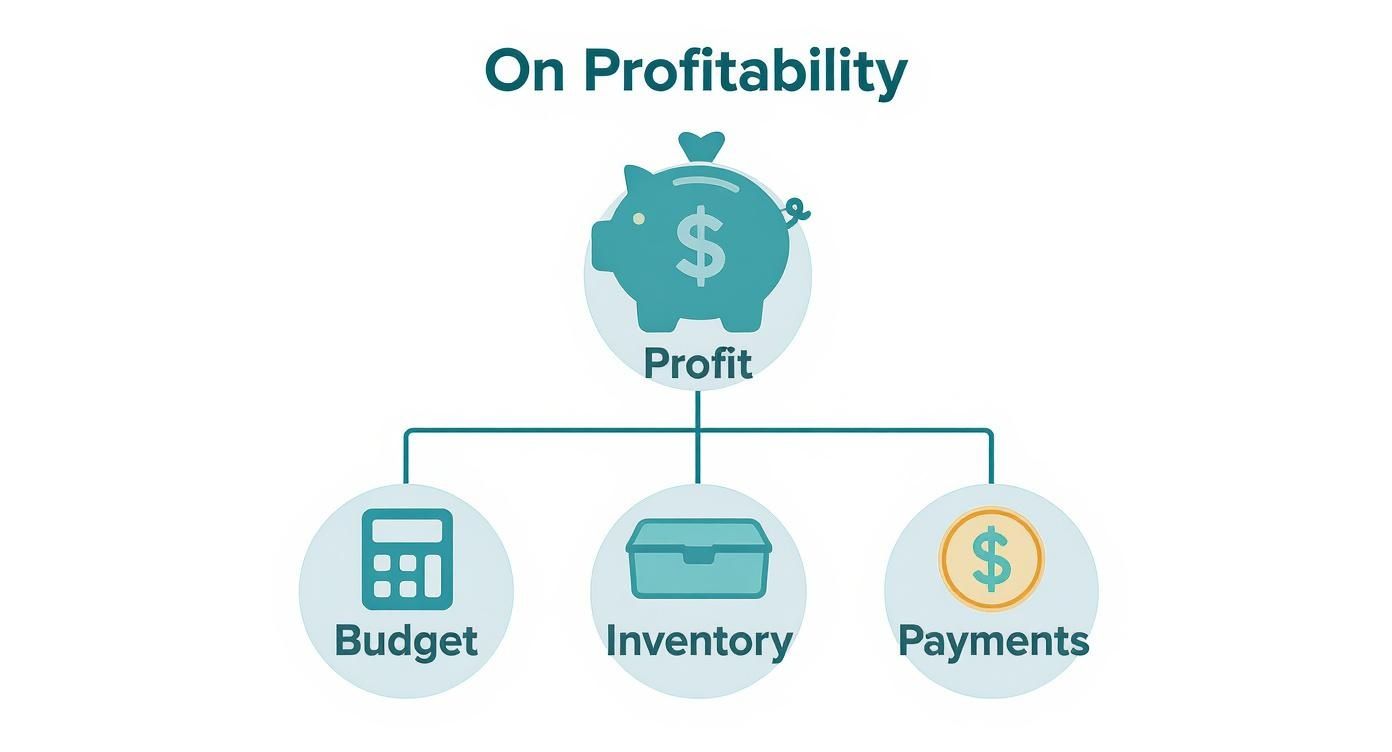
As you can see, everything is connected. How you manage your budget, inventory, and payments directly affects your profit.
Here are the most common types of outsourced dental practice accounting help:
- Outsourced Bookkeeper: This is your first step. A bookkeeper handles the daily work—recording income and expenses and making sure your records are clean and accurate. They build the foundation.
- Controller Services: This is a step up. A controller oversees the bookkeeping, manages cash flow, and helps prepare financial reports. They make sure the whole financial system is running smoothly.
- Fractional CFO: This is your big-picture strategic partner. A fractional Chief Financial Officer helps you understand the numbers to make smarter decisions. They can advise you on when to buy new equipment, how to price your services for more profit, or how to prepare your practice for a future sale.
Most dentists start with bookkeeping and add more help as their practice grows. To see how that high-level support works, check out our guide on why fractional CFO services are a game-changer for small businesses. This lets you get the financial help you need as your practice succeeds.
Common Dental Accounting Questions
We’ve covered a lot, from reading financial reports to making more profit. Still, you probably have a few more questions. Let’s answer some of the most common ones we hear from practice owners.
These are simple answers to help you handle everyday financial challenges.
How Often Should I Review My Financial Reports?
This is a great question. Looking at your numbers too often can make you worry about normal ups and downs, but waiting too long means you could miss a big problem.
For most practices, looking at your key reports at least once a month is a good rhythm.
Your monthly review should always include your:
- Profit and Loss Statement: To see if you made a profit that month.
- Balance Sheet: To check your practice’s overall financial health.
- Cash Flow Statement: To make sure you have enough cash.
Think of this monthly check-in as a team huddle. It’s your chance to see what’s working, spot what isn’t, and make smart changes for the next month.
What Is the Best Accounting Software for a Dental Practice?
There isn’t one “best” software for every practice, but QuickBooks Online is the most popular choice for a reason. It’s easy to use, you can access it from anywhere, and it works with most dental practice management software.
But the software isn’t the most important part—it’s how it’s set up. It is super important that your Chart of Accounts—the list of all your financial accounts—is designed specifically for a dental practice. A generic setup won’t give you the information you need on things like lab fees, dental supplies, or associate pay.
Think of your Chart of Accounts as the filing cabinet for your money. If the labels on the folders are wrong, you’ll never find what you’re looking for. A dental-specific setup makes sure every dollar is filed in the right place, giving you a clear picture of your practice.
Should I Use Cash or Accrual Accounting?
This one sounds technical, but it’s an important choice. The two methods just record money at different times.
- Cash-basis accounting is simple: you record money when you get the cash, and expenses when you pay the bill.
- Accrual-basis accounting records income when you earn it (like when you finish a procedure) and expenses when you get the bill, no matter when the money actually moves.
While cash-basis seems easier, accrual-basis gives a much more accurate picture of your practice’s real profit. It’s the method most CPAs recommend for making smart business decisions and is a core part of effective dental practice accounting.
Feeling overwhelmed by the numbers? You don’t have to manage it all alone. The team at MyOfficeOps can provide the financial clarity and expert guidance you need to grow your practice with confidence. Schedule your free consultation today.