
You're probably looking at your P&L right now, circling expenses, and thinking the same thing most owners think under pressure: cut fast, save cash, move on.
That instinct is understandable. It's also where a lot of businesses hurt themselves.
I've seen owners slash bookkeeping, pause advisory support, cancel software they rely on, and squeeze admin help so hard that the business starts running blind. Bills still go out. Payroll still has to clear. Customers still expect answers. The work doesn't disappear just because you cut the line item. It usually comes back as errors, delays, rework, and bad decisions.
Overhead cost reduction isn't about making your business look cheap on paper. It's about removing waste without damaging the systems that protect cash flow, pricing, compliance, and customer service. The process is much like cleaning out a garage: you want to toss the broken junk, not the toolbox.
More Than Just Cutting Checks
A lot of advice on overhead is lazy. It treats every expense like dead weight. That's wrong.
Some overhead is waste. Some overhead is the support structure that keeps the business from making expensive mistakes. If you cut both the same way, you don't get lean. You get fragile.
The dangerous version of cost cutting
The most common bad move is cutting the “invisible” functions first. Bookkeeping. Payroll support. Financial reporting. Advisory help. Owners cut those because they don't seem tied to a sale in the same obvious way as a salesperson or a project manager.
But those functions are what tell you whether your jobs are profitable, whether your pricing works, whether your cash is tightening, and whether payroll and tax items are being handled correctly.
That's why blind cuts backfire. Most content treats overhead reduction as a straight line to more profit, but aggressive cuts in advisory or bookkeeping functions often increase long-term costs by 15% to 25% due to errors or delayed decision-making. A 2025 study also found that SMBs in professional services and healthcare that eliminated outsourced CFO support saw an 18% increase in operational errors and a 12% drop in cash flow predictability within 6 months.
Practical rule: Cut friction first. Cut visibility last.
A law firm that drops reporting support might save a monthly fee. Then partner draws get sloppy, trust accounting gets harder to monitor, and nobody has a clean read on matter profitability. A medical practice can do the same thing with billing support or bookkeeping cleanup and end up making scheduling, staffing, and purchasing decisions with bad numbers.
Good overhead versus bad overhead
Here's the plain version:
| Type of overhead | What it looks like | Keep, cut, or review |
|---|---|---|
| Protective overhead | bookkeeping, payroll accuracy, compliance, reporting | Keep and improve |
| Productivity overhead | useful software, admin support, process tools | Review for efficiency |
| Waste overhead | duplicate subscriptions, unused vendors, bad workflows | Cut fast |
If an expense helps you see problems early, bill faster, price better, or stay compliant, it's probably earning its keep. If it creates extra clicks, extra approvals, extra software logins, or extra confusion, it's a target.
The owners who handle overhead well don't ask, “What can I remove?” They ask, “What's helping us operate well, and what's just hanging around because nobody touched it?”
That question changes everything.
Where Is Your Money Actually Going
Most owners don't have an expense problem first. They have a visibility problem.
If your books are messy, your categories are inconsistent, and half your subscriptions are buried in credit card statements, you can't make smart cuts. You're guessing. And guessing with overhead usually means cutting the obvious stuff, not the expensive stuff.
Before you reduce anything, get a clean baseline.
Start with simple buckets
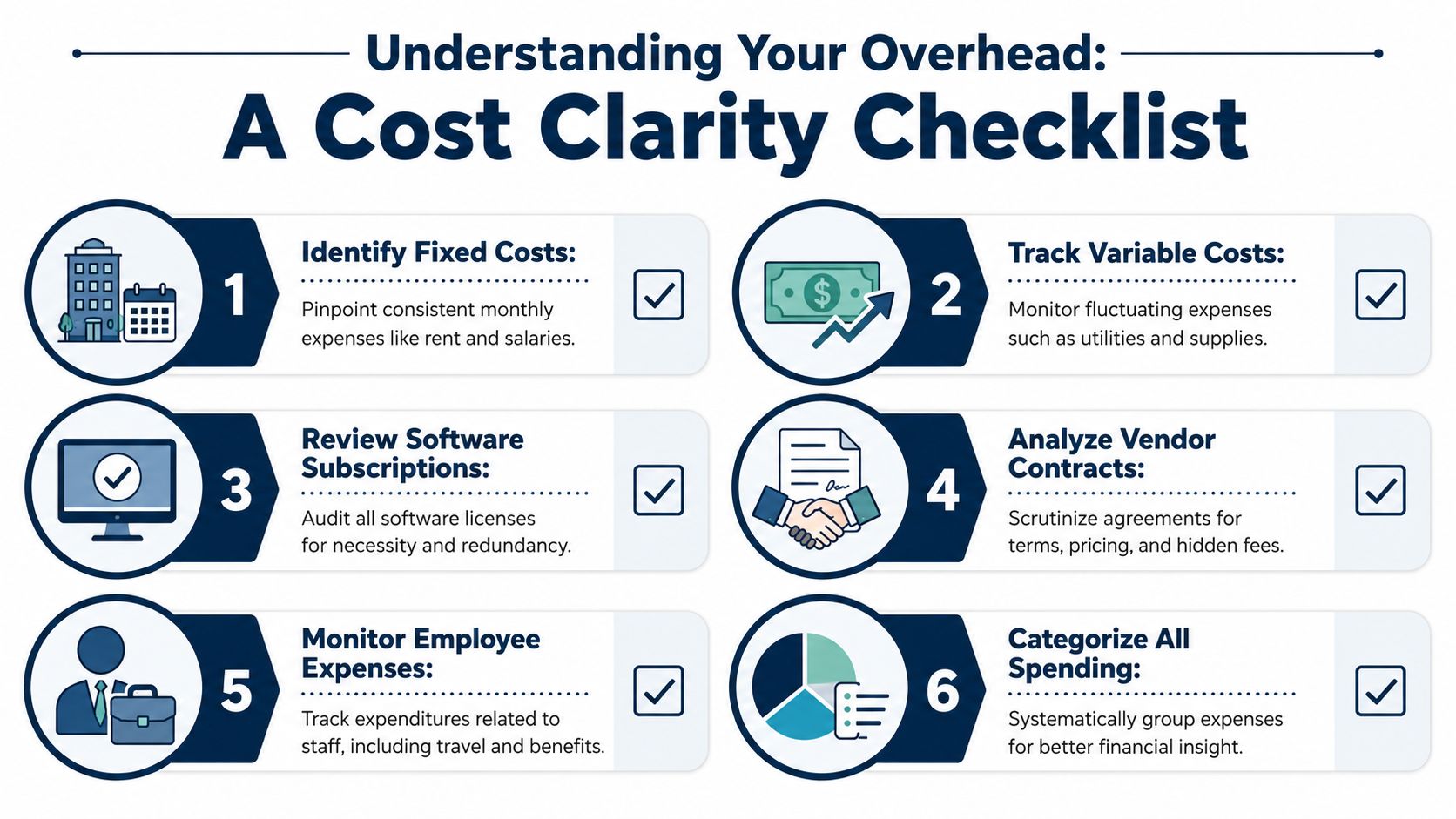
You don't need fancy finance language to do this. Just sort costs into three groups:
- Fixed costs are the bills that usually stay the same each month. Rent is the easy example. So is a base software plan or a standard insurance payment.
- Variable costs move up and down with activity. Supplies, shipping, and job materials usually land here.
- Semi-variable costs start with a base amount, then rise when usage rises. Utilities, overtime, and some phone or cloud bills fit this group.
Think about a coffee shop. Rent is fixed. Coffee beans are variable. Electricity is semi-variable. More customers mean more usage, but there's still a base bill even on a slow month.
That basic sort helps you stop treating every expense the same way. Fixed costs need renegotiation or structural change. Variable costs need tighter controls. Semi-variable costs need monitoring.
Clean categories before you cut
A lot of businesses bury overhead inside broad labels like “office expense” or “admin.” That's useless.
Break those apart. Software should be separate from merchant fees. Payroll taxes should be separate from wages. Outsourced bookkeeping should not sit in the same bucket as random office supplies. If you want a practical starting point, this guide on how to categorize business expenses is worth using as a cleanup checklist.
Bad categories hide bad spending.
Once categories are clean, review the payroll side with the same discipline. Owners often focus only on salary and forget taxes, benefits, equipment, management time, and onboarding. This breakdown from hireSDR.io on employee costs is useful because it forces you to look beyond wages when you compare hiring versus outsourcing.
Track one number that matters
If you only track one metric to start, track your overhead rate.
Use this formula:
Total indirect costs / total revenue
That number won't solve everything, but it gives you a baseline. If your overhead rate is drifting up while revenue is flat, something is bloating. If revenue grows and overhead grows faster, your systems aren't scaling well.
Here's a simple review list for your next finance meeting:
- Pull every recurring charge from bank and credit card statements.
- Match each item to a real category instead of dumping it into misc.
- Flag duplicates across software, telecom, storage, and vendors.
- Separate direct job costs from indirect overhead so profitability stops getting blurred.
- Calculate your overhead rate and save it monthly.
- Write down the top five biggest indirect costs and review them before touching anything else.
Owners love action. Good. But this is the action that matters first. You wouldn't repair an engine without opening the hood. Don't do overhead cost reduction without seeing where the money is going.
Easy Wins to Reduce Overhead Today
Once your numbers are clean, you can make a few fast moves without breaking the business.
These aren't dramatic. That's the point. Good overhead work often starts with boring cleanup that pays you back every month.

Kill the quiet subscriptions
A lot of owners think they know their software stack. Then they pull the statements and find old project tools, duplicate cloud storage, extra user seats, and apps one team tried for a month and forgot to cancel.
A small contractor might have Procore for project management, QuickBooks for accounting, Adobe for plans, then two file-sharing tools because different people prefer different systems. None of those choices looks big by itself. Together, they become a leak.
Look for:
- Unused licenses tied to former employees
- Overlap between Teams and Slack, Dropbox and Google Drive, or multiple scheduling tools
- Monthly plans that should be annual, if you know you'll keep them
- Add-ons nobody can explain
Get rid of paper when possible
One easy win is going digital with invoices, approvals, receipts, and document storage. Going paperless eliminates recurring costs tied to paper, ink, and physical printing, and it also improves organization, according to the U.S. Chamber's guidance on cutting overhead costs.
That matters more than people think. In a small construction office, printed plans, printed invoices, and paper receipts create a second job. Somebody has to print, file, scan, resend, and hunt for missing documents later. Move that work into a digital system and you cut both supply costs and admin drag.
Small savings matter when they repeat every week.
Renegotiate the boring bills
Owners delay this because it feels annoying. Do it anyway.
Call your phone provider. Review insurance policies. Check payment processing terms. Ask vendors if they have a lower tier that fits current usage. Long-time customers often overpay because they never ask.
Use this simple script: “We're reviewing overhead and want to understand whether our current pricing is still the best fit for our usage. Can you walk me through options?”
That's not aggressive. It's normal business.
A strong week-one overhead checklist looks like this:
- Audit subscriptions and cancel what nobody owns
- Switch paper-heavy processes to digital workflow
- Review telecom and insurance bills for outdated plans
- Tighten purchasing rules so small recurring buys don't go untracked
Fast wins won't fix a broken cost structure. But they create momentum, and momentum matters.
Smarter Systems for Long-Term Savings
Quick wins are useful. Systems are what make savings stick.
If your team still handles invoicing, scheduling, data entry, follow-up, and reporting through email chains and manual spreadsheets, your overhead will creep back up. Not because your people are bad. Because the process is.

Use automation where humans add the least value
AI gets oversold. That doesn't mean it isn't useful.
The right use case is simple: let software handle repetitive work so your people can handle judgment, service, and exceptions. Appointment reminders, invoice matching, data extraction, and basic workflow routing are good examples.
There's real evidence behind that shift. AI-based predictive maintenance generates about a 10% reduction in annual maintenance costs and can decrease unplanned downtime by up to 25%. Across industries, 41% of companies in supply chain management functions achieved at least a 10% cost reduction thanks to AI, based on this review of AI and operational overhead.
For a healthcare office, that might mean automating reminders and intake steps so front-desk staff spend less time chasing routine tasks. For a contractor, it might mean using digital tools to speed up estimating and reduce manual re-entry. If you're in that world, Exayard AI-powered takeoff and estimating is one example of the kind of workflow tool worth evaluating when estimating labor is eating up admin time.
Watch the hidden cost of hybrid work
Remote work can save rent. Hybrid work can gradually add clutter.
A lot of small businesses now run with some staff remote, some onsite, and a patchwork of systems built on the fly. That often means duplicate file storage, extra licenses, IT confusion, and people bouncing between tools.
Recent data shows SMBs with hybrid teams face 20% to 30% higher indirect overhead costs because of fragmented software and duplicated cloud storage. A Harvard Business Review analysis also found hybrid companies spent 22% more on redundant software.
That doesn't mean hybrid is bad. It means you have to manage it.
If two employees do the same task in two different systems, you don't have flexibility. You have waste.
Build one operating system for the back office
Long-term overhead cost reduction usually comes from consolidation. Fewer tools. Clearer ownership. Less duplicate work.
Use this short audit:
| Question | If the answer is no | What to do |
|---|---|---|
| Does each recurring tool have an owner? | Nobody is accountable | Assign an owner or cancel |
| Is there one place for financial truth? | Reports conflict | Consolidate reporting |
| Does the workflow remove re-entry? | Staff types the same data twice | Integrate or redesign |
| Can managers see costs without asking finance? | Decisions are delayed | Build simple dashboards |
If your expense systems are still manual, this resource on expense management automation lays out the kind of process changes that reduce admin load without cutting control.
And yes, a provider like MyOfficeOps offers a fitting solution. Not as a magic fix. As one option for businesses that need bookkeeping, payroll integration, reporting, and advisory in one structure so the owner isn't juggling five separate back-office pieces.
Negotiating Deals and Outsourcing Wisely
Owners often treat vendor negotiation and outsourcing as separate topics. They're not. Both are about the same thing: paying for outcomes, not habit.
If an outside relationship lowers your cost, improves reliability, or frees up your team for revenue work, it deserves a hard look. If it's just renewing itself every year because nobody wants to deal with it, it deserves pressure.
Negotiate like a grown-up
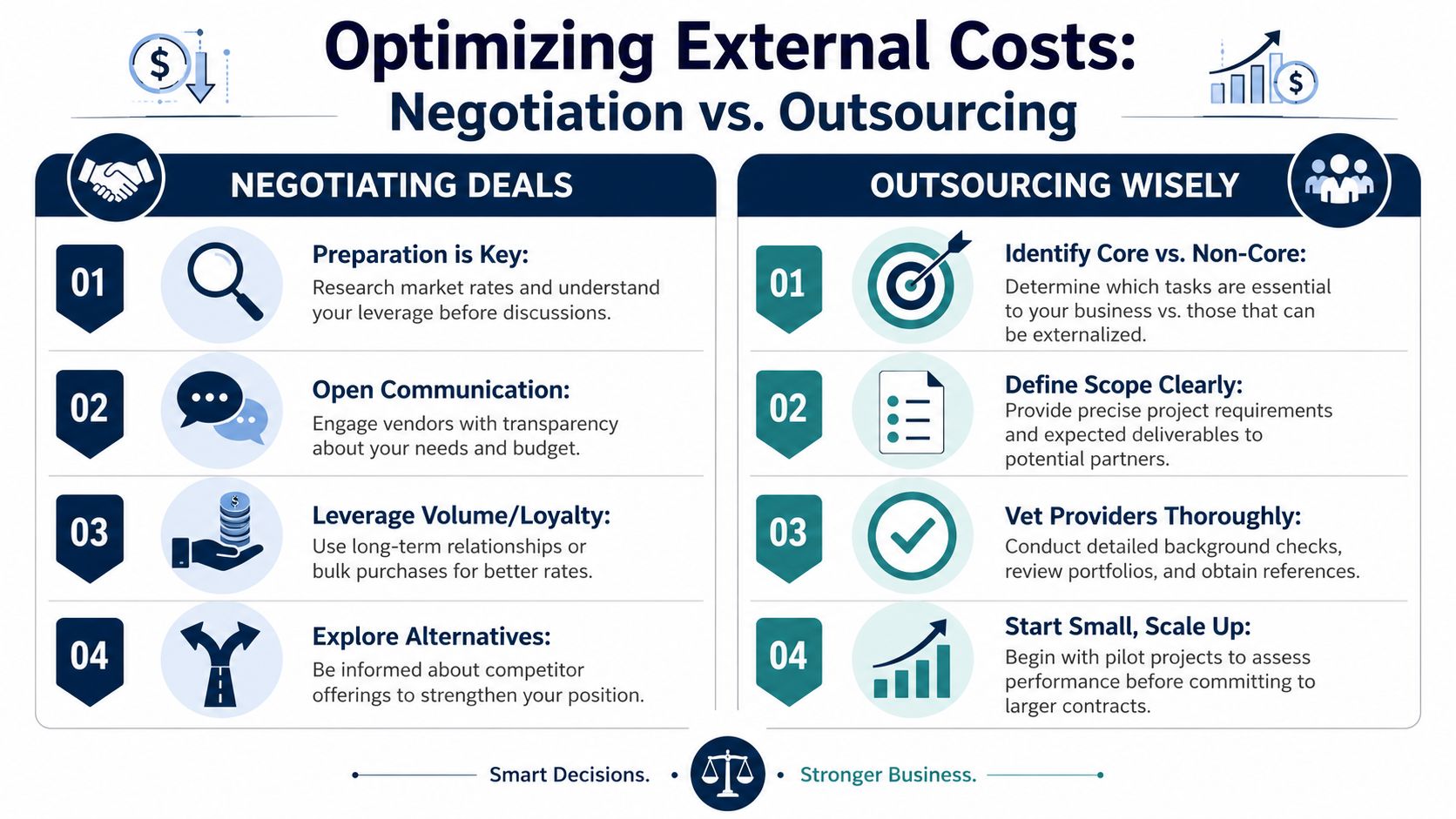
You don't need to bully vendors. You need to show up prepared.
Before the call, gather three things: what you currently pay, what you use, and what would happen if you switched. That changes the conversation fast. Vendors respond differently when they know you've done your homework.
Try language like this:
- For long-term vendors: “We've worked together a while, and we're reviewing all overhead. I'd like to revisit pricing and service levels based on what we're using today.”
- For underused services: “We're paying for capacity we don't need. What lower-cost structure would fit our current usage?”
- For messy contracts: “Before renewal, I want line-item clarity on fees, add-ons, and any automatic increases.”
That approach keeps the relationship intact while still protecting your margin.
Outsource work that isn't your edge
A lot of owners resist outsourcing because they think it means losing control. Usually the opposite is true. Good outsourcing gives you tighter process, cleaner reporting, and a lower fixed cost base.
That's why outsourcing non-core work is such a practical overhead move. The basic logic is simple. If accounting, tax prep, admin support, or payroll processing isn't the reason customers choose you, it doesn't always belong on a full-time payroll slot. It can often be handled by a partner. That approach is specifically recommended in this piece on outsourcing non-core tasks to reduce overhead.
The labor math can be meaningful. Businesses that outsource administrative roles offshore report average labor cost reductions of 60% to 80% compared to equivalent U.S.-based hires. A midsize firm paying $60,000 annually for a U.S.-based admin could potentially secure similar support for $12,000 to $24,000, according to 2026 outsourcing cost savings data.
That doesn't mean every role should go offshore. It means you should stop assuming every task needs a full in-house seat.
For finance work, the better question is often this: do you need a full-time bookkeeper, or do you need clean books, payroll integration, reports, and advice? Those are not the same thing. A lot of firms get better results by outsourcing the function instead of hiring around the problem. If you're weighing that decision, this explanation of the advantages of outsourcing bookkeeping services is a useful reality check.
What to keep in-house
Keep work in-house when it directly shapes customer delivery, pricing, relationships, or quality control. Outsource it when it is necessary but not differentiating.
That line is where smart external spending lives.
Making Your Cost Reductions Stick
Most cost cuts don't fail because the idea was bad. They fail because nobody keeps watching after the first round.
A team cancels a few tools, changes one vendor, cleans up paper processes, and feels done. Six months later, new subscriptions have crept in, hybrid software sprawl is back, and everyone is paying for convenience again.
You need a rhythm, not a one-time project.
Review overhead monthly
This doesn't need to be a giant finance meeting. It does need to happen.
Set one monthly review with a short agenda:
- Overhead rate. Compare it to the prior month.
- Top indirect costs. Check for movement.
- New recurring charges. Ask who approved them and why.
- Vendor changes. Confirm savings materialized.
- Workflow issues. Find where staff are doing manual rework.
If you have a hybrid team, put software sprawl on the list every month. That's where a lot of waste sneaks back in. Data from 2024 to 2025 shows SMBs with hybrid teams face 20% to 30% higher indirect overhead costs, and an HBR analysis found they spent 22% more on redundant software. If nobody owns that category, it will grow.
Cost discipline works best when someone has to explain each recurring expense out loud.
Give every cost an owner
This is one of the simplest fixes I know, and owners skip it all the time.
Every recurring cost should have a name next to it. Not a department. A person. If nobody owns the CRM, the file storage stack, the phone system, the payroll app, or the scheduling platform, those costs become permanent clutter.
Use a short table like this in your monthly review:
| Cost category | Owner | Keep, change, or cancel | Next review date |
|---|---|---|---|
| Software | Operations manager | Change | Next month |
| Insurance | Owner or controller | Keep | Renewal date |
| Payroll tools | Finance lead | Review | Next month |
| Telecom | Office manager | Cancel or reduce | Renewal date |
That one habit creates accountability without making overhead management feel heavy.
Use a simple ninety-day plan
Don't try to rebuild your cost structure in one week. Use a short sequence.
Month one
- Clean up categories
- Pull all recurring charges
- Calculate overhead rate
- Flag obvious waste
Month two
- Cancel duplicates
- Go paperless where it's practical
- Review contracts and vendor terms
- Tighten purchasing approvals
Month three
- Evaluate process automation
- Review hybrid tool sprawl
- Decide what stays in-house and what should be outsourced
- Build a recurring reporting rhythm
This works because it's manageable. Owners don't need another giant project. They need a process that fits real life.
Smart overhead cost reduction gives you options. It protects cash. It improves decision-making. It helps you hire more carefully, price more accurately, and grow without dragging a bunch of hidden waste behind you.
That is the central aim. Not to operate a stripped-down business, but to operate a stronger one.
If you want a second set of eyes on your numbers, MyOfficeOps helps small and midsize businesses clean up books, improve reporting, tighten payroll and expense processes, and make better decisions about overhead without cutting the support functions that keep the business healthy.