
It’s a huge headache for any business owner: you did the work, sent the bill, and now… you wait. And wait. When money you’ve earned is tied up in unpaid invoices, it doesn't just mess with your cash flow; it messes with your sleep. You start wondering if you should have been tougher on payment rules, or if you're following up too much (or not enough). It feels like a guessing game you can't afford to lose.
But what if getting paid wasn't about luck or angry phone calls? What if it was about having a smart, simple system? This isn't about complex theories. These are 10 straightforward accounts receivable best practices you can start using today. Think of this as your playbook for turning those unpaid bills into cash in the bank, so you can get back to focusing on what you actually love doing: running your business.
We’ll cover everything from setting clear payment rules and automating invoices to sorting customers and creating a collections plan. To use these accounts receivable best practices well, it helps to understand the basics. You can learn more by exploring resources on mastering accounts receivable accounting.
Each tip is meant to be easy to act on, whether you’re a consultant in West Chester, a doctor's office in Philadelphia, or a construction contractor trying to make more money on jobs. Let's get your money in the door faster.
1. Implement Clear Credit Policies and Terms
Think of your credit policy as the rules of the game for getting paid. If you don't have clear rules for how and when you expect money, you’re letting your customers decide when you get paid. One of the most important accounts receivable best practices is setting and sharing your payment rules from the very first conversation.
This isn't about being mean; it's about being clear. A good policy stops confusion later and gives you something to point to if a payment is late. For a small business, this simple step can be the difference between having money in the bank and always struggling to pay your own bills.
Why It's a Foundational Practice
A formal credit policy isn't just for big companies. It's even more important for small and medium-sized businesses. When you clearly state your terms upfront, you're less likely to have fights or awkward phone calls later.
Your credit policy is a tool to prevent problems. It makes sure everyone is on the same page from day one so payment issues don't even start.
How to Put It Into Action
Making your policy work is all about telling people the rules and sticking to them. Here are a few real-world examples:
- For a Construction Contractor: Before you start building, have the client sign a contract that lays out payments based on project steps (like 25% upfront, 25% after the foundation is done). Also, state that there’s a 1.5% monthly late fee on overdue bills.
- For a Healthcare Practice: Put your payment policy on a sign at the front desk and on your website. Teach your staff to explain that co-pays are due when the patient checks in, before they see the doctor.
- For a Marketing Agency: I used to run a small agency, and we learned this the hard way. Now, every proposal has a "Payment Terms" section. We specify "Net 15" (meaning payment is due in 15 days) and say a 5% late fee will be added to bills over 30 days late. We even mention this during the sales call so it's not a surprise.
2. Automate Invoice Generation and Delivery
Making and sending invoices by hand is slow and full of mistakes. A typo, a wrong amount, or a forgotten bill can delay payments and make you look unprofessional. One of the best accounts receivable best practices is to automate your invoicing. Automation makes sure your invoices are correct, look professional, and are sent on time, every time.
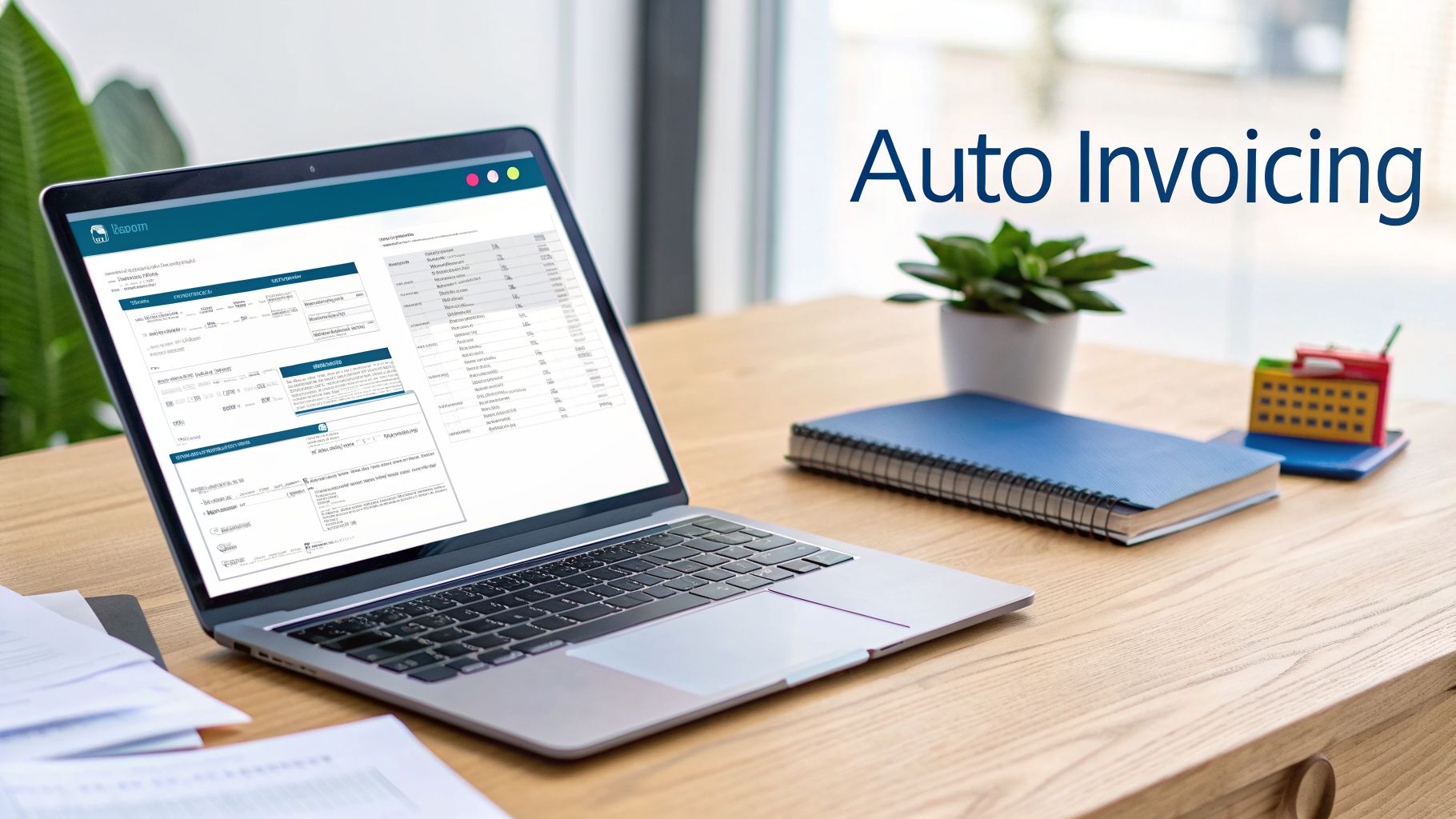
This simple change gets the bill to your customer faster, which means you get paid sooner. Modern accounting software can do everything from creating the invoice to sending it by email, leaving a perfect record. For a busy owner, this saves hours of paperwork and makes the whole billing process shorter.
Why It's a Foundational Practice
Automated invoicing gets rid of the "I never got the bill" excuse. It creates a digital trail that shows when an invoice was sent and even when the client opened it. This tracking makes you look professional and gives you facts to use if a payment problem comes up.
Automation is your secret weapon for being consistent. It makes sure every client gets a professional, correct bill on the same day every month, without you lifting a finger.
How to Put It Into Action
Setting up automation is easy with today's accounting tools. The trick is to make it part of your normal routine. Here are a few real-world examples:
- For a Professional Service Firm: A marketing agency using QuickBooks Online can set up recurring invoices to automatically bill clients for their monthly fee on the 1st of the month. The invoice automatically includes a link to pay by credit card or bank transfer (ACH).
- For a Healthcare Practice: An orthodontist's office can use its software to automatically create and email monthly payment plan statements to patients. This saves the front-desk staff from having to print and mail them.
- For a SaaS Company: A software company I know uses a tool that automatically bills subscribers on their renewal date. The system is even set up to try a failed credit card payment three times before someone has to look at the account.
3. Conduct Early and Proactive Follow-Up
Waiting until an invoice is late to make your first call is a bad idea. A good collections process starts before the due date. Contacting customers right after you send the invoice changes the conversation from "Where's my money?" to a friendly check-in. This is one of the most powerful accounts receivable best practices because it stops simple issues, like a lost invoice or a question about a charge, from becoming big problems.
This early check-in is great for small businesses where relationships matter. It shows you're organized, and it gives your busy clients a gentle nudge. You’re not chasing a debt; you're helping them stay on track. This simple change in timing and tone can make a huge difference in how fast you get paid.
Why It's a Foundational Practice
Following up early helps you find payment roadblocks when there’s still plenty of time to fix them. Did the invoice go to the wrong person? Is there a question about the charges? Finding this out on day five is much better than on day forty-five when you're already behind on your own bills. It’s a key part of good accounts receivable management because it keeps communication open and positive.
Following up early isn't about being pushy. It’s about making sure everything goes smoothly by confirming they got the bill and offering to help before a problem even starts.
How to Put It Into Action
Being consistent is the key to making early follow-up work. Create a simple schedule and stick to it. Here are a few real-world examples:
- For a Professional Services Firm: I set an automated email reminder to go out one week before a big invoice is due. A simple script could be, "Hi John, just checking to make sure you received our invoice #1234 and to see if you had any questions. We appreciate your business!"
- For a Healthcare Practice: Use your patient portal or an automated text service to send a reminder 2-3 days before a payment plan installment is due. This helps patients avoid missed payments and late fees.
- For a Construction Contractor: After sending a bill to a general contractor, have your project admin follow up in 3-5 days to confirm their accounting department got it and has it ready for approval.
4. Segment Customers by Payment Risk and Value
Not all customers are the same, so why treat their accounts the same? A one-size-fits-all collections plan wastes time on good payers while maybe not paying enough attention to risky ones. One of the smartest accounts receivable best practices is to sort your customers based on how they pay and how valuable they are to your business.
This strategy lets you focus your collection efforts where they matter most. By putting clients into groups, you can change your communication, payment terms, and follow-up actions for each one. This smart use of your time helps you get cash from risky accounts without hurting your relationships with your best, most reliable clients.
Why It's a Foundational Practice
Sorting customers helps you be strategic instead of just reacting. It lets you be more or less strict, which helps your team use their time better and get better results. For a growing business, this means you can put more energy into the accounts that are the biggest risk to your cash flow.
Your best customers deserve some flexibility, while your riskiest accounts need to be watched closely. Sorting them lets you apply the right amount of pressure to the right accounts at the right time.
How to Put It Into Action
To put customer sorting into practice, you need to create clear groups with specific actions for each. The key is to be consistent. Here are a few practical examples:
- For a Professional Services Firm: Offer standard "Net 30" terms to old, reliable clients with a perfect payment record. For new startups or clients with no payment history, ask for 50% of the payment upfront and set stricter "Net 15" terms for the rest.
- For a Construction Contractor: I worked with a contractor who gave flexible payment schedules to big general contractors they'd known for years. For smaller or newer ones, they had a strict rule: "we get paid when you get paid," tying their payment to the general contractor's own payment schedule.
- For a Healthcare Practice: Allow longtime patients to be billed for any balance left after insurance pays. For new patients, require 100% of the co-pay and deductible to be paid at the time of service, before they see the doctor.
5. Establish a Structured Dunning Process
Waiting for overdue payments without a plan is just asking for cash flow problems. A structured dunning process is your step-by-step plan for talking to customers about past-due bills, starting with gentle reminders and moving to more serious actions. This is one of the most critical accounts receivable best practices because it ensures every late bill is handled the same way.
This process isn't about bugging customers; it's about being persistent but respectful. It creates a predictable series of steps that stops invoices from getting lost and becoming way too old. For a busy business owner, having a set dunning plan takes the guesswork and emotion out of collections, making the whole thing less stressful and more effective.
Why It's a Foundational Practice
A formal dunning process creates a record of your collection efforts. This is very important if you ever have to go to court or send an account to a collections agency. It makes sure all customers are treated fairly and increases the pressure in a measured way, which helps keep the customer relationship good for as long as possible while still protecting your right to be paid.
Your dunning process is a series of automated or semi-automated steps that does the chasing for you. It shows customers you are serious about your payment terms because you are consistent.
How to Put It Into Action
The key is to decide on your timeline for escalating and stick to it. Automate the early steps if you can and know when a real person needs to get involved.
- For a Professional Service Firm: Set up an automated dunning sequence in your accounting software. For example: a friendly reminder email at 10 days past due, a second notice with the invoice attached at 25 days past due, and a personal phone call from the account manager at 35 days past due. If it's still unpaid at 60 days, send a formal letter.
- For a Construction Contractor: The project manager should make the first follow-up call. If the bill is still unpaid, the business owner should call next. Later steps could include a formal legal letter and putting a stop to any future work until the balance is paid.
- For a Healthcare Practice: The process often starts with a new patient statement being mailed after 30 days. This can be followed by an automated phone call or text. For accounts over 90 days, the next step is usually a final notice before sending the account to a collections agency.
6. Implement Multiple Payment Methods and Convenience
Think about the last time you were about to buy something online but stopped because it was too hard to check out. The same thing happens with your invoices. If paying you is a hassle, your customers will put it off. One of the best accounts receivable best practices is to make it incredibly easy for customers to give you their money.
Making the payment process easy by offering options like bank transfers (ACH), credit cards, and online portals can seriously speed up collections. A late payment often isn't because of a lack of money; it's because your invoice wasn't a priority and paying wasn't easy. When you let customers pay how they want, when they want, you take away that excuse.
Why It's a Foundational Practice
In today's world, you can't just rely on a mailed check. Offering modern, flexible payment options shows that you are professional and easy to work with. It meets your customers where they are, whether they're on a job site paying from a phone or in an office processing a bunch of bank payments.
Don't make your customers work to pay you. The easier you make the payment process, the faster you'll turn your unpaid invoices into cash in the bank.
How to Put It Into Action
Making payments easy is about giving customers clear, simple choices. Here are some real-world examples:
- For a Professional Services Firm: Put a "Pay Now" link directly in the PDF invoices you email. This link should go to a simple online page where clients can pay by credit card or bank transfer, which connects directly to your accounting software like QuickBooks Online.
- For a Healthcare Practice: A dentist I go to sends appointment reminders by text that include a direct link to a payment page that works on my phone. This lets me pay my co-pay from my phone before I even get there. For regular payments or failed transactions, a solid follow-up is key; a deep understanding the dunning process can help you recover this revenue efficiently.
- For a Construction Contractor: Set up bank transfers (ACH) for large project bills. Offer a small perk, like waiving a processing fee for using ACH, to encourage general contractors to use this method. It's usually faster and cheaper for you than credit cards.
7. Perform Regular Accounts Receivable Aging Analysis
An accounts receivable aging report is like a report card for your business's health. It sorts your unpaid invoices into columns based on how old they are, usually in groups like "Current," "1-30 days," "31-60 days," and "61-90+ days." This simple report is one of the most powerful accounts receivable best practices because it instantly tells you who owes you money and how urgent it is.
Ignoring this report is like driving with your gas light on; you know there’s a problem, but you don't know when you’ll run out of fuel. Regularly looking at your AR aging helps you spot problems early, decide which bills to chase first, and predict your cash flow better. It turns a stressful, reactive collections process into a planned, manageable one.
Why It's a Foundational Practice
For any business, cash is king, and an aging report shows you exactly where your cash is stuck. It gives you the information you need to make smart decisions, like when to stop giving a customer credit or when to get tougher with collections. It's not just an accounting task; it's a core tool for running your business.
Your aging report is a diagnostic tool. It quickly shows which customers are good payers and which ones are becoming a financial risk, so you can act before it's too late.
How to Put It Into Action
The key is to be consistent and to take action. Running the report is the first step, but what you do with the information is what matters.
- For a Professional Services Firm: A friend of mine runs a monthly aging report. He noticed a key client always pays at 45 days, even though his terms are Net 30. He can now make a smart choice: either officially change their terms or just start his reminder calls a little earlier for them.
- For a Healthcare Practice: The aging report shows that most of the bills over 60 days old are because of a few specific insurance companies, not slow-paying patients. This tells the team to focus their follow-up calls on the insurers, not the patients, to fix the real problem. You can grab an accounts receivable aging report template to get a clearer picture of these trends.
- For a Construction Contractor: Your weekly aging report shows a general contractor's bill has just moved into the 60+ day column. This is a big red flag that they might have cash flow issues. It should make you immediately stop any new work for them until the old bill is paid.
8. Create Detailed Job/Project-Based Invoicing and Retainers
For any business that sells services instead of products, a fuzzy, one-line invoice is just asking for payment delays. When a client sees "Project Fee: $10,000," their first question is often, "For what, exactly?" A key accounts receivable best practice for service businesses is to give detailed, itemized invoices that connect every dollar to something you did.
This changes your invoice from a simple bill into a progress report. It answers client questions before they even ask, which cuts down on the back-and-forth that slows down payments. It also builds trust by showing them exactly what they paid for. For businesses like construction, healthcare, or consulting, this kind of transparency is a must for good cash flow and happy clients.
Why It's a Foundational Practice
Detailed invoices and retainer agreements change the payment conversation. Instead of waiting for a client to question a big, unexplained bill, you give them the reasons upfront. This leads to fewer arguments and helps you get paid faster for the work you've already done.
Think of your invoice as the final chapter of your project's story. A detailed invoice provides a clear and satisfying ending, leaving no room for confusion or unanswered questions.
How to Put It Into Action
The trick is to build detailed tracking and billing into your projects from the very start. Here are a few practical examples:
- For a Consulting Firm: Use a retainer model where clients pay a set amount each month. With every invoice, include a report showing the hours used and the tasks completed. This proves the value of the retainer month after month.
- For a Construction Contractor: Your invoices should be tied to project steps. When you bill for the "framing" phase, include photos of the finished frame and a list of materials used. This leaves no doubt that the work is done and payment is due.
- For a Marketing Agency: Use project management software that tracks time for each person and task. When billing by the hour, the invoice should break it down: "Graphic Designer: 5 hours on social media graphics," "Copywriter: 3 hours on blog post draft." This gives clients a clear view of their budget.
9. Perform Credit Checks and Financial Review for New Customers
Would you give a stranger a $10,000 loan without asking any questions? Probably not. But many businesses give credit to new customers without checking on them first. Doing a credit check before you start work is one of the most practical accounts receivable best practices you can use, especially for big business-to-business deals.
This isn't about not trusting your customers; it's about protecting your business from risk. A quick financial check can show a history of late payments or money troubles, helping you avoid clients who are likely to become a problem. This simple step saves you from losing money and from the stress of chasing down payments.
Why It's a Foundational Practice
Giving credit is a business decision, not a handshake deal. A formal credit check process makes your client intake more professional and stops you from accidentally funding another company's money problems. It gives you the information you need to either approve their credit, ask for different payment terms, or politely say no to the job.
Think of a credit check as a financial background check for your business partners. It makes sure you're starting a healthy relationship from a cash flow perspective.
How to Put It Into Action
To add credit checks to your process, set a standard procedure and use it every time. Here’s how different businesses can do it:
- For a Professional Services Firm: When signing up a new corporate client for a project over $5,000, have them fill out a credit application. Use a service like Experian Business to check their payment history. Make this a standard part of your sales process.
- For a Construction Contractor: Before bidding on a large job, get a Dun & Bradstreet report and ask for three references from the general contractor. I always tell my contractor clients to call those references and ask one simple question: "Do they pay on time?"
- For a Healthcare Practice: For new corporate wellness contracts, run a business credit check. Set a rule that any business-to-business bill over $2,500 requires a credit review before you provide the service.
10. Use Accounting Software Analytics and KPI Dashboards
Flying blind with your finances is a sure way to have cash flow problems. Instead of digging through spreadsheets, modern accounting software gives you a real-time dashboard of your most important numbers. This turns raw data into a clear picture, letting you see exactly what’s happening with your money. One of the best accounts receivable best practices is using these dashboards to make smarter, data-driven decisions.

These tools show you trends before they become big problems. You can instantly see who owes you money, how long they’ve owed it, and which customers are causing the biggest delays. This knowledge is key to managing your finances proactively, allowing you to stop guessing and start making decisions based on facts.
Why It's a Foundational Practice
Data gives you power. Instead of reacting to a cash shortage, analytics dashboards help you see problems coming. They show you the "why" behind your numbers, revealing patterns in payment behavior that you can act on to get paid faster and make your business stronger.
Your dashboard is your financial command center. It turns complex data into simple, actionable signals that guide your collection efforts and strategic planning.
How to Put It Into Action
To make dashboards work for you, focus on the right numbers and check them regularly. Here’s how different businesses can apply this:
- For a Professional Services Firm: Look at Days Sales Outstanding (DSO) for different types of clients. You might find that startups pay in 60 days while established companies pay in 30. This tells you to change your terms or collection focus for the startup group.
- For a Healthcare Practice: Track your aging report by splitting what insurance owes from what patients owe. If patient balances are consistently getting older than 90 days, it’s a clear sign to improve how your front desk collects co-pays.
- For a Construction Company: Analyze payment delays by general contractor. If you see that one specific GC consistently pays 30 days late, you can plan for that delay in your cash flow forecast for their projects or negotiate tougher terms on the next job. Choosing the right platform is key; you can explore our guide on how to choose accounting software to find a tool with strong reporting features.
10-Point Accounts Receivable Best Practices Comparison
| Item | Implementation Complexity 🔄 | Resource Requirements ⚡ | Expected Outcomes ⭐ | Key Advantages 📊 | Ideal Use Cases 💡 |
|---|---|---|---|---|---|
| Implement Clear Credit Policies and Terms | Low–Medium: drafting policies and legal review | Low: admin time, occasional legal support | More predictable payments; fewer disputes ⭐ | Sets expectations, legal standing, reduces disputes 📊 | SMBs, professional services, healthcare, construction 💡 |
| Automate Invoice Generation and Delivery | Medium: system setup and integrations 🔄 | Medium: software subscription, configuration time ⚡ | Faster billing cycle; fewer errors; consistent delivery ⭐ | Consistent invoices, audit trail, recurring billing 📊 | SaaS, subscription services, firms with repeat billing 💡 |
| Conduct Early and Proactive Follow-Up | Low–Medium: process discipline and scheduling 🔄 | Medium: staff time or automated reminder tools ⚡ | Reduced DSO; fewer accounts become delinquent ⭐ | Preserves relationships; resolves issues early 📊 | Relationship-driven clients; professional services; healthcare 💡 |
| Segment Customers by Payment Risk and Value | Medium–High: data modeling and policy design 🔄 | Medium: historical data, CRM/AR customization ⚡ | Targeted collections; better cash allocation ⭐ | Prioritizes high-impact accounts; reduces losses 📊 | B2B firms, diverse customer bases, growing SMBs 💡 |
| Establish a Structured Dunning Process | Medium: escalation rules and automation 🔄 | Medium: templates, software, staff time ⚡ | Higher collection rates; legal defensibility ⭐ | Consistent escalation, documented actions, reduced ageing 📊 | Any recurring-billing business; healthcare; construction 💡 |
| Implement Multiple Payment Methods and Convenience | Medium: processor integration and compliance 🔄 | Medium: payment fees, integrations, PCI considerations ⚡ | Faster receipts; higher payment velocity ⭐ | Removes friction, improves customer experience, automates reconciliation 📊 | Remote clients, consumer-facing services, recurring billing 💡 |
| Perform Regular Accounts Receivable Aging Analysis | Low–Medium: report setup and review cadence 🔄 | Low: accounting software use, periodic analyst time ⚡ | Early warning on cash flow; identifies chronic payers ⭐ | Informs strategy, forecasting, and allowance for doubtful accounts 📊 | All companies monitoring cash flow; finance/accounting teams 💡 |
| Create Detailed Job/Project-Based Invoicing and Retainers | Medium–High: time tracking & project integration 🔄 | Medium: PM/time-tracking tools, detailed billing effort ⚡ | Fewer disputes; steadier cash flow via retainers ⭐ | Links billing to deliverables, supports dispute defense 📊 | Professional services, agencies, construction, consultancies 💡 |
| Perform Credit Checks and Financial Review for New Customers | Medium: credit process and compliance controls 🔄 | Medium: credit report fees, underwriting time ⚡ | Fewer bad debts; better credit limit decisions ⭐ | Prevents high-risk onboarding; sets evidence-based terms 📊 | High-value B2B clients, new corporate customers, large contracts 💡 |
| Use Accounting Software Analytics and KPI Dashboards | Medium: dashboard setup and data hygiene 🔄 | Medium: software, configuration, analyst time ⚡ | Real-time visibility; faster, data-driven decisions ⭐ | Alerts, trend detection, consolidated receivables metrics 📊 | CFOs, finance teams, scale-ups needing operational insight 💡 |
Your Next Step to Getting Paid Faster
We've just walked through ten powerful accounts receivable best practices, from setting clear payment rules to digging into your financial data. It can feel like a lot to take in at once, but the goal isn't to do everything overnight. The real magic happens when you start small, build momentum, and turn these practices into habits.
Think of your accounts receivable process like the engine of your business. When it's running smoothly, it powers everything else: making payroll, buying new equipment, and planning for growth. When it sputters, the whole operation can grind to a halt. Each overdue invoice is a small clog in that engine, and using these strategies is how you clean it out and keep it humming.
From Information to Action: Your First Steps
The most important question now is: What’s next? Don't let this guide become just another bookmarked article. Real change comes from taking a single, small step. Look back at the ten practices and pick the one that fixes your biggest headache right now.
- Is your team spending hours making and sending invoices by hand? Your first step is to explore invoice automation in your accounting software. Set a goal to automate just one client's invoicing this week.
- Are you always surprised by late payments? Your mission is to create a simple aging report and set aside 30 minutes every Friday to look at it. Find your three oldest unpaid invoices and make a friendly follow-up call.
- Are you losing track of project costs in your construction business? Focus on creating more detailed, job-based invoices. Start with your next new project, breaking down costs from the beginning.
- Do you feel like you're flying blind with new clients? Your starting point is to create a simple credit application or checklist for your next new client. A quick check can prevent a massive headache later.
The key is to choose one action and stick to it. By making a small, manageable change, you start building the muscle for better financial habits. Once that practice becomes second nature, you can move on to the next.
The Big Picture: Why This Matters
Mastering these accounts receivable best practices is about more than just getting paid faster. It’s about taking control of your business's financial future. For a consulting firm, it means having the cash on hand to hire great people. For a doctor's office, it means you can invest in better technology for patients. For a construction contractor in West Chester, it’s the confidence to bid on bigger, more profitable jobs.
When you have a reliable system for managing incoming cash, you reduce stress and free up your most valuable resource: your time. You can shift your focus from chasing payments to serving your clients and building a business that lasts. You stop reacting to money emergencies and start steering your company toward its goals. This isn't just paperwork; it’s the foundation of a strong, healthy business.
Feeling overwhelmed by the numbers or just want an expert partner to help you build a bulletproof financial system? At MyOfficeOps, we specialize in taking the stress out of bookkeeping and financial management for businesses just like yours. We help you move from confusing books to clear, actionable insights so you can stop chasing payments and start growing your business. Schedule a Discovery Call with us today.