
You’re halfway through a job. The crew has done the work. Materials are on site. Then the draw gets held up because the paperwork doesn’t match what the lender expected. Now the subcontractors are asking when they’ll be paid, and you’re moving money around just to keep the job alive.
That problem shows up all the time in construction. It usually isn’t because the work wasn’t done. It’s because the money plan was loose, unclear, or disconnected from the actual job progress.
A good construction draw schedule template fixes that. It gives you a clean way to tie payments to real milestones, track what’s been earned, and show the owner or lender exactly why a draw should be approved. When it’s built right, it’s not just a form. It’s part of how you protect cash flow.
Why Your Construction Business Needs a Draw Schedule
A draw schedule matters most when things get tight.
I’ve seen jobs where a contractor thought the next payment was basically automatic. Then the inspector asked for backup, the owner wanted a cleaner breakdown, and the bank kicked the request back. The work kept moving, but the money didn’t. That’s when one missed draw starts causing three new problems at once. Payroll gets squeezed, supplier balances age, and the job schedule starts slipping.

What a draw schedule actually does
Think of it as the project’s money map.
A construction draw schedule is a financial roadmap tied to verifiable milestones and usually built around a Schedule of Values, or SOV. Strong templates include milestone names, payment percentages, and retainage rules, with 5% to 10% commonly held until the end. When the schedule matches actual completion percentages on site, it builds trust with lenders and owners. When it doesn’t, payments can be delayed by weeks, which can hit 30% to 50% of small contractors’ cash flow according to SmartBarrel’s guide to construction draw schedules.
That’s why this isn’t office paperwork for the sake of paperwork. It’s the thing that keeps the field moving.
Practical rule: If your draw schedule can’t answer “what got finished, what’s billable now, and what proof do we have,” it isn’t ready to send.
Why loose billing causes real damage
A lot of contractors still bill in broad chunks. They’ll say things like “framing is basically done” or “we’re ready for the next payment.” That may feel true on the jobsite, but lenders don’t approve “basically.”
They approve what can be matched to a signed contract, an SOV, and visible progress. The cleaner your schedule is, the less back-and-forth you get. The less back-and-forth you get, the faster money moves.
Here’s what a solid draw schedule helps you do:
- Control timing: You know when to submit, what amount to request, and what work supports it.
- Protect working cash: You’re less likely to float labor and materials longer than planned.
- Set expectations early: The owner, lender, and project team all see the same milestones.
- Reduce arguments: People fight less when the payment structure was clear before the first hammer swing.
What works better in the real world
The contractors who stay calmer through a project usually aren’t luckier. They’re more organized.
They’ve got a draw schedule that matches the budget, the contract, and the actual sequence of work. They don’t wait until draw day to figure out what to bill. They already know.
That’s the difference between chasing money and managing it.
Your Downloadable Construction Draw Schedule Template
A blank spreadsheet can be annoying if you don’t know what belongs in it. So keep this simple. Your construction draw schedule template should be easy to read, easy to update, and clear enough that someone outside your company can understand it without a long phone call.
Here’s the visual overview.
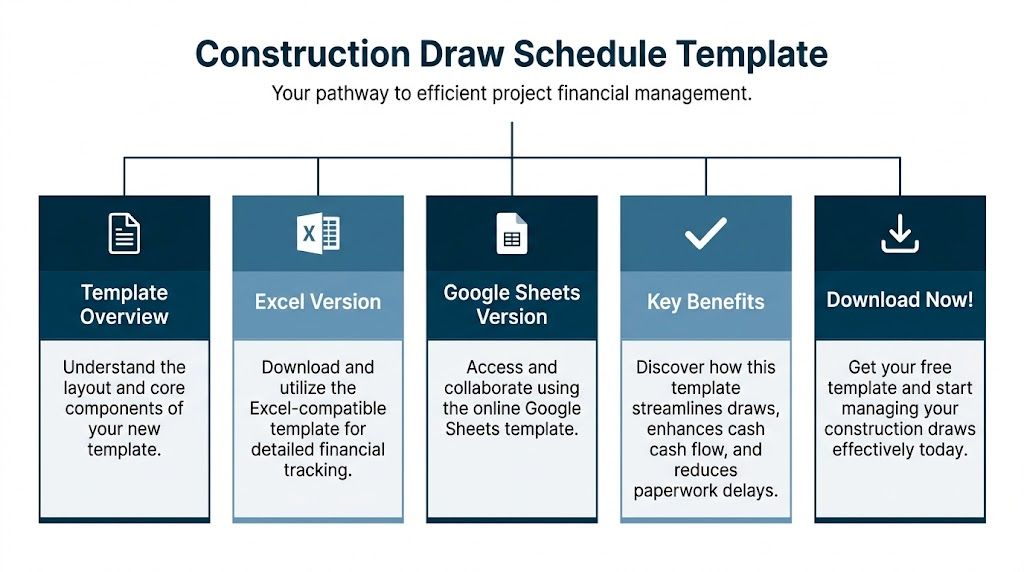
What to include in the template
At minimum, your template should have the parts below. If one of these is missing, somebody will usually ask for it later.
| Column | What it means in plain English | Simple example |
|---|---|---|
| Line item | The phase or cost category you’re billing for | Demo, foundation, framing |
| Scheduled value | The total amount budgeted for that line | Total framing budget |
| Draw amount | What you’re asking to be paid this round | Current request for rough-in |
| Percent complete | How much of that line item is actually finished | Rough-in is partly complete |
| Earned value | The amount you’ve earned based on work done | Billable value tied to completion |
| Retainage held | The part withheld until later | Holdback on current draw |
| Balance to finish | What remains after the current request | Amount left on finishes |
| Verification notes | What proves the work is done | Photos, inspection, signed approval |
That’s the core. You can add more tabs later for cash flow, change orders, or lender forms. But if the base schedule isn’t clean, adding extra tabs won’t save it.
Three terms that trip people up
A lot of confusion starts with words people hear all the time but never get explained clearly.
- Schedule of Values (SOV): This is the full project broken into billable parts. Instead of one lump sum, you assign value to each phase of work. If the contract is one number, the SOV is how that number gets organized.
- Milestone: A milestone is a point in the job where payment can be justified. It should match real progress, not wishful thinking. “Foundation complete” is a milestone. “We’ve been busy this month” is not.
- Retainage: This is the amount held back until the end or until certain closeout terms are met. In many jobs, 5% to 10% is withheld. You need to show it clearly so you don’t mistake withheld cash for available cash.
A draw schedule should be boring. If it’s dramatic, vague, or open to interpretation, it’s going to create trouble.
How to make the file useful right away
A lot of templates fail because they look neat but don’t match how the job operates. Your file should let you answer a few basic questions fast:
- What’s the total contract value tied to this schedule
- What has already been billed
- What is being billed now
- What is being held back
- What is left to bill later
- What support documents go with this draw
If you can answer those in a minute or two, the template is doing its job.
Excel or Google Sheets
Both can work. The better choice depends on who needs to touch the file.
Use Excel if one person controls the schedule and you want tighter formula control. Use Google Sheets if the PM, office, and owner’s rep all need to look at the same live file. Either way, lock your formulas, label your tabs clearly, and date every update.
A few practical habits make a big difference:
- Name each draw clearly: Draw 1, Draw 2, Draw 3. Don’t use random file names.
- Freeze key rows: Keep headers visible so nobody scrolls into confusion.
- Track revisions: If you change a line item, note why and when.
- Match the contract language: If the contract says “rough mechanical,” don’t rename it “MEP stage” just because it sounds cleaner.
Keep the template tied to the real job
The file should reflect the field, not the other way around.
If the crew and project manager use different language than the office, fix that before the first draw goes out. The best construction draw schedule template is one everyone can follow. Owner, lender, PM, bookkeeper, and subcontractor should all be looking at the same picture.
That alone solves a lot of payment problems before they start.
How to Build Your Draw Schedule from Scratch
If you’re building the schedule yourself, don’t start with the draw amounts. Start with the job.
That’s where many schedules go sideways. Someone opens a spreadsheet and guesses what the lender wants to see. What you need first is a clear breakdown of the work, then a clean path from that work to the billing.

Start with the work breakdown
A solid schedule begins with a work breakdown structure, or WBS. That just means you break the job into major parts before assigning money to them.
According to ProjectManager’s guide to making a construction schedule, the usual process is to build a detailed budget from the WBS, divide it into 8 to 12 milestones, and then sequence those tasks based on dependencies and resources. Their benchmark examples include foundation at 10% to 15% and framing at 20% to 25%, and they note that delays affect 30% of projects in parts of the U.S. East Coast.
For a residential addition, your rough breakdown might look like this:
- Pre-construction and permits
- Demo and site prep
- Foundation
- Framing
- Roofing and dry-in
- Rough plumbing, electrical, HVAC
- Insulation and drywall
- Finish carpentry and paint
- Fixtures and final trim
- Punch list and closeout
That gives you a clean starting point. It also keeps you from stuffing too many unrelated costs into one draw line.
Group work into milestones that make sense
The best milestones are easy to verify.
“Demo complete” works. “Phase 1 labor” usually doesn’t. The point is to make each draw request easy for someone else to approve. If the line item is too broad, you end up arguing about what’s included.
Here’s a simple way to judge your milestone list:
| Good milestone | Weak milestone |
|---|---|
| Foundation complete | Structural progress |
| Rough electrical approved | Mid-project electrical work |
| Dry-in complete | Exterior phase |
| Final trim installed | Interior completion work |
If an inspector or lender rep can stand on site and clearly say yes or no, the milestone is probably workable.
If you need a long explanation to justify a line item, the line item is probably wrong.
Assign values without front-loading the job
Contractors often get tempted to solve cash flow by loading too much into early draws. That might feel helpful at first, but it often creates problems later if the lender thinks billing got ahead of the work.
Use the job budget and estimate to assign values accurately. Labor-heavy and material-heavy phases should carry more value than smaller cleanup or closeout tasks, but the numbers still need to match the reality of the project sequence.
A few practical rules help:
- Keep early mobilization reasonable: Don’t bury half the overhead in the first draw.
- Tie each value back to your estimate: If framing cost more in the bid, framing should carry more weight in the SOV.
- Leave room for the back end: Punch list, closeout, and retained money still matter even if they feel small during the middle of the job.
- Watch the retainage effect: What you earn and what you receive are not always the same thing.
Build the schedule in the same order the job will move
A schedule has to work for operations, not just accounting.
If roofing can’t happen until framing is done, and rough-ins can’t happen until the shell is ready, your draw order should reflect that. That sounds obvious, but I still see files where the money plan is disconnected from the project flow.
Use dependencies and common sense. Sequence the milestones the same way the superintendent would explain the job. If you want cleaner spreadsheet logic for this kind of planning, it helps to look at examples of how teams create powerful Excel templates with locked formulas, repeatable inputs, and cleaner layouts.
For tighter cost tracking, a job costing sheet also helps. This job costing Excel template is useful when you want your draw schedule and your field costs speaking the same language.
Review the schedule before the job starts
Don’t wait until the first draw request to ask whether the owner or lender agrees with the structure.
Get buy-in early. The PM, estimator, owner, and office should all review the same draft. If lender forms are required, line your schedule up with those forms before work starts. Early alignment prevents numerous avoidable headaches.
A quick review should answer these questions:
- Does every milestone match the contract scope
- Can each milestone be verified on site
- Do the values match the estimate
- Does the billing order match the construction order
- Are retainage terms shown clearly
- Is there a simple way to handle approved changes later
Update it every week, not only at draw time
A construction draw schedule template works best as a living file.
When the superintendent updates progress weekly, the office doesn’t have to scramble at the end of the month. You already know what’s billable, what’s delayed, and what documents you’ll need. The draw package comes together faster because the schedule stayed current all month.
That weekly habit is what separates a useful schedule from a forgotten spreadsheet sitting in a download folder.
Keeping Lenders and Subcontractors Happy
The fastest way to create cash flow problems is to surprise people who control the money.
Lenders hate vague requests. Subcontractors hate late payment. Owners hate finding out after the fact that the billing didn’t line up with what they thought was complete. A draw schedule helps, but only if you use it to communicate.
What lenders want before they release money
Most lenders are not trying to make your life hard. They’re trying to confirm that the draw request matches the work.
That means they want a package they can follow without guessing. Best practice includes reviewing each draw after submission, documenting progress, and folding in change orders. Change orders affect 20% to 30% of projects, and in Philadelphia, verified draw systems tied to completion percentages help reduce cash flow gaps by 40%, support over 95% stakeholder alignment, and matter because 65% of contractors say delayed draws are a top profitability killer, according to Adventures in CRE’s construction draw model discussion.
That sounds technical, but the lesson is simple. If your paperwork is clean, money moves faster.
Build a draw package that gets approved
Don’t send the lender a number and hope the rest sorts itself out. Send a complete packet.
A clean package usually includes:
- Updated draw schedule: Show what was previously billed, what’s being billed now, and what remains.
- Current SOV: Make sure it matches the draw form and the contract language.
- Progress photos: Clear, dated photos help when someone reviewing the package wasn’t on site.
- Inspection or sign-off support: If an inspection happened, include proof.
- Change order backup: Approved changes should be reflected before they become billing fights.
- Lien waivers: Conditional waivers for the current draw and unconditional waivers after payment keep the file clean.
The draw request should answer questions before anyone has to ask them.
Pay subcontractors in step with draw receipts
This is the part many office teams underestimate.
If your subcontractor payment timing is disconnected from your draw timing, you end up floating someone else’s labor out of your operating cash. That’s how a profitable job can still create stress.
A better approach is to line up three things:
| Moving piece | What should match |
|---|---|
| Subcontract terms | Their billing points should mirror your major milestones when possible |
| Draw schedule | Your request dates should reflect when work can actually be verified |
| Office payment plan | Vendor payments should be queued based on expected receipt, not optimism |
This doesn’t mean holding subs unfairly. It means setting expectations in writing before the work starts.
Communication solves more than people think
Most draw disputes don’t begin as fraud or bad intent. They begin because one person assumed something the other side never agreed to.
A weekly update from the PM to the office. A quick note to the lender when a milestone slips. A clear statement to the subcontractor about when a draw was submitted and when funds are expected. Those small habits prevent a lot of friction.
The draw schedule gives everyone one version of the truth. Use it that way, and your job gets quieter.
Integrating Draws with Your Bookkeeping and Cash Flow
A draw schedule by itself is useful. Connected to your books, it becomes a management tool.
That’s the jump a lot of contractors never make. They build the schedule for the lender, submit the draw, and then let the accounting system tell a different story. That creates confusion fast. The office sees deposits one way, the PM sees job progress another way, and nobody has a clean view of what the job is producing.

Turn the schedule into a live accounting tool
Each draw should connect to your accounting records in a way that makes the job easier to read later.
That means the draw amount, retainage held, change orders, and job costs should all tie back to the same job name, cost code structure, and reporting period. If the draw says rough-in is billed, but your books lump all field labor into one bucket, you lose visibility.
If you’re using QuickBooks in a construction setting, it helps to see how firms structure jobs, customers, classes, and reporting in a more practical way. This overview of QuickBooks for Construction is a useful reference for that setup.
Why this matters more on mixed-funding jobs
This gets even more important when a project is funded from more than one place.
In Greater Philadelphia, 45% of SMB projects use blended sources such as SBA loans, private equity, and trade credit. Generic templates often miss that complexity, which leads 35% of firms to pull owner equity too early and take interest penalties. A properly integrated draw schedule gives clearer cash flow visibility and can improve bid-to-profit margins by 20% to 25%, based on Adventures in CRE’s draw schedule discussion.
If your schedule only shows one inflow line called “draw,” you can miss a funding gap that’s obvious once debt, equity, and vendor terms are split out.
What to track every month
When I review construction books, I want the draw schedule and the cash forecast to answer the same questions.
Track these together:
- Expected draw receipts: What’s been submitted, approved, and still pending
- Retainage receivable: Money earned but not yet available
- Committed payables: Bills and subcontract balances tied to the same project phase
- Job cost vs budget: Whether the value earned matches what the job is costing
- Funding source timing: Which payments come from lender proceeds and which come from owner cash
For a cleaner process, it helps to use a separate forecast view alongside your accounting system. This guide to construction cash flow management is a good companion if you want to connect project draws to business-level planning.
Your bank balance never tells the full story on a construction job. The draw schedule usually explains what’s coming next, what’s stuck, and what has already been earned but not collected.
The real benefit
Once the draw schedule feeds your bookkeeping, you stop guessing.
You can spot whether a profitable job is still starving the business of cash. You can see if retainage is building up too fast. You can tell whether a change order improved the job or just added work without enough margin.
That’s when the schedule stops being a form for the lender and starts becoming part of how you run the company.
Avoiding Common Draw Schedule Disasters
Most draw problems don’t come from one huge mistake. They come from a handful of small mistakes that stack up.
A line item is too broad. Retainage isn’t tracked clearly. A change order gets approved in the field but never gets worked into the next billing. Then a month later everyone is arguing over numbers that should have been settled already.
Disaster one, ignoring retainage until the end
Too many contractors treat retainage like a footnote.
It isn’t. A 2025 CFMA report found that 62% of small contractors ran into cash flow disruptions because retainage and change orders weren’t modeled properly. The same source notes that retainage is commonly 5% to 10% of contract value, and that better handling of those items can improve job profitability by 15% to 20%, according to Procore’s construction draw schedule resource.
If you don’t track retainage separately, you may think a job is generating more usable cash than it really is.
Do this instead:
Create a dedicated retainage column in the draw schedule and in your accounting reports. Treat retained funds as earned but unavailable until release terms are met.
Disaster two, billing approved changes the lazy way
A lot of teams handle change orders with sticky notes, texts, or a quick email chain. Then they try to bill them later as one lump adjustment.
That’s where disputes start. The lender may not recognize the new amount. The owner may remember the scope differently. Your office may not know which future draw should carry the revised value.
Do this instead:
Once a change is approved, update the schedule right away. Add the revised value, show where it will be billed, and spread the impact across future draws if the work spans more than one phase.
Disaster three, using a template that doesn’t match the job
A generic file can get you started. It can also give you false confidence.
Residential rehab, commercial fit-out, and ground-up construction don’t move the same way. A template that works for one project can create a mess on another if the milestones, verification points, or payment logic don’t fit the actual job.
Here’s a quick check:
- Bad fit: The template has milestone names that don’t match your contract.
- Bad fit: It leaves no place to show retainage release or revised line items.
- Bad fit: It doesn’t help the office tie billing to job costs.
- Better fit: The schedule mirrors the estimate, the contract, and the order of work on site.
Disaster four, waiting too long to compare estimate to actuals
This one sneaks up on people.
The draw schedule may look fine, but if actual labor and material costs are outrunning the value earned, the job can still go bad. Billing on time won’t fix a margin problem if you’re not checking costs against the schedule.
That’s why cost review matters. If you want a practical framework for spotting these issues earlier, this resource on cost overruns in construction projects is worth keeping nearby.
Good draw schedules don’t just help you collect money. They help you notice when a job is drifting before the damage gets bigger.
The simple standard to use
Before every draw goes out, ask four questions:
- Does the billed amount match actual job progress
- Is retainage shown clearly
- Have approved changes been folded into the current schedule
- Does the office have the backup to defend the request
If the answer to any of those is no, fix it before the request leaves your desk.
If your draws are getting stuck, your retainage is muddy, or your books don’t line up with what’s happening in the field, MyOfficeOps can help you clean it up. We work with contractors around Philadelphia and West Chester to tighten bookkeeping, improve cash flow visibility, and turn job data into better decisions.