
Let's be real. In construction, a full schedule doesn't always mean your business is doing well. The real test is having enough cash in the bank to pay your crew, your suppliers, and keep the lights on. That's what construction cash flow management is all about—making sure money comes in faster than it goes out.
Why Managing Cash Flow Is Your Most Important Job

You can have profitable jobs on paper and still go broke waiting for checks to show up. This is a tough spot that too many contractors find themselves in. Cash flow isn't just a fancy term for accountants; it's the fuel for your business, deciding every move you can (or can't) make.
Imagine this: you just finished a big part of a project and sent out a large invoice. You've already paid for the materials and your crew's last two weeks of work. But the client's check doesn't arrive for 30, 60, or even 90 days. In the meantime, payroll is due again next Friday. That gap is where good businesses get into trouble.
The Real-World Squeeze
This isn't a rare problem—it's common in the industry. The construction world has a big issue with late payments. In fact, some data shows that around 70% of contractors regularly get paid late, with the average wait stretching past three months. That’s a lot longer than the 45 days experts say you need to stay healthy. You can read more about these industry challenges over at OpenAsset.com.
This waiting game causes a chain reaction. When you can't pay your suppliers on time, you might lose discounts or damage a relationship you've spent years building. If you're late paying your best subs, they might not be free for your next job.
Before we get into the fixes, let's look at the common things I see draining cash from good construction companies.
Common Cash Flow Killers for Contractors
| Problem Area | How It Drains Your Cash |
|---|---|
| Slow Invoicing | You don't get paid until you ask. Any delay in sending a bill makes your wait for cash longer. |
| Poor Job Costing | If you don't know your real costs, you're guessing on bids and losing money on every project. |
| Unexpected Change Orders | Changes that aren't approved or written down mean you pay for extra work yourself, often for weeks or months. |
| Retainage Tie-Ups | A chunk of the money you've earned is held back, squeezing your available cash until the very end of a project. |
| High Overhead | Fixed costs like rent, insurance, and office staff salaries use up your cash every month, no matter how much work you have. |
These issues are more than just annoying; they can sink your company. Dealing with them is the first step to building a stronger business.
The point of construction cash flow management isn't just to chase money you're owed. It's about building a business strong enough to handle the ups and downs of the industry.
It’s about knowing your numbers so well that you can see a cash shortage coming, giving you time to do something about it. It means having a plan instead of just crossing your fingers.
Moving From Reactive To Proactive
When cash is tight, you're always playing defense. You have to make choices based on what you can afford today instead of what’s best for the business in the long run. You might have to skip a good discount on materials or wait to buy a new tool that would make your crew faster, all because you don't have the cash.
This guide is here to help you change that. We're going to skip the complicated words and focus on simple, real steps to help you take control. Getting these basics down is your first step toward building a more stable and profitable business.
Know Your Numbers with Practical Job Costing
If you don't know where your money is going on each job, you're just guessing. You might feel like a project made money, but feelings don't pay the bills. This is where job costing comes in, and it’s simpler than it sounds.
Think of it like this: for every project, you need a money plan. Job costing is how you create that plan by tracking every dollar you spend—from screws and lumber to your crew's hours and a sub's invoice.
The whole point is to compare what you're actually spending to what you planned to spend while the job is still going on. This isn't just something for your accountant at the end of the year; it's a tool that tells you right now if you're on track or in trouble.
Why Guessing Is So Dangerous
Without tracking costs for each job, you're flying blind. It's a classic problem: you might have one very profitable job that's covering the losses from two other jobs, but you’ll never know which is which.
This leads to a bad cycle where you keep bidding on the wrong kinds of projects, losing a little cash each time without knowing why your bank account is always low.
For example, you might think you're making good money on kitchen remodels. But after tracking a few, you realize the time spent on custom cabinets and fixing small issues is eating up all your profit. The smaller bathroom jobs, which you thought weren't as good, are actually where you make your real money.
Job costing isn't about creating more paperwork. It's about learning the truth about your business so you can make smarter choices and bid on work that actually makes you money.
A Simple Framework to Get Started
You don't need fancy software to start. You can begin with a simple spreadsheet. The key is to group your expenses into categories so you can see where your money is going.
Start by creating columns for these main cost groups for each project:
- Materials: This is everything from concrete and drywall to paint and light fixtures. Be specific.
- Labor: Track the hours each person works on a specific job. Don't forget to include labor burden—payroll taxes, insurance, and benefits. This is a big cost that often gets missed.
- Subcontractors: Every invoice from your plumbers, electricians, and other subs should be tied to the right project.
- Equipment: If you rent equipment or use your own, assign that cost. For equipment you own, you can give it an hourly or daily rate for the job.
- Overhead & Other Costs: This can include things like permits, dump fees, and other costs directly related to the job.
Putting It Into Practice
Let's use a real-world example. Say you're building a deck. You budgeted $5,000 for lumber. Halfway through the job, you check your job costs and see you've already spent $4,000 on lumber because the price went up.
This is your early warning sign. Right then, you know there's a problem and can figure out why. Did you bid too low? Was there waste on the job site? Was a delivery wrong? This information lets you react, change things, and learn for your next bid.
This level of detail is also what makes the difference between a decent P&L and truly accurate construction company financial statements that show the real health of your business.
By always tracking these numbers, you build a powerful history of your own information. The next time a similar deck project comes up, you won't have to guess the lumber cost—you'll know. That's how you go from guessing to winning with confidence.
Create a Simple and Realistic Cash Flow Forecast
You don't need a crystal ball to see your financial future. Job costing tells you where you've been, but a cash flow forecast is your best tool for looking ahead. Think of it as a roadmap for your money, showing you the hills and valleys before you get to them.
I’m not talking about some super complex financial model. I mean a simple document—usually just a spreadsheet—that maps out the money you expect to come in and the money you know has to go out.
For most construction businesses I work with, looking ahead 13 weeks (one quarter) is the perfect amount of time.
This simple forecast is your early warning system. It helps you see a potential cash shortage weeks or even months away. That gives you plenty of time to chase down a late payment or talk to your bank before it becomes a middle-of-the-night emergency.
Mapping Out Your Next 13 Weeks
Let's build one right now. Imagine you're a small contractor. Just open a spreadsheet and create 13 columns, one for each week. Your goal is to fill in the blanks with every dollar you expect to get and every dollar you expect to spend.
This isn't a wild guess; it's a plan based on what you already know is coming.
- Money In (Cash Inflows): List all the payments you expect to get from clients. Look at your contracts and billing schedules. If you’re expecting a $40,000 check for a finished milestone, put it in the week you actually think it will hit your bank account, not just the day it’s due.
- Money Out (Cash Outflows): This is for every single dollar you have to pay out. Be thorough. This includes your weekly payroll, shop rent, truck payments, insurance, fuel—everything.
Let's make it real. You know you have a $5,000 payroll every Friday. You also have a big material delivery in week three that will cost $15,000. Your electrician will need a $10,000 payment in week six. You put all of this on your spreadsheet.
By doing this, you can see how your bank balance will change each week. You might notice your account getting dangerously low in week seven, a full week before that big client payment is supposed to arrive in week eight. Now you have a heads-up.
A cash flow forecast turns worry into action. Seeing a potential problem a month away gives you the power to do something about it, instead of just reacting when it's already here.
Accounting for the Unexpected
Of course, your forecast is a live document, not set in stone. Things change fast in construction. A big thing throwing off cash flow for contractors right now is the swing in material costs. Recent tariffs have driven up prices for things like steel and lumber by 15% to 25%. This puts a huge strain on your profit, especially on a fixed-price contract.
This is exactly why you need to look at and adjust your forecast every week. Did a client say their payment might be a week late? Change the forecast. Did lumber prices go up again? Update your planned spending. This constant adjusting is what keeps your financial picture clear.
This simple process shows how good financial information leads directly to smarter, more profitable choices.
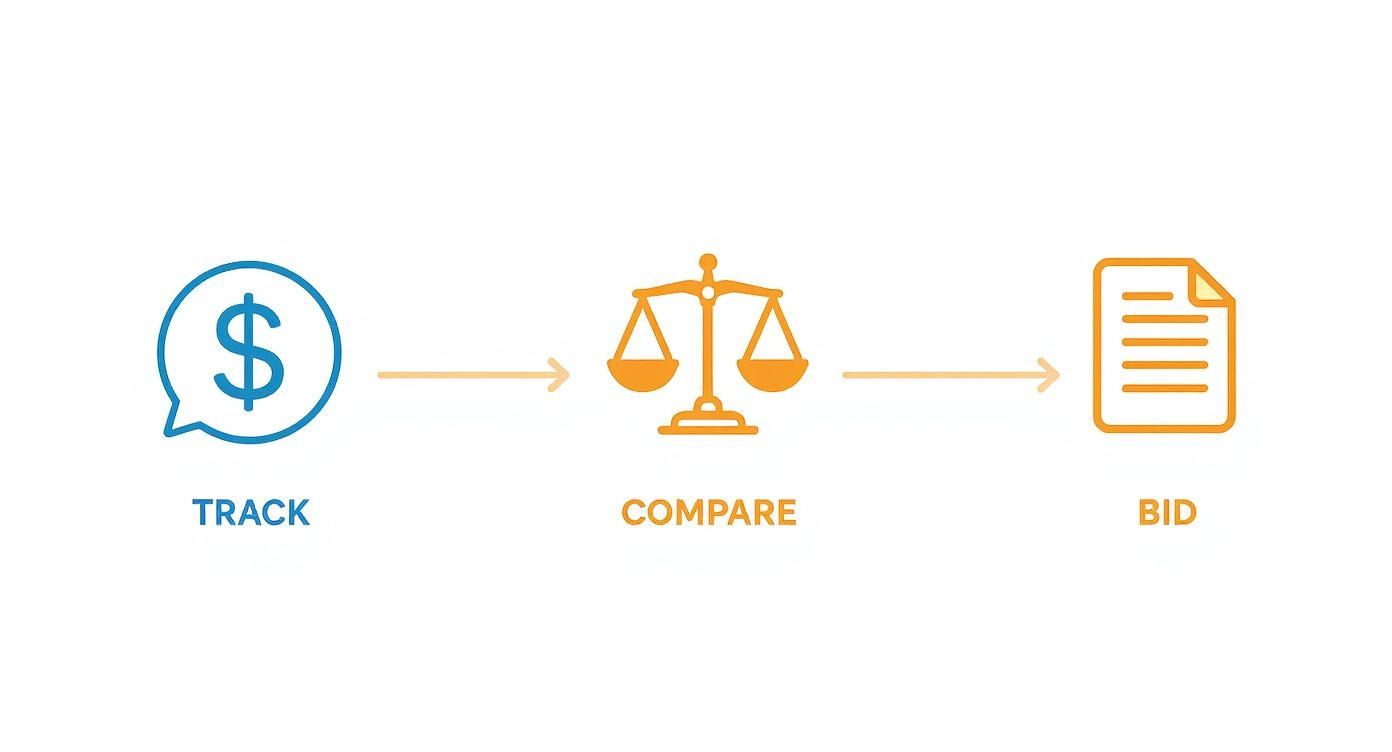
The key takeaway here is that tracking your money isn't just for taxes; it's the foundation for making better bids in the future.
To create a stronger forecast, you can also look at tools that help you model different situations. For contractors who are good with spreadsheets, it's worth checking out AI-powered cash flow improvement strategies that can work with Excel. This can help you ask "what-if" questions and see the impact on your cash balance.
Ultimately, forecasting is about building financial strength. It’s the difference between driving with a GPS and driving with your eyes closed, hoping you stay on the road.
Simple Tactics to Get Paid Faster

Waiting on money you’ve already earned is one of the most frustrating parts of this business. It's your cash, stuck in someone else's office while you're trying to make payroll. Improving your construction cash flow management often starts with one simple goal: getting paid faster.
This isn’t about being mean or hurting client relationships. It’s about being professional, clear, and consistent.
You can speed up how fast you get paid by focusing on three areas: your contract, your invoice, and your follow-up. Let's break down how to handle each one.
Start with a Rock-Solid Contract
Your ability to get paid quickly starts the moment you sign a new project. A fuzzy contract is an invitation for payment delays. Your agreement needs to spell out the payment terms so clearly that there’s no room for confusion.
Think of your contract as the rulebook for how money will move. Don't just put "Net 30" on there and call it good. Be specific.
- Define Due Dates: Say exactly when payments are due. Is it 30 days from the invoice date or the day it's received? This small detail matters.
- Outline Progress Payments: For any job longer than a few weeks, build in payments based on milestones. Bill after the foundation is poured, after framing is done, and so on. This turns one huge payment at the end into smaller, regular cash boosts.
- Include Late Fees: A simple line saying that a 1.5% late fee will be added to overdue bills is often enough to get people to pay on time. Just make sure this is legal in your state.
Setting these rules up front creates a professional tone from day one. You’re not just a contractor; you're a business owner with clear money policies.
Create Invoices That Are Impossible to Misunderstand
As soon as you finish a part of the job you can bill for, don't wait. Send the invoice right away. The longer you wait to bill, the longer you’ll wait to get paid. But sending it fast is only half the battle—the invoice itself has to be perfect.
A confusing invoice is a common excuse for a late payment. The person paying you might not be the project manager you see every day. It could be someone in an accounting office who has never seen your job site.
Your invoice should tell a complete, simple story of the work you did and the money you're owed. If the person paying the bills has to call and ask a question, you’ve already lost a week.
Make your invoices clean and easy to handle by including these things every time:
- A unique invoice number.
- Your company name, address, and contact info.
- The client’s name and project address.
- A clear list of the work completed for that bill.
- The total amount due and a very clear due date.
- The different ways they can pay you (check, bank transfer, credit card).
Making it easy for people to pay you is a simple but powerful trick. If you can accept online payments, do it. The convenience can cut days or even weeks off your wait time.
Master the Polite Follow-Up
This is where a lot of contractors mess up. They send the invoice and then just… wait. Hope is not a plan. You need a simple, repeatable system for following up that keeps your invoice on their radar without being annoying.
Think of it as a professional reminder service. You’re not calling to complain; you’re calling to help them pay you.
Here’s a schedule that I’ve seen work really well for my clients:
- One Week Before Due Date: Send a short, friendly email. "Hi [Client Name], just a friendly reminder that invoice #123 is due next week. Please let me know if you need anything from me to get it paid."
- On the Due Date: If you haven't been paid, send another polite email. "Hi [Client Name], following up on invoice #123, which is due today. Can you confirm you've received it and it's set up for payment?"
- One Week Past Due: Now it's time for a phone call. It’s harder to ignore a person than an email. Be professional. "Hi, I'm just calling to check on the status of invoice #123. I wanted to make sure there weren't any problems holding it up."
This polite but firm process shows that you are organized and serious about your money. A lot of the time, a late payment is just a mistake. Your reminders make sure your invoice doesn't get lost in a stack of papers.
Smart Ways to Manage Supplier and Sub Payments
Your suppliers and subs are the engine of your business. They are your partners on every job. Building strong, trusting relationships with them isn't just nice, it's necessary to survive. And a big part of that trust is paying them on time.
But here’s an important point that many contractors miss: good relationships don’t mean you have to pay every bill the second it arrives.
Managing your accounts payable is a balancing act. You have to keep your partners happy, but you also have to protect your own cash. Writing a huge check to a supplier a week before you know a big client payment is coming can put you in a tough spot, even if you meant well.
Smart cash flow management in construction is all about timing—specifically, timing your payments to line up with your income.
Negotiate Your Payment Terms Upfront
The best time to manage a payment is before the first invoice is even sent. When you start working with a new supplier or sub, talk to them directly about payment terms. Don't just accept their standard "Net 30."
Ask if they can be flexible. Can you push for "Net 45" or even "Net 60"? On a long project, that extra 15 or 30 days can make a huge difference. It gives you a buffer, letting your client's payment hit your account before your own bills are due.
On the other hand, always ask about discounts for paying early. Some suppliers offer a 2% discount for paying within 10 days. Paying early isn't always the right move for your cash flow, but if you have extra cash, it can be a smart money move. Just do the math to make sure the discount is worth giving up the cash for a few extra weeks.
Create a Payment Schedule That Works for You
Stop paying bills whenever they show up in your inbox. Instead, pick a specific day each week—like every Thursday afternoon—to pay your bills. This one simple habit puts you in control and makes you look at the big picture.
Before you pay anything, pull up your cash flow forecast.
The goal is simple: match your cash outflows (what you're paying) with your cash inflows (what you're getting paid). If you know a big check from a client is arriving on Friday, schedule your supplier payments for the following Monday.
This habit keeps you from accidentally emptying your account right before payroll. It turns a reactive, stressful task into a planned, predictable part of your week. This is especially important in a business where contractors often have to pay for huge costs up front. The industry's need for financing to cover these gaps has grown, making access to credit a key survival tool, as noted in recent looks at infrastructure and investment trends on cbreim.com.
Tackling the Tricky Issue of Retainage
Ah, retainage. It's a standard part of most construction contracts, but it can be a nightmare for your cash flow. This is the 5-10% of the contract price that the client holds back until the project is 100% done to their liking. It's your money, but it's locked away where you can't get it.
The real problem? It's very easy to lose track of this money when you're busy with multiple projects.
You absolutely must have a system to track retainage—both the money owed to you by clients and the money you're holding back from your own subs. A simple spreadsheet can work. For every project, list the total retainage amount and what needs to happen for it to be released.
As you get close to finishing a project, be proactive. Don't wait for the client to bring it up. Start the closeout process early and turn in all the paperwork as soon as you can. The faster you finish that final checklist, the faster you can send the bill for that final retainage payment and get the cash you’ve earned back into your business.
Building a Financially Resilient Business
We’ve covered a lot, from tracking every dollar on a job to making sure your invoices get paid. Now, let's bring it all together. This is about turning these ideas into habits that last.
Contractors who are good with money aren’t just lucky—they have good habits. I've seen it over and over. They have a few things in common. They track everything, they’re always looking ahead with a forecast, and they talk clearly about money with everyone, from clients to subs.
The whole point is to move from just surviving from one check to the next to building a business that can handle the bumps in the road. A surprise price increase or one late payment shouldn't be enough to cause a crisis.
Your Three-Step Action Plan
Making a real change in your construction cash flow management starts with small, regular steps. Instead of trying to fix everything at once, just focus on what you can do this week.
Here’s a simple checklist to get you started:
- Review One Job’s Costs: Pick one of your current projects. Just one. Spend 30 minutes this week comparing what you’ve actually spent on materials and labor to your original budget. This simple step starts the important habit of knowing your numbers.
- Make One Follow-Up Call: Look at your list of unpaid invoices. Find one that’s a week away from being due—or maybe one that's just a few days late—and make a polite follow-up call. This gets you comfortable with being active about getting paid instead of just waiting and hoping.
- Schedule Weekly Payments: Instead of paying bills the second they arrive, block off one hour on your calendar each week to handle all your payments. This simple change puts you in control of when your cash goes out.
Building a strong financial future isn’t about one big move. It’s about making small, smart choices every single day. These little habits are what create a business that can not only survive but truly grow.
For a deeper dive into getting your finances organized, understanding your chart of accounts is a great next step. And for an even more complete look at this whole topic, the guide on Mastering Construction Cash Flow Management is an excellent resource.
Got Questions? We've Got Answers.
We’ve covered a lot about managing cash flow in construction, but I know how it is. Once you start digging in, new questions always come up. Let's go over a few of the most common ones I hear from contractors.
What's the Single Most Important Thing I Can Do to Improve My Cash Flow Right Now?
Honestly? The best thing you can do is get a clear picture of where you stand today. That means you have to start doing simple job costing.
You have to know how much you're spending on each project compared to what you're billing for it. Without that, you're just guessing and hoping for the best.
You don't have to do it all at once. Just start small. Pick one of your current jobs and track every dollar spent on labor, materials, and subs. This one action will immediately show you where your money is going and tell you if your bids are actually making you a profit.
How Often Should I Be Looking at My Cash Flow Forecast?
You need to look at that forecast at least once a week. Think of it as your quick, 15-minute financial check-in. It's a must-do.
In construction, things can change fast. A project gets delayed by weather, a client pays a few days late, or lumber prices suddenly go up. Life happens.
A weekly review turns your forecast from a piece of paper into a live tool. You update it with what's actually happening, which lets you see problems before they become big emergencies.
This simple habit is what keeps your business headed in the right direction, no matter what comes up.
My Clients Always Pay Late. What Can I Do Besides Making Angry Phone Calls?
Ah, the classic problem. The key here is to be proactive, not reactive. You can't just hope for the best; you need a system.
First, make sure your payment terms are spelled out perfectly in your contract from day one. There should be no confusion about when payments are due.
Next, send your invoices the moment a part of the job is done. Don't wait. Make them clean, simple, and easy to read.
Third, and this is the most important part, set up a schedule of friendly, professional reminders.
- Send a polite email a week before the due date.
- Send another one on the due date.
- If it's late, follow up with another email or a call a week after.
Most of the time, late payments are because of disorganization on their end, not because they don't want to pay. A consistent, professional follow-up process makes a huge difference and keeps your client relationships strong. You're just helping them stay organized so they can pay you on time.
Feeling a bit overwhelmed trying to get all this in place on your own? The team here at MyOfficeOps can help you build the systems you need for better construction cash flow management. From setting up real job costing to creating weekly forecasts that actually work, we provide the financial clarity that lets you get back to building your business. Schedule a discovery call with us today to see how we can help.