
Running a construction business by just looking at your bank account is like trying to build a house without a blueprint. Construction company financial statements are your real guide. They show you exactly where your money is, where it's going, and if all your hard work is actually paying off.
It’s an easy trap to fall into, but it’s a quick way to get into trouble.
Why Your Financial Statements Are Your Most Important Tool

Think of your company as your biggest project. You wouldn't just look at the final price, right? You’d track the cost of materials, your crew's hours, and your profit every step of the way. That’s what financial statements do for your business. They give you the real story of your company's health.
These documents aren't just for your accountant or the bank. They're your toolkit for answering the tough questions you face every day:
- Can we really afford that new excavator?
- Do we have the cash to hire another crew for that big job next month?
- Are we charging enough on our bids to cover our real costs?
- Which types of jobs are actually making us the most money?
Without clear answers, you're just guessing.
Moving Beyond the Bank Balance
A big number in your bank account can hide a lot of problems. You might get a large payment from a client, making you feel rich. But that money has to cover your crew, materials, and subcontractors for the next three months. Financial statements connect the dots and show you the whole story.
This clear view is a must-have in a huge and complex industry. The global construction market was worth about $15.78 trillion in 2024 and is expected to hit $20.44 trillion by 2029. The only way to handle huge amounts of cash, rising material costs, and a changing economy is with sharp financial tracking.
Your financial statements turn numbers into a story. They tell you what you own, what you owe, and whether you're winning or losing on your jobs.
A Blueprint for Growth and Survival
In the end, understanding these documents is about staying in business and growing. They help you spot problems early, like a job that’s losing money, so you can fix it before it hurts your company. They also show you where the opportunities are, pointing out your most profitable services and where you should focus your energy.
For a deeper look at how this data applies across the sector, exploring construction industry-specific use cases can be incredibly valuable.
In the tough world of construction, the companies that do well are the ones that know their numbers inside and out. It’s time to start treating your financials not as a chore, but as your best tool for building a stronger, more profitable business.
Decoding the Balance Sheet and P&L Statement
Think of your financial statements as different tools in your toolbox. Each has a special job. One gives you a perfect picture of a single moment in time, while another is like a movie, showing you what happened over a month or a year. The two most important reports—the Balance Sheet and the Profit & Loss Statement—give you these two different but equally important views.
Let's break them down without the confusing accounting talk.
The Balance Sheet: Your Company’s Financial Snapshot
The Balance Sheet is like a photograph of your business on one specific day—for example, the last day of the month. It’s a complete list of everything your construction company owns (your assets) and everything it owes (your liabilities) at that exact moment.
It’s built on a simple rule that must always be true:
Assets = Liabilities + Equity
Think of it this way: everything the company has (its assets) was paid for in one of two ways. It was either bought with borrowed money (liabilities) or with the owner's own money (equity). The two sides must always be equal.
Let's see what this looks like for a small roofing company:
- Assets: This is all the stuff you own that has value. It’s the cash in your bank account, the money clients owe you for finished work (accounts receivable), your trucks, and all your tools.
- Liabilities: This is simply what you owe other people. This includes money owed to your shingle supplier (accounts payable), any credit card debt, and the loans you took out for your trucks.
- Equity: This is what’s left over for the owners after you take away all the liabilities from all the assets. It’s the real value of the owner's part of the company.
A healthy balance sheet shows that you have more than enough assets to cover your debts. If what you owe is growing much faster than what you own, it’s a big red flag that you're taking on too much risk.
The Profit & Loss Statement: Your Company’s Performance Movie
While the Balance Sheet is a still photo, the Profit & Loss (P&L) Statement is the movie. It shows your company’s financial performance over a specific time—like a month, a quarter, or a whole year. It tells the story of whether you actually made money or lost it during that time.
The P&L follows another simple formula:
Revenue – Expenses = Net Profit (or Loss)
It’s that simple. The report lists all the money you brought in, subtracts every dollar you spent, and shows you what’s left. For our roofer, this is where you see if your jobs are really profitable.
Here's how a P&L helps you see what's really going on:
- Revenue (or Income): The total amount of money you billed clients for all the roofing jobs you did during that time.
- Cost of Goods Sold (COGS): These are the costs directly tied to getting the jobs done—like shingles, wood, and the wages you paid your roofing crew.
- Gross Profit: This is your revenue minus your COGS. It tells you exactly how much money you made on your jobs before paying for business overhead.
- Operating Expenses: These are the costs to keep the business running that aren't tied to a specific job. Think office rent, insurance, advertising, and salaries for your office staff.
- Net Profit: This is the bottom line. It’s what’s left after you subtract all expenses from your revenue. This is the true profit your business earned.
Understanding your P&L is key for pricing jobs correctly and keeping your general business costs under control. To see a more detailed breakdown, check out our guide on what is a profit and loss statement. It’s the report card for your business.
The Secret Weapon for Contractors: The WIP Report
While the Balance Sheet and P&L give you a great look at your business overall, they mostly tell you what has already happened. To really get ahead in construction, you need a tool that shows you what’s happening with your jobs while they're still going on.
That tool is the Work-in-Progress, or WIP, report.
Think of it as the live scoreboard for every single project you have running. It’s probably the most important financial statement for a construction company. It answers the one question that keeps every contractor up at night: "Am I actually making money on this job?"
A WIP report cuts through the confusion by tracking three key things as they happen:
- How much you’ve spent so far.
- How much you’ve billed the client.
- How much profit you think you’ll make when the job is done.
This lets you spot problems early. For example, you might see that lumber costs are suddenly way higher than you planned. You can then make changes before those costs eat up all your profit.
Understanding Overbillings and Underbillings
Two of the most important ideas on a WIP report are overbillings and underbillings. The terms might sound like accounting jargon, but the idea is simple. They just compare how much work you've actually done to how much you've billed the client for.
Let's say you're halfway through a kitchen remodel. You’ve finished 50% of the work.
- If you’ve billed the client for 60% of the total price, you are overbilled. This is usually great for your cash flow because you have the client's money in your bank before you've fully earned it.
- If you’ve only billed for 40%, you are underbilled. This can be a sign of a cash flow problem. You've paid for labor and materials for work you haven't even sent an invoice for yet.
A WIP report is your early warning system. It tells you if a project is going off the rails financially, giving you time to get it back on track before it’s too late.
The money on a construction project is always moving between your assets, liabilities, and eventual profit. This flowchart gives you a simple view of how these pieces all fit together.
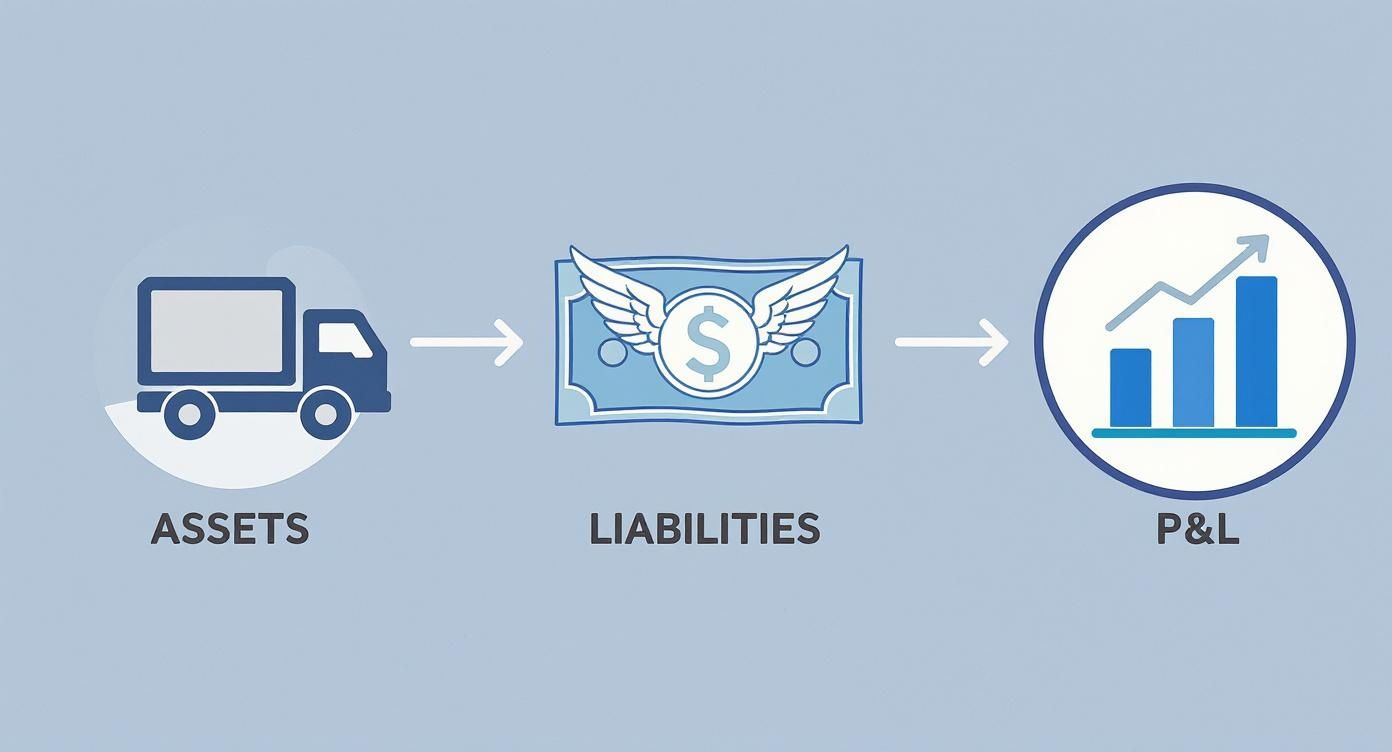
As the image shows, you use assets like equipment to do work, take on liabilities like loans to pay for costs, and the P&L ultimately shows you the final score. The WIP report gives you a peek at this process while it's still happening.
A Simple Kitchen Remodel Example
Let's see how this works. Imagine you have a kitchen remodel with a $50,000 price. You estimated your total costs would be $40,000, leaving you with a $10,000 gross profit.
One month into the project, your WIP report shows:
- Costs to Date: $20,000
- Total Billed to Client: $30,000
At first, this looks great—you've brought in more cash than you've spent. But the WIP report makes you ask the most important question: how much of the job is actually done?
Your project manager walks the site and figures out the job is 50% complete. Since your costs so far ($20,000) are exactly half of your total estimated costs ($40,000), you are right on budget. So far, so good.
You've also billed for 60% of the contract ($30,000 / $50,000), which means you are $5,000 overbilled. This is a good spot to be in. You have extra cash, and the project is on track to make its profit goal.
This is the power of a WIP report. It connects your real-world progress to your financial numbers, giving you a clear view that other construction company financial statements can't offer by themselves. For a deeper dive into construction-specific financial management, explore our complete guide on accounting for construction companies.
Key Metrics on a WIP Report
To really get the hang of it, you need to know the key parts of a WIP report. This table breaks down the important pieces and explains what they mean for your job's financial health.
| WIP Metric | What It Means | Why It Matters |
|---|---|---|
| Contract Value | The total amount you'll be paid for the job. | It's the starting point for all your math. |
| Estimated Cost | Your best guess at the total cost to finish the project. | This sets your budget. If it's wrong, your profit will be too. |
| Costs to Date | The actual amount of money you've spent on the job so far. | It tells you if you're spending your budget too fast. |
| Percent Complete | An estimate of how much of the work is physically done. | This connects your money to what's happening on the job site. |
| Earned Revenue | Percent Complete x Contract Value. The money you've actually earned. | This is the true measure of your sales, not just what you've billed. |
| Over/Under Billing | The difference between what you've billed and what you've earned. | This shows you the cash flow situation for your job. |
| Projected Profit | Your best guess of the final profit based on how things are going. | It's your crystal ball, telling you if the job will be a winner or a loser. |
Once you get used to reading these numbers together, you'll start seeing the story each project is telling you. A good WIP report doesn't just show you numbers; it tells you what's happening on every job, every single day.
Common Financial Mistakes That Sink Construction Companies
Running a construction business is a high-stakes game. You can be the best builder in town, but a few quiet financial mistakes can slowly pull your company underwater before you even realize you’re sinking.
Knowing what these common traps are is the first step to avoiding them.
One of the biggest problems is messy job costing. Think of it this way: if you sold hamburgers, you'd track the exact cost of the bun, patty, and cheese for each one. Construction is the same. If you aren't tracking every dollar spent on labor, materials, and subs for each specific project, you have no idea which jobs are making you money and which are secretly losing you a fortune.
Forgetting About Your Overhead
Another huge mistake is ignoring your real overhead costs. These are all the expenses that aren't tied to a specific job—things like office rent, truck insurance, accounting software, and your own salary. It’s easy to forget about these when you’re focused on the direct costs of a project.
But overhead is like a slow leak in a tire; it constantly eats away at your profits. If you bid on a job and only think about labor and materials, you might believe you’re making a 20% profit. In reality, once you add in overhead, that profit could shrink to just 2% or even turn into a loss. You have to "charge" each job its fair share of the overhead to see the real picture.
Beyond basic financial reporting, not having the right insurance can be a devastating mistake. To avoid such problems, it's key to have a clear grasp of understanding general contractor insurance requirements.
Mismanaging Your Cash Flow
Cash flow is the lifeblood of your company, and nothing kills it faster than poor management. A classic construction problem is dealing with retainage—where clients hold back a part of your payment until the very end of the job. If you haven’t planned for that gap in cash, you can find yourself unable to pay your suppliers or your crew, even when you have profitable jobs.
Slow-paying clients are another major headache. You've already paid for the labor and materials, but your cash is tied up waiting for them to pay you. This is why keeping a close eye on your accounts receivable isn’t just an accounting task; it’s a survival plan.
Many profitable construction companies have gone bankrupt simply because they ran out of cash. Profit on paper means nothing if you can’t pay your bills this Friday.
This has become even tougher recently. In 2025, the U.S. construction industry faced a lot of financial pressure from rising material costs, inflation, and worker shortages. The cost of materials like steel and aluminum shot up by as much as 50%, hurting the profits of contractors who didn't adjust their budgets. This tough situation shows why a careful review of your construction company financial statements is more important than ever. You can learn more about how the economy impacts the industry by reviewing these construction industry insights.
How to Use Your Financials to Make Smarter Decisions

Your financial statements shouldn't be a history lesson that collects dust. They are your playbook for the future, helping you make smart calls on the job site and in the office every single day.
The numbers tell a story. Learning to read that story is how you turn your business from just a job into a real, growing company.
It’s all about turning that information into action. Instead of just looking at your profit at the end of the year, you can use these reports to guide your decisions right now. This is where your financials become a tool for winning better jobs and building a healthier business.
Turning Numbers into Actionable Insights
The trick is to focus on a few key numbers, often called Key Performance Indicators (KPIs). Think of these as the vital signs for your company—quick health checks on different parts of your business. You don't need dozens of them; a few powerful ones will tell you almost everything you need to know.
Let's start with one of the most important KPIs for any contractor: Gross Profit Margin.
This one number tells you how much money you're making on your jobs before you pay for overhead like office rent or insurance. It’s a direct measure of how well you're bidding and managing your projects.
- How to Calculate It: (Revenue – Direct Job Costs) / Revenue
- What It Tells You: For every dollar that comes in from a job, this is the percentage left over to cover overhead and, hopefully, leave you with a net profit.
If your gross profit margin is always low, that's a huge red flag. It means either your bids are too low, your job costs are out of control, or both. Knowing this number helps you fix your pricing on future bids to make sure you’re not just working hard, but working smart.
Making Better Bidding and Pricing Decisions
Let's put this into a real-world situation. Imagine you run a plumbing company. You look at your P&L statement and notice your gross profit margin on new home construction is only 12%. But when you look at commercial service calls, it's a healthy 35%.
This one piece of information is incredibly powerful. It doesn't mean you have to stop doing new homes, but it shines a bright light on where your real money is being made.
Now you can make decisions based on facts instead of just your gut:
- Adjust Your Bids: You might need to raise your prices on new builds to get that margin up to a healthier level.
- Focus Your Marketing: Maybe you should spend more of your marketing budget on getting more of those profitable commercial service clients.
- Analyze Your Costs: This could make you look deeper into why your new build costs are so high. Are you wasting materials? Is your crew not as efficient on those jobs?
Your financial statements give you the evidence you need to stop guessing and start making smart choices. They move you from feeling like you're just busy to being in control of your business.
Managing Cash and Big Purchases
Beyond just bidding, your construction company financial statements are your guide for managing cash. The Statement of Cash Flows is your best friend here. It shows you exactly where your cash came from and where it went over a period of time.
If you see that your cash from your regular work is consistently strong, it might give you the confidence to finally buy that new skid steer you need.
But if you see that your bank balance only looks good because you just took out a new loan, you know it's not the right time for a big purchase. It forces you to be honest about your company's real financial strength, not just the number in your checking account.
Knowing When to Get Help With Your Construction Finances
As a contractor, you’re an expert at building things. You can look at a set of plans and see the finished project in your head. But when it comes to the numbers, things can get messy—and that's okay.
There comes a point in every growing business where trying to do your own books stops being a way to save money and starts actively holding you back. The long nights spent fighting with accounting software and weekends lost to checking numbers aren’t just frustrating; they're a signal.
That signal is telling you that your time is much better spent running your jobs, managing your crews, and winning new work.
Are You Seeing These Warning Signs?
So how do you know you’ve hit that point? It’s usually not one big thing but a slow buildup of smaller problems. You might be ready for help if you find yourself nodding along to any of these.
You might be:
- Always worried about cash flow. Are you stressing about making payroll next Friday, even though you have plenty of work? This is a classic sign your financial systems aren't giving you the clear view you need.
- Unsure if your jobs are actually profitable. You just finished a big project and got paid, but you have no real idea if you made good money or just broke even after everything was done.
- Struggling with your accounting software. You bought the program everyone said to get, but you’re spending more time watching "how-to" videos than working on your business.
- Making decisions based on your gut. You're pricing big jobs based on what "feels right" instead of what your numbers tell you is profitable.
If these sound familiar, you're not failing. You’re growing. And growth means you simply can’t wear every single hat in the business anymore.
Getting professional financial help isn't giving up; it's a smart move to build a stronger company. It’s about focusing on what you do best.
Finding the Right Kind of Help
Bringing in support doesn't always mean hiring a full-time person. There are different levels of help for different needs and budgets. A bookkeeper, for example, can handle the daily work of recording bills and tracking payments. An accountant or CPA can then take that clean information to prepare your taxes and official financial statements.
But for contractors looking to really grow, a higher level of advice is often what's missing. This is where services that provide both expert bookkeeping and smart financial planning come in. For those who need help with planning for the future, managing cash flow, and making big decisions, learning more about the role of virtual CFO services can show you how to get that expert guidance without the cost of a full-time executive.
The goal is simple: to get you back on the job site, feeling sure that your construction company financial statements are accurate, helpful, and handled by experts who have your back.
Frequently Asked Questions
Even when you have a good handle on the basics, it’s normal to have questions about your construction company's financial statements. Let's be honest, these documents can feel complicated, but understanding them is what separates the contractors who grow from those who just get by.
Here are a few of the most common questions I hear from contractors.
What Do Lenders Look for on My Financials?
When you go for a loan or a line of credit, lenders and bond providers are looking for one thing: stability. They want to see that you manage your business responsibly. They aren't just looking at your profit; they're digging in to see how much risk they’re taking.
They’ll focus on a few key areas:
- Your Balance Sheet: They want to see a healthy amount of assets compared to liabilities. Specifically, they’re checking your working capital (current assets minus current liabilities) to make sure you have enough cash to cover your short-term bills easily.
- Your Income Statement: A history of making a profit is a must. Lenders need to see that your business model works and that you can reliably make money from your projects.
- The Details Matter: Don't be surprised when they ask for more. Lenders often want to see your Work-in-Progress (WIP) report to understand your current jobs and how profitable they are. They'll also look closely at your accounts receivable report to see if you’re good at collecting the money you’re owed.
How Often Should I Really Look at My Financial Reports?
Thinking of your financial reports as a once-a-year headache for tax time is a huge mistake. The most successful contractors I know are always looking at their numbers. The right schedule really depends on the report and the size of your company.
A good rule of thumb is:
- Weekly: A quick check on your cash, who you owe money to, and who owes you money. This keeps you on top of what's coming in and what's going out. It’s a 15-minute review that can prevent big surprises.
- Monthly: This is your deep dive. Look at the P&L, Balance Sheet, and WIP report. This is where you study job profitability, check your profit margins, and make sure your overhead costs aren't getting too high.
- Quarterly: Time for a big-picture review to spot trends. Are your profits growing each quarter? Are certain types of jobs consistently doing better than others?
When you get into this routine, your financial statements stop being old news and become your best tool for planning the future.
What’s the Big Deal Between Cash and Accrual Accounting?
This is probably one of the most important ideas for any contractor to understand. The method you use completely changes the story your financial statements tell.
Cash-basis accounting is simple, like balancing your own checkbook. You record money when a client's check actually comes in, and you record an expense when you actually pay a bill. The problem? It gives you a misleading view of your real profit, especially on long projects.
Accrual-basis accounting gives a much more accurate picture. You record revenue when you earn it (like after finishing a part of a project), not just when you get paid. You also record expenses when they happen (like when lumber is delivered to the site), not when you pay the bill three weeks later.
For any serious construction business, accrual accounting is the way to go, and for good reason. It correctly matches the money you've earned with the costs it took to earn it in the same period. This gives you a true reading of a job's profitability, which cash-basis accounting simply can't do.
Are you ready to stop guessing and start making decisions based on solid data? The team at MyOfficeOps can help you build the clean, clear financial reports you need to see your business clearly and plan your next move. Learn more about our services and schedule a discovery call today.