
You can have a strong month on paper and still feel the squeeze in your bank account. Payroll comes due, vendors want payment, tax money is sitting there waiting, and the balance in checking feels too thin for comfort. That gap is where a lot of owners get blindsided, because profit and cash are not the same thing, and working capital is often the reason they drift apart.
A marketing agency can book a profitable project and still wait 30 or 60 days to get paid. A dental practice can fill the schedule, then sit on insurance receivables. A contractor can finish the job, invoice fast, and still watch cash disappear while materials, labor, and subs need to be covered first. The business is busy, the P&L looks fine, but the money is stuck in the middle.
That middle is what this topic is really about. Working capital is the quiet buffer that keeps the lights on while the business waits for customers to pay.
The Moment a Profitable Business Runs Out of Cash
A lot of owners first notice the problem on a Friday afternoon. The books show profit, the team is busy, and the work looks healthy. Then payroll hits, a supplier invoice lands, and the checking account suddenly feels too small.
That's not a math mistake. It's a timing problem.
A dental office can collect later from insurers while staff wages go out every week. A contractor can buy lumber today, finish the job next week, and wait a month or more for payment. An agency can pay designers, ad platforms, and subcontractors before the client ever clears the invoice. The business is earning money, but cash is moving through a long pipeline before it lands back in the account.
Practical rule: profit tells you whether the business made money over time. Cash tells you whether you can pay people this week.
That is why owners get frustrated when the P&L looks healthy but the bank balance doesn't. The missing piece is usually not sales, it's how much cash is tied up in receivables, inventory, and other short-term obligations. When money is slow to come in and fast to go out, the business can look successful and still feel tight.
Working capital is the bridge between those two views. It shows how much short-term cushion you have while you wait for sales to turn into cash. If that cushion is thin, every delay feels bigger. If it's healthy, the business can breathe.
What Working Capital Actually Means
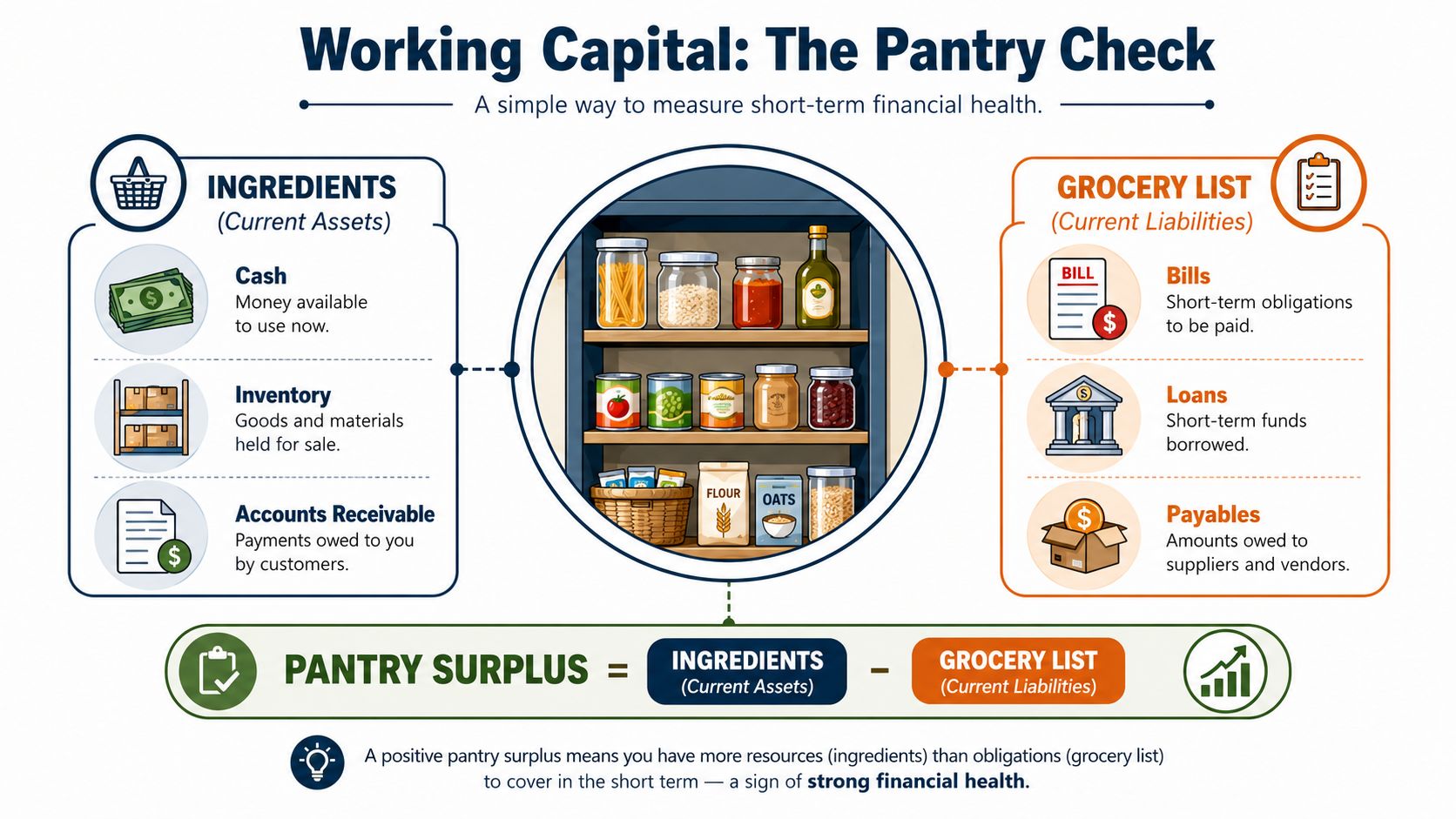
Think of your business like a pantry. Some shelves hold food you can use right away, like cash. Some items are still in the fridge, like invoices you've sent but haven't collected yet. Other items are sitting on the counter as bills due soon.
In plain English, working capital is what's left after you subtract what you owe soon from what you can use soon. The standard formula is current assets minus current liabilities, and that's the version most accountants mean when they talk about working capital on a balance sheet. It's a core liquidity measure used to judge whether a business can cover short-term obligations from cash, receivables, and inventory instead of leaning on long-term financing.
Here's the simple way to read it:
- Current assets are things expected to turn into cash within a year, like cash itself, customer receivables, and inventory.
- Current liabilities are bills due within a year, like vendor payables, payroll taxes, credit card balances, and short-term debt.
- Working capital is the leftover cushion after those near-term bills are covered.
Say a 12-person marketing agency has $120,000 in current assets, made up of cash, receivables, and a bit of prepaid expense. It also has $85,000 in current liabilities, including payables, payroll, and taxes. The working capital is $35,000. That means after covering short-term obligations, the business still has a buffer.
Some finance people also talk about net working capital in a narrower way, focusing on the more liquid short-term items. That matters when you want a tighter read on day-to-day cash pressure rather than a broad balance-sheet view. In practice, both lenses help, but the basic formula is the one you'll see most often.
A simple question helps here, what short-term money do I have, and what short-term money do I owe?
The Building Blocks on Your Balance Sheet
The formula makes sense only when you know what goes into each side. A balance sheet can look technical, but the pieces are usually ordinary business items.
What belongs in current assets
Start with the things that should turn into cash within a year:
- Cash and cash equivalents. Money in checking, savings, or petty cash. This is the most liquid piece.
- Accounts receivable. Money customers already owe you for work done or goods delivered.
- Inventory. Products, materials, or supplies waiting to be sold or used.
- Prepaid expenses. Things you paid for in advance, like insurance or rent.
- Short-term investments. Assets you can usually turn into cash fairly quickly.
A bakery might count flour on hand, a contractor might count lumber, and a clinic might count patient receivables. All of those matter, but they do not act the same way. Cash is instant. Receivables depend on customer behavior. Inventory can fool you if it sits too long.
What belongs in current liabilities
These are the bills and obligations due soon:
- Accounts payable. Money owed to vendors.
- Credit card balances. Charges that need to be paid soon.
- Payroll liabilities. Wages, benefits, or withholdings not yet paid.
- Taxes owed. Sales tax, payroll tax, or other near-term tax bills.
- Current portion of long-term debt. The part of a loan due within the next 12 months.
A good habit is to pull your latest balance sheet and tick off each line item against those buckets. If you're not sure where something belongs, ask one question, will this become cash or require cash within the next year?
Check it this way: if an item won't help you pay next month's bills, don't count it like cash.
The Cash Conversion Cycle Explained
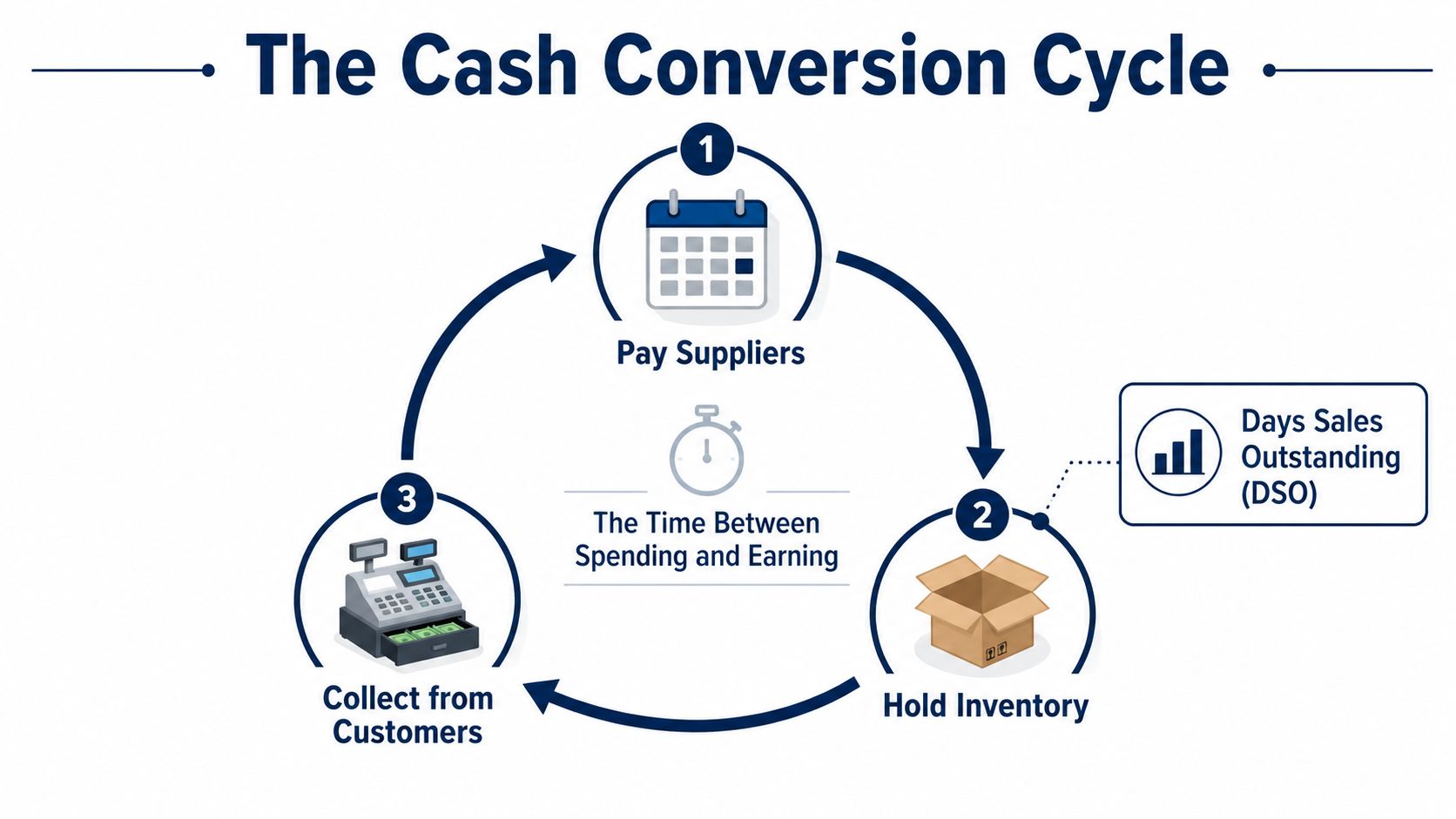
Working capital gets real when you watch the clock. The cash conversion cycle is the number of days between paying suppliers and receiving cash from sales, which is why it connects working capital directly to operating efficiency, as described by ACCA in the JPMorgan explanation of the concept. It shows how long your money is trapped in the operating cycle.
The cycle usually has three parts. Days Sales Outstanding is how long it takes customers to pay. Days Inventory Outstanding is how long stock sits before it sells. Days Payable Outstanding is how long you take to pay suppliers. Put together, they show how long cash is tied up before it comes back to you.
A contractor example makes this easy. On day 1, they buy lumber. On day 20, they finish the deck. On day 60, the customer finally pays. The business had to carry the material and labor cost for 60 days before the cash returned. If the supplier gave 30 days to pay, the contractor still had a 30-day gap between paying out and collecting in.
That gap matters because every extra day makes cash tighter. A shorter cycle usually means better liquidity, less strain, and fewer emergency calls to the bank. The owner does not need to love the formula. They only need to know that slow collections, slow-moving inventory, and fast supplier payments all stretch the cycle in different ways.
The best way to see your own pattern is to watch Days Sales Outstanding closely, since it often shows up first when cash gets stuck. A simple guide to Days Sales Outstanding can help if that term is new.
When Negative Working Capital Is a Good Sign
Some hear negative working capital and assume trouble. Sometimes that's true. Sometimes it's a sign the business is built to move cash fast.
Allianz Trade explains that negative working capital can happen when a business relies on fast cash conversion, low inventory, and extended supplier terms, and that it directly affects liquidity and day-to-day operations. That setup can work well in businesses where customers pay upfront or close to it, and suppliers allow more time.
A subscription box company is a simple example. If customers pay before the next box ships, cash arrives early. If the company can delay some supplier payments, it may operate with very little working capital, or even a negative figure, without being in distress. Some grocery chains and other fast-turn businesses also work this way.
A capital-heavy manufacturer is different. It may buy raw materials, carry work in progress, and wait a long time for payment. In that case, negative working capital can be a warning sign, because the business is funding a long operating cycle with too little cushion.
The key question is not whether the number is negative. It's whether the business model is built for that pattern.
- Healthy negative working capital usually shows up with fast collections, low inventory, and reliable supplier terms.
- Risky negative working capital shows up when receivables are late, bills are overdue, and cash keeps getting patched together.
- Model-driven negative working capital often fits retailers, subscription businesses, and some service firms better than heavy production businesses.
If your business runs on deposits, same-week payment, or very quick turnover, a low or negative working capital number may reflect efficiency. If it comes with stress, late payroll, or supplier complaints, it's a different story.
Practical Ways to Improve Working Capital
Working capital usually improves through small changes, not one dramatic fix. The best moves tend to come from four places, receivables, payables, inventory, and financing.
Receivables, payables, inventory, and financing
On the receivables side, send invoices the same day work is done, ask for deposits on larger jobs, and set automated reminders so late payers don't slip through the cracks. This week, tighten your invoicing process. Next quarter, review which customers always pay late and decide whether credit terms need to change.
On the payables side, ask vendors for longer terms when your relationship is solid, batch payments instead of paying tiny invoices all week, and look carefully at early-pay discounts before taking them. If the math works, pay early. If it doesn't, keep the cash longer.
Inventory needs a hard look too. Dead stock and overbuying trap cash. A contractor, retailer, or clinic can cut that drag by reviewing slow movers, trimming duplicate SKUs, and ordering closer to actual demand.
For financing, a line of credit can be a backstop, not a habit. Credit cards, factoring, and revenue-based financing all have a place if they solve a short-term mismatch instead of masking a deeper issue. For businesses dealing with long payment cycles, a resource like financing oilfield jobs on net-60 terms can be useful when the contract timing is the core problem.
PwC's 2024 global study, based on more than 19,000 listed companies, estimated that €1.56 trillion of excess working capital could be freed up worldwide for investment in transformation and reinvention, which shows how much cash gets trapped when these levers drift out of balance.
MyOfficeOps' working capital optimization guide walks through the same levers in a practical way for small businesses that need cleaner cash flow, not more theory.
Benchmarks and KPIs Worth Watching
Owners usually do better when they track a few numbers every week instead of staring at one giant balance sheet once a quarter. The most useful KPIs are current ratio, quick ratio, Days Sales Outstanding, Days Payable Outstanding, and the cash conversion cycle itself. Those numbers tell you whether the business has breathing room or is drifting into a cash squeeze.
The table below gives broad, working ranges. Real life varies by business model, so use these as a rough comparison, not a rule carved in stone.
| Working Capital Benchmarks by Industry | Current Ratio | Quick Ratio | Typical DSO (days) |
|---|---|---|---|
| Professional services | Moderate, often near the low end of healthy liquidity | Often close to the current ratio because inventory is usually light | Usually shorter because billing is tied to client work |
| Healthcare | Often needs a stronger cushion because collections can lag | Can look tighter when receivables are large | Often longer because payer systems slow cash |
| Construction | Needs enough liquidity to bridge labor and material timing | Usually more pressured because cash is tied to jobs | Often longer because progress billing and retainage slow payment |
| Retail | Can operate with leaner balances if inventory turns fast | Usually watched closely because stock is part of the mix | Often shorter when customer payment is immediate |
PwC's 2025/26 study found that globally, Days Sales Outstanding rose from 47.3 days in 2015 to 50.0 days in 2024, a 5.7% increase, which means cash is staying tied up longer in customer invoices. That matters because benchmarks move. What looked normal a few years ago may already be behind the curve.
If you want a cleaner reporting rhythm, HelpWithMetrics for audit-ready KPIs is a useful reference point for keeping data definitions consistent across reports and dashboards.
A simple weekly dashboard can be just three numbers, cash on hand, receivables overdue, and bills due soon. If those three stay in view, working capital stops being a vague accounting term and becomes a management habit.
When to Bring in a Bookkeeper or CFO Partner
Some owners can track this on their own for a while. Then the cracks start to show. DSO creeps up, tax bills surprise everyone, the forecast is missing, and growth slows even though the business looks profitable. That's usually the point where a clean set of books is no longer enough on its own.
A solid bookkeeping setup handles the basics, keeping transactions clean, payroll organized, and reports current. A more advanced setup adds profit analysis, cash planning, and decision support. In plain terms, that's the difference between knowing what happened and knowing what to do next.
MyOfficeOps, a Philadelphia-area bookkeeping and advisory partner, fits that middle ground for owners who need more than data entry. Its three-tier model, Core Accounting, Profit Optimization, and Exit Strategy, lines up with businesses that want clean books first, then better margins and cash flow, then value-building support for a future sale or transition. That can matter in professional services, healthcare, construction, and real estate, where payment timing and job profitability can change fast.
Good timing for outside help is when the books are current, but the cash still doesn't make sense.
The scale of the issue is not small. JPMorgan's Working Capital Index reported that S&P 1500 companies held about $707 billion of trapped liquidity, described as near-record working capital levels and about 40% above pre-pandemic levels. That's the same basic problem at a larger scale, too much money stuck in the operating cycle and not enough available for the next move.
If your reports feel reactive, When to hire a CFO is a practical next read. It can help you decide whether you need stronger bookkeeping, profit analysis, or full advisory support.
If your cash keeps getting tight even when sales look fine, MyOfficeOps can help you sort out what's trapped in receivables, inventory, and payables. Visit MyOfficeOps to see how their bookkeeping and advisory support can give you a clearer handle on working capital and the cash behind it.