

Payroll is due Friday. A big client says the check is coming, but it hasn't landed yet. Your profit and loss report says the month looked fine, and still your stomach says otherwise.
That gap is where a lot of owners get stuck. The business can look healthy on paper and still feel tight in real life. When that happens, the issue usually isn't profit. It's working capital calculation.
Why Working Capital Matters More Than Profit on Paper

Tuesday looks busy but manageable. Friday payroll is coming. Two customers still have not paid, your credit card draft hits tomorrow, and the profit and loss report says the month was fine. That report can be true while your checking account still feels tight.
Profit measures whether the business earned more than it spent over a period. Working capital measures whether enough short-term resources are available to cover the bills coming due now. The IRS uses that same day-to-day lens in its business exam guidance.
That difference matters because timing runs small businesses.
I see it all the time. A service firm can post a good month and still wait 45 days on client invoices. A medical practice may be busy and profitable, but insurance reimbursements arrive on their own schedule while payroll does not move. A contractor can have signed work, solid margins, and a full pipeline, yet cash is tied up in labor, materials, retainage, and jobs that are not billable yet.
In each case, the owner usually says some version of the same thing: "We are making money, so why does cash still feel so tight?" The answer is often that profit is showing the outcome of the work, while working capital shows the strain of carrying that work.
That is also where the simple formula can mislead people. Basic net working capital is useful, but it can overstate comfort if prepaid expenses are high or if inventory is slow to turn. It can also understate the picture if a business collects cash fast and carries little receivables by design. For day-to-day decisions, many owners get a clearer read from operating working capital because it focuses on the accounts tied directly to operations, usually receivables, inventory, and payables.
If you want a plain-language outside view on ways to improve working capital cash flow, that resource is useful because it keeps the focus on cash timing, not just accounting terms.
For a broader explanation of the basics, MyOfficeOps covers the foundation in this guide to what working capital is.
What a positive or negative number usually signals
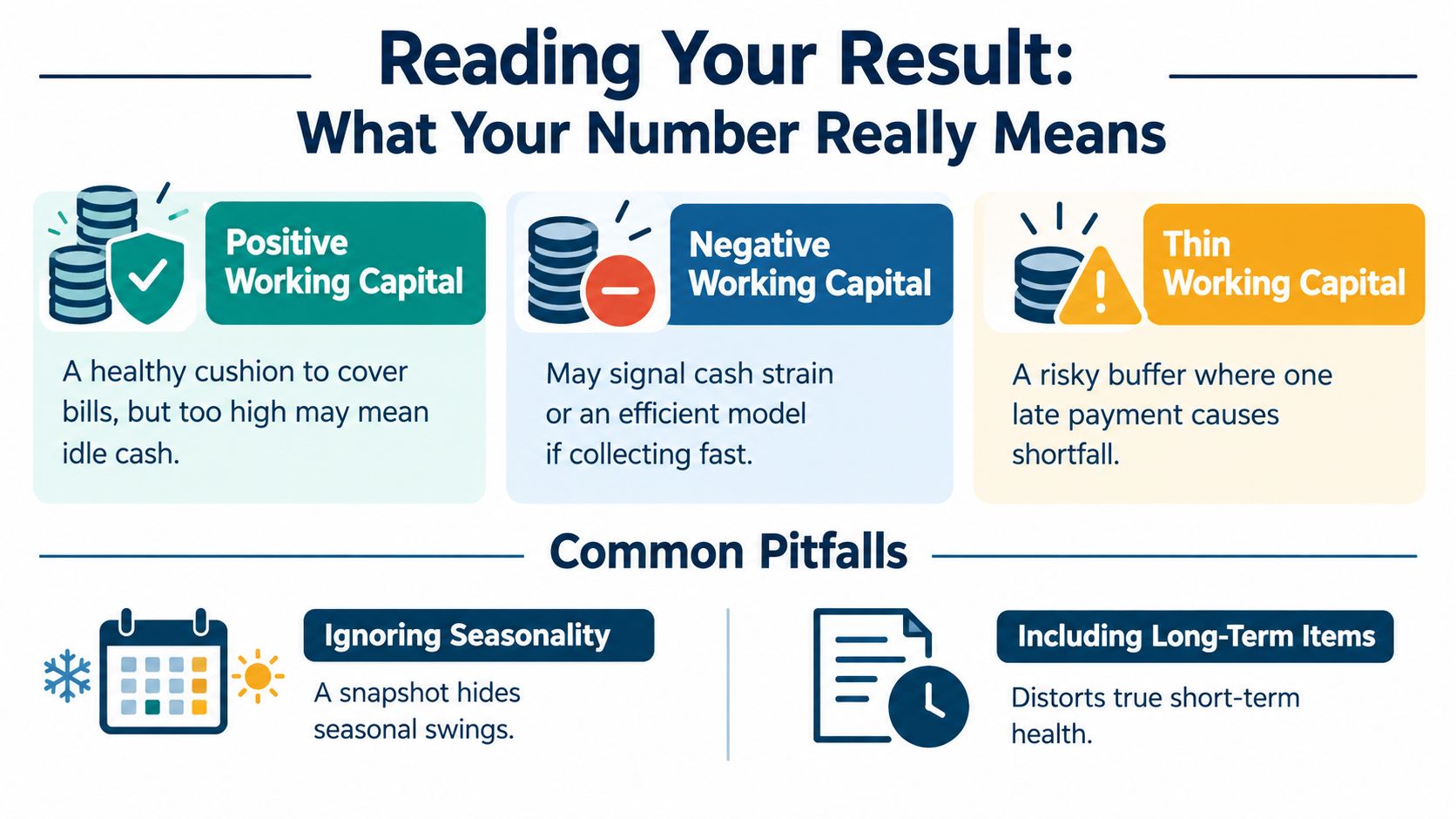
- Positive working capital usually means short-term assets are greater than short-term obligations, which gives you room to operate.
- Negative working capital can point to pressure, but context matters. Some businesses collect cash quickly and pay vendors later on purpose.
- Thin working capital means one slow-paying customer, one tax payment, or one repair bill can create a real cash squeeze.
The number matters. The mix behind the number matters more.
The Simple Formula Behind Working Capital Calculation
A profitable month can still leave you short on cash by Friday. That is why this formula matters.
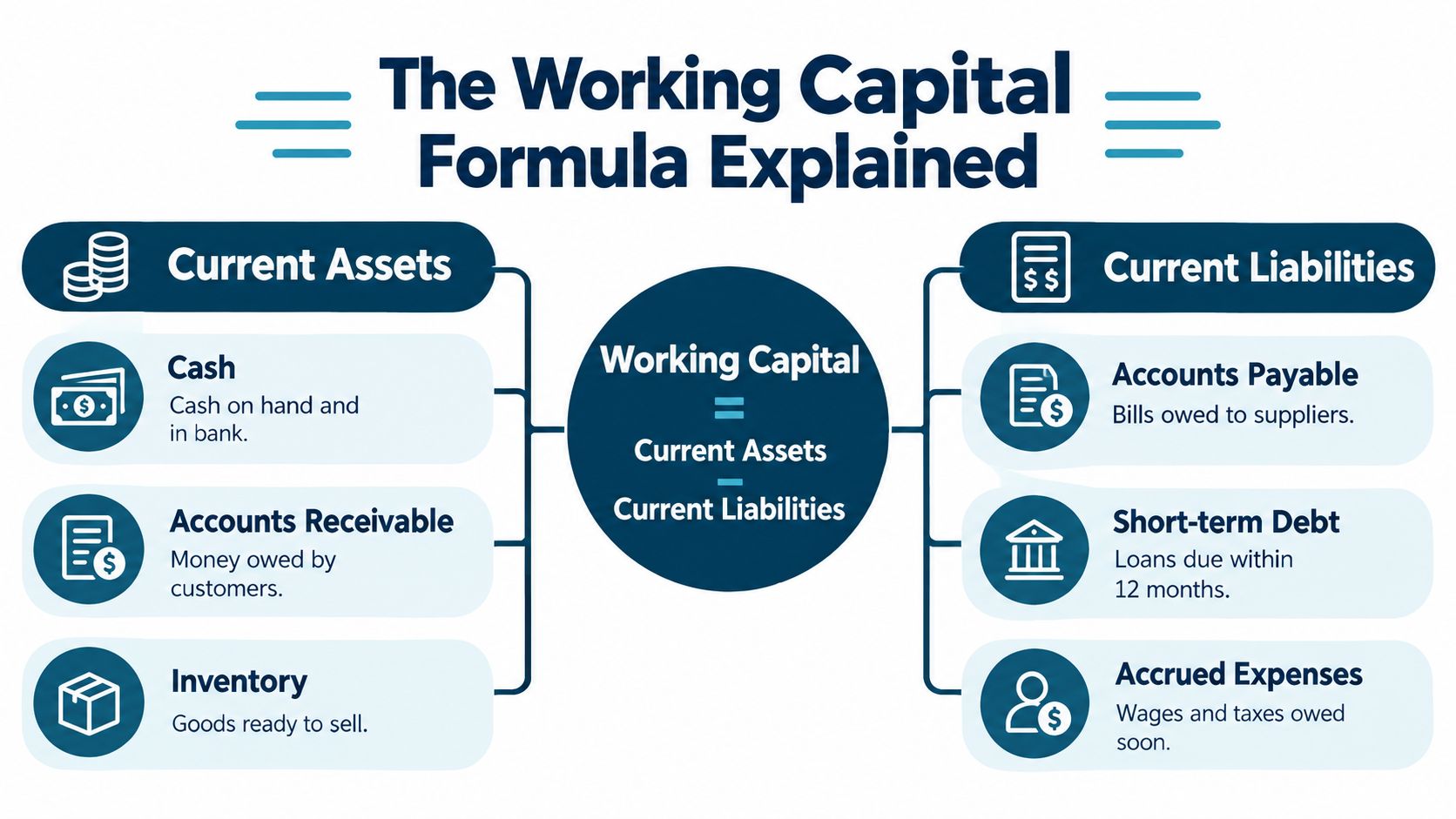
Working capital = Current assets – Current liabilities
What counts as current
“Current” usually means expected to turn into cash, be used, or come due within one year.
For many small and midsize businesses, current assets include:
- Cash in operating accounts
- Accounts receivable from customer invoices
- Inventory expected to sell or be used soon
- Short-term investments
- Prepaid expenses such as insurance paid ahead
And current liabilities usually include:
- Accounts payable owed to vendors
- Short-term debt due within a year
- Accrued payroll and other accrued expenses
- Taxes payable
- Other obligations due soon
JPMorgan gives a clear plain-language overview of the working capital formula and calculation.
The formula is simple. The judgment is not.
I tell owners to do the subtraction, then ask one more question. Are these the right accounts for the decision in front of you?
Net working capital uses all current assets and all current liabilities. That is fine for a broad balance sheet check. It gets less useful when prepaids are large, inventory moves slowly, or a current loan balance makes the number look tighter than day-to-day operations really are.
Operating working capital strips the view down to the accounts tied directly to operations, usually accounts receivable + inventory – accounts payable. That version often gives a better read on how much cash the business itself is tying up as it sells, delivers, and collects.
A simple way to read the difference
Use net working capital when you want a full short-term liquidity snapshot.
Use operating working capital when you want to see whether the business model is absorbing cash or releasing it through normal operations.
A service firm with almost no inventory may care far more about receivables aging than about prepaids. A contractor may have a large current asset balance that looks healthy on paper, but if most of it sits in underbilled work or slow jobs, the comfort is thinner than the formula suggests. In healthcare, insurance receivables can make the balance sheet look strong while delays in payer collections still create payroll pressure.
That is why experienced owners and advisors do not stop at one number. They check what is inside it.
Add one ratio for context
The current ratio is current assets divided by current liabilities. The Corporate Finance Institute explains the standard definition in its current ratio overview.
That ratio helps because two companies can both show $100,000 of working capital and still have very different risk. One may hold mostly cash and clean receivables. The other may hold old inventory and prepaids that will not cover next week's bills.
| Measure | Formula | What it tells you |
|---|---|---|
| Working capital | Current assets – current liabilities | Your short-term dollar cushion |
| Operating working capital | Accounts receivable + inventory – accounts payable | How much cash operations are tying up |
| Current ratio | Current assets / current liabilities | How much short-term coverage you have |
Owners who want another outside perspective on cash planning can also look at ELECTE's piece on strategie liquidità PMI. It frames liquidity as a timing problem, which is usually the right lens.
Where to Find Your Numbers and Which Formula to Use
A West Chester owner once pulled up a banking app at the kitchen table and said, "We have money in the account, so why does payroll still feel tight?" The answer was sitting in the balance sheet. Receivables were old, vendor bills were waiting to clear, and sales tax had not been set aside.
Start with the balance sheet, and use one date
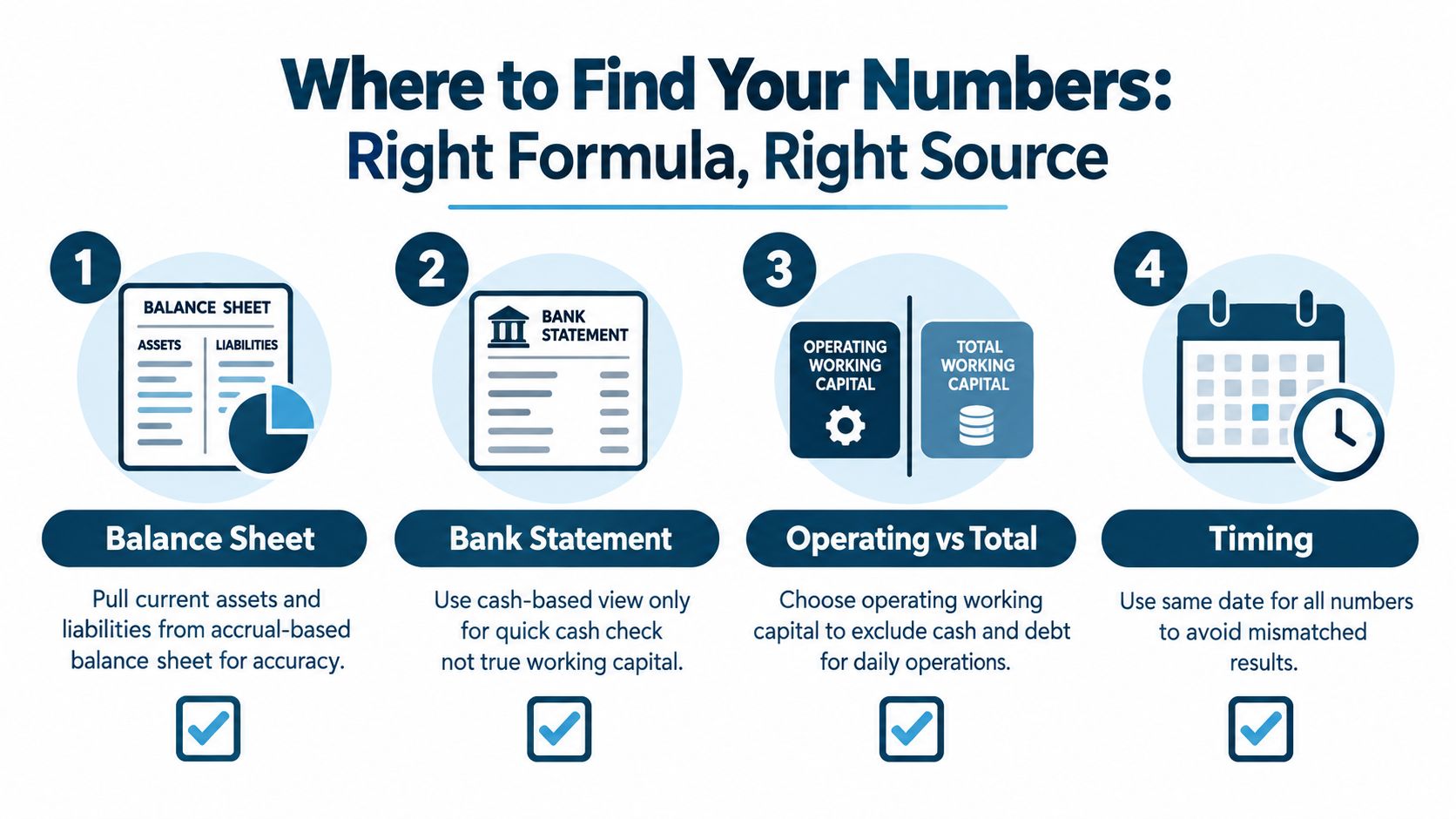
For a real working capital calculation, use an accrual-basis balance sheet for one exact day.
The bank balance only shows cash on hand. Working capital depends on what customers owe you, what you owe vendors, what payroll has accrued, and what taxes are due soon. If those items are missing or out of date, the formula gives a clean-looking answer that can still be wrong.
A reliable review usually follows this order:
- Run the balance sheet for one date only. Do not mix numbers from reports pulled on different days.
- Check current assets. Review cash, accounts receivable, inventory, and prepaids. Remove amounts that are stale or not current.
- Check current liabilities. Confirm accounts payable, payroll liabilities, taxes payable, credit cards due soon, and the current portion of debt.
- Confirm reconciliations. If bank, loan, payroll, or credit card accounts are not reconciled, the result is only a rough estimate.
If the report layout is confusing, this guide to reading a balance sheet helps owners spot where each item belongs.
Use the formula that matches the question
The simple formula is still valid:
Net working capital = current assets – current liabilities
Use that version when the question is broad. Can the business cover short-term obligations? What does a lender or buyer see at a glance? How much cushion is there on paper?
But this is the point where owners can get misled.
A company can show positive net working capital and still struggle week to week. That usually happens when the "good" number is being propped up by cash from a loan, owner contribution, or a busy season that has not turned into collections yet.
For day-to-day cash pressure, operating working capital is often more useful:
Operating working capital = accounts receivable + inventory – accounts payable
Wall Street Prep explains the difference between net working capital and operating working capital in its working capital overview.
That narrower formula strips out financing noise and focuses on the operating cycle. In plain terms, it shows how much cash the business has tied up in doing the work.
When the simple formula misleads
The broad formula works fine for a quick liquidity snapshot. It works less well when an owner is trying to answer questions like these:
- Are slow collections causing the squeeze?
- Is inventory eating cash?
- Are supplier terms carrying too much of the business?
- Did a loan make the balance sheet look healthier than operations really are?
Those are operating questions, not just balance sheet questions.
A service firm may have little inventory, so receivables drive the whole story. A healthcare practice may look healthy because insurance receivables are large, while actual cash timing is still uneven. A contractor may show positive current assets because of job-related billings, but supplier balances and underbilled work can still create pressure.
Stripe explains a related measure, working capital requirement, in its guide to working capital requirement. That version is useful when you want to see how much cash operations need before financing enters the picture.
A practical rule for owners
Use net working capital for outside reporting, high-level review, and broad liquidity checks.
Use operating working capital when cash feels tighter than the balance sheet suggests, or when you are trying to fix billing speed, inventory levels, vendor timing, or job management.
Both formulas matter. The mistake is using one answer for every decision.
What helps the number mean something
What works:
- Using current, reconciled books
- Writing off receivables that are no longer collectible
- Placing the current portion of debt in current liabilities
- Separating owner activity from normal operations
What creates bad readings:
- Relying on the checking balance alone
- Leaving old prepaids or duplicate inventory on the books
- Counting every invoice as collectible
- Assuming positive working capital means healthy cash flow
Worked Examples for Services Healthcare and Construction
A positive working capital number can mean three very different things depending on the business.
I have seen a consulting firm show a healthy balance sheet and still sweat payroll because one client was 45 days late. I have seen a medical practice carry a similar number and sleep fine because claims were moving on a steady cycle. I have also seen a contractor post positive net working capital while cash was pinned down by slow draws, retainage, and supplier payments due before the next billing went out.
That is why the simple formula needs context. As noted earlier, industry benchmarks vary widely, and many analysts also compare working capital to revenue to make businesses of different sizes easier to judge.
Working Capital Examples by Business Model
| Business Type | Current Assets Breakdown | Current Liabilities Breakdown | Working Capital Result |
|---|---|---|---|
| Professional services firm | Cash, accounts receivable, prepaid software and insurance | Accounts payable, accrued payroll, payroll taxes, credit card balance due soon | Positive, but mostly tied up in receivables |
| Healthcare practice | Cash, insurance receivables, patient receivables, small medical supply inventory, prepaids | Payroll liabilities, accounts payable, rent due soon, taxes payable | Positive, with steady inflow if collections stay on pace |
| Construction contractor | Cash, accounts receivable, materials inventory, job-related current assets, prepaids | Supplier payables, accrued labor, taxes payable, short-term debt due soon | Can look positive on paper while cash still feels tight because timing drives everything |
Professional services
A services firm usually has little or no inventory, so the headline number often rises or falls with receivables.
Say a small marketing agency has $140,000 in current assets and $85,000 in current liabilities. Net working capital is $55,000. That looks decent at first glance. But if $95,000 of those current assets sits in receivables and half of that is over 60 days old, the owner does not really have a $55,000 cushion to use this month.
That is the point where I stop admiring the formula and start asking better questions.
- Are invoices going out as soon as work is delivered?
- Are unbilled hours stacking up at month-end?
- Are old receivables still collectible, or just overdue and untouched?
For service businesses, operating working capital usually gives a clearer read than net working capital. It strips attention back to the operating cycle. Receivables, payables, and accrued expenses. If payroll lands every two weeks and clients pay in 45, the business is funding that gap itself.
Healthcare practice
Healthcare has a steadier expense pattern and a more layered collections process.
Take a three-provider practice with $220,000 in current assets and $150,000 in current liabilities. Net working capital comes out to $70,000. On paper, that is stronger than the agency example above. In practice, the comfort level depends on what sits inside receivables. If claims are clean, insurance payments are posting on schedule, and patient balances are being worked, that $70,000 may hold up well.
If claim follow-up is behind, the picture changes fast. A practice can look liquid while cash is still arriving unevenly because money is stuck between service dates, payer review, and patient collections.
Here is what I check first:
- Insurance receivables aging by payer
- Credit balances or denied claims that were never cleaned up
- Payroll and tax payments due before the next collection cycle
- Patient balances that staff have stopped pursuing
In healthcare, net working capital is useful for the broad liquidity check. Operating working capital is better when the owner says, "We are busy, profitable, and still tighter than we should be." That usually reveals the underlying issue faster.
Construction
Construction gives owners the most misleading working capital readings.
Say a contractor shows $500,000 in current assets and $420,000 in current liabilities. Net working capital is positive at $80,000. A banker may see a cushion. The owner may still be scrambling because $180,000 of receivables includes retainage, $90,000 sits in materials bought ahead of schedule, and suppliers want payment long before the next draw clears.
That is why I rarely stop at net working capital in construction.
I want to know how much of current assets can turn into cash soon, how much is tied to billing status, and whether payables are being timed by plan or by pressure. Underbilled work, overbilled positions, retainage, and prepaid materials can all distort the simple formula.
A positive result is more reassuring when:
- Billing is current
- Change orders are approved quickly
- Collections match the draw schedule
- Supplier terms are being used intentionally, not stretched out of necessity
A positive result deserves caution when:
- Materials are purchased well ahead of billing
- Retainage makes up a large share of receivables
- Underbilled work keeps growing
- Payroll and subcontractor costs are being carried for too long before reimbursement
For construction, operating working capital usually gives the sharper answer because it shows whether jobs are consuming cash before the contract terms send it back. That is often the number that explains why the balance sheet looks acceptable while the checking account says otherwise.
How to Read Your Result and Avoid Common Pitfalls
A business can show positive working capital on the balance sheet and still come up short for Friday payroll.
That usually happens because the formula is answering one question, while the owner is asking another. Net working capital tells you whether current assets exceed current liabilities at one point in time. It does not tell you how quickly those assets turn into usable cash, or whether the liabilities will come due before the cash arrives.
Positive, negative, and thin
A positive result usually means there is some cushion. The next question is whether that cushion is real cash, collectable receivables, or inventory and prepaids that will not help much this month.
A negative result can mean stress. It can also fit a business that gets paid upfront and pays vendors later. I see that more often in certain service models than in construction or healthcare, where labor and supply costs often hit before collections catch up.
A thin result deserves attention even when it is technically positive.
That is the danger zone for owner-run companies. One slow-paying client, one tax payment, or one equipment repair can throw off the whole month.
Use the current ratio as a second check
The current ratio adds context by showing current assets compared with current liabilities. A higher ratio usually means more short-term coverage, but the right range depends on how the business operates.
A service firm with monthly retainers may function well with less cushion than a medical practice waiting on insurance reimbursements. A contractor may post a decent ratio and still feel pressure because receivables include retainage or underbilled work. In those cases, operating working capital usually gives the clearer answer because it strips the question down to day-to-day operations.
The same warning applies in the other direction. A ratio that looks low is not always a crisis if customer cash comes in fast and obligations are scheduled predictably.
Read the number in context
Here is the practical test I use with clients: if the checking account feels tight, which balance sheet line is causing it?
For a service business, the usual issue is receivables. The formula may look fine, but one or two old invoices can create most of the "working capital" on paper. If clients are stretching payments to 45 or 60 days, positive net working capital can give false comfort.
For healthcare, receivables need a closer look. Insurance billing delays, denials, and patient balances can make current assets look stronger than they are. In that case, operating working capital gives a better read than the simple formula because it focuses attention on collections that support payroll and overhead.
For construction, timing can distort nearly everything. Retainage, prepaid materials, underbillings, and draw schedules can all make net working capital look safer than the bank account feels. A contractor with positive net working capital may still be funding jobs out of pocket for weeks.
Quick decision table
| What you see | What it may mean | What to check first |
|---|---|---|
| Positive working capital and strong cash | Healthy short-term buffer | Whether cash is sitting idle or needed soon for taxes, payroll, or debt |
| Positive working capital but cash feels tight | Assets are tied up in receivables, inventory, or prepaids | A/R aging, billing delays, inventory movement, large prepaids |
| Negative working capital | Timing pressure or a business model built on fast collections | Customer payment pattern, vendor terms, upcoming payroll and tax dates |
| Thin working capital | Very little room for delay or surprise costs | Cash forecast for the next 30 days, not just the month-end balance sheet |
Common mistakes owners make
- Using net working capital when operating working capital would answer the question
- Counting all receivables as equally collectable, even when part of the balance is old, disputed, or delayed by insurance or contract terms
- Leaving prepaids in the comfort pile, even though prepaid insurance or deposits will not cover payroll
- Ignoring timing inside current liabilities, especially payroll taxes, credit lines, and vendor balances due sooner than expected
- Comparing raw dollar amounts across industries instead of asking whether the number fits the billing and cash cycle of that business
The formula is simple. Reading it well takes judgment.
Practical rule: If the result says you are fine but cash says otherwise, separate usable cash, near-term receivables, inventory, prepaids, and short-dated liabilities. That step usually shows whether you need net working capital for a broad snapshot or operating working capital for a real-world cash read.
Forecast Improve and Track Working Capital Going Forward
A month-end working capital number helps. A forward view helps you make payroll, buy materials, and decide whether you can take on the next job.
I usually tell owners to stop treating working capital as a score and start treating it as a timing tool. The balance sheet shows where you stood on one date. The forecast shows whether cash will arrive before the bills hit.
Build a tracker that matches how your business collects cash
Use one sheet each month and keep the categories consistent. Track net working capital if you want a broad balance sheet view. Track operating working capital if you need to see whether the business can fund day-to-day operations without being fooled by prepaids, old receivables, or short-term swings in debt.
Include:
- Month-end date for each snapshot
- Current assets by type such as cash, receivables, inventory, and prepaids
- Current liabilities by type such as payables, payroll liabilities, taxes, and short-term debt
- Net working capital
- Operating working capital, if that gives a better read for your business
- A 13-week cash forecast with expected collections and required payments
- Short notes on large draws, insurance delays, retainage, seasonal buying, or unusual vendor payments
That last item matters more than owners expect. I have seen two companies report the same working capital on paper and face completely different cash pressure because one had current receivables it could collect in ten days, while the other was waiting on disputed invoices and slow insurance payments.
If you want help setting up the process, this guide on working capital optimization gives a practical framework.
Forecast by the pressure points, not just the formula
The simple formula can miss what is about to happen next.
A services firm usually needs to watch billing lag and collections. If the team finishes work on the 28th but invoices do not go out until the 10th, working capital may look stable while cash slips every month.
A healthcare practice has a different problem. Receivables may look healthy in total, but insurance claims, denials, and patient balances do not turn into cash on the same schedule. In that case, operating working capital and a weekly collections forecast are more useful than a broad current asset total.
Construction is different again. Materials, subcontractor timing, retainage, and job-specific deposits can make one month look strong and the next month feel tight. I have seen contractors show positive net working capital and still scramble because cash was tied up in retainage and inventory for the next phase.
Improve the result without dressing up the books
The strongest improvements are operational.
- Bill faster after work is completed
- Review aging weekly and act on slow accounts before they become old accounts
- Separate collectable receivables from delayed or disputed balances
- Schedule purchases around real job timing, especially in construction and inventory-heavy work
- Ask for better vendor terms when the relationship supports it
- Keep payroll taxes and short-dated liabilities visible, not buried in a general current liabilities line
- Update the books on time so the forecast reflects real conditions
Owners sometimes try to fix working capital by stretching payables without a plan. That can buy a little time, but it can also strain suppliers right when you need them most. Better billing, better collections, and cleaner timing usually hold up longer.
Set a review rhythm that matches risk
Monthly review works for many businesses. Weekly review is better during growth, seasonality, claim delays, or tight cash periods.
Look at the same numbers each time. Compare what you forecasted against what happened. If collections came in late, note why. If inventory rose, decide whether it was planned. If payables climbed, check whether that was a strategy or a warning sign.
Clean books will not create cash. They do give you time to act while the problem is still manageable.
If your working capital looks fine on paper but cash still feels tight, the issue is usually timing, quality of receivables, or the wrong formula for the decision in front of you. MyOfficeOps helps owners clean up the balance sheet, track receivables and payables clearly, and turn working capital into a tool for hiring, pricing, and cash planning.