
You open your accounting software late at night because an investor wants updated numbers in the morning. The bank balance looks fine at first, then you notice several uncategorized charges, a contractor payment sitting in the wrong account, and a payroll withdrawal you forgot was scheduled. You still can't answer the question that matters most: Can the company make payroll next month?
That moment is why founders search for outsourced bookkeeping for startups. They aren't looking for someone to type numbers into a spreadsheet. They need clean records, a reliable close, and a plain answer about what the business can afford to do next.
Why Founders Search for Help at 2 AM
The problem usually starts small. A founder handles the books between sales calls, product decisions, hiring interviews, and customer support. Bank feeds import transactions, but nobody checks whether the software put them in the right place. Receipts remain in email. Contractor invoices sit in a folder. The income statement says the company is profitable, yet the bank balance keeps falling.
Then an important decision arrives. Should the company hire another developer? Can it pay a new sales commission? Is there enough cash to wait for the next customer payment? A messy ledger turns each question into a guessing exercise.
I've seen founders treat bookkeeping as a chore until the day it becomes a business emergency. The books may be technically populated, but they don't explain what happened. A payment could be a software subscription, a customer refund, an owner's personal charge, or a prepaid expense. Those differences matter when you're deciding whether to spend, hire, raise money, or slow down.
The useful test: If your monthly reports don't change a decision, you don't have a finance system yet. You have transaction storage.
Outsourcing helps when the outside team takes responsibility for the full monthly rhythm. That means gathering source documents, reviewing imported transactions, reconciling bank and credit-card accounts, closing the books, and explaining the result in language a founder can use.
The case for professional support is stronger than a simple time-saving argument. Intuit's 2025 Accountant Technology Report covered 2,487 U.S. small businesses and found that businesses with accountant support were 73% more likely to describe themselves as being in good financial health than businesses without that support. The finding is correlational, so it doesn't prove that accountant support caused the stronger result, but it does show a meaningful link between outside accounting help and financial confidence. Read the Intuit report.
Founders considering the decision can also review this practical guide to the advantages of outsourcing bookkeeping services. The key question isn't whether you can enter transactions yourself. You probably can. The question is whether you can keep doing it accurately while the company changes every week.
What Outsourced Bookkeeping Actually Is
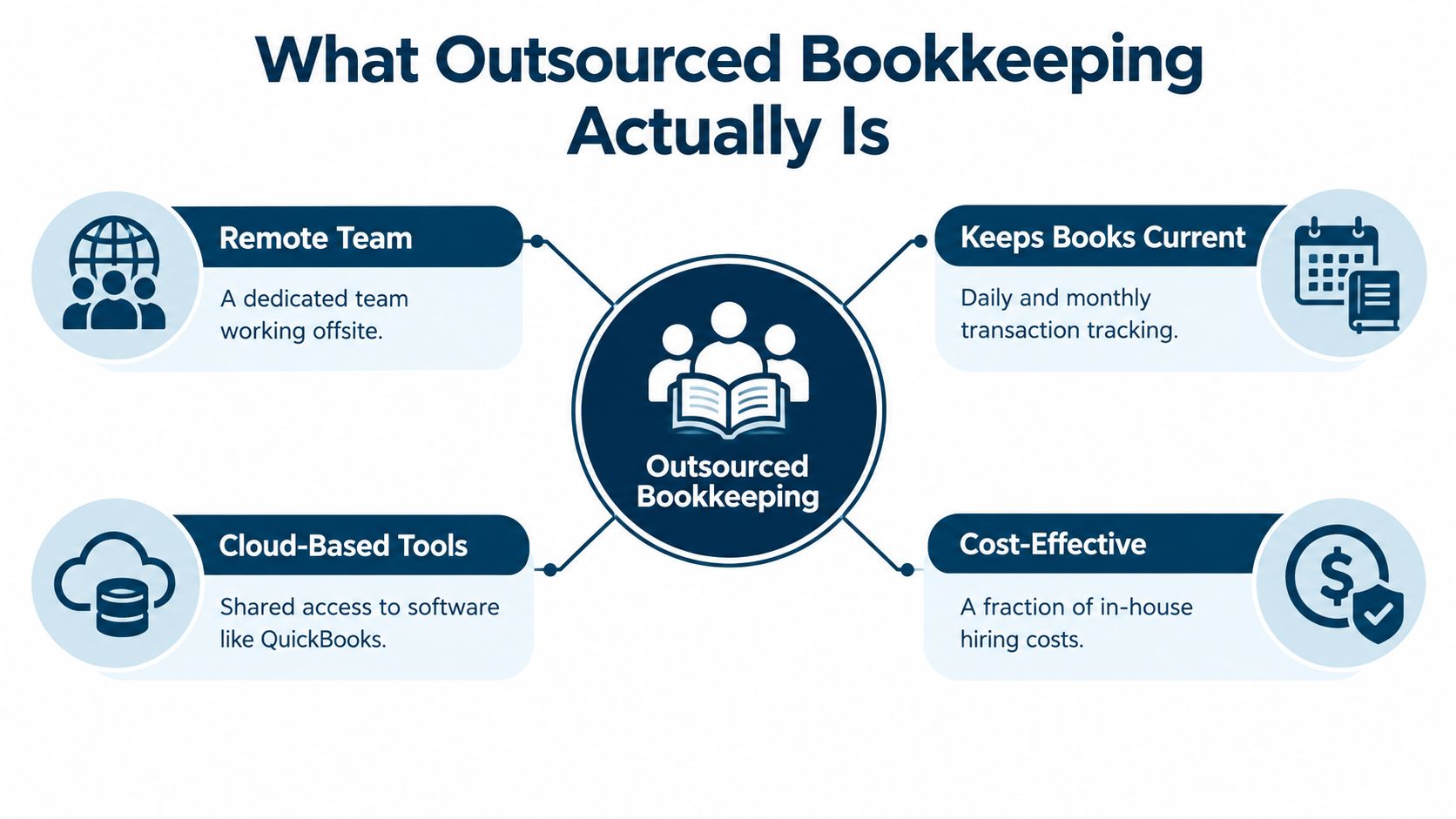
Outsourced bookkeeping means an external bookkeeper or accounting team maintains your financial records, closes the books, and helps you understand what those records say. The work happens through shared cloud tools, but the value comes from the review and explanation around the data.
Think of the monthly close like packing lunch for a long trip. You gather everything you need, check that nothing is missing, put each item in the right place, and make sure the bag is ready before you leave. A close does the same for your financial records.
A normal monthly package should include:
- Transaction review: The bookkeeper checks bank, card, payment processor, and expense activity.
- Account reconciliation: They compare the ledger with bank and credit-card statements so missing or duplicated entries stand out.
- Financial statements: You receive an income statement, balance sheet, and cash-flow statement.
- Founder summary: Someone explains unusual movements, open questions, and decisions that need your attention.
The chart of accounts is like a filing cabinet with labeled drawers. If you put every expense in a drawer called “general,” you may have a full cabinet, but you won't know how much went to software, contractors, advertising, travel, or equipment. A good bookkeeper sets useful labels and applies them consistently.
This role fits between daily administration and higher-level finance work. A bookkeeper maintains the records and prepares regular reports. A CPA may handle tax returns, tax advice, and complex accounting questions. A controller focuses on accounting processes, controls, and reporting quality. A fractional CFO uses reliable financial information to guide planning, fundraising, pricing, and capital decisions.
Those roles can overlap, especially in a small startup, so define the boundaries before signing an agreement. If you're comparing support options, find accounting support for small businesses that matches your transaction volume, reporting needs, and level of founder involvement.
Digital tools are now part of the basic setup. A Small Business Majority survey of 1,043 U.S. small-business owners found that 66% used financial accounting software. Among reported platforms, QuickBooks represented 69%, followed by Xero at 11%, Zoho Books at 8%, FreshBooks at 8%, and Wave at 4%. Review the survey details.
Pricing Models and Their Common Costs
Pricing proposals often look simple until you ask what happens outside the standard monthly work. The structure matters less than the scope. A low monthly fee can become expensive if cleanup, payroll support, investor reporting, or tax coordination sits outside the package.
Here are the common models founders will encounter:
| Pricing model | Typical monthly range | Best for | Watch out for |
|---|---|---|---|
| Per transaction | Varies with activity | Very small businesses with steady volume | Costs rise as transactions and payment channels grow |
| Flat monthly retainer | Varies by scope | Startups that want predictable close and reporting | Confirm the transaction limit and included reports |
| Hourly billing | Varies by time used | Cleanup projects or irregular accounting needs | The monthly bill can be hard to predict |
| Bookkeeping plus CFO package | Varies by advisory depth | Startups needing forecasts and decision support | Make sure the advisory deliverables are specific |
I won't give you invented dollar ranges. Bookkeeping costs depend on account count, transaction volume, payroll, revenue recognition, inventory, entities, reporting needs, and the condition of the existing books. A provider should be able to explain its price from those facts, not from a vague “startup package.”
Per-transaction pricing can work for a simple business with few accounts. It becomes awkward when the company adds a payment processor, corporate cards, payroll, subscription billing, and multiple bank accounts. The work grows because the business grows, but the price may not reflect the review needed to keep classifications consistent.
A flat retainer gives you a clearer budget. Ask whether it includes bank and card reconciliations, accruals, monthly statements, cash-flow reporting, accounts payable, accounts receivable, payroll coordination, and questions from your tax preparer. Also ask what triggers a change in price.
Hourly work makes sense for a cleanup or a one-time chart-of-accounts redesign. It isn't my first choice for an ongoing close because founders need a dependable deliverable, not a surprise invoice.
Technology can help, but it doesn't replace design. An academic review of startup management-control research found that investment in accounting information systems is positively associated with budgeting, cash, and cost controls, while also noting that implementation alone doesn't guarantee stronger bookkeeping. See the academic review.
How Bookkeeping Connects with Payroll and Accounting
Payroll isn't a separate island. It creates accounting entries, tax obligations, employee records, and cash movements that must all agree with the general ledger.
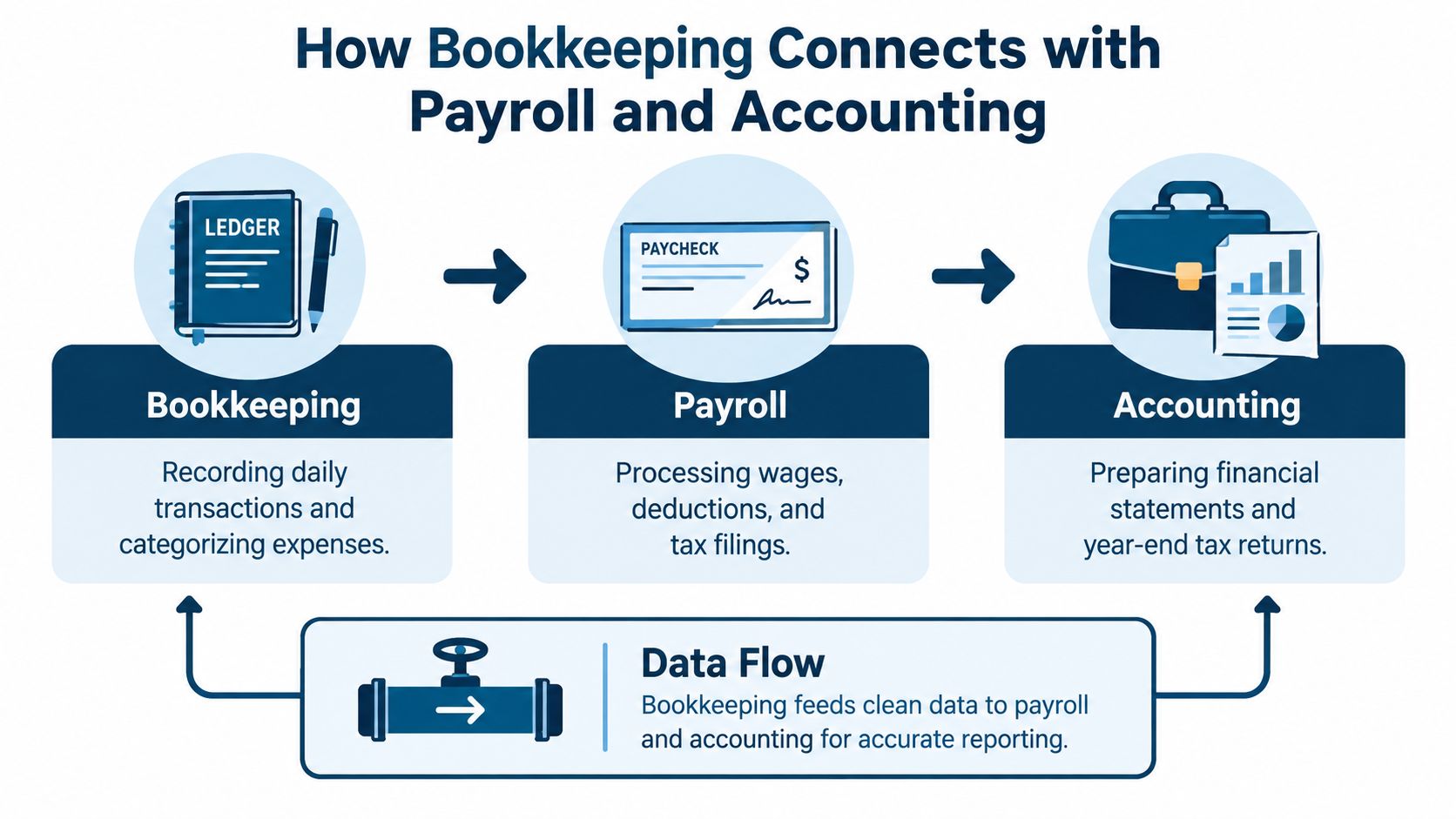
A simple flow looks like this:
- Bookkeeping records activity. Bank feeds, card charges, invoices, bills, and deposits enter the system.
- Payroll processes wages. The payroll system calculates pay, deductions, employer taxes, and filings.
- Accounting reviews the result. The company uses reconciled records for financial statements, tax work, lender requests, and investor reporting.
Take a small SaaS company that hires two engineers. Payroll now creates wage expense, tax liabilities, benefit deductions, and cash withdrawals. The bookkeeper needs to confirm that the payroll entry reaches the correct accounts, that the tax liability clears when the deposit is made, and that the payroll reports agree with the bank activity.
Federal payroll deposits follow monthly or semiweekly schedules. The schedule is based on payroll-tax liability during the IRS lookback period, not on whether employees are paid weekly or every other week. An employer generally follows the monthly schedule when the relevant liability was $50,000 or less, and the semiweekly schedule when it was more than $50,000. New employers generally begin as monthly depositors because they have no prior lookback-period liability. If tax liability reaches $100,000 or more during a deposit period, the deposit is generally due by the next business day. Check the IRS deposit and reporting rules.
Your bookkeeper should organize the following by pay period:
- Payroll register: Gross wages, deductions, net pay, and employer taxes.
- Employee records: Names, addresses, Social Security numbers, occupations, and employment dates.
- Tax documents: Form W-4 certificates, filing records, deposit dates, and electronic payment confirmations.
- Reconciliations: Proof that payroll withdrawals and tax payments match the ledger.
A startup with employees must keep employment-tax records for at least four years after the tax becomes due or is paid, including each wage payment, employee details, and copies of Form W-4 withholding certificates. See IRS Publication 15. Payroll software may calculate a paycheck, but it won't automatically guarantee that your records, accruals, approvals, and accounting entries are complete.
For a useful companion resource on organizing business spending, review Coto & Waddington on expense tracking. Founders should also understand how systems connect before choosing a provider. This guide to payroll integration explains why the handoff matters.
How to Choose the Right Provider
Choose the provider who can produce a dependable close and answer a finance question without making you translate accounting language. Industry familiarity matters, but clear ownership and review matter more.
Use this matrix during discovery calls:
| Criterion | Why it matters | What to ask |
|---|---|---|
| Startup experience | Subscription revenue, equity, contractors, and fundraising create special needs | “Which startup transactions do you review manually?” |
| Software fit | Poor integrations create duplicate or missing records | “Which tools connect directly, and what remains manual?” |
| Review process | Automation can misclassify unusual activity | “Who reviews the work before the books close?” |
| Communication | Founders need answers before decisions, not after problems | “Who is my contact, and how do questions get escalated?” |
| Security | Your provider handles sensitive financial and employee data | “Do you use role-based access, audit logs, and multi-factor authentication?” |
| Reporting | A plain profit and loss statement may not show cash risk | “Will you report runway, burn variance, and receivables?” |
The IRS doesn't require one special bookkeeping system. It requires records that clearly show income, expenses, gross income, deductions, and tax credits, with electronic records that can be indexed, stored, protected, retrieved, and reproduced. Read IRS Publication 583.

Ask these questions before you hire:
- Who closes the books? Get the person's name and backup plan.
- What arrives each month? Request a sample report, not a promise.
- Who approves exceptions? Understand how unusual transactions are handled.
- What isn't included? Ask about cleanup, tax support, payroll, investor reports, and urgent requests.
- Can I see the books? You should retain appropriate access to your financial system.
- How is data protected? Ask about access controls and the handling of sensitive records.
A provider that promises AI will replace review is selling you a shortcut. For broader business questions, a resource such as LegesGPT for business owners may help you organize issues to discuss with your accountant or attorney, but it shouldn't replace professional judgment on your books.
Your First 30 Days of Onboarding
A good onboarding process creates a clean starting point. A rushed one moves old confusion into a new software account.
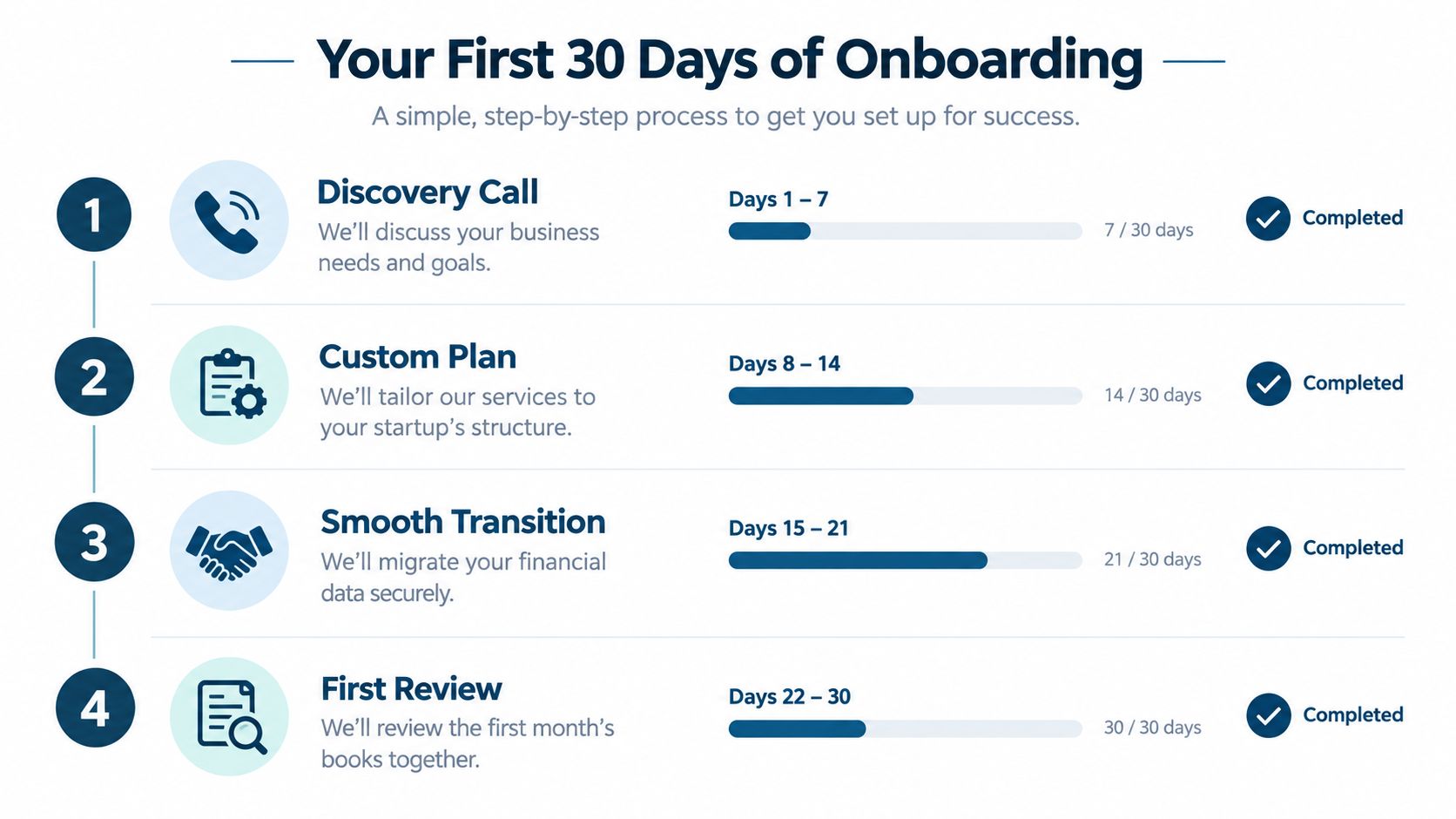
Days one through seven
Start with a discovery call. Explain the business model, legal entities, bank accounts, payment processors, payroll system, revenue cycle, current reporting, and the decisions you need to make. Send read-only or appropriately controlled access to the accounting platform, bank and card accounts, payroll system, billing tools, expense receipts, vendor list, prior financial statements, and prior-year tax returns.
Days eight through fourteen
The provider should turn that information into a written plan. It should identify the accounting method, close schedule, chart of accounts, approval responsibilities, document-storage rules, reporting package, and escalation path.
This is also the point to fix obvious historical problems. Use a focused bookkeeping cleanup checklist to identify unreconciled accounts, duplicate entries, missing invoices, old receivables, and unexplained transfers.
Days fifteen through thirty
The provider should migrate or organize the data securely, confirm opening balances, update the chart of accounts, and complete the first close. Ask for four concrete outputs:
- Reconciled opening balance sheet: Starting balances should have support.
- Updated chart of accounts: Categories should reflect how you manage the business.
- Clean first month-close: Bank, card, payroll, receivables, and payables should be reviewed.
- Narrative report: Someone should explain the major movements and unresolved items.
Don't accept silence as progress. A delayed close, missing reconciliation, or report with no explanation means the process needs attention. Ask which accounts remain open, what evidence is missing, who owns the fix, and when the corrected report will arrive.
Forecasting should begin early, not after the books are perfect. A 2025 empirical analysis of more than 7,000 U.S. startups using publicly available SBA data found that financial forecasting and scenario planning were associated with stronger survival and growth outcomes. Review the analysis.
The KPIs and Reports You Should Receive Every Month
A monthly report should help you choose what to do next. If it only tells you what happened, it is incomplete.
The minimum close-to-decision package should include the following:
| KPI | What it tells you | Decision it feeds |
|---|---|---|
| Cash balance | What is available in the bank after actual activity | Whether planned spending is affordable |
| Rolling 13-week cash forecast | How expected receipts and payments affect near-term cash | Whether to accelerate collections, delay hiring, or prepare financing |
| Burn-rate variance | Whether actual spending differs from the plan | Which costs need review |
| Accounts-receivable aging | Which customers owe money and how long invoices remain open | Whether to change collection efforts or payment terms |
| Hiring affordability | Whether a proposed hire fits the cash plan | Whether to hire now, later, or part time |
| Downside scenario | What happens if fundraising or customer payments arrive late | How much time the company has to adjust |
The cash balance must come from reconciled bank activity, not a stale dashboard. The 13-week forecast should show expected customer receipts, payroll, taxes, vendors, debt, and planned purchases. The burn variance should compare actual spending with the plan and explain the largest differences.
Accounts-receivable aging is especially useful for startups that report revenue but collect slowly. A profitable month can still create a cash problem if customers take too long to pay. Hiring affordability connects the cash forecast to a real founder decision, while downside scenarios force the team to plan for a delayed raise rather than assume one will arrive.
Founder rule: Every number on the monthly scorecard should answer, “What should I do differently?”
AI can help with receipt capture, transaction suggestions, recurring reconciliations, and exception spotting. It shouldn't approve revenue recognition, payroll classification, multi-entity reporting, investor metrics, or tax-sensitive adjustments without human review.
A 2025 survey of 424 U.S. senior finance leaders found that 97% recognized measurable AI impact, while 62% had implemented AI at scale, 62% reported integration friction, and only 25% invested in training. Read the report summary. The lesson for a startup is simple: automate low-risk capture, then require a person to review the areas where judgment changes the financial story.
When should monthly monitoring become weekly? Move to weekly cash review when payroll, vendor commitments, fundraising timing, or collections can change your available cash quickly. The trigger is decision risk, not a particular revenue level.
What should happen if the books are accurate but still unhelpful? Ask the provider to add the scorecard above, explain the changes, and connect each report to a decision. Accuracy is the floor. Useful reporting is the reason to keep the system.
MyOfficeOps provides outsourced bookkeeping, accounting, payroll integration, cash-flow monitoring, monthly close work, and advisory reporting for growing businesses. Visit MyOfficeOps to discuss a monthly finance package that turns clean books into runway, hiring, pricing, and cash-flow decisions.