

You've found a business that looks like a good fit. The owner wants to retire, the customers look familiar, and the asking price seems reasonable. You're already thinking about what the combined company could become, but there's a harder question to answer before you make an offer: What will you do differently after you own it?
The Deal That Looked Like a Win
Consider a hypothetical Philadelphia professional-services firm owner buying a smaller competitor. The price feels right, the seller's client list looks solid, and both firms offer similar services. The buyer expects to combine the offices, remove duplicate expenses, and give existing clients more reasons to stay.
After closing, the owner learns that several clients hired the seller personally, not the firm. Employees dislike the new reporting rules, billing gets harder, and managers spend their days resolving problems instead of serving customers. The overhead savings never appear because the buyer still needs both systems and both administrative teams.
That's an illustration, not a documented case. But it exposes the question a purchase agreement can't answer: Can you run the combined business well enough to justify what you paid?
A reasonable price doesn't make a sound deal
A buyer can negotiate carefully and still buy trouble. The seller's business might work perfectly under its current owner, yet struggle under new leadership, different processes, or a rushed change to customer service.
Bain's integration guidance reports that 83% of surveyed executives who had experienced failed acquisitions identified integration as a primary problem. That finding doesn't mean every disappointing deal had the wrong target. It means buyers need to examine what happens after ownership changes, not just what they're buying.
Practical rule: Don't approve an acquisition unless someone can explain how the business will operate after closing, who will manage the changes, and how you'll know they worked.
The conventional explanation of M&A, one company combining with or buying another, tells you what the transaction is. It doesn't tell you whether you should do it.
A useful strategy protects the owner's money, time, and existing business. Before signing, you need to understand which customer relationships you must preserve, which employees you can't afford to lose, and which changes can wait. Buying revenue is easy to describe. Keeping it profitable is the job.
What M&A Strategy Actually Means
M&A strategy is a disciplined plan that connects a merger or acquisition to a measurable business goal. You might want to enter a market, add a service, improve customer retention, or reduce the cost of delivering your work. Getting bigger isn't enough.
Think of buying a house. A nice kitchen might get your attention, but a sensible purchase also accounts for repairs, financing, ongoing expenses, and what the property will be worth to you. An acquisition deserves the same discipline, with more people and moving parts.
The process stretches well beyond finding a seller and agreeing on a price.
Write a deal thesis you can defend
Your deal thesis is the written explanation of why this purchase deserves your money. Keep it plain enough that your accountant, operations manager, and lender can challenge it.
- Standalone value: What is the target worth without your promised improvements? Start with sustainable earnings and cash flow, not the seller's most flattering year.
- Your advantage: Explain what you bring that the seller doesn't have. That could be available capacity, stronger billing processes, or access to customers who need the target's services.
- Required investment: Include systems, training, management time, transition support, and the cash needed to keep operating.
- Measured benefits: Separate cost savings from added revenue. Give each expected benefit a calculation, an owner, and a deadline.
For another perspective on organizing those decisions, owners can browse M&A strategic guide from Everglow Prosperity alongside their own financial model. Use outside frameworks to sharpen your questions, not replace your judgment.
Make the explanation specific
Suppose a West Chester healthcare practice is considering a smaller clinic. Its thesis could identify the clinic's sustainable earnings, the buyer's available appointment capacity, the expense of moving billing systems, and the expected reduction in duplicate administrative work.
Added patient volume belongs in the revenue calculation. Billing consolidation belongs in the cost calculation, but only after accounting for transition expenses and any disruption to collections.
What is M&A strategy? It's the difference between liking a business and proving why owning it should improve yours. If you can't explain that difference on a page, you're not ready to negotiate.
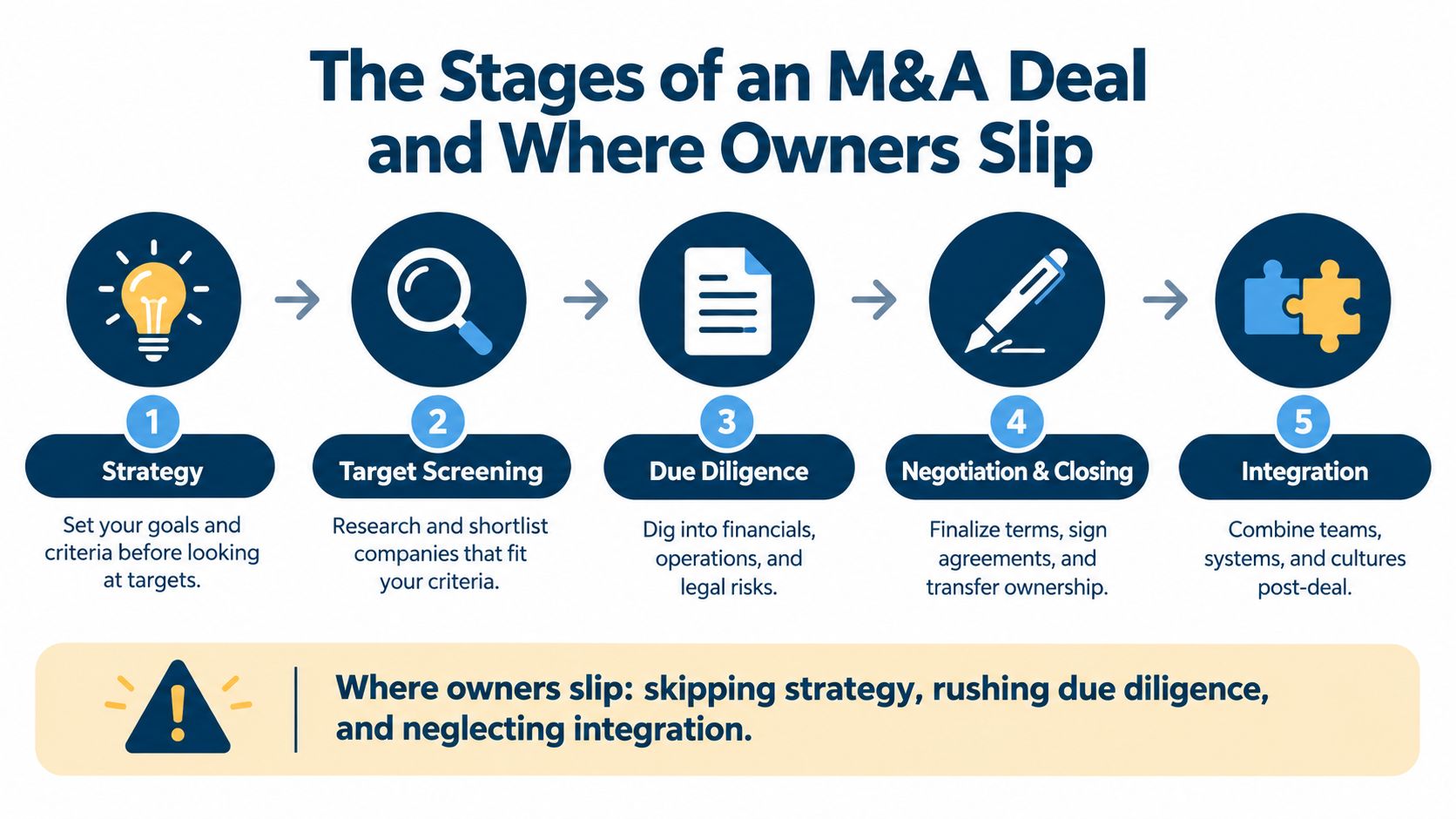
The Stages of an M&A Deal and Where Owners Slip
Suppose a construction contractor in the Philadelphia suburbs wants to buy a smaller HVAC business. The strategic reason is to offer related work without relying entirely on outside providers. That reason should guide target screening, valuation, diligence, and the eventual operating plan.
The seller's availability shouldn't set the buyer's strategy. A business can be for sale and still be wrong for you.
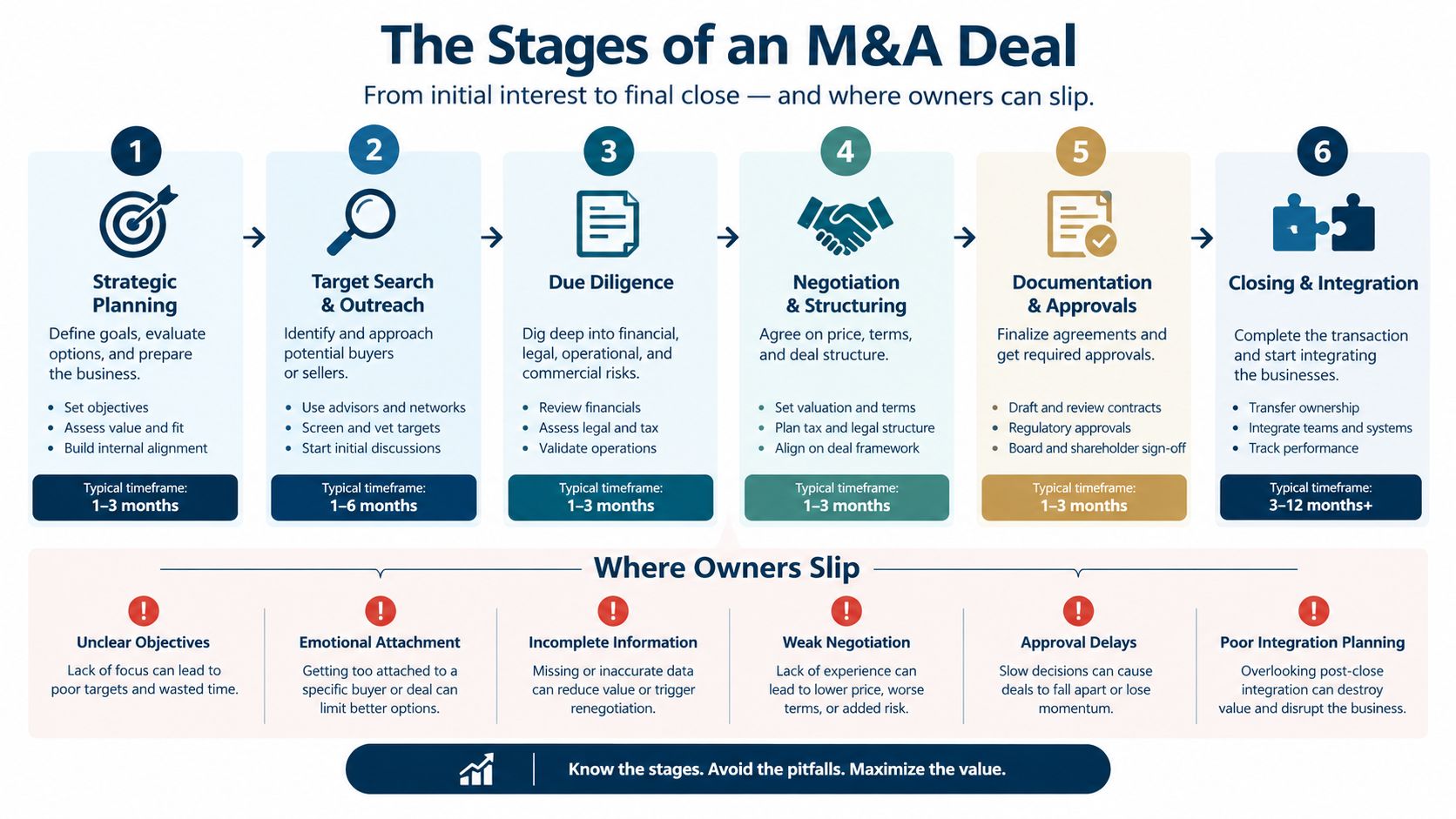
Follow the transaction without rushing it
The contractor first screens targets for service fit, customer relationships, staff capability, and seller dependence. Preliminary valuation tests whether sustainable earnings support a purchase price the buyer can afford.
A confidentiality agreement protects information shared during the process. The letter of intent records proposed price and major terms, while due diligence tests financial, operating, and legal risks; the final purchase agreement defines what transfers and the protections attached to the transaction, as described in PLI's mergers and acquisitions legal reference.
For the HVAC purchase, investigate unbilled jobs, disputed work, equipment debt, and contracts rather than accepting the headline profit figure. A mergers and acquisitions due diligence checklist helps organize the questions and supporting records.
Cross-border plans need their own review. If Israel is part of the expansion plan, RNC Group's guide for companies expanding into Israel is a relevant starting point for local advice.
Spend more attention on operating changes
Closing transfers ownership. It doesn't prove the acquisition worked.
| Deal work | Value-capture work |
|---|---|
| Agree on price and payment terms | Preserve customers and profitable work |
| Define contractual protections | Assign responsibility for operating changes |
| Complete required approvals | Verify savings and service performance |
| Transfer ownership | Confirm that benefits reach the books |
In the contractor example, dispatch, job costing, billing, and employee responsibilities need decisions before closing. Don't move every system immediately just because you can. Keep what protects service, and change what supports the purchase rationale.
Use early execution meetings to identify missed tasks and dependencies, then validate results through monthly financial reviews. Plan around operational milestones rather than promising a universal completion date.
A signed agreement gives you control of the business. Your managers still have to earn the return.
Measuring Whether the Deal Actually Worked
A year after closing, the combined company's revenue may look healthy. That doesn't answer whether the acquisition created value. You need to know what you paid, what you invested afterward, what customers and employees stayed, and how much cash the business produced.
Accounting consolidation isn't proof of success. Combining financial statements shows the businesses together. It doesn't show whether the buyer's decisions improved performance or whether the same results would have happened without the acquisition.
McKinsey's integration analysis found that companies outperforming peers 18 months after close had a 79% likelihood of continuing to outperform three years later, while successful acquirers achieved at least 50% of publicly stated synergy targets within the first year. Treat that as evidence that early execution matters, not a promise about your own deal.
Freeze the starting point before you change anything
Build a pre-close baseline, a consistent record of how each company performed before you combined them. Reconcile revenue by customer or service, gross margin, employee costs, overhead, working capital, customer losses, utilization, and cash collection.
Definitions matter as much as totals. If one firm includes delivery staff in direct costs and the other puts them in overhead, comparing their gross margins will mislead you. If one counts signed contracts as revenue while the other focuses on completed work, the combined report won't answer a useful question.
Ask your accounting lead to document the treatment of each major measure. Keep the supporting customer records, payroll detail, receivables reports, and adjustments. You want a starting point another person can reproduce, not a spreadsheet only the deal sponsor understands.
A practical baseline should distinguish:
- Reported results: What the books show before adjustments.
- Sustainable results: What remains after justified changes for unusual expenses or owner-specific items.
- Expected combined results: What you think the businesses can produce together, after the costs and risks of making changes.
Don't let the seller's adjusted earnings become your baseline without checking the adjustments. A removed expense may still be necessary under your ownership.
Pre-Close Baseline vs Post-Close Scorecard
Set targets before signing, using the deal model and the operating plan. Don't choose easier targets after results disappoint.
| Metric | Pre-Close Baseline | Post-Close Target |
|---|---|---|
| Recurring revenue retention | Revenue from the existing recurring customer group | Preserve the agreed customer revenue base, tracking departures and reductions separately |
| Gross margin | Consistently classified revenue and direct costs | Deliver the modeled improvement without weakening service |
| Customer concentration | Dependence on the largest customer relationships | Stay within the buyer's approved exposure limits |
| Employee retention | Critical roles, named employees, and replacement costs | Keep the people needed to deliver the acquisition plan |
| Employee costs and overhead | Payroll and operating expenses by function | Achieve approved changes after replacement and transition costs |
| Integration costs | Pre-close budget by workstream | Record actual spending separately and explain deviations |
| Working capital | Receivables, payables, and operating cash needs | Maintain enough cash to support the combined workload |
| Cash conversion timing | Time between performing work, billing, and collecting | Meet the approved collection timetable |
| Owner dependence | Work and relationships handled personally by the seller | Transfer responsibilities with documented evidence |
Retention needs its own line. New sales can make total revenue look fine while acquired customers leave. Track the customer group you bought separately from customers added afterward.
Employee retention also needs judgment. Keeping every employee isn't automatically a success, and losing a person isn't automatically a failure. The question is whether you retained the skills, relationships, and capacity required by the plan.
A law firm with a visible billing problem
Consider a hypothetical law firm acquisition. Before closing, the buyer separates work performed, bills issued, receivables, and cash collected. The baseline also identifies which partner approves invoices and which employee follows up on unpaid balances.
After the transition, lawyers continue completing work, but invoices spend longer waiting for approval. Revenue alone wouldn't explain the cash shortage. The scorecard shows that billing has slowed even though client work continues.
Management can then inspect the process instead of guessing. Who has approval authority? Did the new system change the workflow? Are employees waiting for instructions from the former owner?
The buyer could restore clear approval responsibilities, work through delayed invoices, and verify whether collections recover. That's a decision path, not a claimed turnaround result. The point is that clean records let the owner identify a correctable operating problem before reaching for more debt or cutting staff.
Owner test: Can your team explain why cash changed without blaming everything on the integration?
An IT services buyer without a baseline
Now consider a hypothetical IT services buyer combining acquired companies into one monthly revenue report. The report doesn't distinguish customers inherited from each seller, renewals, reduced contracts, and new sales.
Fresh business keeps the total looking respectable while some acquired customers leave. The owner can't tell whether the purchase delivered its expected customer value because nobody preserved the original customer group and contract economics.
By the time management investigates, important relationships may already be lost. The financial issue isn't just lower revenue. It's that the buyer paid for a stream of future customer earnings without building a way to monitor whether that stream remained intact.
The lesson isn't to produce more dashboards. Build a report that can answer the purchase question. For an IT services acquisition, that means customer-level recurring revenue, service costs, renewals, and departures, connected to the starting records.
Count benefits only when you can prove them
A planned software cancellation isn't a realized saving. Verify that the contract ended, payments stopped, and any replacement expense was deducted.
The same discipline applies to revenue benefits. If the combined firm sells an additional service to an existing customer, check the added delivery cost and whether the customer paid. More billings aren't automatically more profit.
Give each expected benefit a named owner and a record of:
- The starting amount: The expense, revenue, or cash measure being changed.
- The action: What the team must do.
- The evidence: An invoice, payroll record, customer contract, or collection report.
- The financial result: The recurring benefit after related costs.
- The response to a miss: Whether to revise the method, spend more, pause, or abandon it.
Keep one-time integration expenses separate from recurring performance. But don't hide them when judging the deal's overall return. The owner paid those costs, so they belong in the investment calculation.
Make reviews useful enough to change decisions
The finance lead should validate results; the operating manager should explain the work behind them. Don't ask one person to claim a benefit and approve their own calculation.
Review customer service problems beside financial gains. Removing an administrative role may reduce payroll while slowing billing or weakening client support. A saving that creates a larger loss isn't a win.
GPMI's 2025 M&A success survey reported that 92% of deals with explicitly validated and tracked synergies were successful, while only 40% of organizations used structured M&A playbooks. Those survey findings don't establish that tracking alone caused success, but they support making validation part of the operating plan.
Before closing, decide what evidence would make you change course. If a billing migration threatens collections, pause it. If customer retention weakens, investigate the affected relationships before pushing another change.
Strategy without measurement is hope with a purchase price attached. The scorecard should help you act, not give you a polished explanation after the money is gone.
When Buying Is the Wrong Move
PwC reported that small and midsized deal volume fell 18% in 2024, despite continued strategic interest in M&A. Smaller buyers also have less room for financing mistakes and fewer people available to manage integration.
Don't buy when these conditions remain unresolved:
- Weak evidence: Unreliable monthly reporting, poor cash conversion, or unclear recurring revenue.
- Fragile ownership: The seller personally controls essential customers or operations.
- No capacity: Your management team can't absorb the transition.
Use scenario planning for your business to compare acquisition with hiring, pricing changes, partnerships, or internal expansion. An agency that needs delivery capacity should test whether hiring solves the problem before buying an entire company.
Getting Your Books and Business Deal-Ready
Whether you intend to buy, sell, or partner, start by making the business easier to understand and less dependent on you.
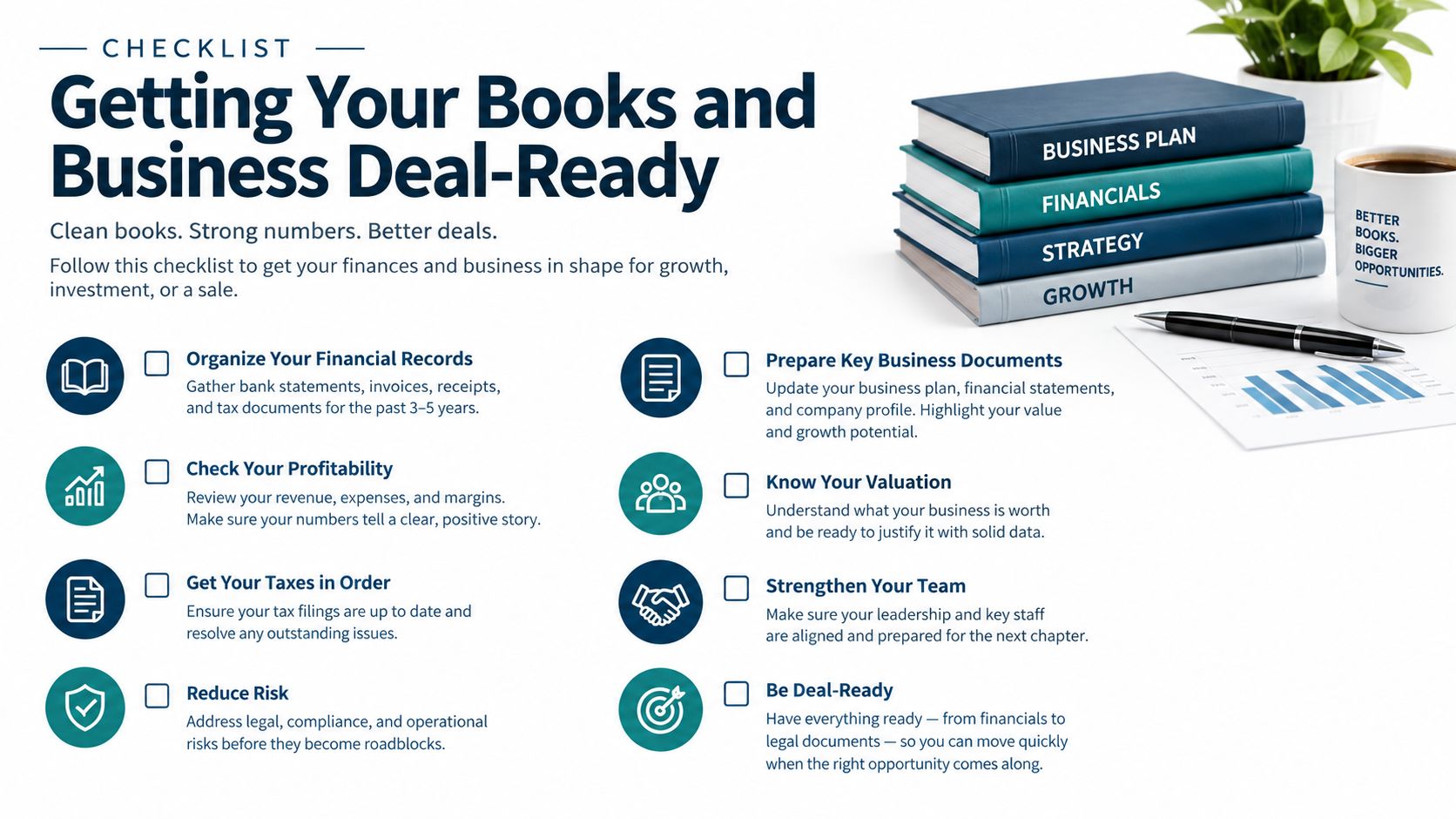
- Clean the accounts: Make revenue and expense classifications consistent.
- Close reliably: Produce reconciled monthly reports on a dependable schedule.
- Document key processes: Show how billing, collections, payroll, and customer handoffs work.
- Map revenue: Separate recurring relationships from project work and identify customer dependence.
- Test earnings: Review adjustments using this explanation of a quality of earnings report.
For collection and payment planning, consider the cash flow improvement insights from Resolut.
Start this week with your latest financial statements and receivables report. Fix what you can't explain before opening another deal conversation.
The Owner Playbook for Smarter Deals
Treat an acquisition as an operating commitment, not a closing-day achievement. Keep the deal thesis, scorecard, walk-away conditions, and readiness work together so your team isn't making disconnected decisions.
Don't let the effort you've already spent become the reason you keep pursuing a bad purchase.
Before your next acquisition conversation, sit down with a CFO-level advisor who can challenge the assumptions, model the full cash requirement, and separate achievable benefits from salesmanship. Ask that advisor to compare buying with the alternatives, not merely help justify the deal.
Your job isn't to complete an acquisition. It's to make a decision that leaves your business and your financial position stronger.
MyOfficeOps offers bookkeeping, financial analytics, CFO-level advisory, and M&A readiness support for small and midsize businesses. Visit MyOfficeOps to discuss your acquisition goals and how clean financials, cash-flow modeling, and a measurable operating plan can help you evaluate the next deal before you sign.