
Selling usually starts the same way. You sit with last year's profit and loss statement, maybe a coffee, maybe a knot in your stomach, and ask the hardest question in the whole process. What is this business worth?
Most owners want a clean number. Buyers rarely think that way. They ask a different question. If I buy this company, how confident am I that the profit keeps showing up after the owner steps out?
That's the heart of business valuation for sale. The math matters. But the bigger issue is the sellability gap, which is the distance between the value you can calculate on paper and the price a buyer will put in an offer. If you understand that gap early, you make better decisions. If you ignore it, the sale process gets expensive, slow, and frustrating.
Thinking About Selling Your Business? Start Here
If you're thinking about selling, you're probably carrying two ideas at once. First, the business is one of the biggest assets you own. Second, you know a buyer won't pay for your effort, your stress, or the years you put in. They'll pay for future cash flow they believe they can keep.
That's why a valuation isn't a magic number pulled from a formula. It's closer to building a case. You're showing a buyer that the business has reliable earnings, clear records, repeatable systems, and a path forward that doesn't depend on hope.

A lot of owners learn this late. The global business sale failure rate for privately held companies is 70–80%, and the main reason is a valuation gap, where seller expectations don't match market reality. That gap drives 35% of failed deals, according to Duedilio's review of business sale failure rates.
What buyers are really testing
A buyer doesn't just ask, “What did this business earn?” They ask things like:
- Can the team run it without you
- Are the customers likely to stay
- Do the books make sense under scrutiny
- Is there enough proof to support every claim
That last part matters more than people think. Owners often say, “The business is worth what someone will pay.” That's true, but incomplete. A better way to say it is this: the business is worth what a qualified buyer can defend, finance, and feel safe paying.
A valuation should help a buyer believe the story, not just read the number.
If you want a plain-English walkthrough of the sale process itself, this guide on how to sell a company successfully is useful because it frames the sale as a sequence of decisions, not a single event.
Your first job
Before you worry about the final price, get clear on three things:
- Your earnings base. What profit number will buyers use?
- Your risk factors. Where could a buyer discount the price?
- Your evidence. Can you prove the numbers and explain the business?
Owners who do this early usually have calmer negotiations. They also avoid one of the most common mistakes in business valuation for sale, which is confusing a rough estimate with a market-ready deal.
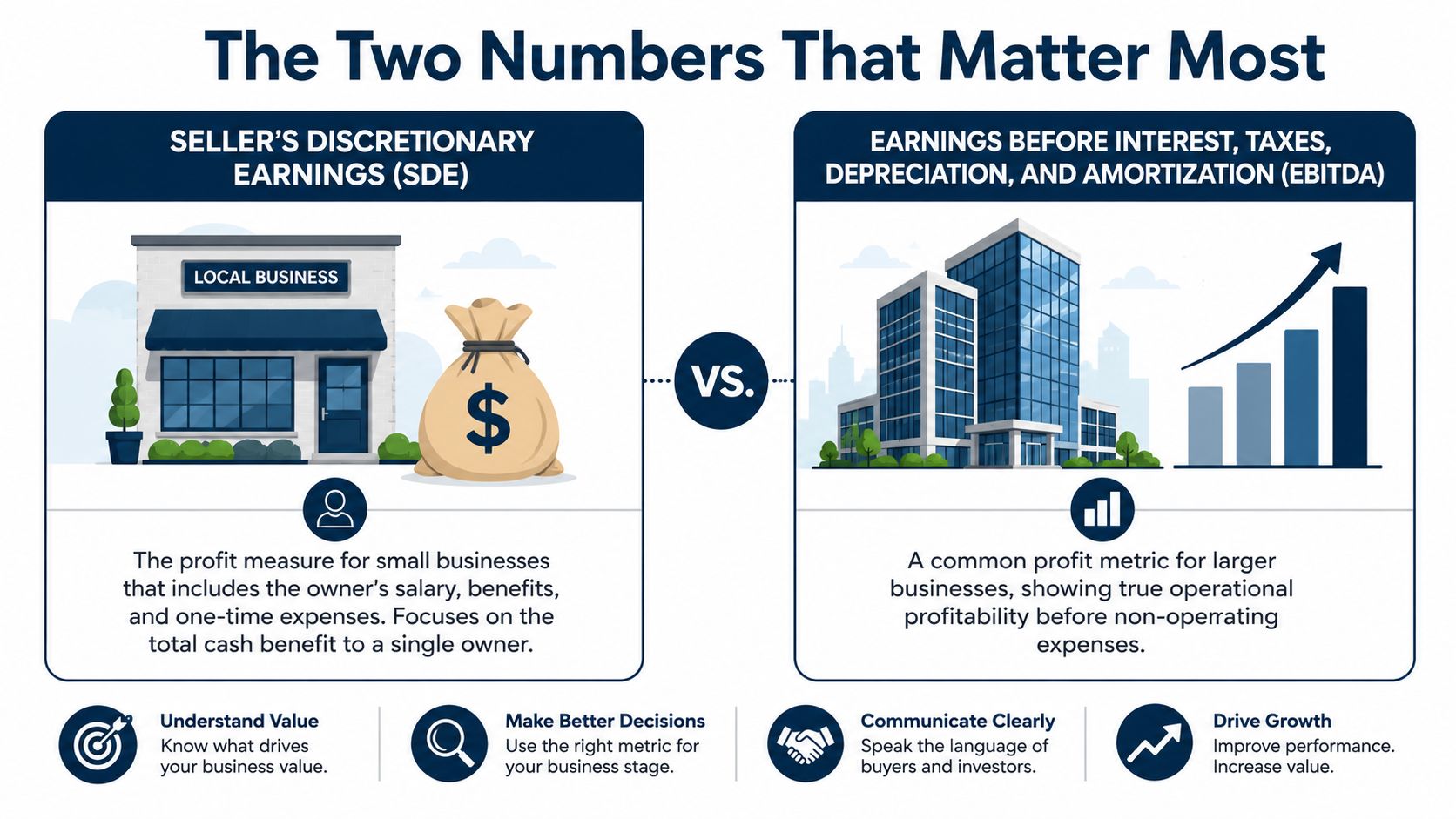
The Two Numbers That Matter Most SDE and EBITDA
When owners first hear valuation terms, they often get buried in acronyms. Ignore most of them. In a sale process, two profit measures matter more than the rest. SDE and EBITDA.
Think of them like two lenses for looking at the same machine. One lens asks, “What does this business put in one owner's pocket?” The other asks, “What does the company earn as an operating company, separate from any one owner?”
When SDE fits
Seller's Discretionary Earnings, or SDE, is usually the profit measure for smaller owner-operated businesses. It includes the owner's salary, perks, and certain one-time or non-business expenses that a new owner may not continue.
A simple way to think about SDE is this. If one person buys the business and steps into your shoes, how much total financial benefit does the business throw off for that person?
Examples where SDE often makes sense:
- Local service companies where the owner still sells or manages daily work
- Small agencies where the founder handles key client relationships
- Retail and trade businesses where ownership and operations are still tightly linked
When EBITDA fits
EBITDA strips out interest, taxes, depreciation, and amortization to show operating profitability. Buyers use it more often when a business has some management depth and can be viewed as a stand-alone company, not just an owner's job with staff attached.
The shift usually happens around $2 million in enterprise value, when buyers like institutional investors and private equity start paying attention, as noted in Sunbelt's market review.
Here's the plain version.
| Profit measure | Best fit | Core question |
|---|---|---|
| SDE | Smaller owner-led businesses | What does one owner get out of this? |
| EBITDA | Mid-sized firms with structure | What does the company earn as an operation? |
Why owners get tripped up
The mistake isn't just picking the wrong metric. The mistake is speaking one language while buyers speak another. If you present SDE to a buyer who wants EBITDA, or EBITDA to a buyer looking at owner benefit, you create confusion right away.
Practical rule: Use the metric that matches how the business will run after the sale, not how you prefer to describe it.
If you want a better feel for how earnings multiples vary across sectors, a page on business valuation multiples by industry can help you frame the conversation before you talk with buyers or advisors.
Getting Your Financials Ready for a Buyer
You tell a buyer the business earns $900,000. Their diligence team comes back at $700,000. Nothing changed in the business. The gap came from how the numbers were presented, what could be proven, and which expenses would survive after the sale.
That is the sellability gap in plain English. A valuation model can produce one number on paper, but buyers pay based on what they believe will hold up after closing.
What normalization really means
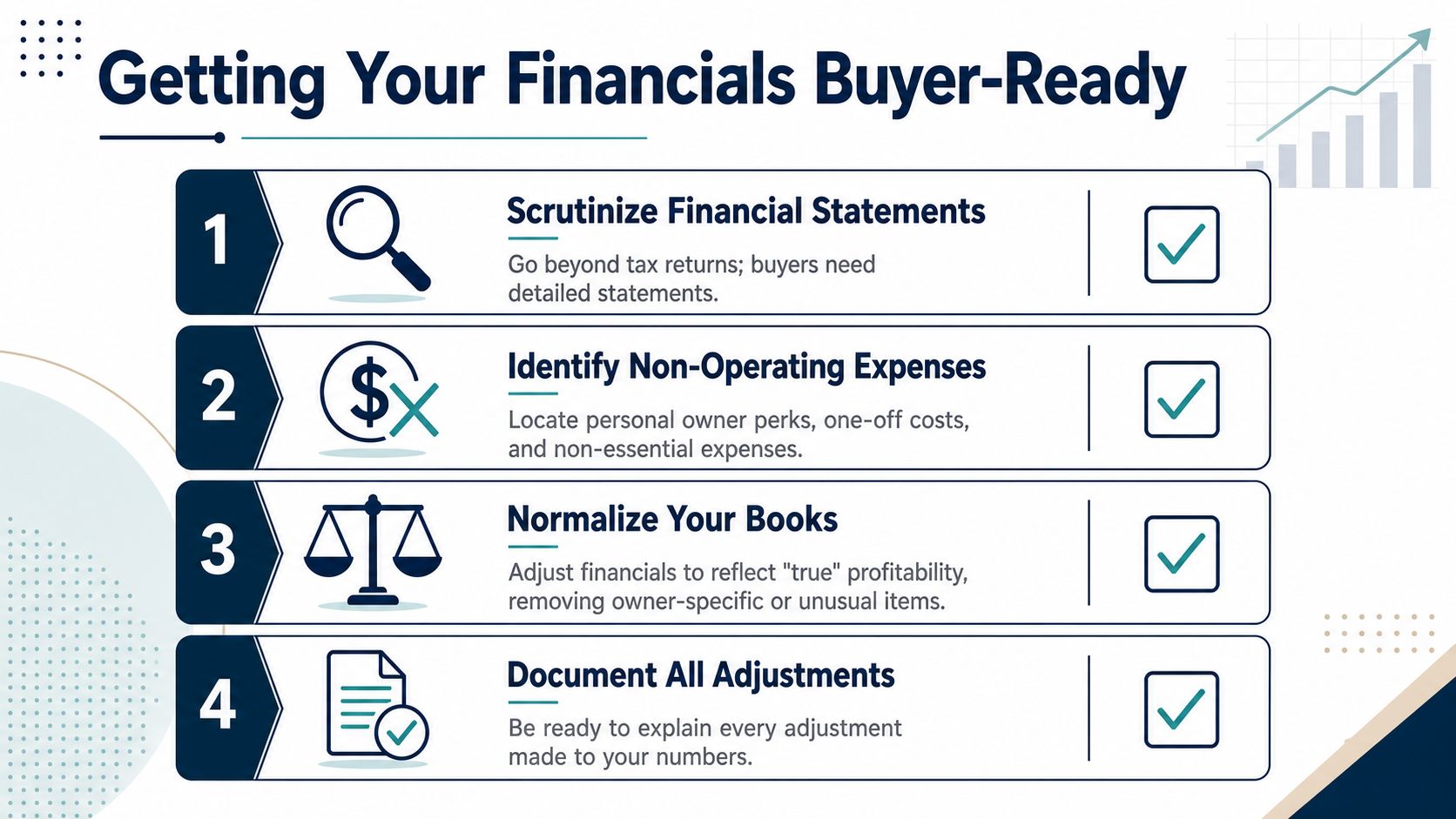
Normalizing the financials means recasting your results so a buyer can judge ongoing earning power under their ownership, not under your personal habits, tax strategy, or bookkeeping shortcuts.
On paper, that sounds technical. In practice, it is simple. Buyers want to know which expenses belong to the business and which belong to the current owner.
That is why add-backs matter. They can raise the earnings base used for valuation, but only if they are real, consistent, and documented.
Common examples include:
- Owner compensation above a market replacement cost. If you pay yourself more than a hired manager would earn, a buyer may adjust that difference.
- Personal expenses run through the company. Vehicle costs, travel, meals, club dues, or phones can be added back if they are clearly not operating costs.
- Family payroll with weak support. If someone is on payroll but their role is vague or intermittent, buyers will challenge it.
- One-time expenses. Legal disputes, unusual repairs, relocation costs, or a nonrecurring consulting project may be adjusted if they are isolated.
Here is the trade-off sellers need to understand. Every add-back can improve value. Every weak add-back can damage credibility.
I have seen owners hurt their case by pushing for every possible adjustment instead of the defensible ones. Buyers rarely object to a well-supported adjustment. They do object to a pattern that makes the books feel optimistic.
What buyers look for behind the numbers
Clean financials do more than support a valuation. They reduce fear.
A buyer is asking practical questions while reviewing your statements. Can this business run without constant owner intervention? Are margins stable, or were they propped up by delayed maintenance and underpaid staff? Does one large customer account for too much revenue? If the books are messy, those risks feel larger, and the multiple usually comes down.
The sellability gap tends to widen. Two companies can show similar profit, but the one with cleaner reporting, lower customer concentration, and less owner dependency usually gets the stronger offer because the earnings look transferable.
How to get your numbers buyer-ready
Owners usually make the most progress by tightening a few basics:
Reconcile every account
Bank accounts, credit cards, loans, payroll liabilities, sales tax. If balances do not tie out, buyers assume there are other problems they have not found yet.Build support for each adjustment
Keep invoices, payroll detail, lease agreements, settlement papers, and short notes explaining why each item is nonrecurring or personal.Separate personal spending from business spending now
A few clean reporting periods help more than a long explanation. Buyers put more weight on current habits than promises.Use consistent expense coding
If auto expenses move between accounts, or contractor costs get mixed with payroll, buyers spend more time reworking your numbers and less time trusting them.Prepare for questions that are not purely accounting questions
If margins improved, be ready to explain why. If one customer grew fast, be ready to show the relationship is stable. If you still approve every quote or major purchase, expect concern about transition risk.
Buyers do not pay for adjustments they see in a spreadsheet. They pay for earnings they believe will survive the handoff.
A quick buyer-ready checklist
| Area | What a buyer wants to see |
|---|---|
| Financial statements | Clean, consistent statements that tie to source records |
| Adjustments | Documented add-backs with a clear reason |
| Expense coding | Personal and non-operating items separated out |
| Consistency | The same logic applied across periods |
If you want a practical sense of how buyers test earnings before they finalize price, this overview of what a quality of earnings report covers is worth reading before you start preparing your files.
How to Calculate Your Business Valuation
Once your earnings number is in better shape, the basic math gets pretty simple. The most common method for SMBs is applying an industry multiple to earnings. For small businesses, that usually means 2.0x to 4.0x SDE. For mid-sized businesses, it often means 3.0x to 6.0x EBITDA, based on Morgan & Westfield's overview of valuation methods.
The formula is straightforward:
Value = earnings x multiple
The part that causes trouble isn't multiplication. It's picking the right earnings figure and the right multiple.
A small landscaping company using SDE
Take a local landscaping business. The owner still handles estimates, manages crews, and takes home a salary. This is classic SDE territory.
Start with reported profit. Then adjust for things a new owner may not keep, such as excess owner compensation, personal items run through the business, and a one-time repair bill from an unusual breakdown. The result is adjusted SDE.
Now apply a market multiple.
If the business is steady, has decent records, and the crews can work without the owner riding along every day, it may sit somewhere in the normal small-business SDE range. If the owner is the rainmaker, scheduler, and quality-control person all at once, the multiple usually slides lower.
The lesson is simple. Two landscaping companies can show similar SDE and still sell for different prices because one is transferable and the other is owner glued.
A small IT consulting firm using EBITDA
Now take a small IT consulting firm with project managers, account leads, and a more formal operating structure. The founder still matters, but the business looks more like a company than a job. That's where EBITDA becomes more useful.
You start with operating profit and adjust for non-operating items. Interest, taxes, depreciation, and amortization are excluded to show the earning power of the business itself. If there are unusual one-time expenses, you review those too.
Then apply an EBITDA multiple from a realistic range for a mid-sized business. A firm with durable contracts, repeat clients, and a team that can carry delivery after the founder exits usually gets a stronger look than one built around one technical expert.
Don't obsess over the first number you get. Use it as a starting range, then pressure-test the risks that could move the multiple up or down.
Back-of-the-napkin rules that actually help
A rough valuation is useful if you treat it like a draft, not a verdict.
- Start with the right profit metric. Small owner-led firms often start with SDE. More structured firms often start with EBITDA.
- Use a range, not one number. A market range keeps you honest.
- Pressure-test the multiple. Customer mix, systems, leadership depth, and clean books can change what a buyer will pay.
- Expect adjustment. Buyers almost always recast the numbers their own way.
If you want to compare the main valuation approaches side by side before running your own estimate, this guide to business valuation methods for small business is a helpful reference.
Simple Ways to Increase Your Business Value Before Selling
A seller gets told their business is worth 4x earnings. Then the buyer visits, asks who approves pricing, learns one customer drives a big share of revenue, and notices nothing important is written down. The math still says 4x. The offer often does not.
That gap is where sale price gets won or lost.
Owners often focus on squeezing this year's profit higher. Buyers focus on whether the business will hold together after the owner leaves. If the answer feels uncertain, they lower the multiple, ask for seller financing, or walk away. The practical job before a sale is to close that sellability gap.
Reduce owner dependency
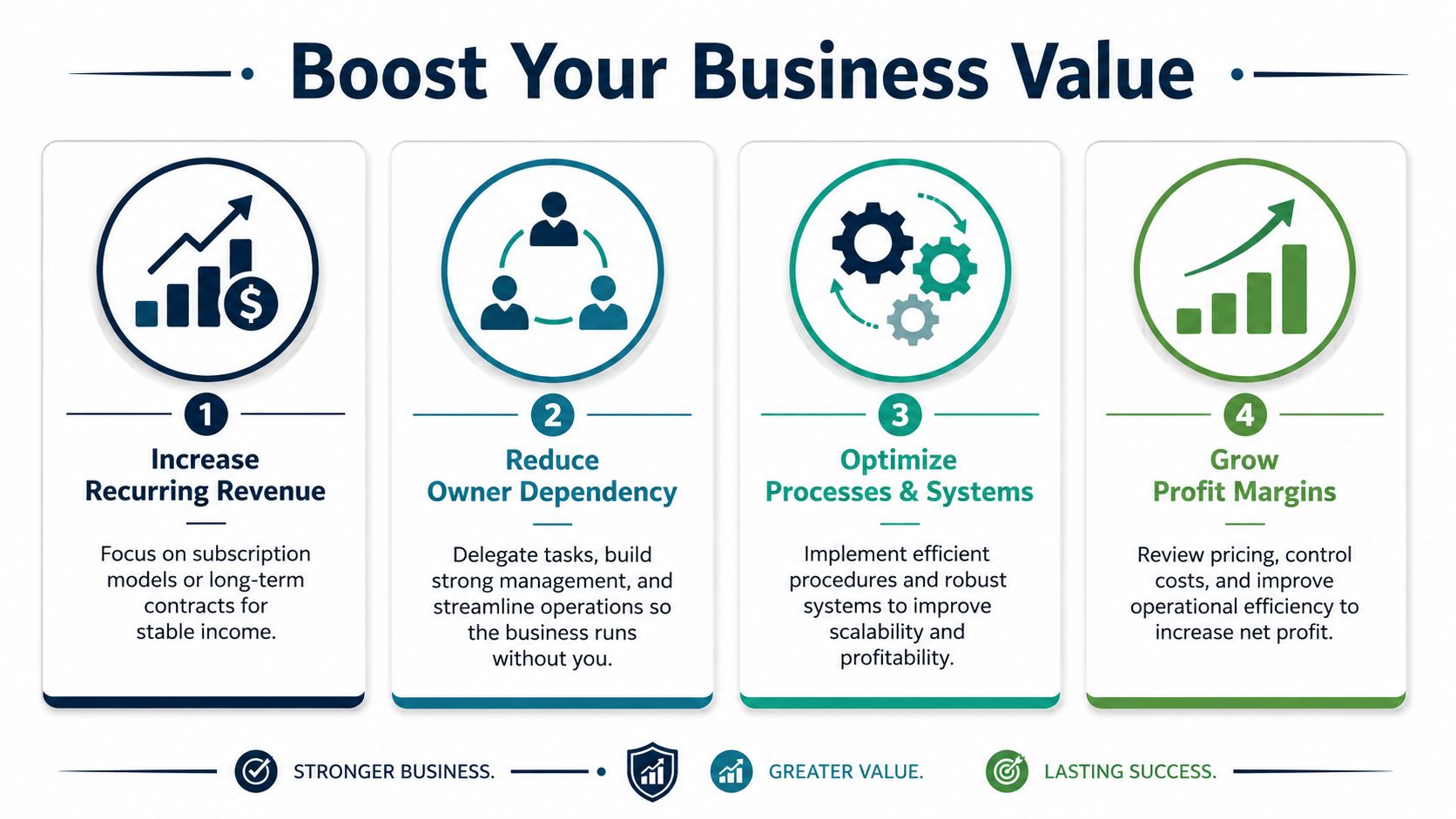
Owner dependency is one of the fastest ways to lose value in a real deal. If you are the only person who can price work, calm down key clients, approve exceptions, or keep staff aligned, a buyer sees a business that may shrink the moment you leave.
The fix is rarely dramatic. It is usually operational.
Move routine decisions into documented processes and assigned roles. Put pricing logic into a playbook. Have someone else run weekly scheduling. Shift client communication to account managers or team leads where possible. Train a second person on anything that would stop cash flow if you disappeared for two weeks.
Simple examples:
- A service owner trains a manager to quote standard jobs within set margin bands.
- An agency founder moves day-to-day client calls to account leads and only joins major reviews.
- A practice owner documents intake, billing, and follow-up so the office runs the same way every day.
A buyer does not need you to be absent. A buyer needs proof that you are not the only load-bearing wall.
Lower customer concentration
A business can look healthy on paper and still feel risky to a buyer if too much revenue sits in one account. The issue is not just exposure. It is negotiating power. A buyer knows that if one client leaves, the forecast breaks.
The goal is not to eliminate strong accounts. The goal is to avoid being hostage to one of them.
Three moves usually help:
- Broaden the customer mix. Add more accounts in the same niche before expanding into unrelated markets.
- Build multiple relationships inside major clients. One loyal contact is helpful. A network of contacts is safer.
- Tighten agreements where possible. Clear terms, notice periods, and renewal habits make revenue easier to underwrite.
If a large customer is unavoidable, be ready to explain why the relationship is durable and how the business would respond if that account changed. That answer can protect value.
Build more predictable revenue
Buyers pay for earnings they believe will repeat.
Recurring revenue is one version of that, but it is not the only one. Maintenance plans, annual renewals, reorder patterns, service contracts, and long-standing client habits all help. The point is visibility. Buyers want to see what next quarter is likely to look like without guessing.
There is a trade-off here. One-off projects can produce strong margins and make a single year look great. Repeatable revenue often produces a better sale because it lowers perceived risk. I have seen owners chase the highest-margin custom work right before a sale, only to make the business look harder to own.
Predictability usually beats spikes.
Tighten systems before buyers start asking
Clean systems do two things. They make the business easier to transfer, and they keep buyers from discounting the price during diligence.
Focus on the basics first:
| Move | Why it matters in a sale |
|---|---|
| Delegate key roles | Shows the business can run without the owner |
| Diversify customers | Lowers the risk that one account hurts value |
| Increase recurring or repeatable revenue | Gives buyers more confidence in future earnings |
| Document systems | Reduces transition risk and buyer friction |
This is also the stage where legal cleanup matters. Loose contractor agreements, unclear ownership of IP, and old customer contracts can slow a deal or give buyers a reason to retrade. If you want a low-cost way to spot issues early, an AI legal assistant for business owners can help you review the practical weak points before they become deal points.
You cannot control the market. You can control whether a buyer sees a company that transfers cleanly, keeps its customers, and performs without the founder in the middle of every decision. That is what raises real sale value.
When to Call a Professional and What Happens Next
A rough estimate done on your own is a good start. But there's a point where DIY stops helping.
If the business has tricky add-backs, large assets, intellectual property, uneven margins, partner issues, or a buyer pool beyond local owner-operators, professional help usually pays for itself in clarity alone. It also protects you from a common problem. Owners spend months talking to buyers before they've built a defensible case for value.
Signs it's time to bring someone in
Bring in a valuation professional, M&A advisor, or transaction-focused CPA when:
- The business story is complicated. Maybe the books are clean enough for taxes but not clean enough for sale.
- Your valuation could be challenged easily. This happens when earnings, asset value, or growth story point in different directions.
- You need buyer positioning, not just math. Pricing the deal is only part of the job. Packaging it matters too.
There's a broader reason this matters too. The global Business Valuation Service Market is projected to reach $20.25 billion by 2035, which points to growing demand for valuation expertise as deals get more complex, according to FE International's agency valuation analysis.
What happens after you hire help
A good advisor usually starts by cleaning the earnings story and identifying the sellability risks that could drag the price down. Then they help frame the business for the right buyers.
That often leads to a sequence like this:
Financial cleanup and positioning
The numbers get normalized. Risk areas get identified. Weak spots get addressed where possible.Marketing package preparation
The advisor drafts a confidential summary or a more detailed buyer package that explains the business clearly.Confidential buyer outreach
Buyers are screened before they see sensitive information.Due diligence and negotiation
Here, many deals wobble. The earlier work on earnings quality and sellability pays off here.
If you're reviewing contracts, deal terms, or legal language during that stage, tools like an AI legal assistant for business owners can help you get your bearings before you talk with counsel. It's not a substitute for legal advice, but it can make the process less intimidating.
The main point is simple. A sale isn't won by the owner with the highest hoped-for number. It's won by the owner with believable earnings, low transfer risk, and a deal package that stands up under pressure.
If you want help cleaning up your books, normalizing earnings, and closing the sellability gap before you go to market, MyOfficeOps can help you build the kind of financial story buyers trust. From bookkeeping and reporting to CFO-level guidance and exit preparation, they help owners turn messy numbers into a business that's easier to value, easier to sell, and easier to hand off.