

You've opened a spreadsheet, entered your revenue and profit, and watched a valuation number appear. It looks precise, so you send it to a potential buyer. Then the questions arrive. Why did you add back the owner's salary? Why is this customer expected to stay? Why did you choose that method? What was the business worth on the valuation date?
That's where a weak report falls apart. A business valuation report template should do more than produce a figure. It should help you explain how the business makes money, which assumptions support the result, and why a buyer, lender, or investor should trust your analysis.
Why Your Valuation Story Matters More Than the Math
A business owner often treats valuation like a calculator. Revenue goes in, earnings go in, a multiple gets applied, and the result becomes the asking price. That approach feels clean because numbers look objective. The problem is that buyers don't buy a spreadsheet. They buy the future cash flow they believe the business can produce.
Consider a small consulting firm led by its founder. The owner has strong margins, a loyal customer base, and several large contracts. The spreadsheet shows attractive earnings. But the buyer sees that the founder personally handles the biggest accounts, approves every project, and brings in nearly all new work. The number may be mathematically correct, yet the buyer still has a serious question: what remains after the founder leaves?
That question belongs in the report's narrative. Explain who the customers are, how revenue repeats, how work gets delivered, and which responsibilities sit with the owner. If recurring revenue is a major strength, show how contracts renew and what support customers receive. If one customer represents a meaningful share of sales, don't hide it. Explain the relationship, contract terms, renewal history, and plan for reducing that dependency.
Turn a number into a defendable case
A credible report answers four basic questions:
- What creates cash flow? Describe the products or services, pricing model, customer types, sales process, and delivery model.
- What could interrupt cash flow? Discuss customer concentration, owner dependency, contract risk, staffing gaps, debt, and other relevant exposures.
- Which assumptions drive value? Identify the expected growth, margin quality, recurring revenue, working capital needs, and risk considerations behind the conclusion.
- Why does the selected method fit? Show why the income, market, or asset approach reflects how a buyer would assess this particular business.
The report should read like a clear conversation with a skeptical buyer. Don't claim that your company is “unique” or “poised for explosive growth” unless you can support those statements. Show the evidence instead. A strong customer retention pattern, documented processes, diversified revenue, or stable margins says more than polished marketing language.
Practical rule: Every important adjustment or assumption should have an owner, a reason, and supporting evidence.
A valuation report also needs context. The value of a business interest depends on what is being valued, why the valuation is being prepared, the applicable date, and the standard of value. A report prepared for internal planning may answer a different question from one prepared for a lender, an acquisition, or a legal dispute.
Your template is therefore a defense file, not a form to complete as quickly as possible. The math is necessary. The story is what makes the math believable.
Setting Up the Front Section of Your Report
The front section establishes the rules before anyone reviews the conclusion. A reader should understand the assignment without digging through financial schedules. If the opening pages are vague, the rest of the report feels less reliable, even when the calculations are sound.
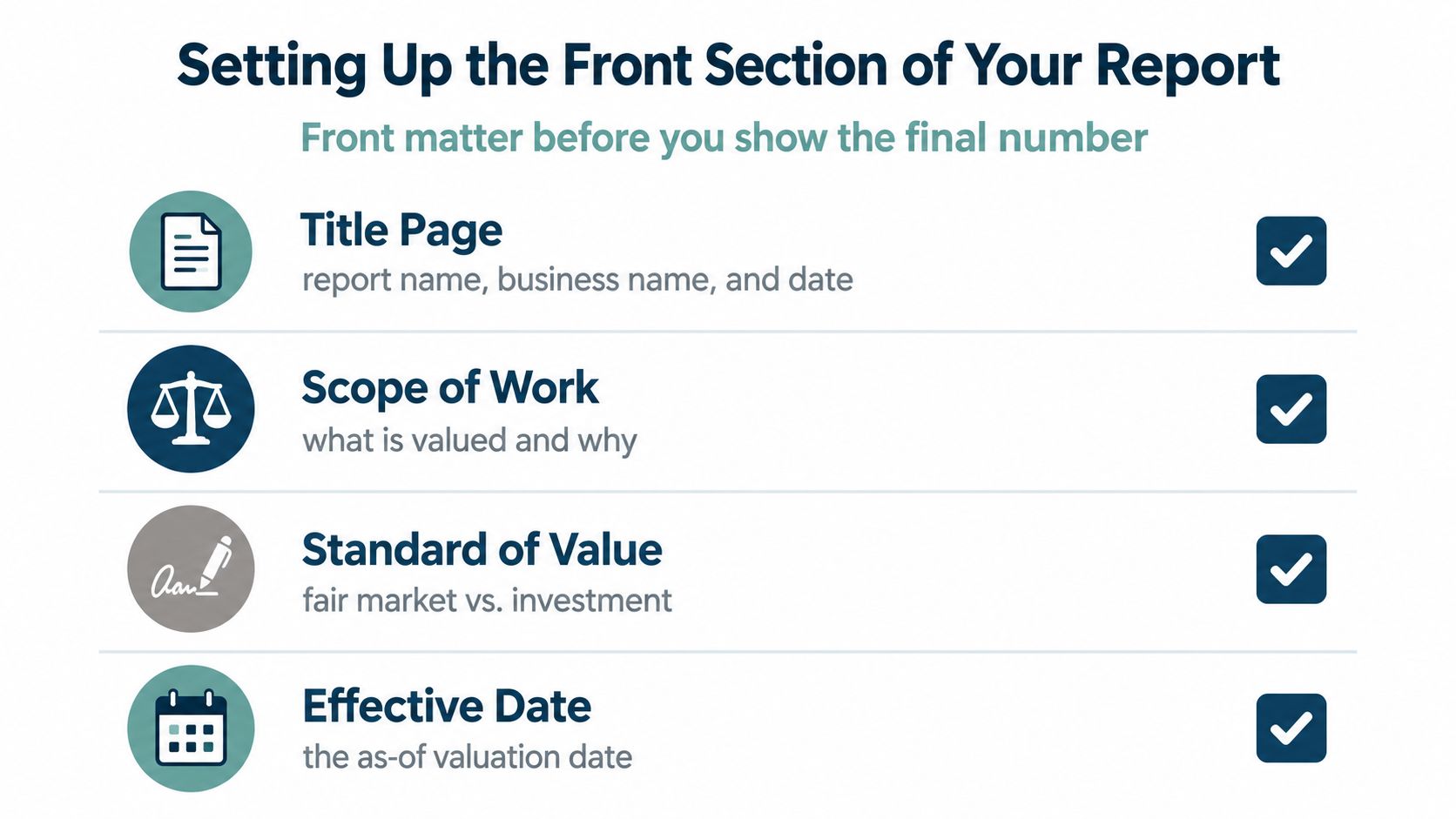
Start with the title page. Name the business, identify the ownership interest or assets being valued, state the report date, and identify the intended recipient. Then write the purpose in plain language. “To estimate the value of the controlling ownership interest for internal succession planning” is more useful than “for valuation purposes.”
Define the assignment before the analysis
Use this order when completing the front matter:
- Identify the property and interest. State whether the subject is the entire business, shares, partnership units, specific assets, or another interest. Clarify whether the interest has control and voting rights if that matters to the assignment.
- State the effective valuation date. This is the as-of date for the opinion. Financial information from another period may be useful, but it shouldn't replace the stated date without clear justification.
- Explain the purpose and intended use. A report for a bank, buyer, shareholder, tax matter, or internal plan may require different analysis and language.
- Name the standard or definition of value. Explain whether the report uses fair market value, investment value, fair value, or another defined basis. Don't assume every reader uses these terms in the same way.
- List assumptions and limiting conditions. State what information was provided, what was independently reviewed, and which matters fall outside the assignment.
- Describe the scope. Identify the records, interviews, analyses, and approaches used. If an investigation was limited, say so directly.
The IRS valuation guidance for business interests treats the property and interest, effective date, purpose, standard of value, assumptions, limiting conditions, and scope limitations as core report elements. It also expects consideration of the income, market, and asset approaches where applicable.
Make the boundaries visible
Limiting conditions aren't an apology for the report. They're boundaries that tell the reader what the conclusion does and doesn't mean. For example, the report may rely on management representations, unaudited financial statements, or an assumption that the business continues operating. A buyer can then test those assumptions instead of discovering them late in diligence.
Put the conclusion in a clear summary, but don't let the summary stand alone. State the subject, purpose, valuation date, standard of value, approach, and conclusion together. That gives a bank or buyer a quick orientation and gives the detailed analysis a clear reference point.
Choosing the Right Valuation Method for Your Business
The right valuation method depends on what a buyer is really purchasing. A service firm is usually valued for its ability to generate future earnings. A property-heavy company may be judged more heavily by its assets. A company with comparable transactions may benefit from market evidence. Selecting a method because it's familiar is a poor reason.
Match the approach to the business
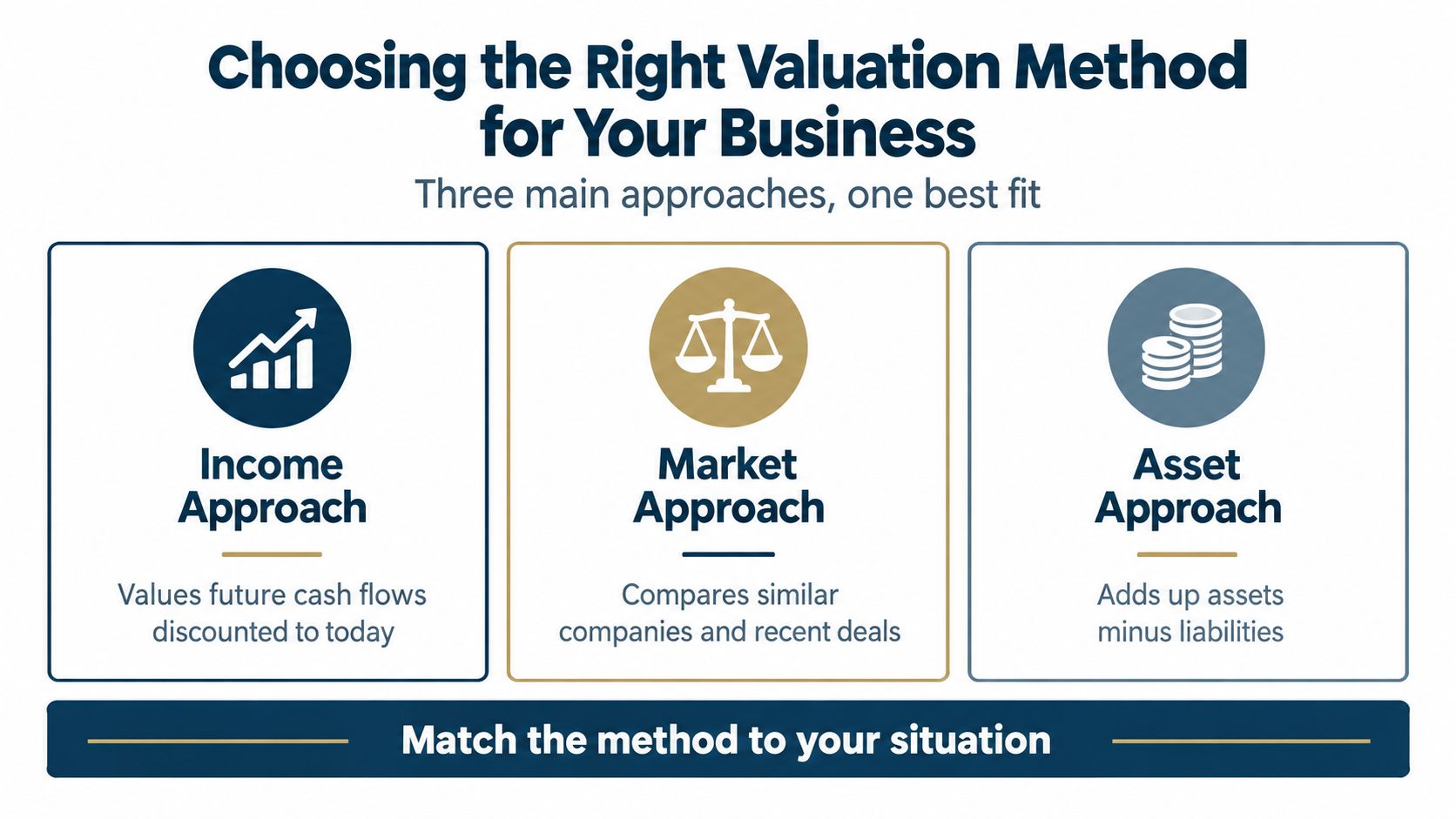
Income approach. This method asks what future economic benefits are worth today. It's a natural starting point for a consulting firm, agency, medical practice, or software business with operating earnings and a measurable path to future cash flow. The report should explain the forecast, the risk applied to those benefits, and why the forecast is realistic.
Market approach. This method compares the business with relevant transactions or market evidence. The comparison only helps if the businesses share meaningful traits, such as customers, services, management depth, earnings profile, competition, and capital needs. A large company in a different market isn't a useful comparison just because its industry label looks similar.
Asset approach. This method focuses on the value of assets after considering liabilities. It can make sense for a holding company, a capital-intensive operation, or a business that may be wound down. It can understate a company whose main value comes from relationships, workforce knowledge, brand, or future earnings.
The small-business guide to business valuation methods offers a useful companion when you're deciding how the approaches fit your operating model. Use it to organize your thinking, then write the specific reasons that apply to your company.
Use secondary methods as reality checks
You don't always need to give every approach equal weight. Choose the primary method that best represents the business, then use the others as cross-checks where the information supports them. If the income approach produces a conclusion far above the asset value, explain why intangible value and future earnings justify the difference. If the market evidence points lower, investigate the assumptions instead of ignoring the result.
A standard report should explain the valuation basis, whether the business is being considered as a going concern or on a liquidation basis, and why the selected approach fits. It should also identify the assumptions that affect the conclusion, as described in Practice Standard No. 110 from the Canadian Business Valuation Institute.
The method also affects financing discussions. A buyer may use different funding sources and structures depending on the expected cash flow, collateral, and risk. For a practical overview of the questions buyers face, Dealmaker Wealth Society's acquisition financing advice provides useful context.
Don't force a single answer where the evidence points to a range. The report should make clear which method carries the most weight and why.
Defending Your Add-Backs and Normalization Adjustments
Normalization adjustments are where many owner-prepared valuations lose credibility. Owners often know that personal expenses, unusual fees, or owner compensation affect reported profit. Buyers know that too. Their concern isn't whether an adjustment exists. Their concern is whether the expense will disappear after closing.
An add-back must answer a simple question: will a new owner avoid this cost without hurting the business? If the answer is no, it isn't a clean add-back. An owner's salary may be adjustable when a buyer will operate the business differently, but the report still needs to account for the cost of replacing the owner's work. A personal expense may be removable, but only if it isn't supporting employees, customers, or operations.
Build an evidence trail
For every adjustment, record the account, amount, period, reason, supporting documents, and expected treatment after a transaction. Attach invoices, contracts, payroll records, or notes from management interviews where they help prove the point.
Use language that describes facts, not wishes. “The company paid a one-time legal fee related to a settled matter, supported by the invoice and general ledger entry. Management doesn't expect the fee to recur in ordinary operations.” That is stronger than “one-time expense, add back.”
| Adjustment Type | Example | How to Defend It |
|---|---|---|
| Owner-specific cost | Personal travel charged to the company | Provide the transaction detail, explain why it wasn't required for operations, and show that removing it won't affect customer or employee activity. |
| One-time event | A nonrecurring legal, repair, or relocation cost | Attach the invoice and explain the event, payment date, and reason the cost isn't part of normal operations. |
| Excess owner compensation | Compensation above the cost of an operating replacement | Compare the owner's duties with the planned replacement role and include the replacement cost in the analysis. |
| Non-operating item | Expense tied to an investment or activity outside the core business | Separate the item from operating results and explain whether the related asset or liability is included in the value. |
A useful EBITDA normalization resource for small businesses can help you organize the bridge from reported earnings to normalized earnings. The final report still needs company-specific support. A generic adjustment list won't survive a buyer's questions.
Don't confuse add-backs with free cash flow
A normalized earnings figure isn't the same as cash available to a buyer. The buyer may need working capital, equipment, debt service, hiring, or technology spending. If the owner performs sales, project management, clinical work, or estimating, the report must show what it costs to replace that contribution.
A serious report also separates discretionary spending from costs that merely look unusual. A large marketing invoice might be a one-time campaign, or it might be the reason the sales pipeline exists. Ask what would happen if the expense disappeared. If revenue would suffer, treat the expense as part of the operating model.
Many template pages explain the mechanics but don't answer the practical question of how to make the report lender-, investor-, or buyer-ready. The sample business valuation report guidance from C.T. Acquisitions highlights that assumptions, normalization adjustments, and the valuation date need to be explained in a way that can withstand scrutiny.
Filling in the Core Narrative and Financial Sections
The middle of the report should let a new reader understand the company without sitting beside the owner. Write it for someone intelligent who doesn't know your business. Avoid slogans. Explain the engine.
Start with the business description. Cover the ownership structure, products or services, customers, geography, sales channels, suppliers, employees, facilities, technology, and competitive position. Then explain how the company earns money. A law firm may bill by matter and attorney time. A contractor may earn revenue by project. A clinic may combine services, insurance payments, and patient demand. The report should make that model easy to follow.
Write the business description like an operator
A strong description connects facts to value:
- Customer base: Identify customer types, contract arrangements, concentration, and the reason customers choose the business.
- Revenue model: Explain recurring, project-based, subscription, referral, or transaction revenue.
- Delivery system: Describe who performs the work and whether documented processes support consistent service.
- Competitive position: State what protects the business from ordinary competition, such as relationships, expertise, location, systems, or switching costs.
- Transferability: Explain what a buyer receives and what still depends on the current owner.
Don't call the business “highly scalable” without showing what can scale. Name the process, team, capacity, or technology that supports the claim.
Turn financial statements into an explanation
Present the income statement, balance sheet, and cash flow information in a way that shows how the business changed. Discuss revenue quality, gross margin, operating expenses, normalized earnings, working capital, debt, and non-operating assets or liabilities. Explain unusual movements instead of leaving the reader to guess.
A useful analysis might say that a margin changed because the company added staff before a new service line reached full demand. Then show whether management expects that cost to produce future capacity or whether it reflects a permanent change in the model. The report should distinguish between a temporary event and a new normal.
The industry outlook belongs here too. Discuss the forces that affect demand, pricing, labor, regulation, suppliers, technology, and competition. Tie the outlook to the company. A broad statement about industry growth means little if the business serves a shrinking customer segment or lacks the staff to capture demand.
ASA standards call for a thorough written report to present pertinent information, valuation methods, and conclusions clearly. NACVA standards allow a Summary or Detailed Report for a Conclusion of Value, while a Calculated Value requires a separate Calculation Report, as explained in the ASA business valuation standards.
Handling Volatile Markets and Scenario Planning
A single-point valuation can create false confidence. It suggests that the future is known when the result may depend on growth, margins, customer retention, capital costs, and owner transition. A better report shows how the conclusion changes when those assumptions change.
Build three understandable cases
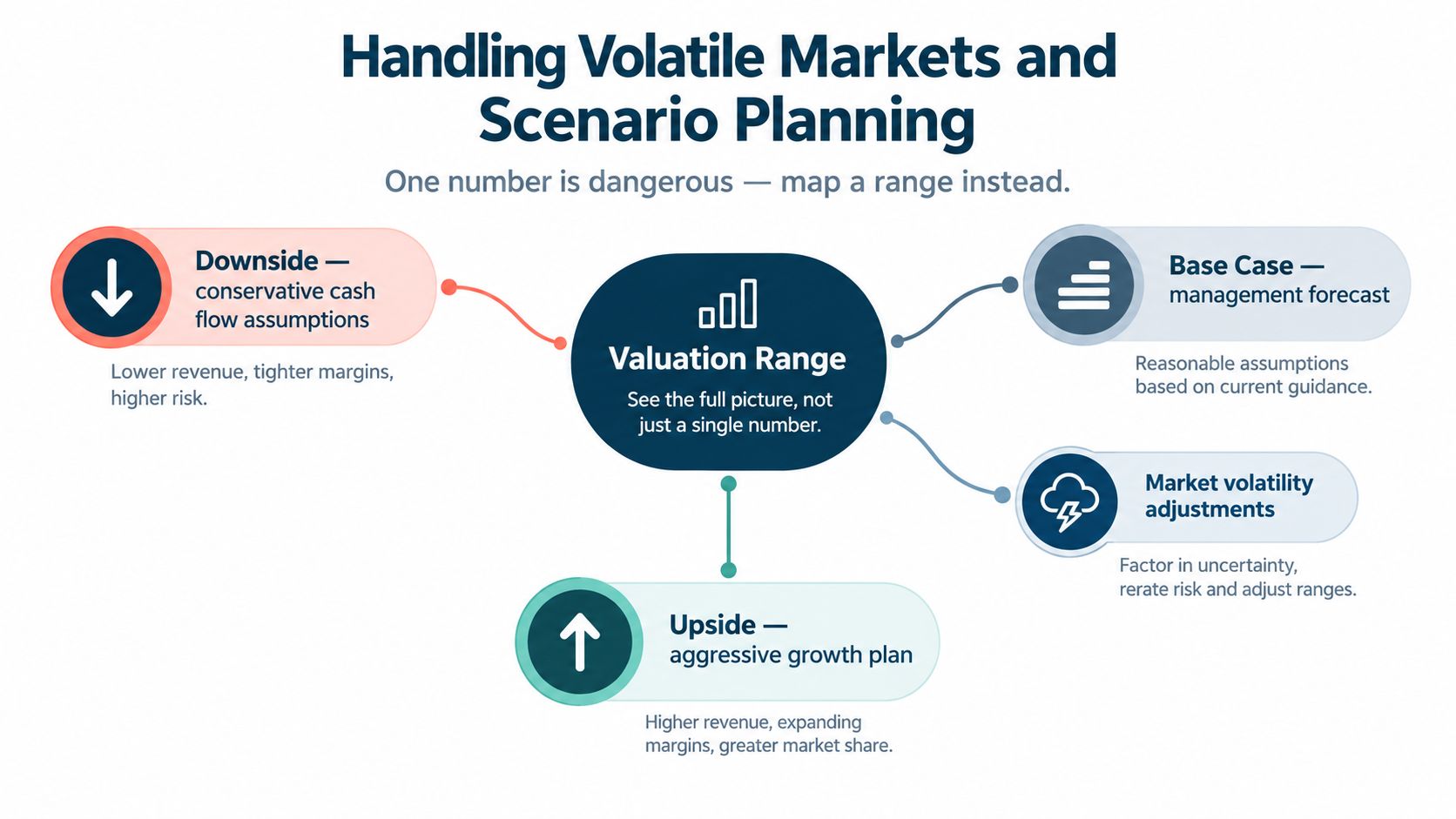
Use a downside case, a base case, and an upside case. Keep the labels plain and make the assumptions visible.
- Downside case: Use cautious assumptions for demand, pricing, margins, customer retention, and owner replacement.
- Base case: Use management's forecast, but test it against contracts, pipeline evidence, staffing plans, and recent operating results.
- Upside case: Include the growth plan only when the business has the capacity, funding, people, and systems to execute it.
Don't use scenarios to make the report look polished. Use them to show which risks matter. If the conclusion changes sharply when one major customer leaves, customer concentration is a central value driver. If the result depends on the owner working full time without replacement, owner dependency needs a clear adjustment.
A modern template should address economic perspective, industry outlook, cost of capital, recurring revenue, customer concentration, owner dependency, growth, and margin quality. Valentiam's business valuation report commentary supports that broader view of the report. The template should help readers see uncertainty, not hide it behind a precise-looking output.
Explain the market adjustments
Interest rates, inflation, and sector-specific risk can affect the assumptions used in an income approach and the confidence placed in market comparisons. You don't need to make a dramatic prediction. State what changed, how it affects the business, and which assumption reflects that change.
A forecasting tool can help you compare cases and keep assumptions consistent across revenue, staffing, expenses, and cash flow. Querio's FP&A tooling articles on forecasting and scenario planning offer useful ideas for structuring that work.
The final report should show a range when uncertainty is material, then explain which case management considers most likely. That is more useful to a buyer than a confident number with invisible assumptions.
Your Exit-Readiness Checklist Before Valuing
A valuation can't repair an unorganized business. It can only describe the business that exists. If the books are unclear, contracts are scattered, processes live in the owner's head, and key risks remain unresolved, the report will expose those problems rather than solve them.
Fix the records first
Begin with the financial foundation. Reconcile accounts, separate business and personal spending, classify expenses consistently, and make sure revenue is recorded in the right period. Keep contracts, leases, loan documents, insurance records, tax filings, payroll records, and major invoices in an organized data room.
Then document how work gets done. Write down the sales process, customer onboarding, pricing approvals, delivery steps, billing, collections, purchasing, and close procedures. A buyer pays more confidently when the business can operate through a system rather than through the owner's memory.
Use this practical sequence:
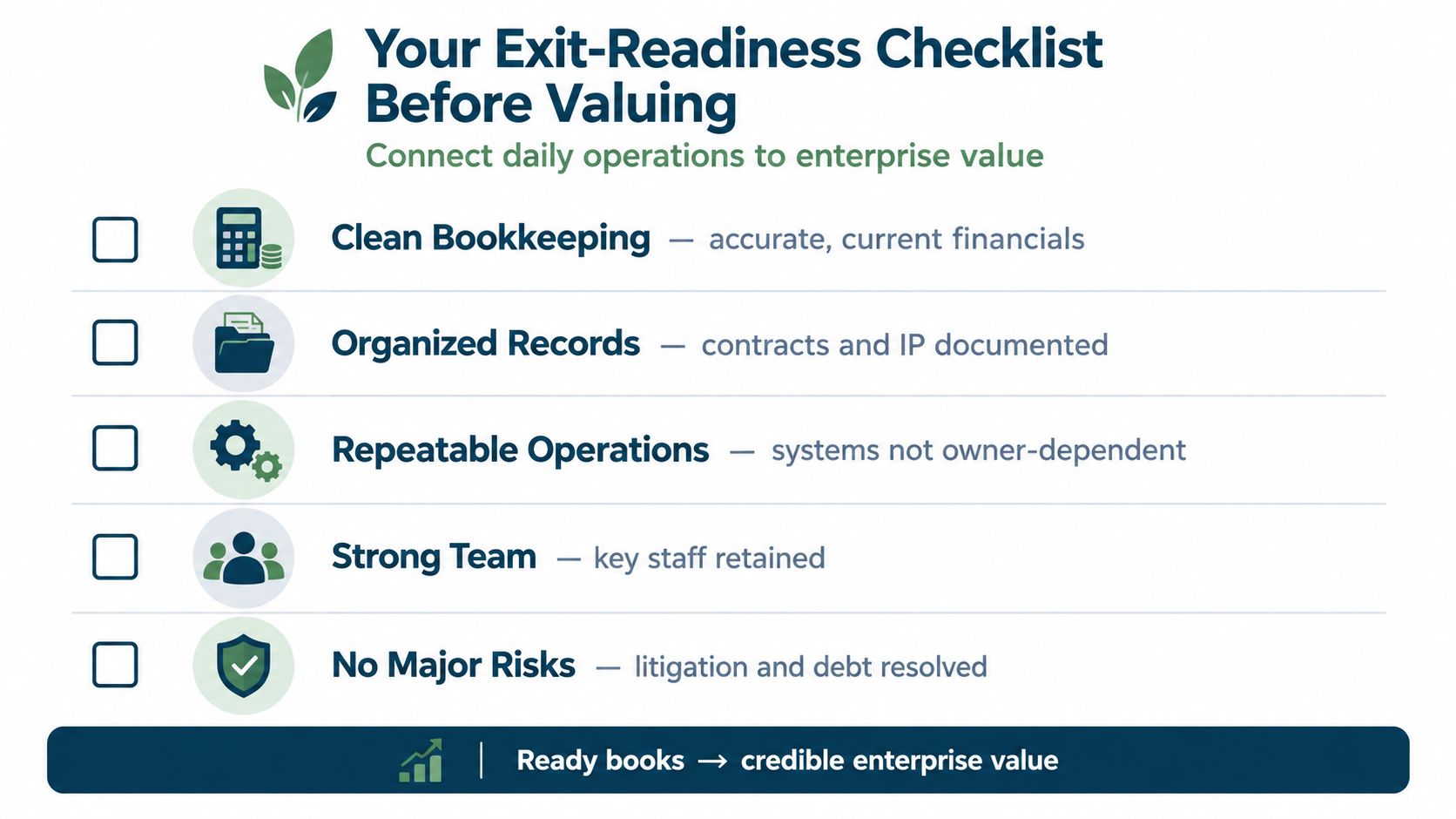
- Clean the books. Resolve unexplained balances and document unusual transactions.
- Organize important records. Store customer agreements, supplier terms, intellectual property records, licenses, and employment documents where another person can find them.
- Reduce owner dependency. Assign decisions, train managers, and record recurring responsibilities.
- Protect the team. Identify critical employees and understand the work each person owns.
- Resolve major risks. Review debt, disputes, compliance matters, insurance coverage, and obligations that could affect a transaction.
- Track useful operating measures. Monitor the indicators that explain revenue, margin, capacity, retention, backlog, or collections.
Connect operations to enterprise value
Clean bookkeeping supports a credible earnings analysis. Documented systems support transferability. A capable management team supports continuity. Risk resolution gives the reader fewer reasons to discount the conclusion.
This doesn't mean every business needs a perfect operation before starting a valuation. It means the owner should know whether the report is measuring a transferable company or a job that depends on one person. That distinction belongs in the narrative and may affect the valuation method, assumptions, and buyer discussion.
Ready books don't guarantee a high value. They make the value easier to understand, test, and defend.
When to Use a Template and When to Hire an Advisor
A template is useful when you need a working estimate, an internal planning tool, or a structured way to prepare for a conversation. It forces you to gather records, identify assumptions, and think about how a buyer might view the business. For an early planning discussion, that discipline can be more useful than a quick online calculator.
A template is not automatically a formal appraisal. It may not address the legal standard, independence requirements, ownership discounts, complex securities, disputed facts, or industry-specific issues that apply to a transaction or proceeding.
Use a template for planning
A well-documented template can fit these situations:
- Internal strategy: You want to understand which operational changes could improve value.
- Early sale preparation: You need a working range before speaking with buyers or intermediaries.
- Partner discussion: Owners need a shared starting point for reviewing earnings, risks, and assumptions.
- Management planning: You want to compare the value effect of hiring, pricing, customer diversification, or process improvements.
Keep the working file organized. Save the source statements, adjustment schedules, forecast versions, method selection, and explanation for each assumption. If someone challenges the conclusion, you should be able to trace the answer back to a document or operating fact.
Bring in an independent advisor when the stakes rise
Hire a qualified valuation professional when the report will support a partner buyout, divorce proceeding, shareholder dispute, tax matter, estate issue, formal financing decision, or complex merger and acquisition transaction. An advisor can define the assignment, select the appropriate standard of value, test management claims, assess discounts or premiums, and prepare a report with the required level of support.
The cost question deserves a wider view. Paying for an expert may feel expensive, but an unsupported conclusion can lead to a lower price, a failed financing request, a dispute, or a renegotiation after diligence. Review the factors that affect business valuation cost before choosing between a planning estimate and a formal engagement.
The best approach is often sequential. Use the template to clean up the story and expose weak evidence. Bring in an advisor when another party will rely on the conclusion in a consequential decision.
MyOfficeOps helps small and midsize businesses organize bookkeeping, financial reporting, forecasting, profitability analysis, and exit-readiness work so owners can build a valuation on reliable information. Visit MyOfficeOps to discuss your books, reporting process, and next step toward a buyer-ready valuation.