

A basic business valuation calculation commonly starts near $1,500 and runs into the low thousands, while a defensible full valuation for a lender, buyer, or court typically lands between $5,000 and $15,000. The right business valuation cost depends on why you need the report and who may challenge the number.
You're probably not asking because valuation is an abstract finance topic. You're at a kitchen table with a laptop open, trying to answer a banker, buyer, or business partner who wants a value now. Maybe you're thinking about selling your company. Maybe your partner wants out. Maybe a lender told you a formal valuation is required before the loan moves forward.
The mistake is treating valuation like a product with one standard price. A rough planning estimate and a signed report built for a lender or court may examine the same business, but they aren't the same service. The report level, the evidence reviewed, and the person expected to defend the conclusion all change the fee.
Why You're Asking This and What the Right Question Actually Is
Start with the decision, not the invoice. If you're trying to decide whether your company is ready to sell, you may need a useful estimate and a clear explanation of the assumptions. If a partner is demanding a buyout price, the number needs more support because another owner has a direct financial interest in disagreeing with you.
A lender creates a different standard. The bank may want documented earnings, market evidence, normalized financial statements, and a report prepared by someone with credentials that fit the assignment. A divorce court, tax authority, or buyer represented by counsel may push even harder. They won't care that your spreadsheet looked reasonable at the kitchen table.
Practical rule: Ask, “Who will rely on this number, and what happens if they reject it?” before asking an appraiser for a quote.
Three common triggers
A sale often begins with a rough range. You want to know whether your asking price is realistic, which earnings adjustments matter, and what a buyer might question. A calculation engagement can be enough early in the process, especially before you spend money preparing for market.
A partner admission or buyout needs more care. The operating agreement may define the process, but the parties still need support for earnings, assets, liabilities, and ownership rights. Disagreements over owner compensation, related-party expenses, or control can turn a simple estimate into a contested assignment.
A lending request usually raises the bar. If the banker specifically asks for a formal valuation, don't hand over a broker's informal opinion and hope nobody notices the difference. Ask the lender what report type, credentials, and professional standards they'll accept.
For a plain-language foundation, how to understand business value can help an owner separate revenue, profit, assets, risk, and market evidence before speaking with a valuation professional.
The price is downstream from purpose. Define the use first, identify the person with veto power, then buy the least expensive report that will survive that person's review.
Calculation Report vs Full Valuation Explained Like You're Twelve
Think of two doctors looking at the same X-ray. The first doctor glances at the image, applies a standard test, and writes a short note. That's a calculation report. The second doctor takes a full history, reviews prior records, orders more tests, compares several possible explanations, and writes a detailed opinion that another doctor can examine. That's a full valuation.
Both doctors may reach similar conclusions, but they didn't do the same work. A calculation report uses a limited scope, fewer inputs, and an agreed method. It gives you a point estimate for a defined purpose. A full valuation examines more records, tests assumptions, considers multiple approaches, and documents why the final conclusion makes sense.
What you're paying for
A calculation report may focus on selected financial statements, a market approach, or another agreed method. It can be useful for internal planning, early sale preparation, or a conversation where nobody expects a courtroom-ready document.
A full valuation usually requires deeper financial normalization, market research, asset review, reconciliation across methods, and a signed conclusion. Professional standards such as USPAP may apply depending on the assignment and intended use. The appraiser's credentials and the report's documentation matter because a lender, buyer, tax authority, or judge may ask how the number was built.
| Feature | Calculation Report | Full Valuation |
|---|---|---|
| Scope | Limited and agreed in advance | Broad review of financial, market, and asset information |
| Methods | Often one primary method | May reconcile income, market, and asset approaches |
| Documentation | Shorter explanation of assumptions | Detailed support for assumptions and conclusion |
| Deliverable | Planning estimate or point value | Defensible opinion of value |
| Best use | Internal planning or early discussions | Lending, tax, disputes, formal sale support |
| Credentials | Match the intended use | Credential and standards requirements are more demanding |
You can review business valuation methods for small business if you want to understand the income, market, and asset approaches before choosing a scope.
The price gap isn't appraiser greed. It pays for the records reviewed, the methods tested, the assumptions documented, and the professional risk of standing behind the conclusion when someone challenges it.
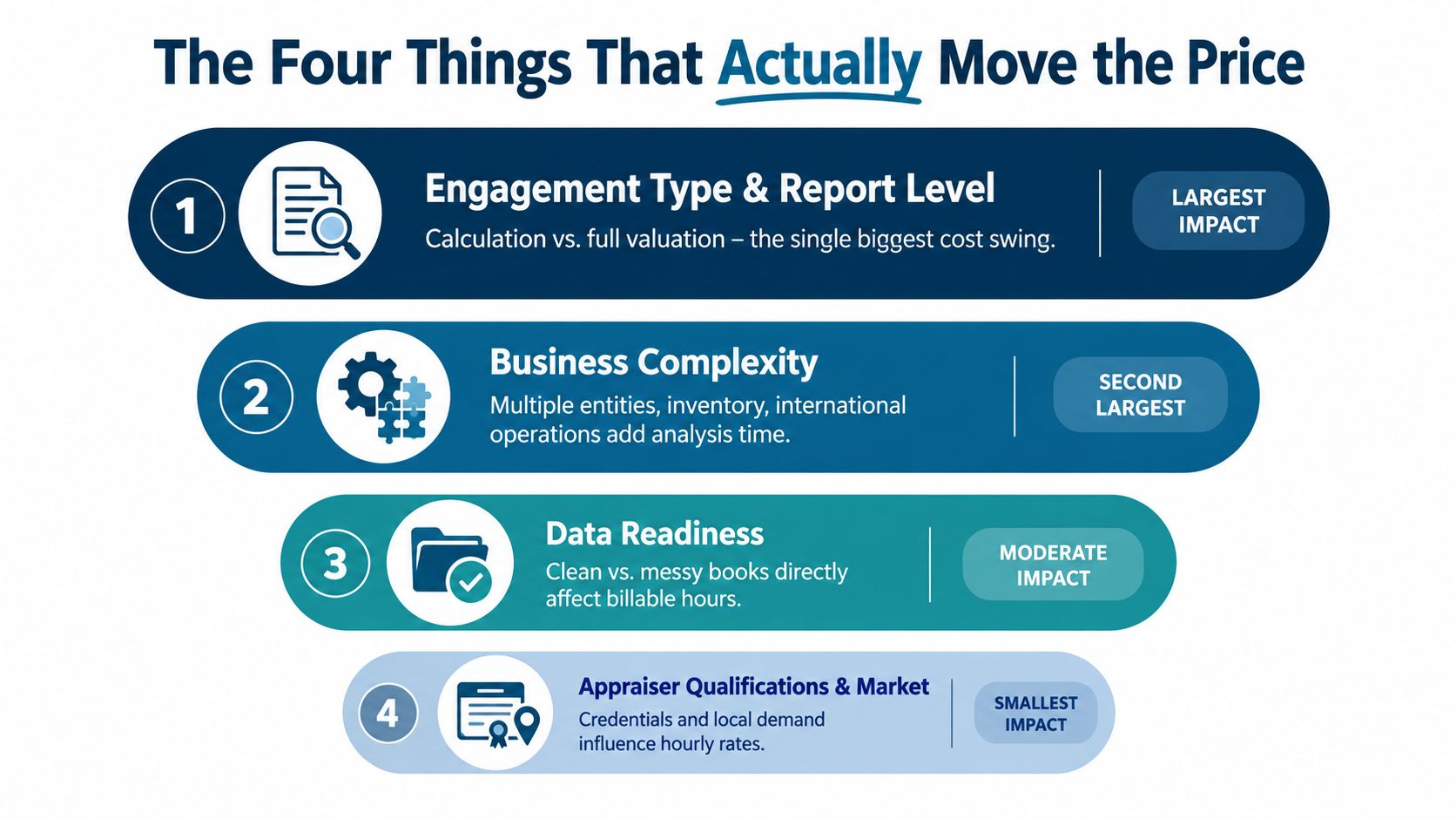
The Four Things That Move the Price the Most
The cheapest report is useful only when it answers the decision in front of you. Engagement type and report level usually move the bill the most, followed by business complexity and the defensibility the assignment requires. Credentials and region affect the quote, but they do not fix unclear scope or disorganized records.
1. Engagement type and report level
A calculation engagement uses fewer procedures than a full conclusion of value. Independent pricing guidance places basic calculation work around $1,500 to $8,000, while full engagements commonly fall around $5,000 to $15,000. Litigation or expert-testimony work can exceed $20,000 to $50,000.
Scope is your best cost lever. Tell the appraiser which decision the report must support. If you are deciding whether to hire a broker, do not pay for courtroom-level procedures. If a lender, tax authority, or attorney will challenge the result, a thin report is false economy.
2. Business size and complexity
Revenue affects the workload, but it is only one input. EBITDA, inventory, multiple locations, several legal entities, unusual ownership rights, and the number of years requiring normalization can all add analysis time. A clean, single-entity service company takes less work than a group of companies sharing employees, equipment, and expenses.
Before kickoff, consolidate the entity records. Provide one ownership map, explain intercompany balances, and separate operating results clearly. Organized records reduce review time and give the appraiser fewer loose ends to investigate.
3. Purpose and defensibility
An internal planning report can accommodate more owner judgment. A report prepared for a tax filing, shareholder dispute, or legal proceeding needs documented assumptions and credentials suited to that assignment. The appraiser must explain the conclusion to people who may hold an opposing interest.
Choose the least expensive report the recipient will accept. Price alone is the wrong filter. The right question is whether the report can survive the review waiting on the other side of the transaction or dispute.
4. Credentials and region
Credentialed appraisers often charge flat fees or hourly rates. Reported hourly rates commonly fall around $150 to $400 per hour, depending on credentials and complexity. A senior ASA or ABV professional may charge more than a generalist broker, especially for a dispute or complicated ownership structure.
Match credentials to the use case, not to the longest résumé. Report level and business complexity usually have a larger effect than geography alone. For additional small-business valuation cost guidance from Baton, compare the assignment purpose with the expected report depth before requesting quotes.
Realistic Price Ranges by Why You Need It
The right valuation budget depends on who will rely on the number. An owner deciding whether to reinvest can work with a rough estimate. A lender, buyer's attorney, tax reviewer, or court needs evidence that can withstand questions.
Published U.S. guidance commonly places basic calculations around $1,500 to $8,000, while full valuation engagements often run $5,000 to $15,000 or more. Use what affects valuation pricing to compare the assignment's purpose with the report depth before requesting proposals.
| Decision | Budget to Plan For | Cheapest Report That Usually Fits |
|---|---|---|
| Owner planning | $0 to $1,500 | Owner benchmark or short-form calculation |
| SBA loan | $3,500 to $8,000 | Calculation or review-level report accepted by the lender |
| Sale preparation | $5,000 to $15,000 | Calculation first, fuller support once buyer diligence begins |
| Partner buyout or shareholder dispute | $7,500 to $20,000 | Full valuation addressing ownership and disputed assumptions |
| Litigation or tax gifting | $10,000 to $25,000-plus | Formal valuation with documented methods and support |
These are planning ranges, not quotes. Business size also affects the bill. A pricing guide places businesses under $1 million in revenue around $2,500 to $5,000, companies with $1 million to $5 million around $4,000 to $8,000, and mid-market companies with $5 million to $20 million around $7,500 to $25,000, according to O'Connor, Gill, Stathis and Capital. The assignment's purpose can move the fee outside those bands.
Spend more when the number will be tested
For a sale, start with a lower-cost estimate if you are still deciding whether to sell. Order deeper work when a serious buyer enters diligence. For an SBA loan, get the lender's requirements in writing before hiring an appraiser. For a partner dispute, pay for a report that addresses ownership, adjustments, and opposing review from the beginning.
One properly scoped engagement may support planning, financing, and sale discussions. Ask whether the appraiser can serve those purposes without weakening the report's intended use. That can prevent paying for overlapping reports.
Review business valuation multiples by industry for market context. An industry multiple can check your assumptions, but it is not a final opinion of value.
DIY Tools, Broker Opinions, and Credentialed Appraisers Compared
Cheap tools have a place. They're useful when the consequence of being wrong is small and nobody expects a signed professional conclusion. The trouble starts when an owner uses a rough number in a setting where the other party needs evidence.
Four provider tiers
Free or under-$200 calculators use simple rules of thumb. Use one to sanity-check a number before a casual conversation. Don't use it for a lender, tax filing, dispute, or formal negotiation.
DIY spreadsheets can work for owner-only planning. Build the model with industry comparisons, a discounted-cash-flow template, documented assumptions, and a review from your accountant. The spreadsheet helps you learn how cash flow, owner compensation, risk, and assets affect the result. It doesn't become a certified appraisal because the formulas are neat.
Business broker opinions of value commonly fall around $500 to $2,500, according to Website Closers' business valuation cost guidance. A broker's opinion can help position a company for an initial sale or support an informal partner discussion. Many buyers and lenders discount it because the broker may be focused on marketing the business rather than issuing a credentialed valuation conclusion.
Credentialed appraisers commonly charge $5,000 to $25,000, with complex or litigation-ready assignments moving higher, based on BizWorth's valuation cost guidance. Credentials can include ASA, ABV, CVA, or CBA. This tier fits a report shown to a bank, the IRS, a buyer with counsel, or a courtroom.
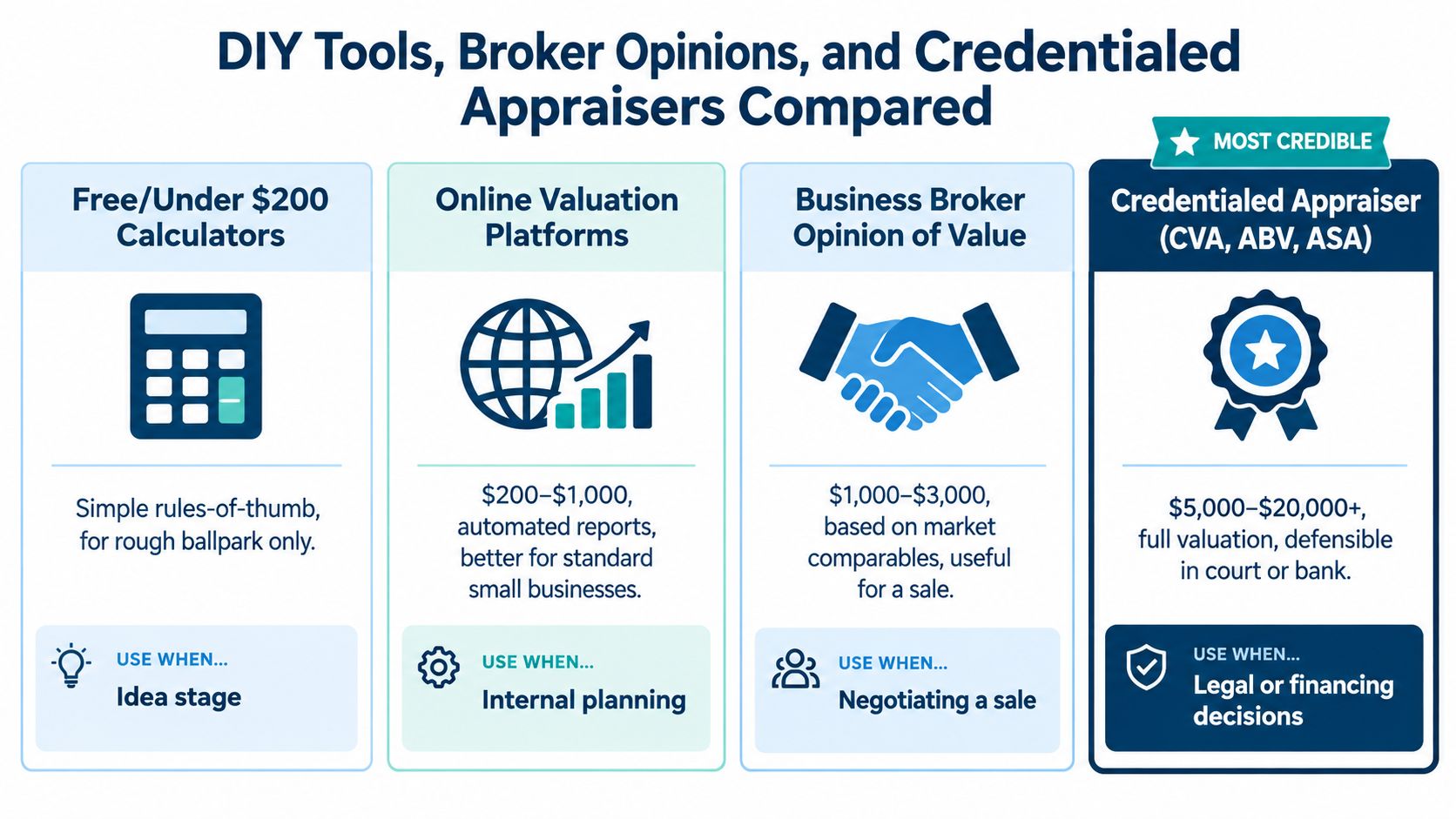
The higher the financial or legal consequence of being wrong, the less sense it makes to rely on a rough estimate.
MyOfficeOps provides bookkeeping, financial analytics, business valuation support, and CFO-level advisory for small and midsize businesses. For a Philadelphia-area owner, that kind of support can help clean up the financial story before an appraiser begins, while a credentialed valuation firm remains the right choice when formal independence and defensibility are required.
How to Prep Your Books So the Bill Stays Low
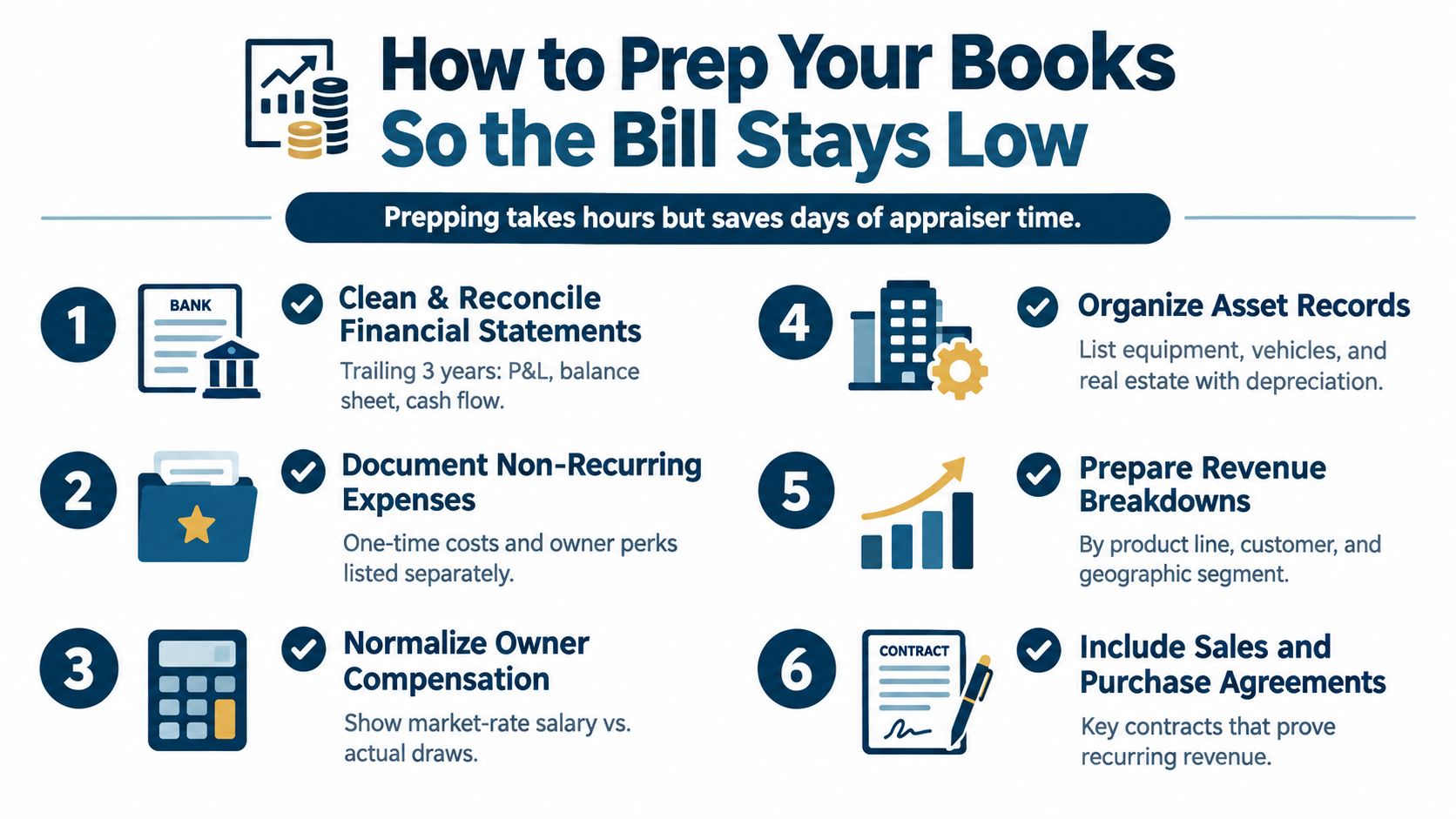
Appraisers charge for time. Give them clean records and they spend more time analyzing value, not rebuilding your accounting file. The preparation also improves credibility because the owner can explain unusual expenses, customer concentration, contracts, and ownership details without searching through old emails.
Build the file before the kickoff call
Prepare clean, reconciled financial statements for the trailing three to five years, including a reviewed or audited set when the assignment requires lender or litigation-grade support. Reconcile bank accounts, merchant processing, and the general ledger so reported revenue can be traced to records.
Then separate non-recurring and owner-discretionary expenses. List personal items run through the business, including auto, travel, insurance, and health costs, with clear add-back schedules. Explain owner hours, family compensation, and related-party transactions before the appraiser starts.
Give the appraiser the operating story
Create a customer and revenue breakdown. Identify customer concentration, recurring contracts, and multi-year agreements. Add an updated fixed-asset schedule, and prepare a current cap table listing every equity class, option, and convertible instrument.
Disclose pending lawsuits, liens, and tax disputes at the start. Surprises create questions, extra procedures, and delays.
Use an EBITDA review such as business valuation and EBITDA guidance to organize earnings adjustments, but don't label an add-back as valid just because it makes the number larger. Each adjustment needs a clear business reason and supporting record.
A Simple Three Step Plan to Pay the Right Amount and Not a Dollar More
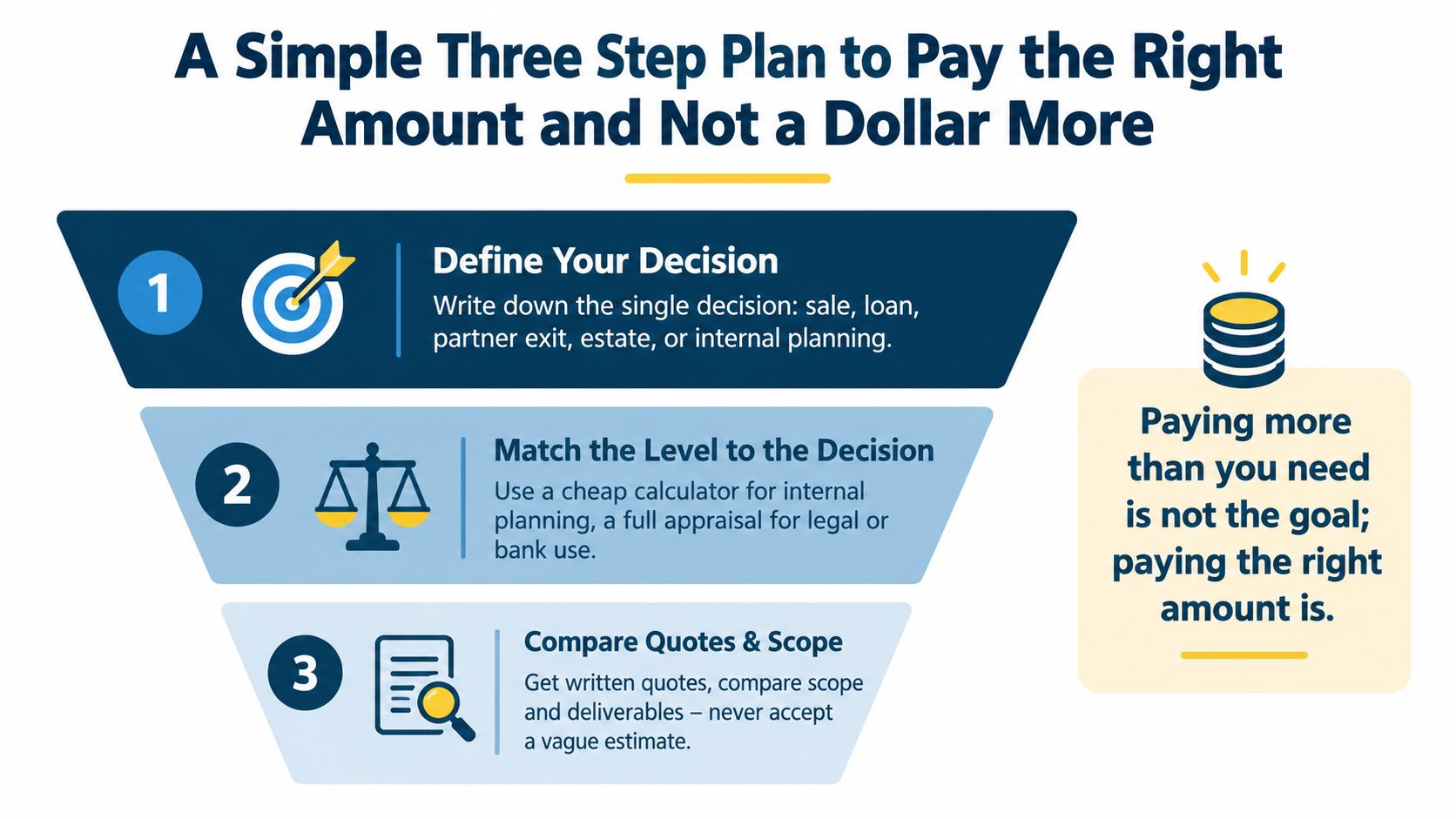
The right business valuation cost comes from matching the report to the decision. Use this path before you request proposals.
Step one defines the job
Write down the single decision the valuation must support. Is it a sale, a loan, a partner exit, an estate matter, or internal planning? Name the person or organization that will rely on the report.
That sentence prevents a vague engagement. “I want to know what my company is worth” isn't enough for a professional quote. “I need a report my lender will accept for a financing decision” gives the appraiser a usable scope.
Step two sets the defensibility level
Choose a calculation report for internal use when nobody outside the ownership group needs a formal opinion. Choose a full conclusion of value when a lender, buyer, court, or taxing authority will scrutinize the work.
Ask each provider to state the intended use, methods, records required, credentials, standards followed, deliverables, and revision process. A cheap quote with unclear scope isn't cheap. It's an unanswered invoice waiting to happen.
Step three protects the budget
Prepare reconciled statements, normalize owner perks, organize add-back schedules, and gather contracts, asset records, ownership documents, and tax information before the engagement starts. Get written quotes from more than one qualified provider, then compare what each quote includes rather than comparing only the headline fee.
The most expensive mistake goes both ways. Owners sometimes pay for a formal valuation when a calculation would have answered the question. Others save money by skipping proper valuation work, then discover that a deal, lender, tax authority, or judge won't accept the number.
The cheapest defensible report for the job is usually the right spend. Not the cheapest report available, and not the most elaborate report an appraiser can sell you.
If you're preparing for a sale, financing request, partner buyout, or valuation engagement, MyOfficeOps can help organize your books, normalize financials, and turn your records into a clearer decision package. Visit the site to discuss the right preparation and advisory support for your business before you pay for a report that doesn't fit the job.