

You're staring at a profit and loss statement, trying to work out what your company might be worth. Net income looks respectable, but it includes loan costs, taxes, depreciation, personal expenses, and a few unusual charges that won't follow the business to a new owner. A buyer won't look at the bottom line and write a check. They'll rebuild your earnings, test every adjustment, and then decide what multiple your business has earned.
That's the issue with business valuation EBITDA. The formula is easy. The hard part is agreeing on the EBITDA that represents ongoing earnings, and proving that those earnings will continue after you leave.
What EBITDA Actually Means for Your Business
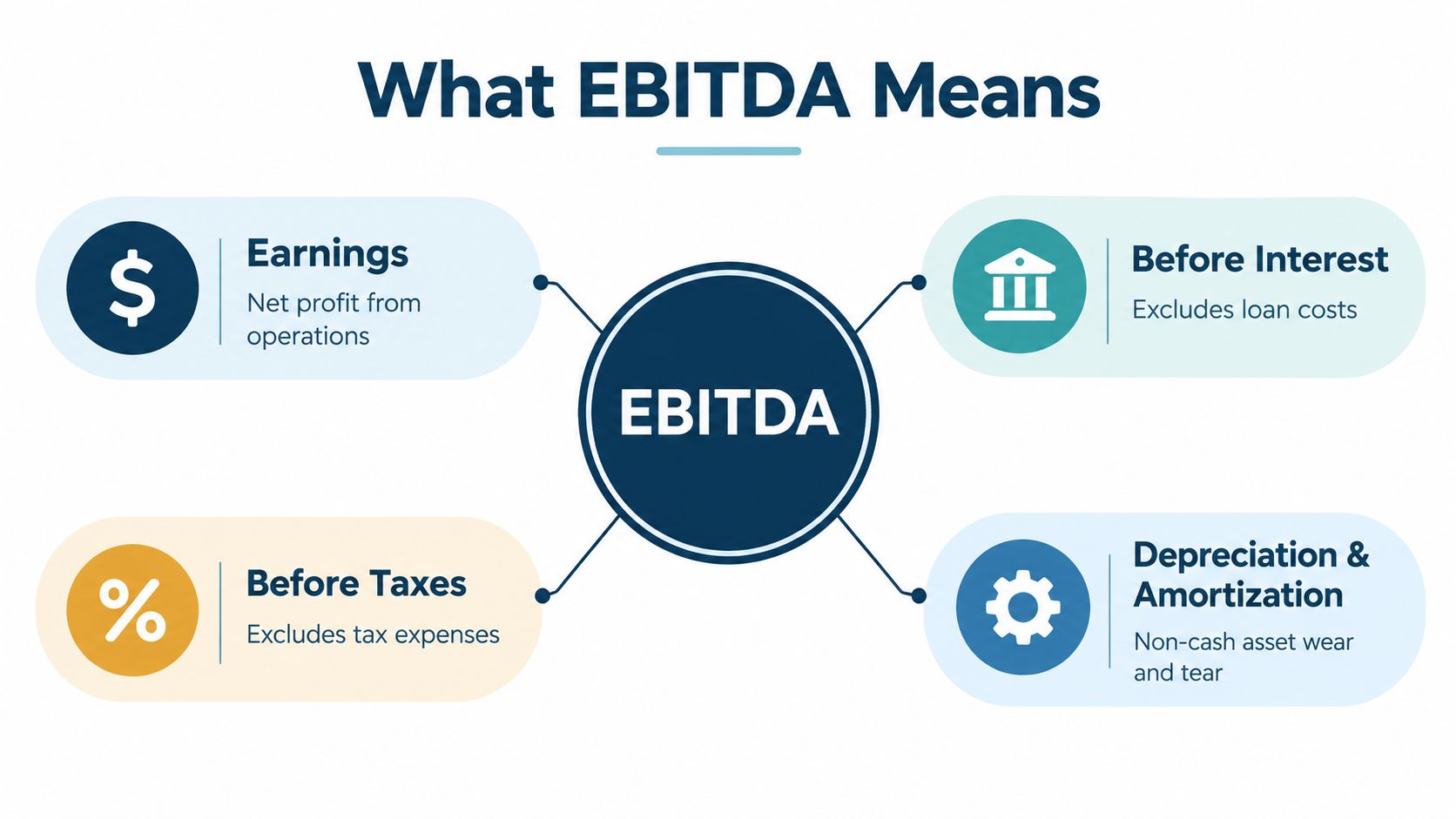
Most owners know EBITDA is important, but few could explain it over dinner without reaching for a finance textbook. The acronym means Earnings Before Interest, Taxes, Depreciation, and Amortization. In plain English, it's an attempt to show what the operating business earns before financing choices, tax treatment, and certain non-cash accounting costs affect the result.
Imagine two delivery companies with the same routes, customers, staff, and operating profit. One financed its vans with loans. The other bought its vans with cash. Their interest costs will differ, and their depreciation schedules may differ too, even though the underlying operation could be very similar. EBITDA helps a buyer compare the businesses on their operating engine rather than on the owner's financing decisions.
Why buyers start with EBITDA
Net income answers an accounting question, what remains after expenses. EBITDA answers a deal question, what does this operation produce before certain items tied to ownership, financing, and accounting treatment?
That makes EBITDA useful for comparing enterprise value with operating earnings. EV/EBITDA has become a mainstream valuation benchmark because it reduces the distortion caused by different capital structures and compares enterprise value with earnings before financing and non-cash expenses. Stern NYU's cross-industry data supports its use as a broad market tool, while historical evidence shows the multiple can move with risk, returns, interest rates, growth expectations, and investor sentiment. The underlying valuation study and market evidence explain why a “normal” multiple isn't permanent.
You also need to understand the revenue line before trusting the earnings line. A broker, agency, or intermediary may report money that passes through to another party as gross revenue, while the business really keeps only its net amount. This guide to gross vs net revenue for brokers is useful when checking whether reported revenue reflects actual economic activity.
Enterprise value is the value of the operating business before the final debt and cash adjustments. This explanation of enterprise value is worth reviewing before you compare a valuation headline with the amount you'll receive.
How Adjusted EBITDA Turns Messy Books Into a Real Number
Reported EBITDA is only the starting point. Buyers want Adjusted EBITDA, a normalized figure that removes items that don't describe the company's ongoing earnings power. The adjustment process is where owners either defend value or lose credibility.
Start with a clean bridge. Don't hand a buyer a spreadsheet with a large “miscellaneous add-backs” line and expect approval.
Build the bridge in a defensible order
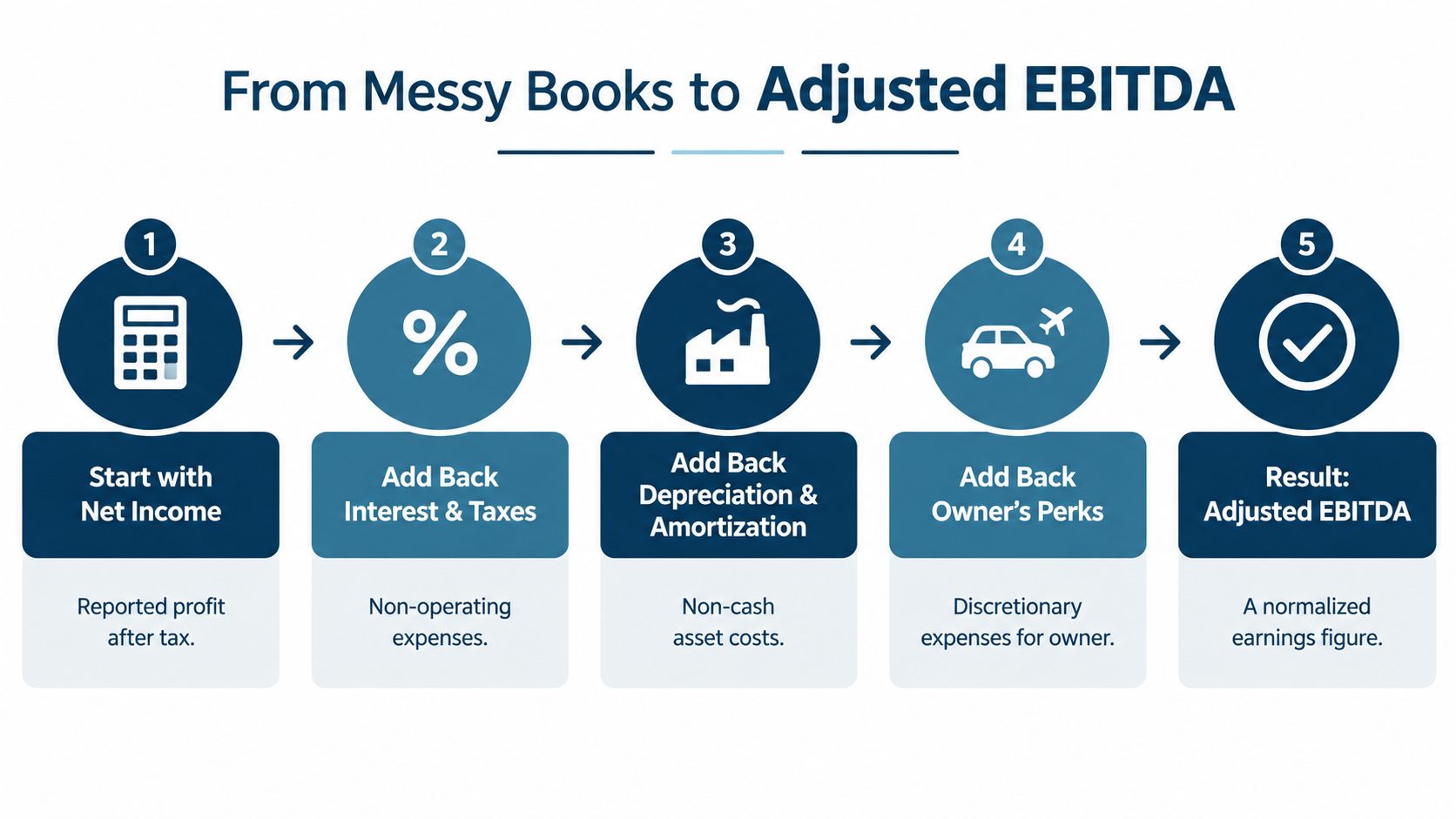
Start with reported profit. Use net income or reported EBITDA from the financial statements. Keep the source clear, and make sure the amount ties to the general ledger.
Separate financing and tax items. Interest and taxes are added back because the buyer may use a different capital structure or tax position. These adjustments explain the move from net income toward EBITDA, not a free pass to add back ordinary operating costs.
Remove depreciation and amortization. These are non-cash accounting expenses tied to asset wear and intangible assets. A buyer will still consider future capital spending, so adding them back doesn't mean the equipment is free to replace.
Document owner-specific costs. Personal travel, excess owner compensation, personal vehicles, and similar expenses may be valid adjustments when they're clearly non-operating or above the cost of a reasonable replacement. If the owner performs a real job, the buyer will usually include a market-rate replacement cost.
Add only genuine one-time items. Adjusted EBITDA guidance from the Corporate Finance Institute notes that common adjustments can include restructuring charges, litigation costs, acquisition-related expenses, stock-based compensation, and owner-specific expenses, provided they're irregular or non-recurring and properly supported.
What buyers accept and what they challenge
A documented legal settlement that won't recur is easier to defend than a recurring “one-time” consulting charge. A clearly personal expense is easier to explain than a broad category containing both business and private purchases. The test is simple, would the expense disappear under new ownership, and can you prove it?
Keep invoices, contracts, payroll records, bank statements, and a short explanation for every adjustment. Your bookkeeper should track these items throughout the year, not search for them after a buyer opens diligence.
Practical rule: If you can't show the entry, explain why it won't recur, and identify the replacement cost, don't count it as an add-back.
A credible bridge may produce a higher EBITDA number, but it can also expose weak margins, owner dependence, or inconsistent categorization. That's useful. Buyers don't pay for a creative spreadsheet. They pay for earnings they believe.
Where EBITDA Multiples Come From and Why They Vary
Owners often ask, “What's my multiple?” as if every industry has one published answer. It doesn't. The multiple reflects the buyer's view of future cash flow, risk, growth, deal competition, business size, and strategic fit.
In a 2024 middle-market review, U.S. deals averaged 7.2x TEV/EBITDA for the full year and 7.3x in the fourth quarter, with the full-year figure flat versus the prior year. The same market reporting found private companies sold to trade buyers averaged 9.4x historic EBITDA, while private equity buyers averaged 11.5x, a 2.1-turn difference. These figures come from Forvis Mazars' 2024 middle-market deal review.
That gap doesn't mean private equity always pays more. It means buyer type changes the valuation conversation. A strategic buyer may see cost savings, distribution access, customers, or technology that another buyer can't use. A financial sponsor may have a different financing structure and a plan to scale the platform. The right comparable is a completed deal with similar size, industry, earnings quality, and buyer profile.
Deal size changes the answer
The following figures show how deal size can influence the average multiple:
| Deal Size Range | Average EV/EBITDA Multiple |
|---|---|
| $10M to $25M | 5.9x |
| $25M to $50M | 6.6x |
| $50M to $100M | 8.7x |
| $100M to $250M | 10.0x |
These 2026 deal-size figures are reported in Kadenwood Group's private-market analysis. They show a strong size effect. Larger companies may offer deeper management, better systems, more financing options, and less dependence on one person.
Industry still matters. In 2024 private-market reporting, average multiples ranged from 6.4x in retail to 7.3x in media and telecommunications, while other private equity data identified Communication and Professional Services among the highest-multiple areas. Mercer Capital's business valuation multiples by industry guide can help you organize comparable companies, but don't use an industry label as a substitute for deal-specific analysis.
The same EBITDA can produce different enterprise values because buyers are pricing the durability of the earnings, not just the earnings themselves.
The Valuation Traps That Quietly Kill Your Multiple
Two businesses can report the same EBITDA and sell for very different prices. Owners usually blame the market. Buyers usually point to risk.
A company with recurring revenue, reliable margins, clean controls, and a capable management team gives a buyer confidence that the earnings will survive the transition. A company where the owner sells every job, approves every invoice, and holds the customer relationships in a personal phone may produce the same current EBITDA, but the buyer has to rebuild the business after closing.
The risks buyers notice first
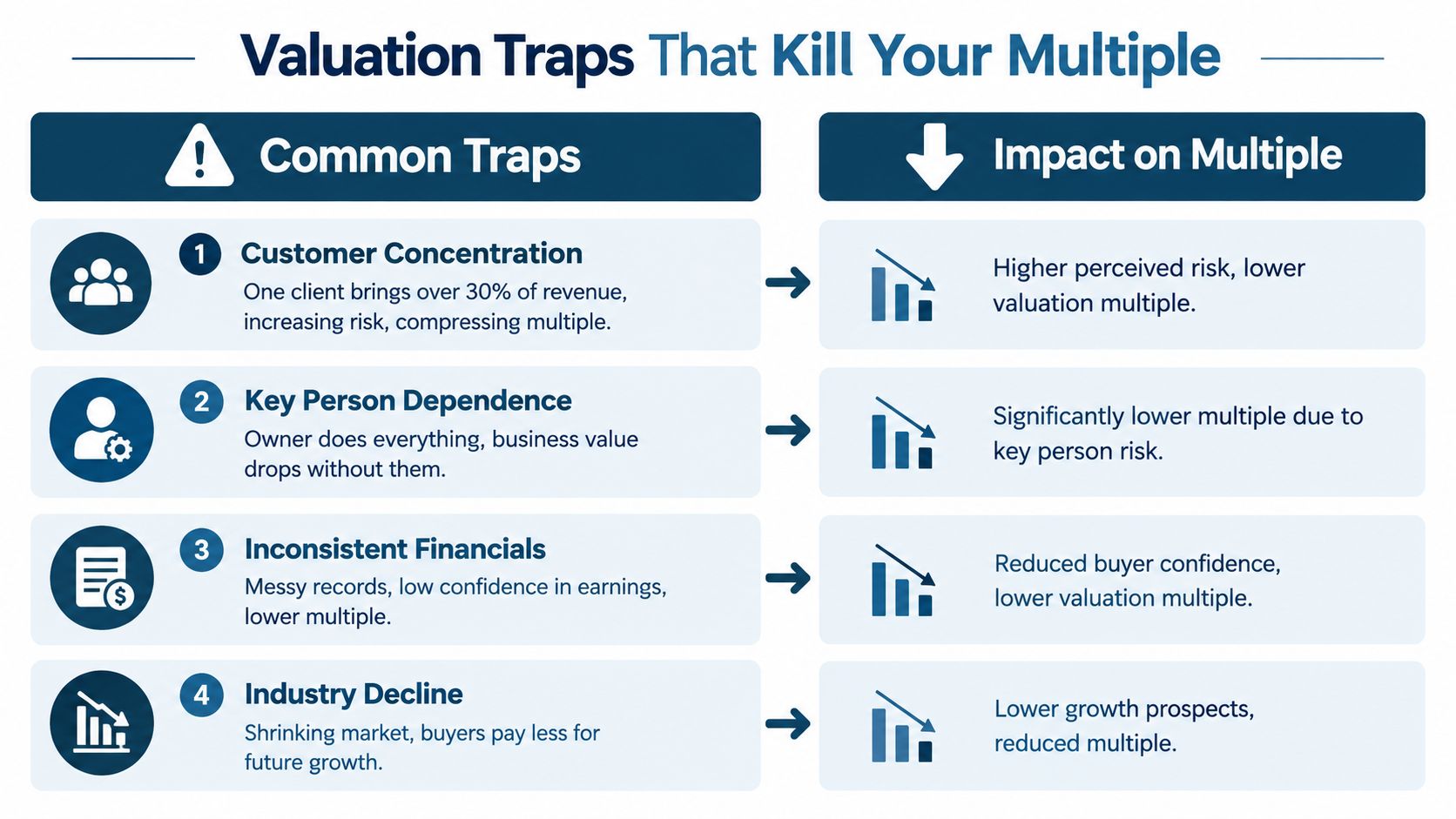
Owner dependence: If you're the chief salesperson, estimator, manager, and problem solver, the buyer may treat part of your EBITDA as a replacement salary rather than pure owner-independent earnings.
Customer concentration: One major account can make revenue look stable until that customer changes vendors. Buyers may ask for contracts, renewal history, margin by customer, and evidence that other accounts can replace the relationship.
Weak recurring revenue: Project work can be profitable, but a business with no repeat pattern requires more proof every year. Buyers generally prefer revenue they can forecast and explain.
Thin management depth: A supervisor who handles daily scheduling is different from a team that can run operations without the founder. Buyers pay more readily for transferability than for a heroic owner.
Inconsistent financials: Late reconciliations, unexplained journal entries, mixed personal and business spending, and shifting classifications make buyers question the whole income statement.
The evidence is direct. Owner dependence, revenue stability, growth, margins, buyer pool depth, and deal structure all influence the multiple, according to CTA Acquisitions' discussion of realistic small-business EBITDA multiples.
Buyers don't discount a business because the owner worked hard. They discount it when the business can't work without the owner.
Fixing these issues takes more than a polished forecast. Create documented workflows, move customer relationships into a shared system, assign decision rights to managers, and review revenue by customer and contract type. A buyer should be able to understand how the company operates by reading the records, not by relying on your memory.
A Real-World Valuation Example for a Small Business
Consider a small commercial cleaning company. The owner reviews the books and sees $300,000 of reported EBITDA. That number includes $40,000 of owner-specific expenses, $25,000 in one-time legal costs, and $35,000 of compensation above the cost of a replacement manager.
The owner can't add everything back without support. The buyer will ask whether the legal matter is finished, whether the owner's role can be replaced for the proposed cost, and whether the personal expenses are clearly separate from operating costs.

The earnings bridge
If the buyer accepts each adjustment, the math looks like this:
| Valuation step | Amount |
|---|---|
| Reported EBITDA | $300,000 |
| Owner-specific expenses | +$40,000 |
| One-time legal costs | +$25,000 |
| Excess owner compensation | +$35,000 |
| Normalized EBITDA | $400,000 |
The normalized figure is $400,000, not because the owner found a clever accounting trick, but because the proposed adjustments describe costs that shouldn't continue in the same form under new ownership. If the owner still performs work that requires a replacement, the replacement cost remains in the buyer's operating model.
Now apply a 5x multiple. Enterprise value equals $2,000,000. If the company has $300,000 of net debt, equity value equals $1,700,000, before considering taxes, working capital terms, transaction fees, or other negotiated items.
The formula is straightforward: enterprise value = normalized EBITDA × industry multiple, and equity value = enterprise value minus net debt. This SME valuation formula also notes that private SME multiples in 2026 often range from 4x to 15x EBITDA, depending on industry. That range is broad for a reason. Earnings quality and business risk decide where a company belongs.
Why the multiple matters so much
If the buyer applies 4x, enterprise value is $1,600,000, producing $1,300,000 of equity value after net debt. At 6x, enterprise value is $2,400,000, producing $2,100,000 of equity value after the same debt.
That difference comes from the multiple, not from changing the EBITDA. A stronger management team, cleaner customer records, and dependable revenue can influence that judgment. So can a buyer's strategic fit and confidence in the transition.
How Clean Books and Quality of Earnings Reports Boost Your Price
Owners often spend years trying to increase EBITDA and then lose value during diligence because nobody can verify the number. That's backwards. A buyer doesn't value an earnings adjustment they can't trace.
A sell-side quality of earnings report, or QofE, reviews revenue recognition, customer trends, margins, working capital patterns, add-backs, and the sustainability of reported earnings. It gives the seller a chance to identify problems before a buyer uses them to their advantage.
The diligence premium is measurable
A 2025 analysis of 360 completed transactions found that sellers with a sell-side QofE report achieved an average 7.4x TEV/EBITDA, compared with 7.0x for sellers without one. A separate 2025 GF Data-based summary reported 7.6x versus 6.6x. Those findings appear in Middle Market Growth's analysis of quality of earnings reports.
The lesson isn't that ordering a report automatically creates value. A QofE can't repair falling revenue or replace a missing management team. It can, however, reduce uncertainty, clarify legitimate adjustments, and prevent a buyer from assuming the worst.
Clean records do more than impress buyers
Reconcile accounts consistently. Separate personal spending. Keep customer and project profitability visible. Track one-time expenses in dedicated accounts. Store contracts, payroll records, tax filings, and major invoices where someone else can find them.
If you're considering a sale, learn what a quality of earnings report covers before you begin negotiations. The best time to prepare isn't after a buyer sends a diligence list. It's while you still have time to correct classifications, build management depth, and show a clean operating history.
A buyer pays a premium for a business they can understand quickly and defend to their investment committee.
Your Action Plan to Maximize Enterprise Value Before Exit
If you may sell within the next 12 to 36 months, stop treating valuation as a year-end exercise. Build the company buyers want to buy while you still control the timeline.
Normalize the accounts now. Identify owner-specific expenses, unusual charges, and replacement costs. Keep a monthly adjustment schedule with supporting documents.
Make revenue easier to forecast. Track recurring contracts, renewal behavior, customer profitability, and concentration. Build a sales process that doesn't depend on your personal relationships.
Transfer the work. Write operating procedures, assign managers real authority, and test whether the business can handle decisions without you. Owner independence affects both the quality of EBITDA and the multiple.
Strengthen controls. Close the books consistently, reconcile balance sheet accounts, and review financial results against a budget. Weak internal controls create doubt even when sales are strong.
Prepare the buyer file. Organize contracts, employee information, tax records, customer data, vendor terms, insurance, and equipment details. A clean data room shortens questions and protects momentum.
Get an outside review. A valuation advisor, CPA, or outsourced CFO can challenge your add-backs before a buyer does. For operating discipline and management cadence, Mastering The Rockefeller Habits is a useful resource for building repeatable systems.
The central rule is simple. Predictable cash flow, diversified customers, strong management, and reliable controls support stronger multiples, while volatility and founder dependence compress them, as explained in KMC's guidance on the drivers behind business value.
MyOfficeOps helps small and midsize businesses turn messy books into clear reporting, normalized EBITDA, and practical exit preparation. Visit MyOfficeOps to discuss bookkeeping, financial analytics, valuation support, and CFO-level planning for a stronger sale process.