
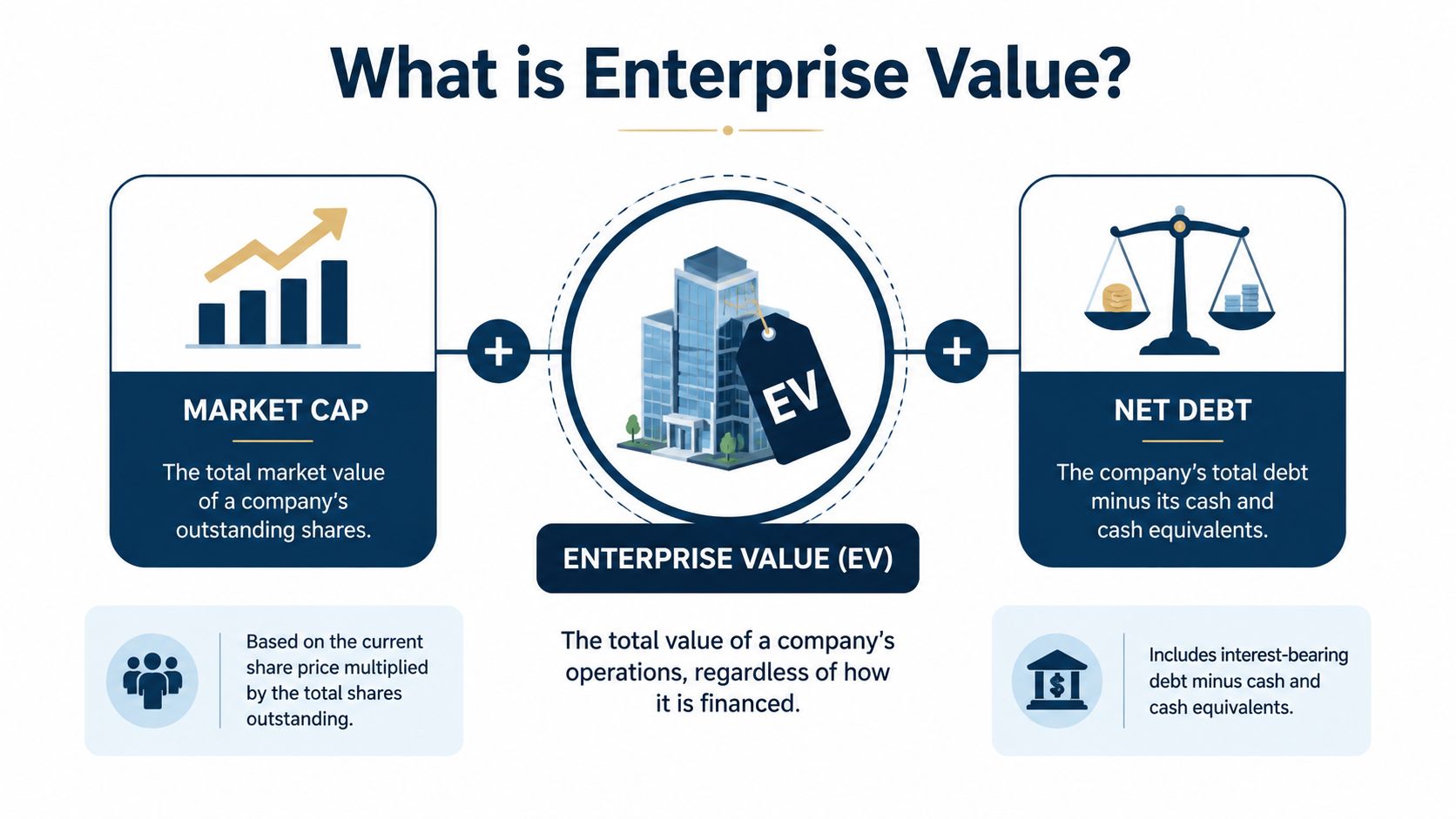
Enterprise value is the total price tag of the whole business, not just the stock. The core formula is EV = market cap + total debt − cash and cash equivalents.
You might be looking at an unsolicited offer on your desk, a valuation report from your accountant, or a competitor that appears to have the same size and profit as your company. The number in front of you may look clear, but it can hide what a buyer must pay to take control of the operating business.
That's why owners need to understand what is enterprise value before they negotiate. EV brings the equity, debt, cash, and certain senior claims into one view. It helps answer a practical question: if someone wanted the whole business, what would the complete price tag look like?
The Simple Definition Most Owners Miss
Suppose an owner receives an offer and sees a purchase price based on the company's shares. Their first reaction is usually, “Is this what my business is worth?” That question is understandable, but the share value only describes the equity slice. It doesn't show the loans the buyer inherits, the cash sitting on the balance sheet, or claims held by other investors.
Enterprise value is the value of the entire operating business, not merely the value of its shares. The basic calculation is:
EV = market cap + total debt − cash and cash equivalents
Market capitalization means the value of the company's outstanding shares. For a public company, it reflects the share price multiplied by the number of shares. For a private business, owners and advisers often begin with an estimated equity value rather than a live market price.
Debt gets added because the buyer must account for it as part of the acquisition. Cash gets subtracted because the buyer receives that cash, or because it reduces the amount of outside money needed to own the business. The broader acquisition-style distinction and standard formula are explained in this enterprise value guide for owners.
Why buyers use EV
EV gives buyers a more comparable view of businesses with different financing choices. Two companies can have similar equity values but very different loans and cash balances. A buyer who looks only at market capitalization can miss the cost of taking on that balance sheet.
That matters when comparing your company with:
- A direct competitor: The competitor may have financed equipment with debt while you paid cash.
- A public peer: Market data often uses enterprise value in valuation multiples such as EV/EBITDA.
- An acquisition target: The buyer wants to understand the cost of owning the whole operation, not just buying shares.
Professional valuation practice treats EV as a capital-structure-neutral measure because it adds net debt and other senior claims to equity value. NYU Stern's industry EV/EBITDA data shows how widely these multiples are used for sector benchmarking.
Equity value alone can hide the full cost. The buyer may also need to deal with loans, preferred stock, minority interest, lease obligations, or other debt-like items. Meanwhile, cash can lower the effective purchase price. The formula is simple, but the balance sheet behind it deserves a careful read.
Breaking Down the EV Formula Piece by Piece
A coffee shop makes the formula easier to picture. The shop is the business. A buyer wants the brand, staff, customer relationships, equipment, inventory, and right to operate the location. The buyer also needs to understand which financial claims come with the shop.
The coffee shop version
Market cap or equity value is the owner's slice. Think of it as the amount paid to the people who own the coffee shop. It's the starting point, not always the final price tag.
Debt gets added. The espresso machine and walk-in cooler may have been financed with loans. The buyer receives useful equipment, but the related obligations still matter. Total debt can include short-term and long-term borrowings.
Cash gets subtracted. The register and bank account contain money that comes with the business. That cash reduces the buyer's effective cost, although the buyer and seller must agree on how much cash stays in the company to support normal operations.
Minority interest can also be added. Imagine a silent partner owns 10 percent of a small subsidiary. The parent company's basic equity value may not capture the full claim held by that outside owner. Minority interest is included because a buyer still has to account for the portion of the subsidiary it doesn't own, as described in this minority interest explanation.
Preferred stock is another possible addition. Picture a cousin who supplied capital and has a first claim on profits. Preferred investors may have rights that rank ahead of common shareholders, so a complete EV bridge may include that claim.
A serious buyer may also review operating leases, unfunded pensions, pensions, and other debt-like obligations. The precise adjustments depend on the company, industry, accounting treatment, and deal structure. The full enterprise value formula discussion from Investopedia covers why the simple formula often needs more balance-sheet detail.
Practical rule: If the buyer must pay it, settle it, or leave it in the company to keep the doors open, put it on the review list.
Working capital deserves its own check because cash tied up in inventory, receivables, and payables may be needed for daily operations. This working capital resource helps explain why the cash number on a balance sheet isn't always the same as excess cash available to a seller.
The full stack
- Equity value: The value belonging to common owners.
- Plus total debt: Loans and other borrowing obligations.
- Plus preferred stock: Senior equity claims, when applicable.
- Plus minority interest: Value belonging to outside owners of subsidiaries.
- Plus debt-like items: Leases, pensions, and other negotiated obligations.
- Less cash and cash equivalents: Cash that reduces the effective purchase price.
The result is an estimate of the value of the operating business before deciding how the final proceeds get divided between owners, lenders, preferred investors, and other claimants.
Why Two Look Alike Companies Can Have Different EVs
Two businesses with identical revenue can sit at very different enterprise values because their balance sheets tell different stories. The operating review may show the same EBITDA, head count, customers, and equipment, while the buyer faces different debts, cash reserves, and other claims.
Consider these simplified examples. The equity values are estimates for comparison, not quoted market data.
| Line Item | Company A (Clean) | Company B (Levered) |
|---|---|---|
| Equity value | $5 million | $5 million |
| Debt | $300,000 | $1.6 million |
| Cash | $600,000 | $100,000 |
| Enterprise value | $4.7 million | $6.5 million |
Company A has modest debt and a healthy cash balance. Its cash exceeds its debt, so EV is lower than its equity value.
Company B has the same equity value, yet it carries a larger term loan and has used most of its cash on a truck fleet. In a simplified transaction, the shareholders might receive the same amount, but the buyer also takes on the larger debt burden. That produces the higher EV.
The difference does not reward Company B. It measures the total claims attached to the business. A buyer taking control of Company B is acquiring an operation with more financing connected to it.
The owner's check and the buyer's total price are different numbers.
That distinction helps buyers compare companies on a more neutral basis. A company that paid cash for equipment can show a different EV from one that borrowed heavily, even when both produce similar operating results.
The table covers debt and cash, but real deals may require a wider balance-sheet review. Preferred stock, minority interest, unfunded pensions, operating leases, and other debt-like obligations can change the amount a buyer must fund or leave in the company. The treatment depends on the business, accounting records, and deal terms.
Owners can use a practical checklist before negotiations: identify every borrowing obligation, separate excess cash from cash needed for working capital, review leases and pension commitments, and confirm who owns each subsidiary. Cleaning up unclear claims and documenting recurring operating performance can make the buyer's calculation easier to defend.
Ask two questions: “What will I receive?” and “What total obligations and cash balances will the buyer price into the deal?” The answers shape negotiation, financing, and the multiple applied to the business.
How Buyers Actually Estimate Enterprise Value
Buyers rarely rely on one valuation lens. They usually compare several approaches, then investigate why the answers differ. Each method asks a different question about the business.
Discounted cash flow
A Discounted Cash Flow, or DCF, analysis asks what the company's future cash generation is worth today. The buyer projects future cash flow, applies assumptions about growth and investment, and discounts those future amounts back to the present.
DCF works best when the company has a cash flow pattern that management can explain. A stable manufacturer, recurring-revenue provider, or established professional services firm may provide the history needed for a useful forecast. The method becomes more sensitive when results depend on uncertain customers, large future investments, or aggressive growth assumptions.
Trading comparables
Trading comparables compare the company with similar public businesses. Buyers and advisers commonly look at valuation measures such as EV/EBITDA or EV/Revenue, then adjust for differences in size, growth, margins, risk, and liquidity.
This method offers a quick sanity check. If your implied multiple sits far outside the range of comparable companies, the buyer will want an explanation. Owners can use business valuation multiples by industry as a starting point for understanding how industry comparisons work, but a multiple alone doesn't replace company-specific analysis.
Precedent transactions
Precedent transactions examine prices paid in completed acquisitions. This approach can be useful in negotiations because it reflects what buyers paid for similar businesses, including the control and deal circumstances attached to those purchases.
The challenge is that private transactions often have different terms, timing, customer concentration, and strategic value. A deal involving a special buyer may not be a clean match for an owner selling to a financial buyer.
A useful outside perspective is Visbanking's 10x book value analysis, which helps readers question simple book-value comparisons and look at the assumptions behind headline valuation claims.
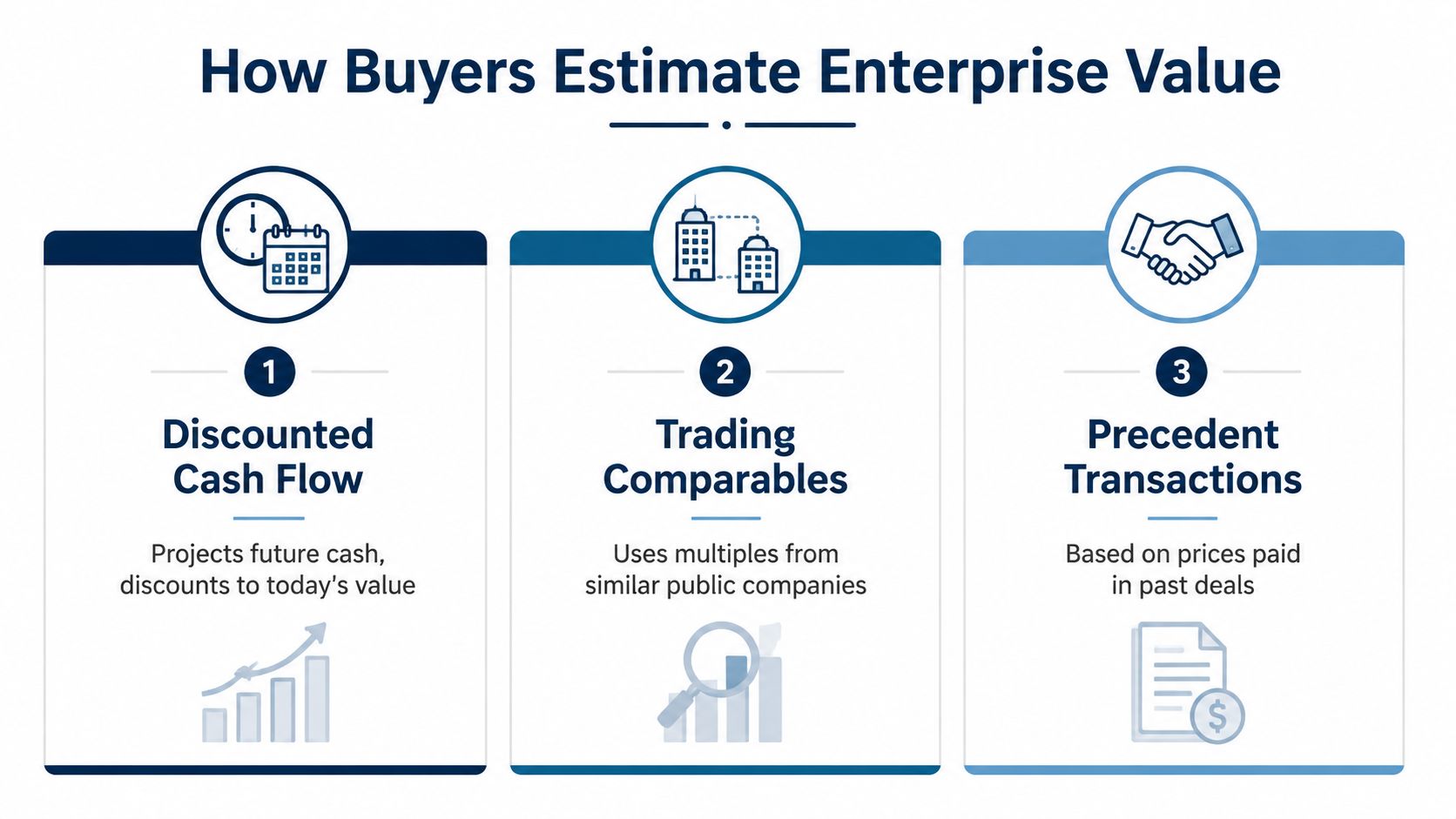
Buyers triangulate all three methods. DCF provides an intrinsic cash flow view, trading comparables provide a market reference, and precedent transactions show deal evidence. Clean financial statements determine whether any of those methods produces a defensible number.
A Real World Midsize Business Walkthrough
Priya runs a packaging supplier with 40 employees, $9 million in revenue, and $1.6 million in adjusted EBITDA. She is not planning to sell next week, but a potential buyer has begun asking questions. Before sharing detailed records, Priya wants a practical EV estimate.
She starts with the familiar bridge:
EV = equity value + debt − cash
The formula is simple. The balance sheet is where the careful work begins. Her adviser finds $180,000 in capitalized equipment leases, $90,000 of minority interest in a small subsidiary, and $250,000 of excess cash in the company account. The leases and minority interest represent obligations or claims a buyer must account for. Excess cash reduces the effective purchase price.
The first estimate is therefore roughly $400,000 too low, based on the omitted items and cash adjustment. The arithmetic is straightforward. The judgment lies in deciding which balances belong in the bridge and documenting the reason for each one.

Cleaning the number
Priya's team reviews the records line by line:
- Lease review: They identify equipment obligations that function like financing.
- Subsidiary review: They confirm the outside ownership claim.
- Cash analysis: They separate cash needed for operations from excess cash.
- EBITDA recast: They document owner expenses, one-time costs, and adjustments unlikely to continue under new ownership.
- Support file: They collect contracts, invoices, schedules, and explanations for every adjustment.
The revised EV becomes a range a credible buyer can evaluate. It does not guarantee a transaction price. It gives both sides a complete starting point and makes later questions easier to answer.
Enterprise value is not a number copied from a screen. It is built from normalized financials, a careful balance-sheet review, and a documented bridge. Owners who prepare those details early can defend the number before an acquirer sets the terms.
Common EV Mistakes That Undermine Deal Price
Owners often study EBITDA first and leave the balance sheet for later. Buyers usually do the reverse during diligence. They prepare an adjustment schedule that can affect the final price, the financing required, and the owner's negotiating position.
Lease obligations deserve early review. A warehouse lease, vehicle fleet contract, or equipment arrangement may function like financing in the buyer's model. If those commitments are missing from the analysis, the initial EV can look stronger than the figure a buyer ultimately supports.
Unfunded pension liabilities create a similar issue. They may sit outside ordinary operating expense, yet the buyer still needs to know who funds the obligation and whether it transfers with the business after closing.
Items that need normalization
- One-off cash boosts: PPP forgiveness, a property sale, or another unusual event may raise reported cash or profit without reflecting ordinary operations.
- Required operating cash: Payroll, inventory, and receivables require cash to keep the business running. That cash should not automatically be treated as excess.
- Contingent liabilities: Guarantees, disputes, and unresolved claims can become buyer adjustments.
- Legal accruals: A weak or missing accrual can create a surprise during diligence.
- Deferred revenue: The buyer may have to deliver future services for cash already collected, affecting working capital and purchase-price adjustments.
- Pensions and leases: Clear schedules and consistent treatment help both sides understand these obligations.
A balance sheet can change the deal even when the income statement looks healthy.
A buyer may also challenge an add-back described as nonrecurring. Personal expenses, unusual repairs, and owner compensation need supporting evidence. Without it, the buyer may remove the adjustment from normalized earnings.
Enterprise value is earned through complete, normalized financials and a documented review of obligations. These issues can change the multiple in a buyer's model. A business that appears to command a 6x multiple may be modeled at 5.5x after the buyer weighs risk, weak documentation, or hidden obligations. Those figures illustrate how a model can change, not a market prediction.
How to Lift Your EV Before You Ever Sell
Enterprise value is something an owner shapes long before a buyer arrives. You improve the business, reduce uncertainty, and make the financial story easier to verify. That work can support EV, even if no sale happens.
Use this as a practical action plan:
- Create reviewed or audited financials: Consistent statements give buyers a stronger basis for analysis.
- Normalize owner add-backs: Separate personal, unusual, and nonrecurring expenses, then keep documentation for each one.
- Manage high-interest debt: Refinance or pay down expensive borrowing when the decision fits your cash plan.
- Separate excess cash deliberately: Decide what the business needs to operate, what supports growth, and what can be distributed.
- Document recurring revenue: Organize contracts, renewal terms, customer concentration, and delivery obligations.
- Show the capex plan: Explain which investments maintain the business and which support expansion.
- Set a working capital target: Establish a normal level that can transfer without creating a cash squeeze after closing.
The checklist counters the problems described earlier. Lease schedules reduce surprises. Normalized EBITDA prevents disputes over add-backs. A working capital policy keeps required operating cash from being treated as an accidental windfall.
Profitability also matters because a stronger margin can improve cash generation and make the business easier to finance. Owners working through that lever can use this guide to improve gross profit margin.
Start next month with one meeting and one shared folder. Ask your bookkeeper, CPA, or CFO adviser to build an EV bridge, list every debt-like item, and mark each assumption that lacks support. Then update it regularly instead of waiting for a buyer's diligence team to find the gaps.
Putting It All Together for Owners
Enterprise value answers a broader question than market capitalization. It combines equity value with debt, subtracts cash, and may include preferred stock, minority interest, leases, pensions, and other debt-like obligations.
The most useful habit is to connect the formula to the business. Compare capital structures, understand whether a buyer is using DCF, trading comparables, or precedent transactions, and keep the financial statements clean enough to support the story. Small balance-sheet items can significantly change the final price.
MyOfficeOps can support the operating work behind that playbook through bookkeeping, financial analytics, profitability consulting, valuation support, and exit-strategy planning. The goal is a business owner who can explain the numbers before an acquirer asks for them.
If you want a clearer EV bridge and a practical plan for improving your financial readiness, visit MyOfficeOps to discuss bookkeeping, CFO-level advisory, valuation, and exit planning. Bring your latest financial statements and debt schedules, and start by identifying the balance-sheet items that could change what a buyer pays.