
To improve your gross profit margin, you can do two main things: charge more for what you sell or spend less on the direct costs to make or deliver it.
Think of it like running a pizza shop. You can either raise the price of your famous pepperoni pizza or find a cheaper place to buy your cheese and flour. Both ways leave you with more money in your pocket from each pizza you sell.
What Gross Profit Margin Really Tells You
Before we get into fancy strategies, let's talk about what gross profit margin really is. It’s not just a term for accountants; it's the simplest health check for your business.
Imagine you run a small coffee shop. For every cup of coffee you sell for $4, how much of that is yours to keep after paying for the coffee beans, milk, and the paper cup? That leftover amount is your gross profit.
The gross profit margin just turns that dollar amount into a percentage. This makes it super easy to track over time and compare your business to others.
If your beans, milk, and cup cost you $1, your gross profit is $3. Your gross profit margin is 75% ($3 gross profit divided by the $4 price). This one number tells a big story about how well your business is running.
Why This Number Is So Important
A healthy gross profit margin is the bedrock of any business that lasts. It's the money that pays for everything else—your rent, your employees' pay, marketing, and what you get to take home.
If your margin is too small, you'll feel like you're always busy but never making any real money. You could be selling thousands of cups of coffee, but if each one only leaves you with a few pennies, you’ll struggle to pay your bigger bills. It's a classic case of working hard, not smart.
On the other hand, a strong margin means your business idea is profitable and can grow. It shows you have a good handle on your prices and your direct costs, which is exactly what banks and investors want to see.
A strong gross profit margin isn't about being greedy; it's about building a tough business that can handle slow months, invest in growth, and reward you for your hard work.
Two Main Ways to Improve Your Gross Profit Margin
To boost your gross profit margin, you have two main options. We'll look at both in this guide.
| Strategy | What It Means | Simple Example |
|---|---|---|
| Increase Revenue | Charging customers more for the same product or service. This directly adds to the money you make on each sale. | A bakery raises the price of a loaf of bread from $4.00 to $4.50. |
| Decrease Direct Costs | Spending less on the things you need to make your product or provide your service. This is called the Cost of Goods Sold (COGS). | The same bakery finds a new flour supplier that is 10% cheaper but just as good. |
In the real world, you'll probably use a mix of both strategies. The rest of this guide will break down exactly how to use these ideas with smart, practical tips you can use in your business right away.
Finding Your Starting Point and Getting Your Numbers Right
Before you can improve your gross profit margin, you need to know exactly where you are today. This is where you have to do a little work. You can’t make good changes based on guesswork, so your first job is to figure out your current margin with real numbers.
This all starts with getting one number right: your Cost of Goods Sold (COGS).
Simply put, COGS is the money you spend directly on making your product or delivering your service. Think of it as the "cost of the sale." If there's no sale, this cost doesn't exist. So many business owners get this wrong by mixing in their general business expenses. This messes up their numbers and hides the real problems.
What Really Goes into COGS
Getting your COGS right is probably the most important step here. If your numbers are wrong, every decision you make after this will be based on bad information. A common mistake is to lump in general business expenses, or overhead, with your direct costs.
Let’s use a real-world example I see all the time. Imagine you own a landscaping company. What are your direct costs for a specific job at Mrs. Smith's house?
- Materials: The cost of the mulch, plants, and fertilizer you used on her lawn.
- Direct Labor: The wages you paid your crew for the hours they were at her house doing the work.
- Job-Specific Costs: The gas for the truck and mowers used only for that job.
These are your COGS. Notice what's not on that list? Things like your office rent, your assistant's salary, or your accounting software subscription. Those are overhead—costs you pay whether you do one job or a hundred.
Don't mix up your direct costs (COGS) with your overhead (Operating Expenses). Your gross profit margin only looks at COGS. This separation tells you if your main service is actually profitable by itself.
A Simple Checklist for Sorting Your Costs
To make it clear, ask yourself this simple question for any expense: "Would this cost still exist if I didn't make this specific sale or do this specific project?" If the answer is no, it’s almost definitely part of your COGS.
Here’s a quick way to sort your expenses and find your true COGS:
Common COGS Examples (Direct Costs):
- Raw materials or inventory: Flour for a bakery, wood for a contractor, coffee beans for a café.
- Direct labor wages: Pay for the person who actually builds the product or does the hands-on service. This doesn't include salaries for sales, marketing, or office staff.
- Shipping and freight: The cost to get raw materials to your workshop.
- Commissions: Sales commissions that are tied directly to a specific sale.
- Project-specific supplies: Tools or supplies used up completely during one job.
Common Overhead Examples (Operating Expenses):
- Rent and utilities: For your office, warehouse, or store.
- Salaries: For office, marketing, and management staff.
- Software subscriptions: Your CRM, accounting software, or project management tools.
- Marketing and advertising: Costs to find new customers.
- Insurance and professional fees: Legal, accounting, or business insurance.
Once you have your COGS figured out, you can calculate your gross profit margin. All of this information is on your financial statements. If you're new to this, learning what is a profit and loss statement is a great place to start. It's the report card for your business and where you'll find these numbers. With a correct starting point, you’re ready to find opportunities and make real improvements.
Smart Pricing Strategies That Boost Your Margin
The thought of raising prices makes most business owners nervous. But when you do it smartly, it’s the fastest way to improve your gross profit margin.
I’m not talking about a random price hike that scares away your loyal customers. This is about being smarter. The key is to stop thinking about what it costs you and start focusing on what the result is worth to your customer. This way of thinking, called value-based pricing, can totally change your profits.
Price the Outcome, Not the Task
Let me put it this way: a consultant who saves a client $50,000 a year by fixing their problems can charge a lot more than someone who just does a few small tasks. The value isn't in the hours worked; it's in the result. One sells time, the other sells a real financial benefit.
This idea applies to any business. Are you a landscaper who sells mowed grass? Or do you sell the good feeling that comes with a beautiful, well-kept yard all summer? The second one is worth a lot more. When you set your price based on the value you create, you can charge more, which instantly boosts your margin.
To do this right, you need to know your direct labor costs. Start by understanding the difference between bill rate and pay rate to see how much you’re actually making from each hour you sell.
Offer Good, Better, Best Options
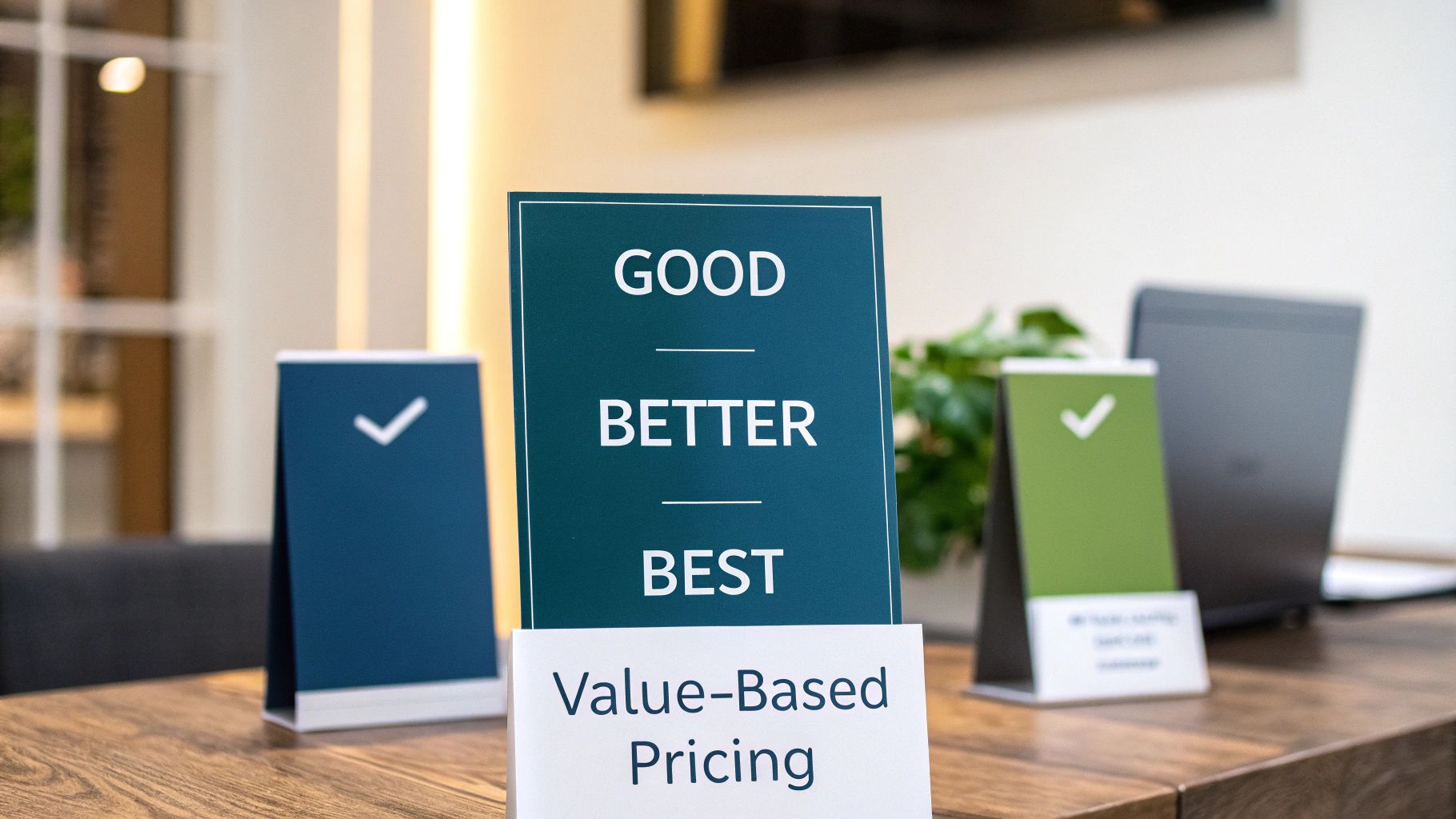
One of the best ways to earn more—without scaring away customers who want a lower price—is to offer different pricing levels. You’ve seen this before: the 'Basic,' 'Pro,' and 'Enterprise' software plans, or the 'Bronze,' 'Silver,' and 'Gold' packages at a car wash.
This "good, better, best" model works well because it gives customers a choice and helps them see the value.
Let’s say you’re a web designer. Instead of giving one flat price, you could offer three options:
- Good: A simple, five-page website. This is your basic option with a decent, but lower, profit margin.
- Better: The five-page site plus basic SEO and a blog. This is usually the most popular choice, priced for a healthy margin.
- Best: Everything in the 'Better' package plus an online store and ongoing monthly help. This is your top-level, highest-margin option.
This approach lets you help people with different needs and budgets. You'll find that many customers choose the middle "better" option, which you’ve smartly priced to be your most profitable. It’s a simple way to guide people toward a better sale for you.
Your pricing shouldn't be a single wall for customers to climb over. Instead, think of it as a staircase, with different steps for different needs. This lets you serve more people while making the most from those willing to pay for more value.
Even a small 1% increase in your average price, if it doesn't drive customers away, can directly improve your gross profit margin by a full percentage point or more. This is especially true for businesses that sell unique things. For example, specialty retail shops often have margins around 36.5% because they aren’t just selling a basic item. Compare that to something like steel manufacturing, where margins can be as low as 11-14%.
Bundle Services to Increase Average Sale Value
Another great idea is bundling. You simply package a few related products or services together and sell them for a single price—one that’s a little less than if the customer bought each item separately.
A marketing agency, for instance, might offer this:
- Social Media Management Package: Includes creating posts, scheduling, and monthly reports.
- SEO Starter Package: Includes a website check, keyword research, and page improvements.
- The Growth Bundle: Combines both packages for a lower price.
Bundling helps your gross margin in two ways. First, it makes each customer spend more on average. Second, delivering bundled services is often easier for your team, which lowers your direct costs. By combining similar tasks, you can make your work process smoother and reduce the labor hours needed for that sale, which directly makes it more profitable.
How to Cut Direct Costs Without Sacrificing Quality
After looking at your pricing, the other side of the gross margin coin is your Cost of Goods Sold (COGS). This is where good business operations can really make a difference. Lowering your direct costs is all about being smarter and more efficient with the money you spend to create your product or service.
It's a common myth that cutting costs means you have to buy cheaper, lower-quality stuff. That’s a short-term move that usually hurts your reputation. The real, lasting wins come from reducing waste and making your processes better. It’s about being more efficient, not just cheaper.
Negotiate Smarter with Your Suppliers
Your suppliers are your partners, but that doesn't mean you can’t ask for a better deal. I see so many business owners who are afraid to even ask. You'd be surprised how often a simple, friendly conversation can lead to real savings.
Here are a few proven ways to start that conversation:
- Offer to Pay Early: Cash is important for everyone, including your suppliers. Try offering to pay bills in 10 days instead of 30 in exchange for a 2% discount. This is a standard practice and an easy win for both of you.
- Buy in Larger Quantities: If you have the storage space and money, ask about discounts for bigger orders. Buying a three-month supply of a key material instead of a one-month supply could easily save you 5-10%.
- Shop Around Annually: Don't get too comfortable. At least once a year, get prices from two or three other suppliers. Even if you don't switch, you can use a competitor's price to get a better deal from your current partner.
This isn’t about squeezing every last penny out of them. It's about building a fair partnership where you get a better price and they get a good, long-term customer.
Find and Eliminate Hidden Waste
Waste is the silent killer of profit margins. It's the extra material you throw away, the spoiled food in the back of the kitchen, or a process that takes way longer than it should. Reducing waste is literally like finding free money.
Think of a restaurant that uses vegetable scraps to make soup stock instead of just throwing them out. That’s a direct cost saving that turns garbage into something valuable. A construction contractor might use software to create better cutting plans for wood, which greatly reduces the amount of scrap on every job.
Every dollar you save by reducing waste drops directly to your bottom line as pure profit. It doesn't require finding a single new customer or making an extra sale.
To start, just walk through your entire process, from ordering materials to the final delivery. Ask yourself at each step, "Is anything being wasted here?" You’ll be surprised by what you find once you start looking.
Boost Your Team's Efficiency
For any service business, your biggest direct cost is almost always your people. That means making your team more efficient is one of the best ways to lower your COGS and increase your gross profit margin.
This doesn't mean you have to be a tough boss or demand longer hours. It’s about giving your team better tools, smarter processes, and the right training so they can get more done in the same amount of time. Buying new software that automates a boring task might cost money at first, but if it saves each team member three hours a week, it pays for itself quickly.
For example, a marketing agency could get a project management tool that cuts down on time wasted in meetings. That frees up more time for paying client work, which directly lowers the labor cost for each project. Exploring how to boost your team's output is key, and you can learn more about how to improve operational efficiency in our detailed guide. In many cases, to cut direct costs well, businesses also need to focus on mastering marketing spend optimization to make sure they are getting customers in the most efficient way.
Analyzing Profitability for Each Product or Service
Your overall gross profit margin is a great starting point, but the real magic happens when you look closer. It's like knowing your car's average gas mileage—it's useful, but it doesn't tell you which trips are using the most gas. You need to know which parts of your business are truly making you money and which are secretly losing it.
Think about it. If you run a marketing agency, you might feel good about your overall numbers. But what if your high-profit SEO work is covering up for money-losing social media projects? You’ll never know unless you break things down.
Looking Under the Hood of Your Business
Looking at the profit of each product or service is how you find the hidden winners and losers in your business. It means tracking the money you make and the direct costs for each individual thing you sell. It’s a little more work, but the results are worth it.
I once worked with a landscaping company whose most popular service was a basic weekly lawn mow. They were busy all summer, but the owner felt like he was always struggling for cash. When we finally looked at the numbers, we found that this popular service had a tiny 8% margin.
At the same time, his less frequent, but bigger, landscape design projects were making a 45% margin. The "popular" service was actually hurting the business by using up time and resources that could have been spent on more profitable work.
How to Calculate Profitability by Offering
To figure this out for your own business, you'll need to do a little accounting. The goal is to separate the revenue and the COGS for each thing you sell.
Here’s a simple way to do it:
- Group Your Offerings: First, list out your main products or services. For an IT company, this might be "Managed Services," "Project Work," and "Hardware Sales."
- Assign Revenue: This part is easy. Just track how much money each of those groups brings in over a month or a quarter.
- Allocate Direct Costs (COGS): This is the tricky part. You need to connect your direct costs to the specific service that created them. For that IT company, the salary of a technician working on a project is a direct cost for "Project Work." The cost of a server sold to a client is a direct cost for "Hardware Sales."
Once you have these numbers, the formula is the same as your overall calculation, just for a smaller piece of the business.
Knowing the profitability of each service is like giving your business a check-up. You might find out that your star player is out of shape, while another player is ready to lead the team.
Making Smarter Decisions with the Data
Once you have this clear information, you can start making powerful, smart decisions. You’re no longer guessing—you’re working based on facts.
You might find out that your most popular product is also your least profitable. This happens a lot. With that knowledge, you suddenly have clear options:
- Focus Your Marketing: Move your advertising money away from the low-profit services and toward promoting your most profitable ones.
- Re-price the Laggards: Can you raise the price on that low-profit product to make it healthier? Even a small increase can make a big difference.
- Create Bundles: Can you package a low-profit item with a high-profit one to make the whole sale more profitable?
- Eliminate What's Not Working: Sometimes, the smartest move is to stop offering a service that's costing you money.
It's also important to remember that margins are very different across industries. Data from S&P 500 companies shows that areas like Information Technology average a gross margin of around 57.1%, while the Energy sector is closer to 27.9%. This is important; knowing where your industry stands helps you set realistic goals and shows how much room for improvement you might have by fixing your own mix of products and services. You can find more industry comparisons and learn more about these average gross profit margin findings to see where you stand.
Creating Your Gross Profit Margin Action Plan
All this information is great, but knowing something and doing something are two different things. Real progress comes from making a simple plan you can actually stick with.
The biggest mistake I see business owners make is trying to do everything at once. Instead, pick just one or two powerful ideas from this guide and focus on them.
Set a Clear and Simple Goal
Don't just say you want to "improve things." Be specific. A good goal can be measured and has a deadline—that’s what makes it real and keeps you on track.
For example, a solid goal looks like this:
- "Increase our overall gross margin from 40% to 45% within the next six months."
This is perfect. It’s clear, you can measure it, and it gives you a timeframe. Now you can work backward to figure out exactly how to get there.
Define Your First Steps
With that goal set, what’s the one thing you’ll do first? Maybe it’s talking to your top supplier to get a better price on materials. Or maybe it’s finally rolling out a "premium" version of your main service to increase your average sale price.
The process of analyzing your profitability almost always follows the same simple path.
This shows how you move from a big-picture view of your overall margin down to taking small, effective actions.
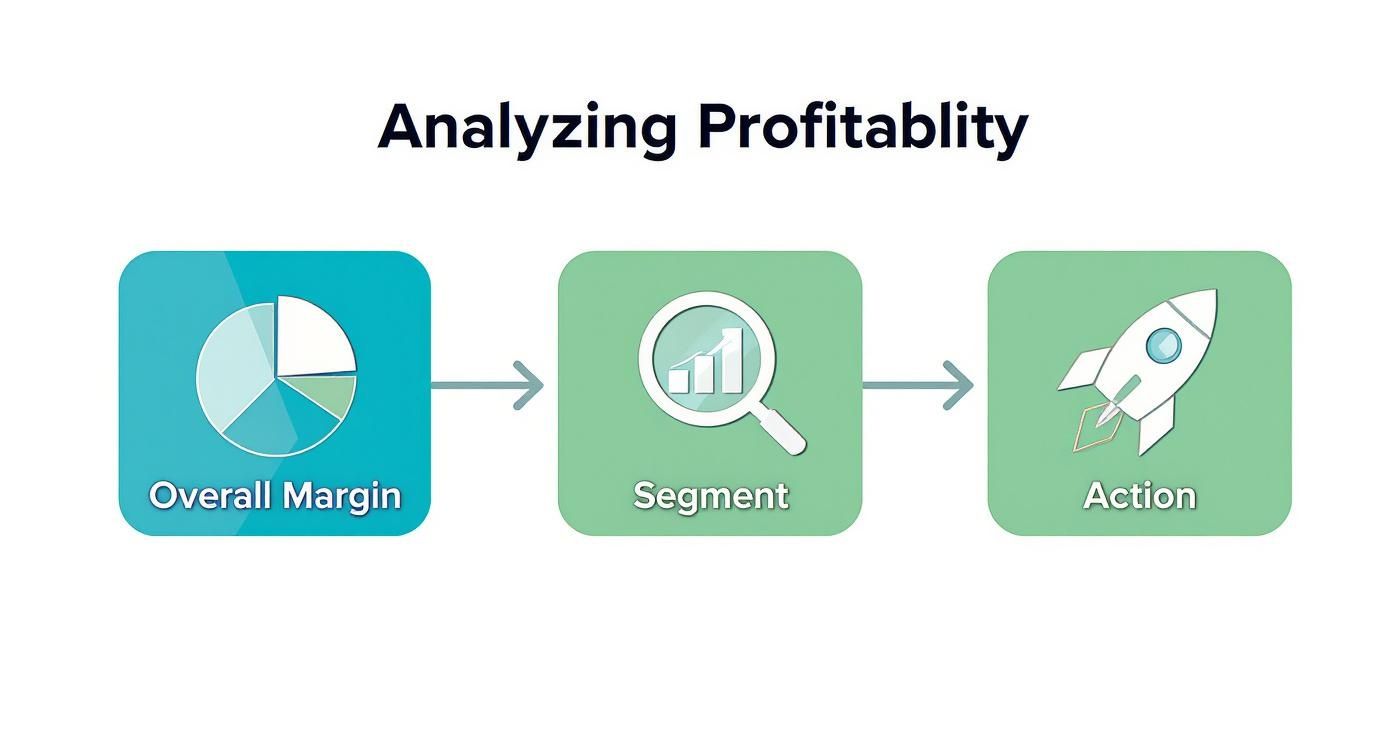
When you break down profitability by area—whether by product, service, or customer type—you can see which specific actions will have the biggest impact.
Don't make your plan too complicated. A simple plan that you actually do is way better than a perfect, complex plan that just sits there. Pick your target, decide on the first step, and get started.
Sometimes, the best first step is asking for help. If you're struggling to get clear numbers or you’re not sure what to do, it might be time to bring in an expert. Understanding how accounting advisory services drive smarter business decisions can show you exactly how a bookkeeper or fractional CFO can give you the clarity you need to grow.
Common Questions About Gross Profit Margin
As you start looking into your gross profit margin, a few questions always seem to come up. Let's answer them so you can move forward with confidence.
What Is a Good Gross Profit Margin?
Honestly, there's no single magic number. A software company might be happy with an 80% margin, while a grocery store could be doing great at 25%. It all depends on your industry, your business, and what it costs to deliver your product or service.
Instead of worrying about one perfect number, it's much better to focus on two other questions:
- How do our numbers compare to our competitors or others in our industry?
- Are we improving our own margin over time?
Steady improvement is a much stronger sign of a healthy business than just hitting some random number you read about online.
How Often Should I Calculate My Gross Profit Margin?
You should look at this number at least once a month. Think of it as a regular financial health check-up for your business.
Checking your margin monthly helps you spot problems before they get big. If you see it go down, you can immediately start asking why. Did material costs go up? Did a big project take more hours than we planned? This lets you react quickly and make changes. Looking at it every three months and every year then helps you see the bigger picture and long-term trends.
Can I Improve Gross Margin Without Raising Prices?
Absolutely. Raising prices is just one option, and it's not always the right one. You can make huge improvements by focusing only on your Cost of Goods Sold (COGS).
Many businesses find a lot of extra profit just by becoming more efficient, not more expensive.
This is all about being smarter with your direct costs. It could mean getting better deals with your suppliers, finding clever ways to reduce waste, or giving your team better training to help them work more efficiently. Every single dollar you save on these direct costs goes straight to your profit.
Feeling overwhelmed by the numbers? You don't have to figure it all out alone. The team at MyOfficeOps can help you get the financial clarity you need to make smarter, more profitable decisions. Learn how our advisory services can help you grow.