
You formed the company. You opened the bank account. You finally got the EIN. Then someone asks, “Are you staying a C corp, or are you filing an S election?”
That's the moment a lot of owners freeze.
Entrepreneurs don't usually start a business because they love tax classification. They start because they're good at something. They build homes in Delco, run an agency in Center City, open a clinic on the Main Line, or launch software with a co-founder in University City. Then the legal and tax side shows up fast, and suddenly one small choice starts touching everything. Your paycheck. Your tax bill. Your growth plans. Your future sale.
The good news is this doesn't need to feel like a law school exam. The C Corp vs. S Corp decision gets much easier once you stop treating it like a label and start treating it like a business tool. The right fit depends on what your business is doing now, what you want it to do next, and whether you expect to keep profits in the company, bring in investors, or sell down the road.
That Letter from the IRS Just Got Real
A lot of owners hit this decision right after the excitement wears off.
One week you're ordering checks, setting up QuickBooks, and telling friends your business is official. The next week you're hearing terms like “pass-through,” “double taxation,” and “Form 2553,” and it feels like everyone else got instructions you never received.
Why this choice feels bigger than it looks
On paper, it can seem like an administrative step. In real life, it's one of the first strategy calls you make.
If you choose one path, you may get a better tax result while the company is small and owner-operated. If you choose the other, you may keep more room for investors, preferred shares, and a future sale structure that's easier to work with. Neither route is automatically smarter. It depends on what kind of company you're building.
I've seen owners in the Philadelphia area make this harder than it needs to be because they assume they must pick the “best” structure forever. That's usually the wrong frame. A better question is, “What structure fits this stage of my business?”
A tax election isn't just paperwork. It's a decision about how money moves through your business.
The everyday problems tied to this decision
Most small business owners care about a few practical things:
- How do I pay myself: Salary, distributions, dividends, or some mix?
- What happens to profit: Does it get taxed inside the company, on my return, or both?
- Can I bring in partners later: And if I do, are there ownership limits?
- Will this create headaches at tax time: Especially if bookkeeping is already behind?
- What if I outgrow the structure: Or want to sell?
Those are the fundamental questions. The letters “C” and “S” are just shorthand for the rules around them.
If you're still getting your books and tax process organized, it helps to get the basics under control early. A clean setup makes this decision much easier, especially before year-end filing pressure starts. This tax season preparation guide for small business owners is a good place to get your records and workflow in order.
The Big Picture What C and S Corps Really Mean
At the state level, you form a corporation. For federal tax purposes, that corporation is usually taxed as a C corporation unless it elects S corporation treatment. An S corp exists because Congress created a separate pass-through election under Subchapter S, and a company that qualifies must file Form 2553 with the IRS. It also has to follow ownership rules, including generally no more than 100 shareholders, shareholders who are generally U.S. citizens or residents, and only one class of stock, as explained by Wolters Kluwer's summary of S corp and C corp rules.

Think of it as two different wallets
A C corp works like a separate wallet.
The business earns money in its own wallet. It pays its own tax. If the company later sends money out to you as a dividend, that's another tax event for you personally. That's why people talk about “double taxation.” The company is one taxpayer. You are another.
An S corp works more like a pipe.
The money doesn't stay trapped at the company tax level for income tax purposes. It flows through to the owners. The business still files its own return, but the taxable income generally lands on the owners' returns rather than being taxed first at the corporate level.
Why owners get confused
The confusion usually comes from the fact that both are still corporations.
Both can give you liability protection if you respect the formalities. Both can have payroll. Both can sign contracts, hire people, and open accounts. So from the outside, they can look similar.
But the tax treatment and ownership flexibility are very different.
Simple test: If you care most about current tax efficiency, owners often lean toward S corp treatment. If you care most about capital raising and share structure flexibility, the C corp usually has the edge.
The mental shortcut that helps
If you remember only one thing, remember this:
| Structure | Core idea |
|---|---|
| C corporation | The company is its own taxpayer for income tax purposes |
| S corporation | The company's taxable income generally passes through to the owners |
That basic difference explains most of the trade-offs owners feel later. How profits are taxed, whether retaining earnings helps, how investors view the business, and what happens at exit all flow from that one split.
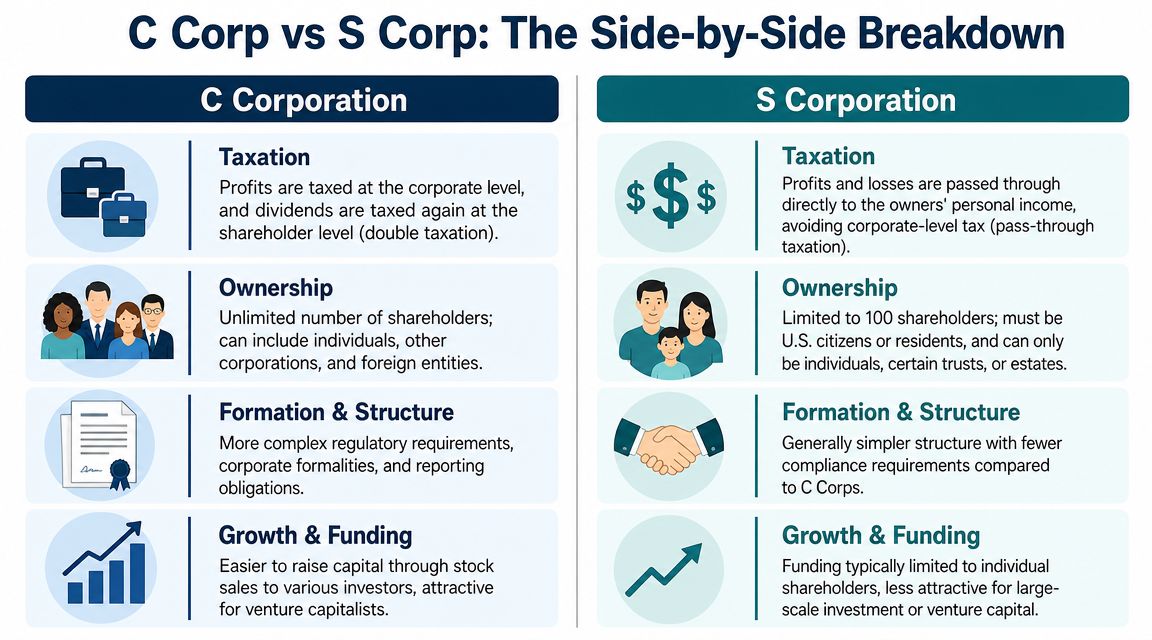
C Corp vs S Corp The Side-by-Side Breakdown
Here's the short version first.
| Issue | C corporation | S corporation |
|---|---|---|
| Federal tax treatment | Company pays tax at the corporate level, and owners may face tax again on dividends | Income generally passes through to owners |
| Shareholders | Unlimited flexibility | Generally capped at 100 shareholders |
| Who can own shares | Broad flexibility | Shareholders generally must be U.S. citizens or residents |
| Stock classes | Multiple classes allowed | One class of stock |
| Fit for outside investment | Usually stronger | Often limiting |
| Fit for owner-operated firms | Sometimes useful, especially if retaining earnings or planning for certain exit outcomes | Often attractive when owners want tax efficiency and simple ownership |
Taxation and cash flow
For most business owners, it's a common starting point, and understandably so. Taxes hit your wallet.
With an S corp, profit usually passes through to the owners for tax purposes. That can work well when the business is distributing most of what it earns. Owners often like the direct connection between business profit and personal tax reporting.
A C corp works differently. The company pays tax at the corporate level. That can sound worse at first, but it's not always worse in practice. If the company plans to retain earnings, build reserves, or fund growth inside the business, a C corp can be more useful because the company can keep earnings inside the entity and pay the 21% corporate rate, while S corp income is generally taxed to owners whether or not cash is distributed, as described in InCorp's discussion of entity choice and retained earnings.
If your business sends most profit out to the owners each year, S corp treatment often feels cleaner. If your business needs to keep cash inside for growth, the answer can change.
Ownership and eligibility
A lot of growing companies often hit a wall here.
An S corp has hard eligibility limits. It is capped at 100 shareholders, shareholders must generally be U.S. citizens or residents, and it can issue only one class of stock. A C corp has no comparable limit on shareholder count and can issue multiple classes of stock. Oyster's overview explains why that flexibility makes the C corp a stronger fit for businesses that want venture financing, preferred equity, or more complex compensation structures like stock options in its comparison of S corps and C corps.
That one-class-of-stock rule matters more than many owners realize. If everyone's economics need to be identical, an S corp may work fine. If you want one investor to have preferred rights, or you want different deal terms for different owners, the S corp can become a bad fit quickly.
Administration and paying yourself
Owners often assume the C Corp vs. S Corp choice changes everything about paperwork. It does change some things, but not as dramatically as people think.
Both are corporations. That means corporate records still matter. You still need payroll discipline if you're working in the business. You still need clean books. If you treat the company bank account like a personal wallet, neither structure will save you from trouble.
The practical difference is usually not “one has paperwork and the other doesn't.” It's more about whether your tax reporting and ownership structure stay simple or become layered.
A few real-world points matter here:
- Salary still matters: If you work in the business, payroll decisions need to be handled correctly.
- Bookkeeping quality matters more than entity hype: Owners often chase the “right” election while their chart of accounts is a mess.
- Distribution planning matters: You need to know what cash is leaving the business and why.
Liability protection
This part is simple.
Both structures are corporations, so both can provide liability protection if you set them up properly and respect the legal separation between the business and the owner.
Practical rule: Don't choose between C corp and S corp because you think one “protects you more.” Choose based on taxes, ownership, growth plans, and exit goals.
How Your Choice Impacts a Philadelphia Business
National advice is useful. Pennsylvania reality is where many owners get surprised.
A Philly-area business doesn't operate in a vacuum. State treatment affects cash flow, owner expectations, and year-end planning. That's why a structure that looks great in a generic online article can feel a lot different once local taxes and owner distribution habits enter the picture.

Why local owners often lean S corp first
For many closely held businesses, S corp status can deliver a meaningful tax advantage. The U.S. Treasury found that, weighted evenly across firms, the average effective tax rate for S corporations was 15.2%, and it would have been 25.3% if those same firms were taxed as C corporations. When weighted by dollars of net income, the Treasury found 23.1% for S corporations under current law versus 30.1% under C-corp taxation, according to the Treasury working paper on effective tax rates for pass-through businesses.
That helps explain why many owner-operated firms start by looking hard at S corp treatment. If you run a profitable service business in the Philadelphia area and you're taking money out regularly, the tax drag can feel very different depending on the structure.
Where Pennsylvania owners need to slow down
Local business owners often hear broad advice like “S corps avoid double taxation” and stop there. That's not enough for planning.
What matters in practice is how your company uses cash:
- If you distribute most profit to owners, pass-through treatment may line up well with how the business works.
- If you need to hold cash for equipment, hiring, or reserves, the timing of taxation becomes more important.
- If ownership may expand beyond a tight local group, the restrictions can become a business issue, not just a tax issue.
That's why this decision is rarely just about this year's return. It's about the kind of company you're building in West Chester, King of Prussia, Center City, or the surrounding counties.
Good entity planning starts with cash flow, not just tax theory.
A better way to think about it locally
For Philadelphia-area owners, the cleaner question is this: does your current structure match how your business earns, keeps, and shares money?
If you need help thinking through that with your own books and tax picture, it's worth speaking with integrated tax consultants who work with growing businesses instead of relying on one-size-fits-all internet advice.
Real-World Scenarios Which Structure Fits Your Story
The fastest way to understand the C Corp vs. S Corp question is to stop thinking in labels and think in stories.
Solo Solutions in Center City
Solo Solutions is a one-owner marketing consultancy. The owner does client work, sends invoices, keeps a small team of contractors, and takes most of the profit home. There's no investor plan. No need for preferred stock. No dream of raising capital from a fund.
For this kind of business, S corp treatment often fits the way the company already operates. The owner wants tax efficiency, simple ownership, and direct access to the cash the business generates. The business isn't trying to create a layered capital structure. It's trying to turn work into income without carrying unnecessary tax friction.
This is the kind of company where owners often overcomplicate things by reading startup advice that doesn't apply to them.
PhillyTech Innovators in University City
Now take a very different company.
PhillyTech Innovators has three founders. They're building a product, not just selling labor. They expect outside funding to matter. They may want preferred shares. They may want equity incentives for early hires. They may eventually bring in investors who don't fit S corp ownership rules.
In that case, the C corp is usually the serious option. An S corp is capped at 100 shareholders who must be U.S. citizens or residents and can issue only one class of stock. A C corp can have unlimited shareholders, including foreign investors and other corporations, and multiple stock classes. Oyster notes that this makes the C corp the only viable choice for businesses seeking venture capital in its overview of ownership limits and fundraising flexibility.
A structure that works for a consultant can block a startup from raising the money it needs.
That's the part some founders miss. They choose based on today's tax return and accidentally make tomorrow's financing harder.
Main Line Builders with family ownership
Main Line Builders is a family-owned construction company. The owners are profitable, but they also need to reinvest in trucks, equipment, staffing, and working capital. They care about tax efficiency, but they also care about succession and long-term value.
The answer becomes more nuanced.
If the family wants regular distributions and expects ownership to stay simple, S corp treatment may still line up well. If the company is moving toward a more formal growth path, retaining earnings for expansion, or exploring a future sale where enterprise value matters more than annual owner distributions, the C corp becomes more worth discussing.
This is also the kind of company where the “right” answer can change over time. A business might spend years in one structure and then reach a stage where the old choice no longer supports the new goal.
What these stories have in common
These businesses are all valid. None is “more correct” than the others.
The decision turns on a few practical questions:
- How do you make money: From owner labor, scalable products, or capital-heavy operations?
- What happens to profit: Is it paid out or retained?
- Who may own the company later: Just you, family, employees, or outside investors?
- What are you building toward: Stable income, aggressive growth, or a sale?
Once those answers are clear, the entity choice gets much less mysterious.
Making Your Decision and Planning Your Next Move
The best structure isn't the one that wins a debate online. It's the one that fits your business now without boxing you in later.
Ask the questions that actually matter
Before choosing between C corp and S corp, sit with these:
- Will you take most profits out each year, or leave money in the business?
- Do you expect outside investors, foreign owners, or complex ownership terms?
- Do you want to keep ownership simple for the foreseeable future?
- Are you building a cash-generating business for yourself, or a company designed for scale and sale?
- Could your answer be different in a few years?
Those questions usually lead to a better decision than chasing a generic “best entity” checklist.
Don't ignore the exit
This is the part many owners miss.
The “best” structure can flip when the business starts optimizing for enterprise value instead of current-year owner distributions. C corporations can offer Qualified Small Business Stock, with the potential to exclude up to 100% of capital gains on qualifying stock held for five years, a benefit that isn't available to S corp owners, as discussed in KLR's explanation of why entity choice can change as exit planning becomes more important.
If you're building something you may eventually sell, that issue deserves real attention. What helps today's tax return may not be what helps at exit.
It's okay if the answer is “not forever”
A lot of owners feel pressure to make a perfect choice at formation. That's usually unnecessary.
A better mindset is to choose the structure that supports your current stage, then revisit it when the business changes. New partners, new investors, retained earnings, succession planning, or sale prep can all justify a fresh look. If you want another practical perspective on edge cases, Attorney Stephen A. Weisberg has a useful piece on when an S corp isn't ideal.
And before you make the call, make sure you're also looking at the basics that affect your real tax picture, including what you may be able to write off. This small business tax deductions list can help you frame the broader conversation.
The right entity should support your business model, your cash flow, and your future plans. If it only helps one of those, keep digging.
If you want help sorting through the C Corp vs. S Corp decision with real numbers from your business, MyOfficeOps can help you think it through clearly. Their Philadelphia-area team supports small and midsize businesses with bookkeeping, payroll integration, reporting, forecasting, and CFO-level guidance, so you can choose a structure that fits both today's tax reality and tomorrow's growth plans.