
It’s a regular workday and your numbers still don’t talk to each other.
Payroll sits in one system. Your bookkeeper sends a report that doesn’t match what your tax person wants. A customer payment is late, bills are due, and you’re trying to decide if you can hire, buy equipment, or give yourself a distribution without creating a mess three months from now.
I’ve seen this with a lot of small and midsize businesses around Philadelphia and West Chester. Construction companies. Medical practices. Agencies. IT firms. Good owners, solid revenue, constant stress. Not because they’re bad at business. Because their financial setup was built in pieces.
That old setup usually looks like this: one person handles the books, another runs payroll, your CPA shows up at tax time, and nobody owns the full picture. That’s where integrated tax consultants come in. The true value isn’t just filing returns. It’s putting bookkeeping, payroll, tax planning, and financial advice into one connected system so you can stop guessing and start deciding.
The Financial Chaos Most Business Owners Face
A Philly business owner told me something years ago that stuck with me. “We’re busy all the time, but I still can’t tell if we’re making money.”
That’s the problem in one sentence.
You can have work coming in, employees working hard, and money moving through the bank account every week, but still feel blind. Your payroll report says one thing. Your QuickBooks file says another. Your tax accountant asks for a report you’ve never seen before. You forward emails back and forth like a middleman in your own company.
The real issue isn't effort
Most owners think the fix is to work harder or check reports more often. It’s not. The issue is that the system itself is disconnected.
When bookkeeping, payroll, and tax are split up, every person sees only part of the puzzle. That creates delays, duplicate work, and bad timing. You find out about problems after the quarter ends, after cash gets tight, or after tax season turns into a scramble.
A lot of this can be improved by automating business processes digitally, especially the repetitive handoffs that waste owner time and create reporting errors.
Practical rule: If you have to email the same financial document to three different people, your system is broken.
Why owners feel stuck
Owners usually don’t need more spreadsheets. They need one version of the truth.
That means your books should support payroll. Payroll should feed cleanly into tax reporting. Tax planning should reflect current numbers, not last year’s cleanup. If that’s not happening, you’ll keep making important decisions with partial information.
If this sounds familiar, you’re not alone. A lot of owners ask the same basic question: where is the money going? This breakdown of why a business might not be making money is useful because it gets to the root of the issue instead of blaming “expenses” in a vague way.
Integrated tax consultants solve this by acting like a connected financial team, not a once-a-year tax stop. That changes everything.
What Integrated Financial Services Really Mean
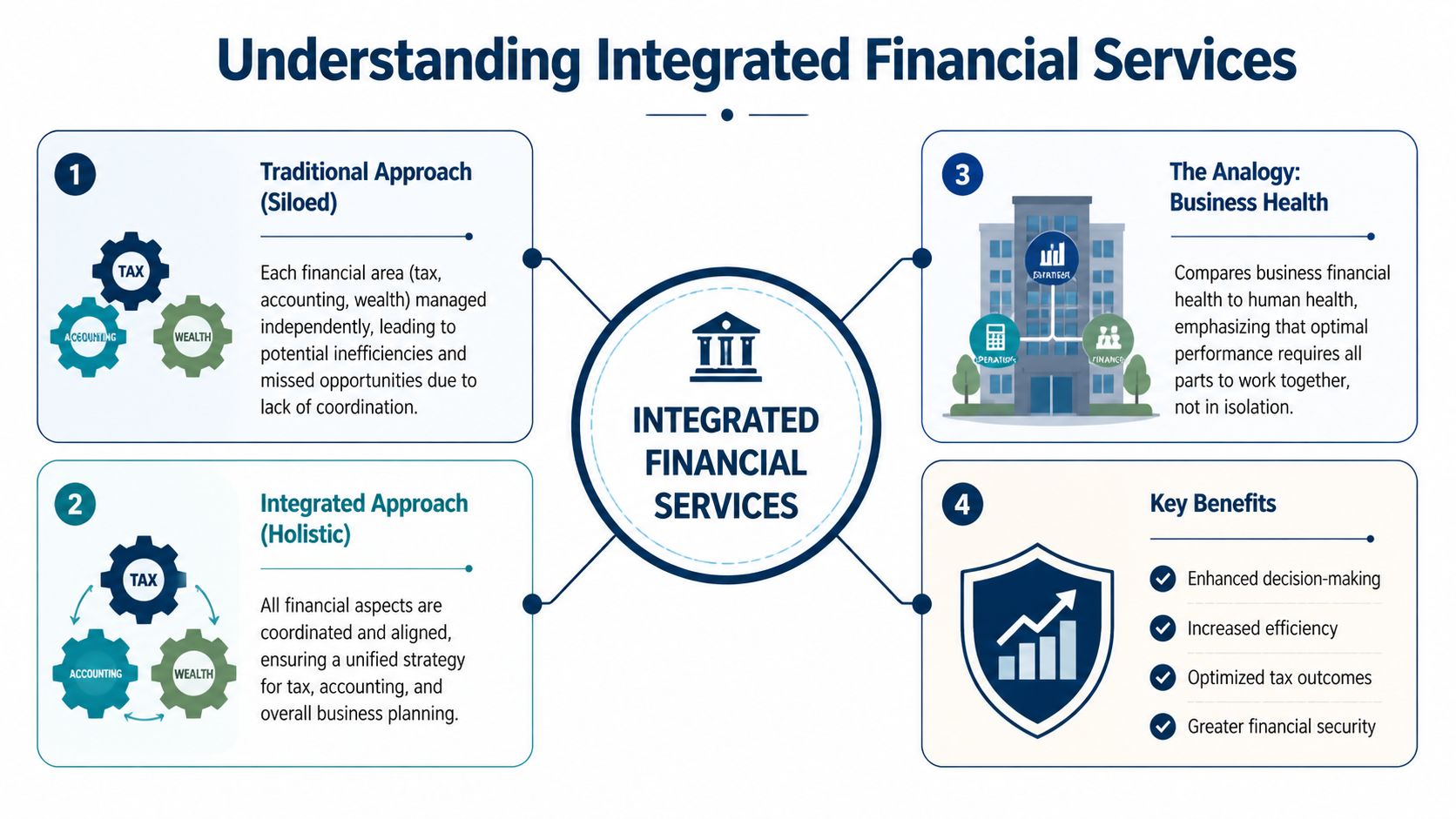
“Integrated” gets tossed around so much that people stop hearing it. In business finance, it means something simple. One team sees the whole picture and works from the same data.
Think about your health. You wouldn’t want your doctor, surgeon, and physical therapist all working from different charts and never speaking to each other. Your business works the same way. If your bookkeeper, payroll provider, and tax advisor aren’t coordinated, you get fragmented care for your company’s finances.
One system instead of separate islands
An integrated model connects four things that owners usually keep separate:
- Daily bookkeeping: clean records, reconciled accounts, current numbers
- Payroll: wages, taxes, benefits, and labor costs posted correctly
- Tax planning and compliance: not just filing, but planning based on live data
- CFO-level advice: turning reports into decisions about pricing, hiring, cash flow, and growth
That matters because a 2023 NFIB survey summary cited by Integrated Tax Consultants says 62% of small and midsize businesses struggle with fragmented financial systems, and that siloed setup leads to a 25% higher error rate in financial reporting.
What this looks like in practice
In a siloed setup, payroll gets processed, then someone manually enters pieces into the books, then your tax preparer adjusts things months later. That’s like writing the same sentence three times and hoping it stays accurate.
In an integrated setup, the systems and people are aligned from the start. The books are built for tax readiness. Payroll data flows where it should. Reports are designed to answer owner questions, not just satisfy software categories.
If you’re a solo consultant or freelancer trying to understand how cleaner software connections work at a smaller scale, this guide to Xero for freelancers is a practical example of how connected financial tools reduce manual work.
A good integrated advisor doesn’t just tell you what happened. They help you see what happens next if you keep going the same way.
Why this matters to SMB growth
Growth breaks weak systems fast. More jobs, more employees, more vendors, more states, more tax complexity. If your setup is already messy, growth doesn’t fix it. Growth exposes it.
That’s why many owners eventually move toward outsourced accounting for small business. Not because they want to hand things off blindly, but because they want one accountable team running a process that makes sense.
Integrated financial services aren’t a luxury. They’re the adult version of business finance.
Traditional Tax Preparer vs Integrated Consultant
A traditional tax preparer and an integrated consultant are not the same thing. They may both touch taxes, but they solve different problems.
A tax preparer usually looks backward. They take what already happened and turn it into a return. That has value. Every business needs compliance. But compliance alone won’t help you decide whether you can afford a new PM, open a second location, or fix shrinking margins on a service line.
An integrated consultant works year-round. They look at current books, payroll trends, cash flow, and tax exposure together. That shifts the relationship from filing forms to guiding decisions.
Tax Preparer vs Integrated Consultant at a Glance
| Attribute | Traditional Tax Preparer | Integrated Tax Consultant |
|---|---|---|
| Primary role | Files returns and handles compliance | Connects bookkeeping, payroll, tax, and advisory |
| Timing | Mostly seasonal | Ongoing through the year |
| Main view | Historical | Current and forward-looking |
| Owner experience | Reactive. You answer requests at tax time | Proactive. You get guidance before decisions |
| Scope | Tax forms, notices, year-end questions | Reporting, planning, cash flow, profitability, tax strategy |
| Communication | Often limited to deadlines and filing periods | Regular check-ins and cross-team coordination |
| Data flow | Pulls from whatever records exist | Helps shape cleaner records from the start |
| Best fit | Very simple situations | Growing businesses with moving parts |
The cheap option often costs more
Owners sometimes keep the old model because the annual tax fee looks lower. I get it. But low visible cost can hide high business cost.
If your numbers are late, you bid jobs wrong. If payroll isn’t mapped correctly, labor reporting gets distorted. If tax planning happens after year-end, your choices are gone. The return gets filed, but the opportunity already passed.
You don’t need a historian for your business finances. You need a guide.
There’s also a practical point here. The integrated model is not some fragile boutique idea. A comparable regional firm, Integrated Tax Services in Washington, generates about $1.37 million in annual revenue with 11 to 20 employees, or roughly $86,000 in revenue per employee, according to Prospeo’s company profile. That’s a lean, workable service model. In plain English, firms can deliver this kind of support without being giant national shops.
What to choose
If your business is very simple, a seasonal preparer may be enough.
If you have employees, multiple service lines, project-based work, partner distributions, or constant cash flow decisions, don’t settle for annual cleanup. Get integrated help. It’s more useful, more honest, and usually more economical than paying for mistakes all year.
The All-In-One Financial Toolkit for Your Business
An integrated setup works because each service supports the others. On their own, bookkeeping, payroll, tax, and advisory are helpful. Together, they become a management system.
Bookkeeping that does more than record history
Bad bookkeeping is like driving with a fogged windshield. You can move forward, but you’re doing it half blind.
Clean books give you current bank balances, accurate expenses, usable profit-and-loss reports, and clear accounts receivable. They also give your tax team something they can trust. If the books are messy, every other service becomes cleanup work.
In an integrated model, bookkeeping is built for decision-making. Not just for closing the month.
Payroll that feeds the books correctly
Payroll creates some of the biggest reporting problems for growing businesses. Labor is often a major cost, especially in construction, healthcare, and professional services. If payroll entries don’t land correctly in your accounting system, your margins get distorted fast.
When payroll is integrated, your wage expense, tax withholdings, benefits, and reimbursements flow into the books in a consistent way. That means less manual fixing and fewer surprise adjustments later.
A contractor can see labor by job more clearly. A medical practice can better understand provider compensation. An agency can compare labor cost against client retainers without patching numbers together.
Tax planning built on live numbers
Integrated tax consultants earn their keep.
Most tax savings are not found when someone starts preparing the return. They’re found earlier, when there’s still time to change compensation, timing, purchases, entity decisions, or estimated payments. That only works if the books are current and payroll data is reliable.
Tax analytics and automation also matter here. The CPA Journal reports that integrating tax analytics and automation can free up 30% to 50% of staff time previously spent on data gathering, which lets teams focus more on strategic insight instead of repetitive collection work, as discussed in this CPA Journal review of tax analytics and automation.
CFO advice that answers owner questions
This is the missing layer in most SMB financial setups.
You don’t just need reports. You need someone who can tell you what they mean. Can you afford a hire? Is one division carrying the whole company? Are you collecting cash too slowly? Should you raise prices?
Here’s how the integrated toolkit changes the owner experience:
- Before: You get reports after the month ends and try to interpret them yourself.
- After: You get numbers tied to decisions, with context.
- Before: Tax, payroll, and bookkeeping teams ask you to connect the dots.
- After: One team connects the dots for you.
That’s the difference between having financial tasks and having financial control.
Seeing Integration in Action with Local Examples
Theory is nice. Real business problems are better.

A contractor in West Chester
A contractor can stay busy all year and still feel broke. That usually comes down to job costing, change orders, collections, and labor not being tracked cleanly enough.
I’ve seen contractors bid based on gut feel because nobody trusts the last job report. The bookkeeper closes the month late. Payroll lives in a separate system. Materials hit the books, but not in a way that helps the owner judge the job. Then they underbid the next project and repeat the pain.
With integrated support, the fix is practical. Labor posts cleanly. Job costs are organized consistently. The owner gets a simpler read on which jobs are healthy and which ones are dragging cash down. That leads to better bids, tighter collections, and fewer bad surprises.
A healthcare practice in Philadelphia
Healthcare has a different headache. There’s payroll complexity, provider pay, equipment spending, insurance timing, and partner decisions. The tax side matters, but it can’t sit by itself.
A growing practice might be profitable on paper while cash still feels tight. That often happens when distributions, payroll, and capital purchases aren’t being viewed together. A tax preparer can file the return just fine and still miss the broader operational problem.
An integrated consultant can help the owners look at current results, upcoming equipment decisions, and tax impact as one issue instead of three separate ones. That’s how owners make a smart purchase without creating pressure somewhere else.
The best financial advice is often boring. Cleaner books, better timing, fewer surprises.
A professional services firm in Center City or the Main Line
Agencies, law firms, IT companies, and consultancies usually have one core challenge. They don’t know which work is profitable.
Revenue looks healthy, but owner compensation, contractor costs, software subscriptions, and payroll burden blur the picture. Pricing decisions get made based on top-line sales instead of margin.
An integrated model changes the conversation. Instead of asking, “Are we growing?” the owner can ask better questions. Which service line is strongest? Which clients drain team time? Can we hire without crushing cash? Should we change how we bill?
That’s where integrated tax consultants stop being “tax people” and start becoming useful business partners.
How to Choose the Right Integrated Partner
A slick website doesn’t mean much. You need to know how a firm works.
Start with one question: Do these people connect the work, or do they just sell multiple services under one roof? Those are different things. A lot of firms offer bookkeeping, payroll, and tax, but they still run them like separate islands.

Questions worth asking in the first call
Ask direct questions and listen for direct answers.
- How do your bookkeeping and tax teams communicate? If the answer is vague, that’s a warning.
- What reports will I see every month or quarter? They should be able to show examples.
- How do you handle payroll integration? You want a process, not hand waving.
- Who reviews my account? Titles matter less than actual accountability.
- What does onboarding look like? If onboarding sounds messy, ongoing service will be messy too.
- Do you work with businesses like mine? Industry context matters in construction, healthcare, and service firms.
Credentials and team depth matter
This part gets overlooked until there’s trouble.
A source cited by Integrated Tax Consultants says IRS audits are projected to increase by 15% in 2025, and 55% of SMB owners distrust consultants who lack portable CFO experience. Their summary also argues that owners should vet for verifiable credentials like Enrolled Agent status and industry-specific advisory strength, which you can review in their service overview.
That doesn’t mean every firm needs a giant bench. It does mean you should ask who is performing the work and what qualifications they hold.
Ask for names, roles, and credentials. “We have a great team” is not an answer.
If you’re sorting through local options, this resource on small business financial advisors near me can help you compare firms with a clearer lens.
Red flags I wouldn't ignore
Some warning signs are easy to miss when you’re overwhelmed.
| Red flag | Why it matters |
|---|---|
| They only talk about tax filing | That usually means they’re reactive, not integrated |
| They can’t explain data flow between systems | Errors and duplicate work are likely |
| They have no examples for your industry | You may end up teaching them on your dime |
| They speak in jargon instead of plain English | Confusion now becomes frustration later |
| They avoid discussing response times | You’ll probably chase them when things get urgent |
Choose a partner who can clearly explain complicated things. If they can’t do that in a sales call, they won’t do it well when your money is on the line.
Your Next Steps to Financial Clarity in Philadelphia
If your finances feel scattered, don’t normalize it. That stress is a signal.
A business with separate books, payroll, tax work, and owner decision-making will always move slower than it should. You’ll spend too much time translating information between vendors and not enough time running the company. That’s why integrated tax consultants matter. They reduce friction and give you a clearer dashboard for key decisions.
There is a compelling reason to partner with a specialized regional firm rather than assuming larger organizations are superior. A standard full-service accounting firm catering to SMBs, such as Integrated Tax Consultants in Maine, operates with fewer than 25 employees and serves 50 to 150 active clients, according to ZoomInfo’s company profile. This represents the type of relationship-based model many owners want. Responsive. Personal. Accountable.
Keep the first step simple
You don’t need to overhaul everything in one week. Start by getting clear on three things:
- What systems hold your financial data today
- Where manual handoffs keep happening
- Which decisions you’re making without confidence
Then talk to a firm that can connect those dots.
If you want your inquiry process to be easy and low-friction, this guide to contact forms for consultants has some smart ideas on what a good first touch should feel like. The same principle applies here. A good advisor should make the first conversation simple, not complicated.
Philadelphia-area owners don’t need more noise. They need cleaner numbers, faster answers, and a financial partner who can help them grow without the usual chaos.
If you’re ready to replace scattered financial work with a connected system, MyOfficeOps is built for exactly that. Based in West Chester and serving Greater Philadelphia, MyOfficeOps helps construction companies, healthcare practices, and professional service firms tie together bookkeeping, payroll integration, tax-ready reporting, financial analytics, and CFO-level advisory. The team is responsive, practical, and easy to talk to. Start with a Discovery Call, get a clear plan, and see whether an integrated approach fits your business.