
You're staring at the bank balance again, and it still doesn't match the story in the P&L. Sales look decent. Profit looks okay. But the cash feels tight, bills are coming due, and somebody has to explain why the numbers don't line up. That's exactly where cash flow statement analysis earns its keep, because it tells you what happened to the money, not what the income statement hoped would happen.
A lot of owners treat the cash flow statement like a report they check when the accountant sends it over. That's the wrong use. Used properly, it's a working-capital diagnostic and an early-warning system. It shows whether the business can fund itself from operations, whether growth is eating cash, and whether you need to act before a shortfall turns into a fire drill.
Why Profit on Paper Doesn't Always Mean Cash in the Bank
A service firm can have a solid month on paper and still feel broke by Friday. The reason is simple. Clients haven't paid yet, payroll already hit, and the vendor bills don't care that revenue was booked last month. That gap is why profit and cash are different animals, and why owners get blindsided when they stare at earnings instead of cash movement.
The cash flow statement is the more honest report. It sits around operating, investing, and financing activities and shows how cash moved during the period, not just how much was earned in theory. A company can look healthy on the income statement while receivables, inventory, or debt service absorb the cash that should have stayed in the bank. That's why the key question is not “Did we make money?” It's “Did operations generate enough cash to keep the business moving without leaning on outside money?”
The part owners miss
Working-capital timing is usually the culprit. A design agency that waits on invoice collection can report profit while cash sits locked up in accounts receivable. A contractor that buys materials upfront can see cash leave before the job is fully billed. And a growing business that keeps stock on hand can watch inventory swallow cash even while sales climb.
Practical rule: if the business keeps “feeling busy but broke,” stop looking at profit first. Look at receivables, payables, inventory, and debt service.
That's the true value of cash flow statement analysis. It doesn't just tell you whether you're profitable. It tells you whether the business model is funding itself in real time. If the answer is no, you don't need a prettier report. You need a better collection process, tighter vendor terms, or a financing plan before the gap gets wider.
The Three Sections of a Cash Flow Statement Explained Simply
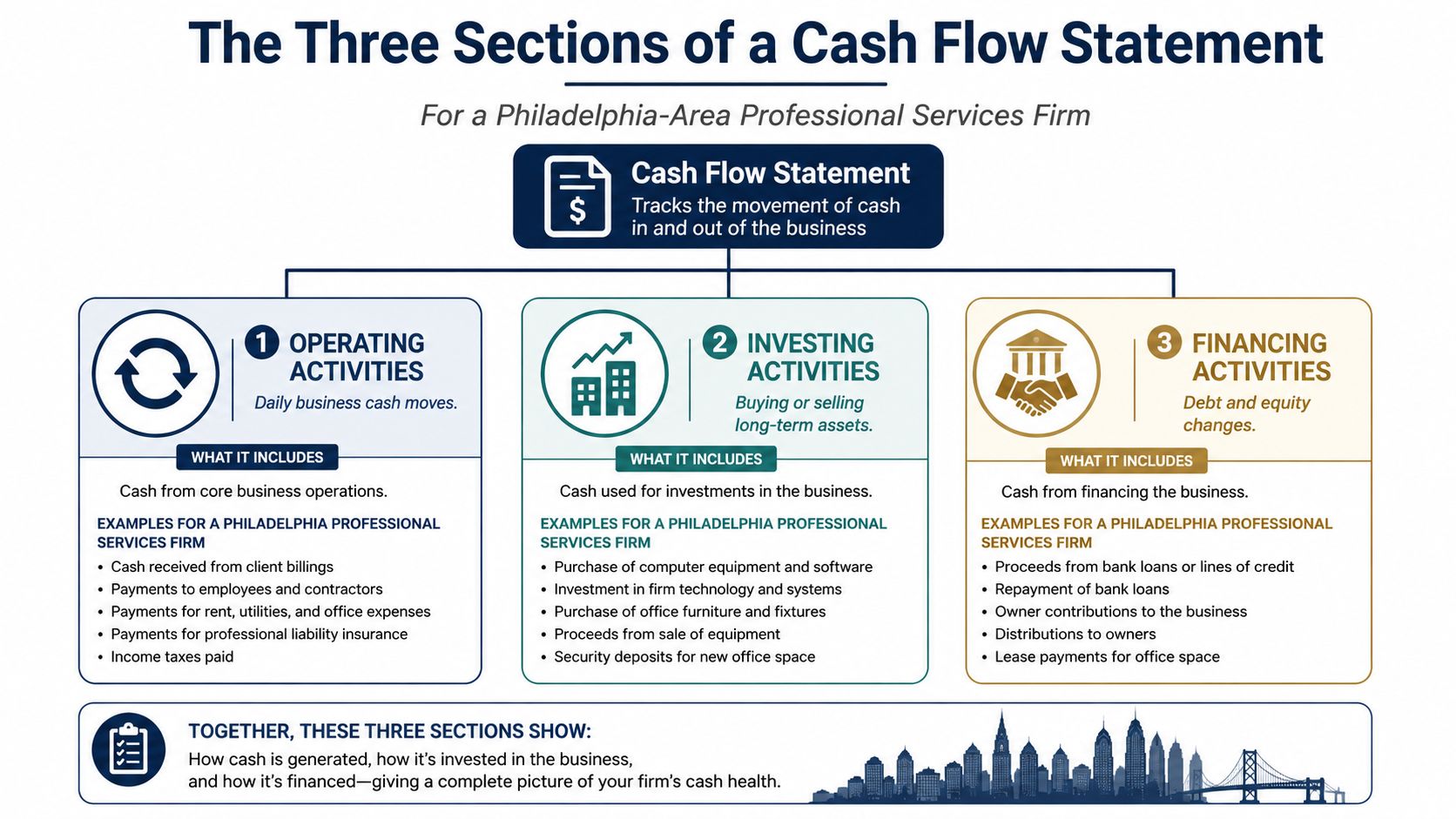
A cash flow statement has three main parts, operating, investing, and financing activities, and it shows how cash moves in and out of a business during a set period such as a month, quarter, or year, as explained in this overview of the statement of cash flows. That sounds technical, but the logic is easy. Each section answers a different question about the business.
Operating activities
This is the day-to-day business. Cash comes in from customers and goes out for payroll, rent, supplies, and other normal expenses. If this section is healthy, the business is feeding itself. If it's weak, the company is living on borrowed time or borrowed money.
For a Philadelphia-area professional services firm, this is the line that matters most. It tells you whether client work is turning into usable cash fast enough to keep the lights on.
Investing activities
This section tracks long-term moves. Buying equipment, software, vehicles, or property shows up here. Selling long-term assets shows up here too. Negative cash here is not automatically bad. Sometimes it means the business is growing. Sometimes it means the owner is replacing old stuff just to stay open.
Financing activities
This section shows debt and owner money. Loan proceeds, loan payments, owner contributions, and distributions live here. It tells you how the business is funding itself when operations and investing don't cover the gap.
Read the three sections together. One section tells you how the business runs, one tells you how it grows, and one tells you how it pays for the whole thing.
If you only glance at one line, you'll miss the story. A good cash flow statement analysis reads the whole thing like a short report on how the company survived the period, what it spent on growth, and who supplied the cash.
How Net Income Turns Into Actual Cash
Under the indirect method, the statement starts with net profit or net income, then adds back non-cash expenses like depreciation and amortization, and then adjusts for working capital changes such as accounts receivable, inventory, and accounts payable, according to this guide on reading a cash flow statement. That's the bridge between accounting profit and real cash.
Step 1, start with net income
Net income is the headline number from the P&L. It tells you what happened on paper after expenses. It does not tell you whether customers paid you, whether vendors were paid, or whether inventory piled up. That's why it's only the starting point.
Step 2, add back non-cash charges
Depreciation and amortization reduce accounting profit, but they don't pull cash out of the bank today. So they get added back. That doesn't mean they're fake expenses. It means they affect profit differently than they affect cash.
Step 3, adjust for working capital
The cash flow statement reveals the true story. If receivables go up, cash usually goes down because customers owe you more. If inventory goes up, cash goes out the door before sales catch up. If payables rise, cash stays in the business longer because you haven't paid the bills yet.
A simple way to think about it is this. Profit says what you earned. Working capital says how fast the cash arrived.
If you want a cleaner accounting foundation behind that reconciliation, MyOfficeOps also keeps a practical explanation of accrual accounting that fits nicely with this view. And if your source data is messy, use a system that helps ensure data reliability for finance. Bad inputs make bad cash analysis, no matter how good the spreadsheet looks.
Bottom line: if the indirect method feels confusing, focus on the three moving parts, profit, non-cash expenses, and working capital. That's the whole bridge.
The Metrics That Actually Matter for SMB Owners
Once the statement makes sense, stop drowning in every line item and watch the handful of metrics that drive decisions. Operating cash flow is the first number to watch because it tells you whether the core business is generating cash from daily operations. Free cash flow matters because it shows what's left after essential investment spending, and that leftover cash can be used to pay debt, fund growth, or sit in reserve, as noted in the cash flow analysis guidance.
Core Cash Flow Metrics
| Metric | Formula | What It Tells You | Healthy Signal |
|---|---|---|---|
| Operating cash flow | Cash from operations | Whether the business is generating cash from its core work | Positive and steady |
| Free cash flow | Net operating cash flow minus capital expenditures | How much cash is left after required investment spending | Positive after needed capex |
| Cash flow margin | Free cash flow divided by revenue | How efficiently sales turn into cash left over | Stable or improving |
| OCF-to-debt-service ratio | Operating cash flow divided by required debt payments | Whether operations can support debt obligations | Enough cushion to pay on time |
Keep the dashboard small
Don't build a monster report. Build a one-page view and review it every month. If operating cash flow is up but free cash flow is weak, your growth may be eating too much cash. If cash flow margin slips, revenue may be rising without enough cash coming through the door.
A helpful internal reference for this kind of scorecard is understanding key performance indicators. The point isn't to worship ratios. The point is to make the business easier to steer.
My rule: if you can't explain the metric to a manager in one sentence, it doesn't belong on your main dashboard.
Use the metrics as a reality check, not a trophy case. A business that looks good in a meeting but can't cover its obligations is not healthy. It's just delayed.
Quality of Earnings and the Red Flags Most Owners Miss
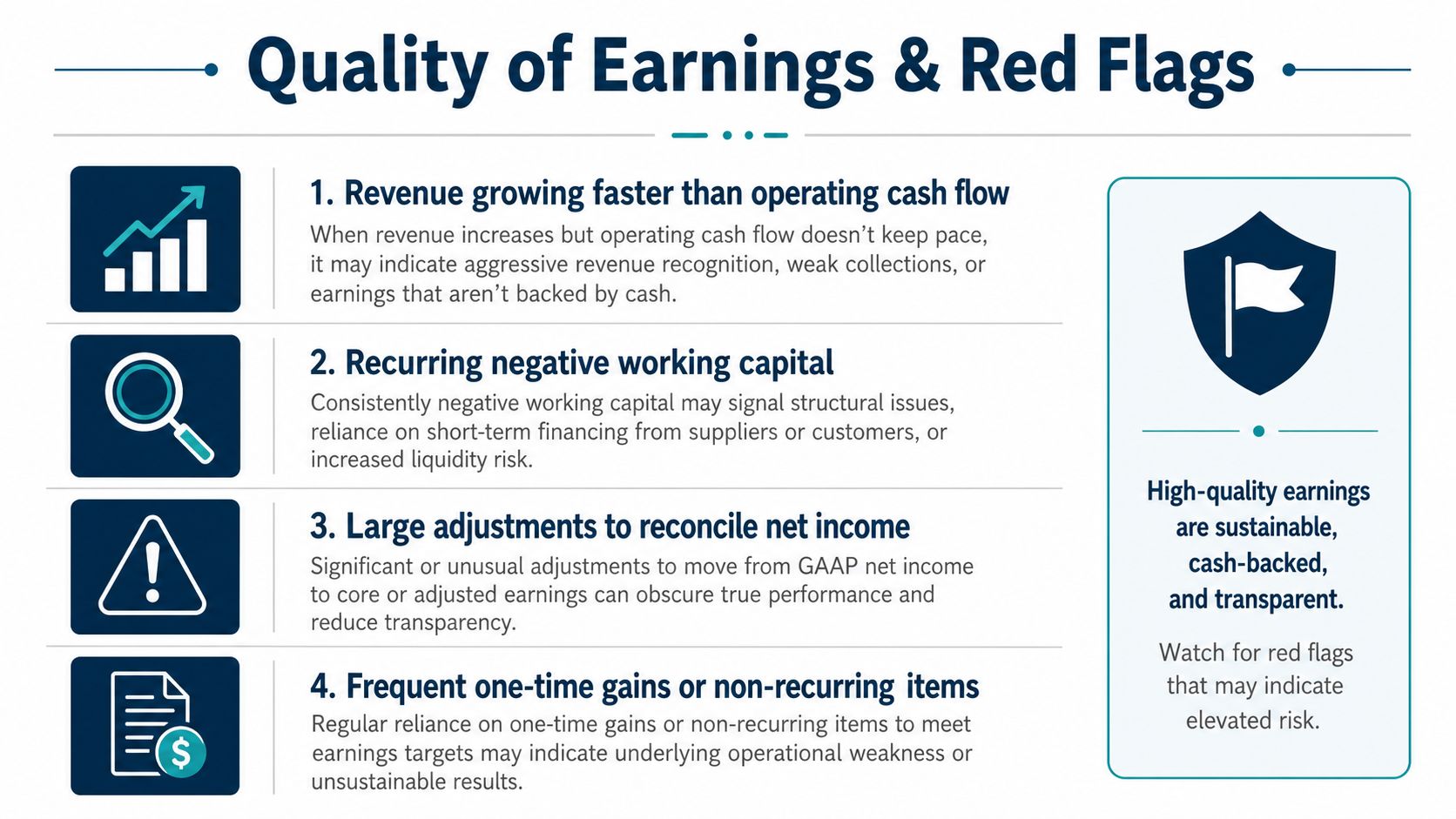
Positive operating cash flow is not automatically good if it is being manufactured by stretching payables or underinvesting in the business, which is why analysts need to separate sustainable cash generation from temporary working-capital release, as explained by Allianz Trade. That's the part too many owners skip. They see cash come in and assume the business is strong. Sometimes it is. Sometimes it's just kicking the problem down the road.
What bad cash quality looks like
If revenue is growing faster than operating cash flow, ask why. If receivables keep swelling, the company is shipping work faster than it's collecting money. If payables keep getting stretched, the business may be using vendors as a bank. That can work for a while, until vendors tighten terms or start asking questions.
A construction company can look fine on operating cash flow while delaying supplier payments and skipping equipment refreshes. That is not strength. That is borrowed time. A healthcare practice can run into the same problem when insurance receivables sit too long and the cash cycle drags behind the clinical work.
A simple quality check
Run these three checks every time you read the statement.
- Compare revenue and operating cash flow. If sales rise but cash doesn't, collections or working capital are probably the issue.
- Check receivables and payables together. Rising receivables with stretched payables means the business is masking stress, not solving it.
- Look at reconciling items. If there are large adjustments between profit and cash, ask for the exact reason.
A healthy business doesn't just report cash. It converts work into cash without squeezing suppliers, starving the business, or hiding the delay in receivables.
If you want better operational visibility, watch the same problem from another angle too. Cash flow statement analysis should always be paired with the balance sheet, because that's where the working-capital pressure shows up first. Revenue is nice. Cash quality pays the bills.
Turning Analysis Into Action for Working Capital and Financing
Analysis without action is just a report on your desk. The useful move is to translate the signal into a decision. If operating cash is weak because receivables are slow, tighten billing and collection. If cash is being drained by inventory, buy less, reorder smarter, or stop stocking slow movers. If vendor terms are too tight, renegotiate before the squeeze gets worse.
The standard workflow is straightforward. Gather the cash flow statement, income statement, balance sheet, and bank records, classify the inflows and outflows, and turn the result into actions like adjusting budgets, renegotiating payment terms, or securing financing before a shortfall hits, as described in this cash flow analysis guide. That's the whole job. Read the numbers, identify the driver, act before the hole gets deeper.
What to do when the signal is bad
- Slow collections: tighten invoice timing, follow up earlier, and stop pretending late payers are “almost there.”
- Weak operating cash flow: inspect margins, pricing, and working-capital drag before you add more overhead.
- Heavy investing cash outflows: delay nonessential purchases and make sure the asset actually supports cash generation.
- Financing stress: line up borrowing before you need it, not after the account is already thin.
MyOfficeOps offers bookkeeping, accounting, payroll integration, financial analytics, and CFO-level advisory, which makes this kind of cash review easier to turn into a monthly habit. It also fits the working-capital side of the work, especially if you need sharper forecasting and cleaner reporting.
The internal process matters here too, and working capital optimization is where most owners find quick wins. Don't wait for the bank to tell you the business is tight. Read the statement early and act while you still have options.
Good cash management is boring on purpose.
The best move is usually the one that prevents panic next month.
Your Weekly and Monthly Cash Flow Checklist
Cash can move materially between close cycles, so cash analysis now requires reconciling bank, AP/AR, payroll, and capex data, then translating variance drivers into actions like renegotiating vendor terms or planning revolver draws, according to current cash analysis guidance. That means this cannot be a quarter-end chore. It has to become a routine.
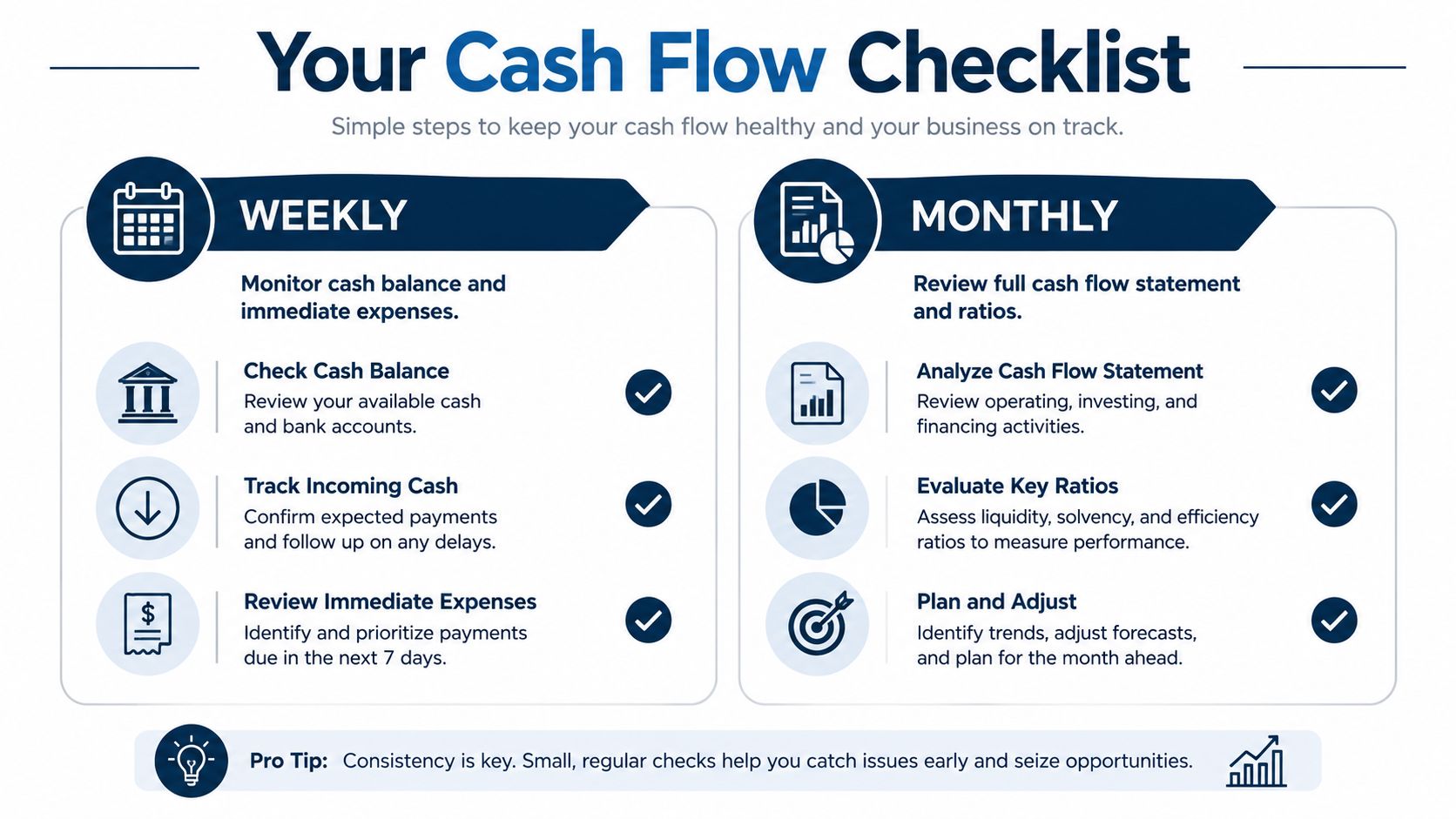
Weekly
- Cash balance: check what's in the bank and flag anything that looks off.
- Immediate expenses: review payroll, rent, tax, and vendor payments due soon.
- Collections: scan overdue invoices and decide who needs a follow-up call.
- Large outflows: watch for equipment, tax, or debt payments that could tighten liquidity.
Monthly
- Full cash flow statement: read operating, investing, and financing together.
- Working capital trend: review receivables, payables, and inventory movement.
- Ratio check: compare operating cash flow, free cash flow, and debt coverage.
Quarterly question
Ask one blunt question. If sales stall, how long can the business keep paying bills without scrambling? If you don't know the answer, you're not managing cash. You're hoping for the best.
That's the habit that separates stable businesses from stressed ones. Check the cash weekly. Read the statement monthly. Adjust the business before the numbers force your hand.
If your cash reports still feel harder than they should, MyOfficeOps can help you clean up the books, build better cash visibility, and turn the statement into decisions you can use. Visit MyOfficeOps if you want a sharper read on working capital, forecasting, and the cash moves that keep an SMB steady.