
If you're a business owner, you probably think of "finance" as something that's already happened. Your bookkeeper tracks last month's sales, and your accountant files last year's taxes. Both are important, but they look backward. They tell you where your money went.
CFO services for a small business do the exact opposite. They look forward.
Imagine you're driving a car. Your bookkeeper sits in the back, writing down all the roads you've already been on. Your accountant helps you report those roads to the DMV. The CFO is your co-pilot, sitting next to you with the map, watching the gas gauge, and helping you figure out the best way to get where you're going.
Moving Beyond Basic Bookkeeping
A bookkeeper's job is to keep your records neat and tidy. This is super important. They make sure every dollar is in the right place. But they are recording history. A CFO uses that history to help you decide what to do next.
A bookkeeper tells you that you spent $10,000 on ads last month. A CFO asks, "Did we make more than $10,000 from those ads, and should we spend more or less next month to hit our goals?"
This change from just recording numbers to using them to make smart decisions is what CFO services are all about. It’s like turning a big pile of numbers into a simple, useful map.
For example, I once worked with a small bakery. They sold fancy cakes and simple cookies. A CFO looked at their sales and realized the cakes took a ton of time and expensive ingredients but didn't make much profit. The cookies, however, were cheap to make and sold like crazy. By focusing more on cookies and adjusting the cake prices, the bakery's profits shot up almost immediately.
A Financial Co-Pilot for Big Decisions
As your business grows, your questions get bigger and the decisions get harder. Just looking at your bank account isn't enough to give you the answers you need. This is where having a smart financial partner becomes a game-changer.
They help you answer the big questions that might keep you up at night:
- Hiring: Can we really afford a new salesperson? How long will it take for them to start bringing in enough money to cover their own salary?
- Pricing: Are we charging enough? What would happen if we raised our prices by 10%? Would we lose customers or just make more money?
- Expansion: We have a chance to open a second store. Is this a great idea, or will it drain all our cash and put the whole business at risk?
- Cash Flow: Why do our reports say we're making a profit, but we're always struggling to pay the bills? Where is our cash getting stuck?
A CFO service gives you the clear answers and confidence you need to run your business by planning ahead, not just reacting to problems. You stop guessing and start making smart choices based on real numbers.
The Different Types of CFO Support
When you hear "CFO," you might picture someone in a fancy suit with a big office and an even bigger salary. For a small business, that's usually not realistic or even what you need.
Luckily, getting CFO help isn't an all-or-nothing deal. You have options that fit your budget and what your business needs right now. It’s like getting around town: you don't always need to buy a car. Sometimes, using a ride-share service or renting a car for a weekend is a much better choice.
Let's look at the different ways you can get this kind of help.
In-House Full-Time CFO
This is the traditional way: hiring a Chief Financial Officer as a full-time employee. They work only for your business, helping you plan your finances and make big decisions every day.
Having someone in your office all the time means they really get to know your business and your team. They can jump into meetings whenever you need them.
But, this is the most expensive option by a long shot. A full-time CFO can cost over $200,000 a year, plus benefits and bonuses. For most small businesses, that's just too much money. It's like buying a new truck when you only need to haul something once or twice a year.
Fractional CFO Service
A fractional CFO is a smarter way for small businesses to get help. Instead of hiring a full-time person, you hire a firm or an expert for a "fraction" of their time. This might be just a few hours a week or a couple of days a month.
This is a game-changer for growing businesses. You get the same smart advice you'd get from a full-time CFO, but you only pay for the time you actually need. It’s like calling an Uber Black—you get a professional driver and a nice car when you need one, without having to pay for the car, gas, and insurance all the time.
A fractional CFO helps with the big-picture stuff: planning for the future, managing your cash, and helping you grow. This is perfect for a business that has its daily bookkeeping handled but needs a co-pilot to help navigate the road ahead. We've seen just how fractional CFO services are helping small businesses grow by giving them top-level advice they can actually afford.
This simple chart can help you see if a bookkeeper is enough, or if it's time for a CFO.
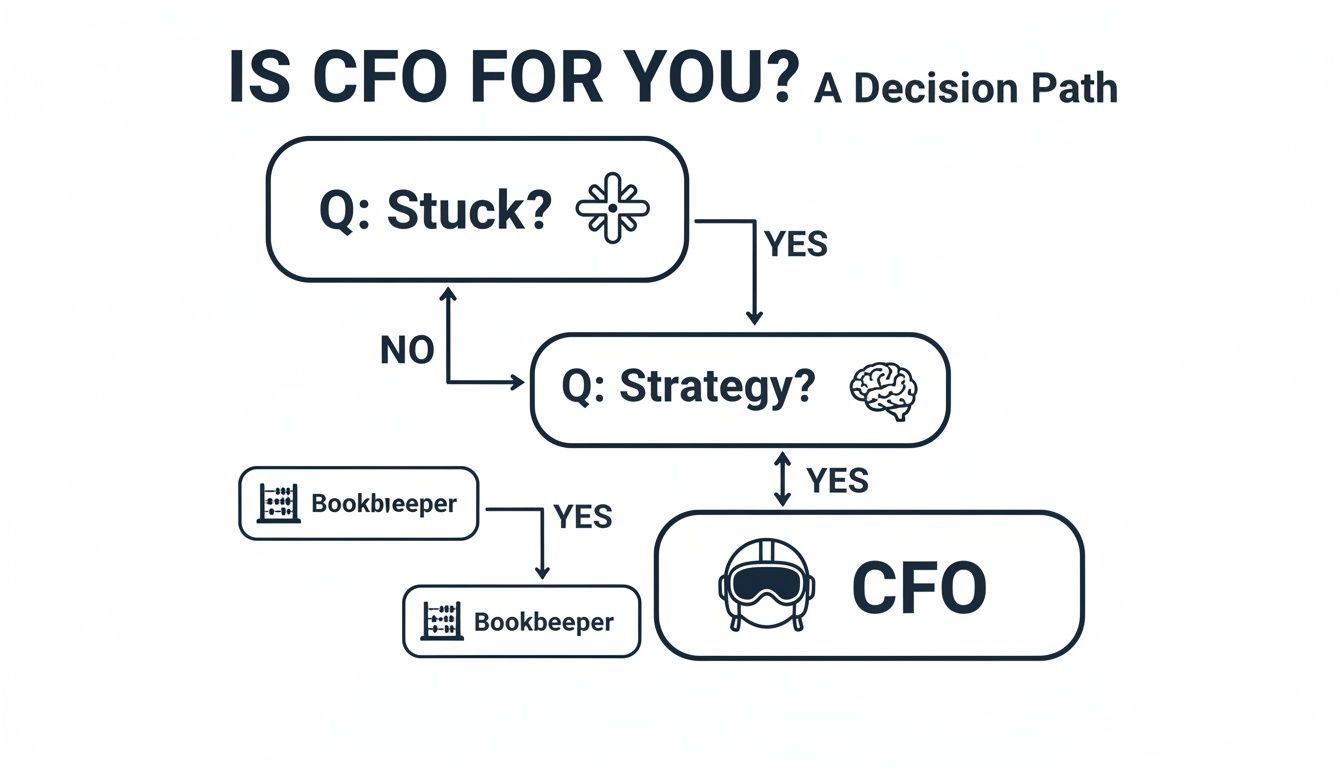
As you can see, if you feel stuck and need a plan for the future, a CFO is the right choice. If you just need your past transactions organized, a bookkeeper does that job well.
Part-Time CFO
A part-time CFO is a lot like a fractional one, but it's usually just one person you hire as a contractor, not a whole firm. They might work a set number of hours each week and handle both big-picture plans and some of the day-to-day money management.
The main difference is the team behind them. A part-time CFO is just one person. A fractional service from a firm like MyOfficeOps gives you access to the knowledge of an entire team of experts.
Here's a quick table to make the options clearer.
Comparing Your CFO Options
| Factor | In-House CFO | Part-Time CFO | Fractional CFO Service |
|---|---|---|---|
| Cost | Highest (Salary + benefits) | Moderate (Hourly/Retainer) | Flexible (Tiered retainers) |
| Commitment | Full-time employee | Part-time contractor | Service agreement |
| Expertise | One individual's knowledge | One individual's knowledge | Access to a full team's expertise |
| Best For | Large, complex businesses | Businesses needing a step-up | Growth-focused small businesses |
As the table shows, hiring an outside service gives you top-level advice without the massive cost of a full-time employee.
In fact, studies have shown that hiring outside help can save small businesses over 60% compared to hiring in-house staff. When you think about how a full finance team could cost $350,000 or more per year, the value of a fractional service becomes very clear.
What a Small Business CFO Actually Does
So, what do you get when you hire a CFO service? It's easy to talk about "strategy," but what does that mean on a Tuesday afternoon? Let's skip the buzzwords and look at the real things a CFO does to help your business.
Think of it like a menu. You're not just hiring a person; you're getting specific things that make your business stronger.

Financial Forecasting and Budgeting
Forecasting is like a weather report for your business. It uses your past numbers to guess what's coming next, so you can be ready for both sunny days and storms. It's not a crystal ball, but it helps you make good plans so you're not caught by surprise.
A CFO will help you answer "what if" questions:
- "If we get that big new client, how much cash will we have in three months?"
- "What happens to our profit if the cost of our supplies goes up 15%?"
A budget is the plan you make based on that forecast. It sets goals for how much you want to make and rules for how much you can spend, keeping you on track.
Cash Flow Management and Strategy
Here’s a hard truth: a business can be profitable and still go broke. This happens all the time. A CFO's main job is to make sure you always have enough cash to pay your bills.
They look at your cash conversion cycle—that's how long it takes for a dollar you spend to come back into your bank account. A big part of this is optimizing the Order-to-Cash process to get paid faster.
For example, a CFO might see that your customers take 60 days to pay you, but you have to pay your suppliers in 30 days. That's a problem. They can help you change your invoices or offer discounts for paying early to close that gap and keep cash coming in. To learn more, you can check out some simple cash flow forecasting techniques that can help.
KPI Dashboards and Performance Reporting
Have you ever looked at a long financial report and felt totally confused? A good CFO turns all that data into a simple dashboard that you can understand in seconds.
Think of the dashboard in your car. It doesn't show you every detail about the engine. It just shows you what's most important: your speed, your gas, and any warning lights.
A Key Performance Indicator (KPI) dashboard does the same for your business. It tracks a few key numbers that tell you if you're doing well. This might include:
- Customer Acquisition Cost (CAC): How much you spend to get a new customer.
- Gross Profit Margin: How much money is left over from a sale after you pay for the item you sold.
- Monthly Recurring Revenue (MRR): For a subscription business, this is your predictable monthly income.
This simple view helps you make faster, smarter decisions without needing to be an accountant.
Profitability and Pricing Consulting
Many owners are so busy that they don't know which parts of their business are actually making them money. A CFO is like a detective who finds the hidden profits.
For instance, they might look at your services and find that "Service A" makes a 50% profit, but "Service B" only makes 10% profit and takes twice as much work. With that information, you can decide to charge more for Service B or focus on selling more of Service A.
This kind of thinking is what separates good businesses from great ones.
Exit Strategy and Planning
Even if selling your business seems far away, the best time to start planning is now. An exit strategy is just about building a company that someone would want to buy—which is just another way of saying you're building a healthy, valuable business.
A CFO helps you think like a buyer. They help you clean up your financials and organize your business so that it's attractive and ready to sell. This makes your company stronger today, even if you don't sell for years.
Choosing the Right CFO Partner
Picking a financial partner is a big deal. It’s like picking a co-pilot for a long flight. You need someone you trust to help you read the map and fly through bad weather. Don't rush this decision.
You need to find someone who understands your business, knows your industry, and can explain things in a simple way. The goal is to find a partner who makes you feel more in control, not more confused.
Start With the Right Experience
Not all CFO services are the same. A CFO who has only worked with big factories won't understand the challenges of a local restaurant or a software company. You need someone who has been there before.
Look for a partner who has helped businesses like yours succeed. They will already know the common problems and the best ways to grow in your industry. This means they can start helping you from day one, instead of learning on your dime.
For example, a CFO who knows the construction business understands that you have to spend a lot of money on a project before you get paid. A CFO who works with software companies will know all about metrics like Monthly Recurring Revenue (MRR) and customer churn.
This specific experience is the difference between getting generic advice and a real plan that works for your business.

Create Your Selection Checklist
Before you start talking to people, make a simple checklist of what you're looking for. This will help you stay focused.
Your checklist should include these things:
- Industry Knowledge: Have they helped businesses like yours before? Can they prove it?
- Clear Communication: Can they explain money concepts in a simple way? You need a teacher, not a professor.
- Team-Based Approach: Are you just hiring one person, or do you get the brainpower of a whole team? A firm usually has more resources.
- Cultural Fit: Do you get along with them? You'll be having important (and sometimes hard) conversations with this person.
- Local Understanding: Do they know your local area and its economy?
Knowing when it's the right time to get help is also important. If you're not sure, our guide on when to hire a CFO can help you see the signs.
Ask Smarter Interview Questions
When you have a few options, the interview is your chance to see how they think. Don't ask easy questions. Ask questions that show how they solve real problems.
Here are a few good questions to ask:
- "Tell me about a time you helped a business like mine fix a big cash flow problem. What did you do, and what happened?"
- "Imagine our profits suddenly dropped 15%. What are the first three things you would look at to find out why?"
- "How do you explain financial reports to a business owner who isn't a numbers person? Can you give me an example?"
- "What are the most common money mistakes you see owners in my industry make?"
Their answers will tell you a lot. You're looking for someone who is not just good with numbers, but who is also a good communicator and a true partner for your business.
Real Results from Local Businesses
Reading about something is one thing, but seeing how it works in the real world is another. Good financial advice does more than clean up your books. It puts more money in your bank account and lowers your stress.
Let's look at a couple of real stories of businesses that turned expert advice into real success. These are local companies, just like yours, who decided to stop guessing.

From Guesswork to Growth: The Marketing Agency Story
A local marketing agency was great at their job but had no idea if they were making money. They priced their work based on gut feelings. They were always busy but always felt broke—a common problem.
The Problem: They didn't know which projects were profitable.
The Solution: Their new CFO partner helped them start tracking their time and the costs for each project. For the first time, they could see exactly how much work went into everything they did.
The Result: What they learned was a game-changer. They found out their popular "website design" service was barely making any money, while their smaller "content" packages were highly profitable. With this new information, they changed their prices, focused on selling the right services, and their overall profit grew by 15% in six months.
Ending the Cash Flow Scramble: The Construction Company
A growing construction company was always short on cash. They’d land a big job, spend a lot of money on supplies and workers upfront, and then wait months to get paid. Even when they were profitable, the owner was always worried about making payroll.
"Our cash flow felt like a rollercoaster. We were profitable one month and scrambling to pay our bills the next. We needed a predictable system, not just more work."
The Problem: Money was going out months before it was coming in.
The Solution: The CFO service looked at how they billed their customers and changed their contracts. They started billing in stages as the work was completed, instead of all at once at the end. They also got better payment terms from their suppliers.
The Result: The change was instant. Cash flow became stable, the stress of payroll went away, and the owner could focus on finding good jobs instead of chasing money. They even had enough cash to take on two big projects they would have had to turn down before.
These stories show that a CFO isn't just a cost—it's an investment in your company's future. Studies show that businesses with CFO help can cut waste by 20-40%. In today's economy, smart financial planning is a necessity, not a luxury. You can discover more about the strategic edge CFO services provide and see how it helps businesses grow.
How We Do It at MyOfficeOps
We believe getting expert financial advice shouldn't be hard. The last thing you need is more confusing words or another complicated spreadsheet. What you need are clear answers and a simple plan to help you grow.
Our whole approach is built on that idea. We skip the accounting jargon and focus on what really matters—helping you make smarter decisions, increase your profits, and build a more valuable business. It’s about giving you the confidence that comes from really knowing your numbers.
Your Path to Financial Clarity
We have a simple, three-part model that meets you where you are. It’s like building a house: you have to pour a solid foundation before you can put up the walls. We make sure we build things in the right order.
Our model is designed to grow with your business:
- Core Accounting: First, we build your foundation. This means getting your daily bookkeeping, payroll, and financial records perfectly clean and organized. Without this, any plan is just a guess.
- Profit Optimization: Once the foundation is solid, we start building. We use your correct numbers to find hidden profits, fix cash flow problems, and help you grow with confidence.
- Exit Strategy: Finally, we help you think about the future. Whether you plan to sell in two years or twenty, we help you build the kind of company a buyer would be excited to own.
This step-by-step process gives you a simple roadmap to follow.
How We Work Together
Getting started with us is also simple. We've made our process easy so you can get the help you need without a lot of hassle.
It’s a simple four-step journey:
- Discovery Call: It starts with a friendly chat to understand your business, your goals, and your biggest problems.
- Custom Plan: We use what we learn to build a clear plan that shows you exactly how we can help. No one-size-fits-all solutions.
- Smooth Onboarding: We handle all the setup, making the switch easy so you can keep running your business.
- Ongoing Growth Partner: From there, we become part of your team. Think of us as your financial co-pilot, always there to give you advice and help you navigate what's next.
At MyOfficeOps, our job isn't just to do your books. Our job is to give you the financial clarity you need to lead your business with total confidence. We handle the numbers so you can focus on the vision.
Got Questions About CFO Services? We’ve Got Answers.
Thinking about hiring a financial expert is a big step, and it's normal to have questions. Let's answer some of the most common things business owners ask me. This should help clear things up.
Is My Business Too Small for a CFO?
Not at all. The right time for this kind of help isn’t about how big you are now—it’s about how big you want to be. If you're starting to ask bigger questions, you're ready.
Questions like:
- Can I really afford to hire a new person?
- How can I make my business more profitable this year?
- Am I charging the right price for what I sell?
Getting expert advice early helps you build a strong foundation. More importantly, it helps you avoid the costly mistakes that can sink a good business. It’s about setting yourself up to win from the start, no matter your size.
Will I Lose Control of My Finances?
This is a common fear, but the truth is the exact opposite—you'll gain more control.
A good CFO service doesn't take over. They give you clear information so you can make decisions with confidence. We organize your numbers into simple reports you can actually understand and give you advice based on those numbers.
You are always the pilot of your business. Think of us as your navigator, helping you read the map. You always make the final decision.
How Much Do These Services Cost?
It’s much more affordable than most people think, and it costs way less than a full-time CFO. A senior finance person can cost over $200,000 a year with salary and benefits.
Outsourced CFO services usually work on a monthly subscription. This often starts at a few thousand dollars a month, depending on what you need. You get a top-level expert without the full-time cost, and you can change the service as your business grows or changes.
Ready to stop guessing and start making decisions with real confidence? The team at MyOfficeOps can deliver the financial clarity you need to take your business to the next level.