
Ever feel like you’re flying blind with your business’s money? You know you made sales, but the bank account doesn't seem to show it. It's a common headache for any business owner, whether you run a coffee shop or a construction company. The problem isn’t about working harder; it's about seeing your money more clearly.
That's where cash flow forecasting comes in. It’s not some fancy trick for big companies. It’s just a way to guess how much cash will come into and go out of your business. Think of it like a weather forecast for your bank account. It helps you get ready for rainy days (like a big, unexpected bill) and shows you when it’s a good time to grow (like hiring a new person).
A good forecast starts with knowing your numbers now. Before you can guess what will happen, you need to know what’s happening. For example, knowing how to calculate cash flow on rental property is a good first step. In this guide, we'll look at 10 simple but powerful cash flow forecasting techniques you can start using today. Let’s get you a clear view of your financial future.
1. Direct Method Cash Flow Forecasting
The direct method is one of the simplest cash flow forecasting techniques. It focuses on the actual cash moving in and out of your business. Think of it like keeping a very detailed checkbook for your company. You list all the money you expect to get (cash in) and then subtract all the payments you expect to make (cash out) over a certain time.
This method gives you a close-up, day-to-day view of your cash. It’s not about profits on paper; it’s about the real money you have to pay bills, cover payroll, and grow your business.

When to Use the Direct Method
This method is perfect for short-term planning, usually looking ahead one to three months. It’s great for businesses where cash comes and goes quickly or changes with the seasons. For example, a construction company needs to track project payments against what it owes to workers and suppliers. A local retail shop can use it to track daily sales against weekly rent and inventory payments.
Implementation Tips
- Break It Down: For the best short-term view, forecast weekly or even daily.
- Track Your Invoices: Make a schedule to guess when customers will actually pay you, not just when the invoice is due.
- Plan Your Payments: Map out when you will pay your suppliers, employees, and rent.
- Update Often: Look at your forecast every week and update it with the real numbers. This keeps it accurate and makes your future guesses better.
2. Indirect Method Cash Flow Forecasting
Unlike the direct method’s checkbook style, the indirect method starts with your net income (your profit) and works backward to figure out your cash. Think of it as a bridge between your profit report and the actual cash in the bank. You start with your profit and then adjust for things that aren't cash, like depreciation, and changes in things like unpaid customer invoices and inventory.
This method gives a big-picture view that explains why your cash changed. It connects your profit directly to your cash flow. It’s one of the key cash flow forecasting techniques for looking at the big picture of your financial health.
When to Use the Indirect Method
This way is best for long-term planning, like for a quarter or a whole year. Banks and investors use it a lot to see if a company is stable. A doctor's office might use it to show a lender how its profits turn into the cash needed to buy new medical gear. It’s also needed for official financial statements.
Implementation Tips
- Look at Working Capital: Make a detailed schedule to guess how your unpaid customer invoices, inventory, and bills you owe will change.
- Find Non-Cash Items: Find and add back costs like depreciation that lower your profit but don't use up cash.
- Check Your Work: Use the direct method for short-term guesses and compare it with your indirect forecast to make sure everything adds up and catch any mistakes.
- Write It Down: Keep a clear record of all the changes you make to your net income. This helps everyone see how you got your numbers.
3. Rolling Cash Flow Forecasts
A normal yearly forecast gets old as the year goes on. A rolling forecast, however, always stays current. This technique keeps a steady view ahead, like 12 months, by adding a new month at the end as the current one passes. It’s like having a map that always shows you the next 12 miles of road, no matter how far you've already driven.
This lets your business react to changes as they happen instead of waiting for a new year to plan again. Among the different cash flow forecasting techniques, this one is built for staying flexible.

When to Use a Rolling Forecast
This method is great for businesses in fast-changing industries where plans need to be updated often. A software company that gets paid monthly can use a rolling forecast to adjust for new customers or cancellations. A manufacturing company dealing with changing supply costs can use it to make smart decisions on the fly. It helps you stay ahead of the game.
Implementation Tips
- Pick a Rhythm: Decide how often you'll update. Monthly is common, but weekly updates can give you a better handle on short-term cash.
- Automate It: Pulling data by hand takes time and can lead to mistakes. Connect your accounting software to your forecast to make it easier.
- Check the Difference: Regularly compare your forecast to what really happened. Figuring out why the numbers were different helps you make better guesses next time.
- Set Triggers: Decide on certain cash levels that will automatically signal a meeting to discuss what to do next.
4. Seasonal Decomposition Forecasting
Seasonal decomposition is one of the more advanced cash flow forecasting techniques. It’s for businesses that have busy and slow times that you can predict. It works by looking at your past cash flow and breaking it into three parts: the long-term trend, the seasonal ups and downs, and any random, one-time events.
By separating the seasonal part, you can guess future cash flow much more accurately. It helps you know when cash will be coming in fast and when it will be slow, so you can plan better. Imagine a landscaping company that makes most of its money in the spring but almost none in the winter; this method helps them plan for that.
When to Use Seasonal Decomposition
This technique is a must for any business with big seasonal changes. It's perfect for a beach-side hotel that's packed in the summer, or an accounting firm that's swamped from February to April. Farming businesses and construction companies that depend on the weather also find this method very useful.
Implementation Tips
- Get Your Data: You'll need at least three years of past monthly or quarterly cash flow numbers to see clear patterns.
- Find the Seasonal Effect: Use your data to figure out how much a certain season is different from the average. For example, you might see that December sales are 50% higher than an average month.
- Remove One-Time Events: Take out any weird, one-time things (like selling a building or getting a special loan) from your past data so they don’t mess up the seasonal pattern.
- Put It Together: Guess the long-term trend and then adjust it using your seasonal numbers to make a more accurate forecast.
5. Accounts Receivable (AR) Aging Analysis
Accounts Receivable (AR) aging analysis is a cash flow forecasting technique that focuses on guessing your cash coming in. It’s based on a simple idea: the longer an invoice goes unpaid, the less likely you are to get the money. You start by grouping all unpaid invoices by how old they are (like 1-30 days, 31-60 days, 61-90 days, and over 90 days).
By using your past collection success for each age group, you can make a much better guess about when money will actually arrive. This method is better than just hoping all invoices get paid on time and gives you a clearer picture of incoming cash.
When to Use AR Aging Analysis
This technique is key for any business that lets customers pay later, especially companies that sell to other businesses. A consulting firm that gives clients 30 days to pay or a wholesale supplier can use this to predict cash coming in much better. It's also vital for doctors' offices that have to collect from insurance companies, where payment times can be all over the place.
Implementation Tips
- Update Weekly: Don’t wait for the end of the month. Looking at your AR aging weekly gives you a more up-to-date and accurate forecast.
- Group Your Customers: Make different collection guesses for different types of customers. A big, reliable company will likely pay differently than a small startup.
- Track Your Results: Regularly compare your guessed collections to what you actually got. Use this info to make your future guesses better.
- Follow Up Early: Keep an eye on invoices that are getting close to the 61-90 day group. A quick reminder can stop them from becoming a big problem. Keeping good records is key; our professional bookkeeping services can help keep your AR data organized.
6. Statistical Time Series Forecasting (ARIMA/Exponential Smoothing)
Statistical time series forecasting is a fancy way of saying you use past cash flow numbers to predict the future. Think of it as a detective looking for patterns in your past money movements. Special models analyze trends and seasonal changes to create a forecast based on math.
This approach takes the guesswork out of forecasting by relying on what has already happened to predict what will happen next. It's less about your own opinions and more about letting the data do the talking.
When to Use Statistical Forecasting
This method works best when your business has a steady history and clear patterns. It’s good for making a basic forecast for the next few months to a year. A software company with steady monthly payments or a doctor’s office with predictable patient visits can use these models to create a solid financial guess.
Implementation Tips
- Start Simple: Begin with a basic method like exponential smoothing. It's easier and works well if you don't have complex seasons.
- Use Good Data: These models are only as good as the numbers you give them. Make sure you have at least two years of clean, correct cash flow records.
- Add Your Own Judgment: Use the statistical forecast as your starting point, then adjust it for things you know are coming, like a new big client or a plan to buy new equipment.
- Check and Update: Regularly see how accurate your forecast was. Rerun your models every few months to keep them sharp.
7. Scenario and Sensitivity Analysis
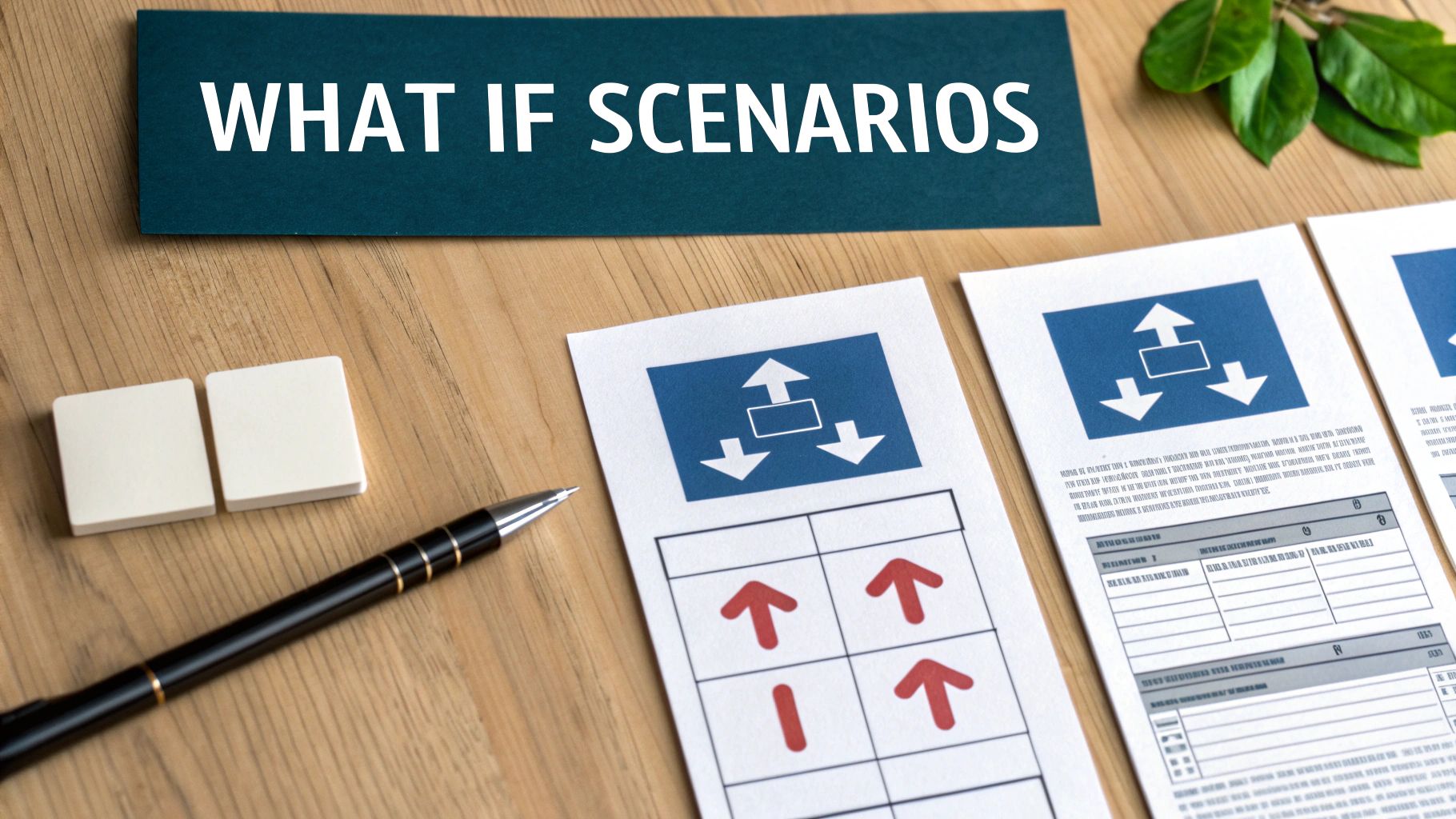
Instead of trying to make one "perfect" forecast, scenario and sensitivity analysis gets your business ready for anything. This technique involves making a few different forecasts: a normal case (what you think will happen), a good case (best-case), and a bad case (worst-case). It helps you answer important "what-if" questions about your money.
By testing how your cash flow reacts to changes, you can see exactly what would happen if sales dropped 15% or a supplier raised prices. It’s like a financial fire drill that makes your business stronger and helps you think ahead. This makes it one of the most useful cash flow forecasting techniques.
When to Use Scenario and Sensitivity Analysis
This method is great for big-picture planning, managing risks, and getting loans. It's perfect for a new company trying to figure out how long their cash will last, or a factory owner thinking about how rising material costs will affect them. It lets you show a full financial picture to banks or investors, proving you’ve thought about what could go wrong. To learn more about financial models, see how to build a discounted cash flow model in Excel.
Implementation Tips
- Define Your Scenarios: Clearly write down the ideas behind your best, worst, and normal cases.
- Find What Matters Most: Pick 5-7 things that have the biggest effect on your cash flow, like sales, advertising costs, or how fast customers pay.
- Test Your Ideas: Change one of those key things at a time to see how it alone affects your cash.
- Make Action Plans: Decide ahead of time what you will do if the worst-case scenario starts to happen, so you can act fast.
8. Regression Analysis and Correlation Forecasting
Regression analysis is a statistical technique that finds the link between your cash flow and other things your business does. Think of it like connecting the dots: if you know that for every 10 new patients your clinic gets, you spend $500 more on supplies, you can guess future cash needs based on how many appointments you expect.
This method uses your past data to build a math model. It finds a link, so you can say, "When X happens (like sales go up 20%), we can expect Y to happen with our cash (like a 10% increase in cash for operations)." It makes forecasting more of a science.
When to Use Regression Analysis
This is for businesses that have been around for a few years and have good data. It’s great for medium-term forecasting (three to twelve months). A software company could use it to link cash needs to how many new customers they get, or a factory could connect cash spending directly to how much they produce.
Implementation Tips
- Test Your Links: Make sure the connection between your key drivers (like sales or number of employees) and cash flow has been steady over time.
- Look for Delays: Sometimes a change in one thing affects cash a month or two later. Make sure your model includes these delays.
- Check Your Model: Use statistical tools to be sure the link is real and not just a coincidence.
- Use Your Brain: Never just trust the numbers. Always use your own business knowledge to check the forecast.
9. Working Capital Cash Cycle Analysis
This powerful technique looks at how long it takes your company to turn investments (like inventory) into cash. It focuses on the Cash Conversion Cycle (CCC), which is the number of days between when you pay your suppliers and when you get paid by your customers.
By guessing how this cycle will change, you can predict your future cash needs. A shorter cycle means you get your money back faster. A longer cycle means your cash is tied up for longer, which can be tough. This is a very important number for any business that holds inventory or has long payment times.
When to Use Working Capital Analysis
This method is a must for businesses with a lot of inventory, like stores, factories, and distributors. A local distributor, for example, could use it to see how getting more time to pay their suppliers while getting customers to pay faster would affect their cash. It's also key for service businesses with long billing cycles, like a construction company managing big projects.
Implementation Tips
- Track the Parts: Keep an eye on the key pieces of your cycle every month: how long inventory sits, how long it takes customers to pay, and how long you take to pay your bills.
- Set Goals: Have clear targets for each part of the cycle based on your industry and your own past performance.
- Balance Your Relationships: Be careful. Pushing suppliers too hard for more time to pay or bugging customers to pay early can hurt important relationships.
- Connect to Your Plans: Link your working capital forecast to your sales goals and buying plans to make sure everything is working together. This is a big step in creating a good business budget. Learn more about how to create a business budget on myofficeops.com.
10. Cash Flow Forecasting Software and Automation
Instead of doing all the math in a spreadsheet, cash flow forecasting software can do the hard work for you. These tools connect to your accounting system, bank accounts, and other financial software to pull in data automatically. This means no more typing in numbers by hand, fewer mistakes, and an always-current view of your money.
Think of it as putting your forecast on autopilot. The software uses your past data and sometimes even artificial intelligence to make better predictions. This frees you up from building forecasts so you can actually use them to make smarter business decisions.
When to Use Software and Automation
This is a good idea for businesses that are getting too big for spreadsheets. If your forecasting takes hours every week or you keep finding mistakes, it’s time for an upgrade. A doctor's office managing lots of insurance payments and payroll, or a growing IT company with many different ways of making money, would get a lot out of a dedicated tool.
Implementation Tips
- Know What You Need: Before you go shopping, list exactly what you need the software to do. Are you focused on short-term cash, long-term plans, or both?
- Make Sure Your Data is Good: A common saying is "garbage in, garbage out." It’s especially true here. Make sure your accounting records are clean and correct before you start.
- Start Small: Begin by automating one main forecasting task. Once you're comfortable, start using more of the advanced features.
- Train Your Team: Spend time teaching your staff how to use the software and understand what it's telling them. For more on this, explore our guide to improving business operations.
10-Point Comparison of Cash Flow Forecasting Techniques
| Method | 🔄 Implementation complexity | ⚡ Resource requirements | 📊 Expected outcomes | Ideal use cases | ⭐ Key advantages | 💡 Quick tip |
|---|---|---|---|---|---|---|
| Direct Method Cash Flow Forecasting | High — transaction-level preparation and reconciliation | High — detailed cash receipts/payments, granular schedules, staff time | High short-term accuracy and transparent cash movement | Small retail, service firms, e‑commerce daily/weekly cash management | Intuitive; pinpoints specific cash bottlenecks | Break into daily/weekly periods and update with actuals |
| Indirect Method Cash Flow Forecasting | Medium — works from net income with adjustments | Medium — accrual accounting data and working capital schedules | Good reconciliation with financial statements and long‑term view | Large corporates, banks, financial analysts | Easier to reconcile; less transaction data required | Maintain detailed working‑capital schedules and reconcile to direct method |
| Rolling Cash Flow Forecasts | High — continuous updates and governance required | Medium‑High — frequent data feeds; automation strongly recommended | Always‑current forward visibility; faster response to change | SaaS, retail chains, manufacturing adapting to supply shifts | Keeps forecasts current and supports agile planning | Automate data collection and set a clear weekly/monthly cadence |
| Seasonal Decomposition Forecasting | Medium — requires statistical decomposition of components | Medium — 2–3+ years of historical data and seasonal-index tools | Improved accuracy for seasonal patterns; clearer trend vs noise | Holiday retail, tax services, tourism, agriculture | Significantly improves seasonal accuracy and planning | Use 3+ years of data; adjust indices annually and exclude one‑offs |
| Accounts Receivable (AR) Aging Analysis | Low‑Medium — processable from AR ledger but needs clean data | Low — AR aging report, collection rates, accounting system | Highly accurate near‑term cash inflow projections | B2B manufacturers, professional services, wholesalers | Precise short‑term cash visibility and early collection flagging | Update AR aging weekly and segment customers by risk |
| Statistical Time Series Forecasting (ARIMA/ETS) | High — model selection, validation, and expertise required | Medium‑High — 12–24+ months history, statistical tools/expertise | Quantified baseline forecasts with confidence intervals | Utilities, insurance, stable subscription businesses | Reduces bias; provides measurable uncertainty ranges | Start with exponential smoothing, validate models quarterly |
| Scenario and Sensitivity Analysis | Medium‑High — multiple scenarios and documented assumptions | Medium — driver assumptions, modeling tools, stakeholder input | Range of outcomes for decision making and stress testing | Banks, startups (runway), manufacturers, retailers | Prepares management for multiple outcomes; risk‑aware | Define 3–5 scenarios, document assumptions, set action triggers |
| Regression & Correlation Forecasting | High — building and validating multi‑variable models | Medium‑High — quality driver data, statistical software, training | Driver‑linked forecasts enabling policy/what‑if analysis | Manufacturing, professional services, e‑commerce, SaaS | Directly links cash to business drivers for actionable insight | Test stability of correlations and use lagged variables |
| Working Capital Cash Cycle Analysis | Medium — requires cross‑functional inputs and monthly tracking | Medium — inventory/AR/AP data, operations coordination | Identifies operational levers to reduce cash needs (CCC impact) | Retail, manufacturing, distributors, FMCG | Links operations to finance; highlights improvement opportunities | Track CCC components monthly and set targets vs benchmarks |
| Cash Flow Forecasting Software & Automation | High (implementation & change mgmt); lower ongoing effort | High — integrations, data cleansing, vendor costs, IT support | Real‑time, scalable forecasts; reduced manual effort; ML improvements | Multi‑entity corporates, treasury teams, fast‑growing firms | Automates data collection, enables continuous forecasting at scale | Define requirements up front, invest in data quality, plan 6+ month rollout |
From Forecasting to Financial Freedom: Your Next Step
We’ve just looked at a whole list of cash flow forecasting techniques, from simple ones like the direct and indirect methods to more active ones like rolling forecasts and scenario planning. It's a lot, but remember this: you don't need to be an expert in all ten right away. The real goal is to find the right tool for the job you have right now.
For a construction contractor, that might mean starting with the direct method to track cash for each project, then adding an AR aging analysis to keep up with clients who pay slowly. For a growing doctor's office, a seasonal forecast could be a huge help for predicting the busy and slow times for patient visits and insurance payments.
The power of these methods isn't how complicated they are; it's how you use them. A good forecast turns numbers on a page into a map for your business. It's the difference between being surprised by money problems and planning for growth.
Your Action Plan: Moving from Theory to Practice
So, what’s next? Don't just let this information sit here. The most important step is the one you take today.
- Start Simple, Start Now: If you're new to this, begin with the Direct Method. Open a simple spreadsheet and map out your expected cash in and out for the next 30 to 90 days. Just doing this one thing will give you more clarity than you had yesterday.
- Layer and Evolve: Once you get the basics, add another layer. Do you run a service business? Add AR Aging Analysis to your process. Worried about the economy? Run a few simple scenarios using Sensitivity Analysis to see how your cash would hold up.
- Be Consistent: A forecast is a living thing, not a one-time project. Set aside time each week or month to update it with real numbers and adjust your guesses. This habit is what gives you real control over your finances.
Learning these cash flow forecasting techniques is about more than just managing money; it’s about reducing stress and feeling confident. It’s about knowing you have the cash to make payroll, buy that new piece of equipment, or hire the perfect person to help your business grow. This is how you move from just getting by to truly growing. It's the foundation of financial freedom for your business.
Ready to turn these techniques into a hands-off, automated system that gives you clarity without the chaos? The team at MyOfficeOps specializes in building and managing robust cash flow forecasts for businesses just like yours. Schedule a consultation with us at MyOfficeOps to see how we can give you the financial foresight you need to grow with confidence.