

You've spent years winning work, managing crews, keeping projects moving, and making payroll when cash was tight. Then a buyer reviews your revenue, applies a broad multiple, and presents an offer that looks credible at first glance. The number may be based on real information, but it's only the opening point in a construction business valuation.
Buyers want to know what they're buying. Can the backlog produce reliable profit? Are job-cost reports accurate? Will the surety support the next owner? How much cash is tied up in retainage and work in progress? Can the company operate when the founder stops answering every call?
What a Construction Business Is Really Worth
A residential contractor once reviewed an offer based largely on top-line revenue. The company had a full schedule and plenty of work in the pipeline, so the owner expected the sales process to be simple. During diligence, the buyer found that several projects had weak margins, customer relationships sat almost entirely with the owner, and job-cost records couldn't clearly explain why completed work earned less than expected.
The buyer didn't reject the company because it lacked revenue. The buyer reduced the price because the earnings were harder to trust and harder to transfer.
That distinction sits at the center of construction business valuation. Revenue shows activity. It doesn't show whether the work creates cash, whether customers return, or whether the next owner can deliver projects without the founder sitting in the cab, reviewing every estimate, or calming every client.
Two contractors can have the same sales and different values
Consider two contractors with similar annual revenue. One depends on a few private customers, accepts thin-margin work to keep crews busy, and has informal job costing. The other has diversified commercial customers, documented margins on signed backlog, repeat contracts, and a management team that handles estimating and project delivery.
The second business can command a stronger price even if its revenue is no higher. Buyers are paying for durable earnings, not gross volume alone. A 2024 industry summary reported a median EBITDA multiple of 3.8x for “All Construction” firms, with a mean of 4.4x and a 2.8x to 8.3x 25th to 90th percentile range. The same summary reported median revenue of $8.1 million and showed segment differences, including 4.1x for electrical construction, 4.6x for HVAC and plumbing, 3.1x for residential home construction, and 3.2x for commercial and heavy construction. The construction valuation summary from BMI Mergers makes the reason for that spread clear: business mix and risk matter.
Practical rule: A buyer's first question isn't “What multiple does construction get?” It's “What evidence supports this company's earnings after the owner leaves?”
Enterprise value is not the seller's check
A buyer may discuss enterprise value first, but the owner ultimately cares about equity value. Enterprise value reflects the operating business before adjustments for debt, excess cash, and working capital. Equity value is what remains after those items are settled under the purchase agreement.
That gap can be large. A contractor may have attractive adjusted EBITDA but still face equipment loans, a working-capital shortfall, old retainage, or project liabilities that reduce the closing check. A seller's number becomes a bankable number only after the financials, contracts, backlog, bonding position, and balance sheet survive due diligence.
The Core Valuation Numbers Made Simple
Think of a construction company as a house. Enterprise value is the value of the entire property and the income-producing structure inside it. Equity value is what the owner keeps after the mortgage, liens, and other obligations are cleared.
In a deal, EBITDA is the business's recurring operating earning power before interest, taxes, depreciation, and amortization. Adjusted EBITDA starts with reported EBITDA and removes items that don't represent the future business, such as unusual legal costs or personal expenses. Buyers will expect each add-back to have support in payroll records, invoices, tax returns, or bank statements.
SDE, or seller's discretionary earnings, is more useful for a small, owner-operated contractor. It generally captures the profit available to one working owner after adding back owner compensation and certain owner-specific expenses. It shouldn't be used casually for a larger company that already has a management structure.
The cash-free, debt-free bridge
Most buyers default to a cash-free, debt-free structure. The buyer pays for the operating company, while the seller keeps excess cash and pays off debt or receives a corresponding adjustment. The business usually needs to deliver an agreed level of normal working capital so it can keep paying employees, vendors, and subcontractors after closing.
A construction company's working capital needs special attention. Buyers examine WIP receivables, retainage, accounts payable, and project-cost accruals because billing and cash collection rarely line up perfectly with earned revenue. This construction cash flow forecasting resource can help owners see why a profitable job may still create a cash squeeze.
| Term | What It Means in Construction |
|---|---|
| Enterprise value | Value of the operating contractor before cash and debt adjustments |
| Equity value | The amount left for the seller after agreed balance-sheet adjustments |
| Adjusted EBITDA | Reported operating earnings, normalized for supported one-time or owner-specific items |
| SDE | Earnings available to a hands-on owner-operator |
| Working capital peg | The normal operating level of receivables, payables, WIP, and related items delivered at closing |
| Debt-free adjustment | Reduction for equipment loans, credit facilities, and other debt assumed or repaid in the deal |
A simple bridge looks like this:
Enterprise value + excess cash – debt – other agreed liabilities +/- working-capital adjustment = equity value.
The exact treatment of leases, retainage, and project obligations depends on the purchase agreement. EBITDA alone isn't distributable cash, and a weak working-capital peg can reduce proceeds at closing. CohnReznick's discussion of EBITDA in construction deals explains why buyers look beyond the income statement.
Choosing the Right Valuation Method
No single valuation method works for every contractor. The right approach depends on the company's size, project mix, earnings history, assets, and the quality of its forecast.
Market methods
Market methods compare the business with public companies or completed transactions. They work best when a contractor has close peers in commercial construction, industrial work, civil construction, or a specialty trade. The comparison becomes more useful when the peer companies share similar margins, customer types, backlog quality, and management depth.
A broad business-for-sale benchmark reported an average revenue multiple of 0.58x and an average earnings multiple of 2.60x for building construction businesses. BizBuySell's building construction valuation benchmarks show why revenue is usually a weak anchor. A company with better margins and repeat work can sell above a simple revenue estimate, while an owner-dependent contractor can trade at a lower earnings multiple.
Market methods break down when transaction data is thin or the contractor serves a narrow niche. A data-center electrical contractor shouldn't automatically be compared with a small residential builder.
Income methods
Income methods estimate value from future cash flow. A discounted cash flow model can make sense for a contractor with stable recurring revenue, reliable historical margins, and backlog that supports a defensible forecast. Owners who need a plain-English introduction can review cash flow valuation explained before discussing a forecast with an advisor.
The method fails when job-cost records are weak. A detailed forecast built on unreliable estimates creates false precision. Capitalization of earnings can work for a stable contractor, but it becomes less useful when results swing sharply from one project to the next.
Smaller owner-led firms often rely on SDE because the owner's work is part of the current earnings stream. Larger contractors with real management teams are better evaluated on normalized EBITDA.
Asset-based methods
Asset-based valuation matters most for heavy civil companies, equipment-heavy contractors, and distressed sellers. The fleet, yard, receivables, and other tangible assets may provide a value floor.
The weakness is that an asset approach can miss goodwill. It may not capture the value of bonded customer relationships, repeat service programs, trained estimators, or a backlog that produces future work. The strongest construction deals often use more than one method, then reconcile the results rather than treating one formula as a final answer.
Construction Drivers That Change the Multiple
A multiple is a summary of risk. Buyers adjust it after reviewing the evidence behind the earnings.
Established commercial and specialty contractors commonly trade around 4x to 7x EBITDA, while smaller owner-operated general contractors may be closer to 2x to 3x SDE or 3x to 5x EBITDA, depending on risk and size. Buyers also discount low-margin or unexecuted backlog. They pay more when signed work has documented gross margins, strong customer payment history, and enough visibility to support 8 to 14 months of revenue. CTA Acquisitions' construction valuation guidance outlines how these operating factors affect the multiple.
A contractor with the same EBITDA as a competitor may still deserve a different price. The following table shows what buyers test.
| Driver | What Buyers Look For | Typical Multiple Effect |
|---|---|---|
| Backlog quality | Signed work, realistic margins, payment history, execution risk | Strong backlog supports a higher multiple, while thin or disputed work creates a discount |
| Gross margin | Stable margins by job and trade, not just company-wide averages | Durable margins support value, while unexplained swings weaken it |
| Change-order recovery | Written approvals, timely billing, and a history of collecting approved changes | Reliable recovery reduces project risk |
| Contract terms | Clear payment rules, escalation clauses, retainage terms, and termination rights | Balanced terms help, while one-sided terms can reduce value |
| Bonding capacity | Current surety support and financial strength | Strong capacity supports scale; a tight cap limits growth |
| Customer concentration | Diversified revenue and transferable relationships | Dependence on a few customers increases risk |
| Management depth | Estimating, project management, and customer coverage beyond the owner | A capable second tier supports transferability |
| Working capital | Accurate WIP, retainage aging, billing timing, and payables | Clean working capital protects the closing adjustment |
| Fleet condition | Useful equipment, maintenance records, and manageable replacement needs | A reliable fleet helps; deferred maintenance can become a price reduction |
| Service revenue | Maintenance agreements and repeat programs | Recurring work can make earnings easier to forecast |
Backlog is more than a sales number
A residential remodeler with 60 percent of its work concentrated in one type of project may have strong demand but still face customer, seasonality, and project-risk concerns. A commercial general contractor with negotiated cost-plus contracts, diversified customers, and documented change-order recovery may offer better earnings visibility.
That doesn't make residential work bad. It means the buyer asks different questions. Are estimates accurate? Do homeowners pay on time? How often do projects run over budget? Does the owner personally sell every job?
Diligence tests the story
A buyer may review lien waivers, certified payroll, WIP schedules, job-cost reports, change-order logs, insurance records, and litigation history. These aren't paperwork exercises. They show whether the company knows what it earned, what it billed, and what it still owes.
Weak job costing can hide margin problems. Limited bonding can restrict the revenue a buyer can safely pursue. Customer concentration can turn one lost relationship into a major earnings shock. These drivers reinforce one another, so fixing one report won't solve a deeper operating issue.
Owners can influence many of these risks before a sale. Standardize change-order approvals, reconcile job costs monthly, keep bonding records organized, and move customer relationships into the management team. For broader context on how multiples differ by sector, see business valuation multiples by industry.
Sample Construction Valuation Calculations
The examples below use stated assumptions only. They show the mechanics, not an appraisal or promised sale price.
Example one, owner-led residential remodeler
Assume:
- Revenue: $4 million
- SDE: $600,000
- SDE multiple: 2.5x to 3.5x
- Cash included in the bridge: $200,000
- Debt and lease obligations deducted: $500,000
- Working capital adjustment: $0, for simplicity
Operating value is:
- Low case: $600,000 × 2.5 = $1.5 million
- High case: $600,000 × 3.5 = $2.1 million
Estimated equity value is:
- Low case: $1.5 million + $200,000 cash – $500,000 debt = $1.2 million
- High case: $2.1 million + $200,000 cash – $500,000 debt = $1.8 million
The owner's involvement matters here. If the owner estimates every project, manages key customers, and solves field problems personally, the buyer may stay near the lower end unless those duties are transferred.
Example two, scaled commercial contractor
Assume:
- Revenue: $22 million
- Adjusted EBITDA: $2.4 million
- EBITDA multiple: 4.5x to 6.5x
- Cash included in the bridge: $1 million
- Debt and lease obligations deducted: $3 million
- Working capital adjustment: $0, for simplicity
Operating value is:
- Low case: $2.4 million × 4.5 = $10.8 million
- High case: $2.4 million × 6.5 = $15.6 million
Estimated equity value is:
- Low case: $10.8 million + $1 million – $3 million = $8.8 million
- High case: $15.6 million + $1 million – $3 million = $13.6 million
| Metric | Residential Remodeler | Commercial Contractor |
|---|---|---|
| Revenue | $4 million | $22 million |
| Valuation metric | $600,000 SDE | $2.4 million adjusted EBITDA |
| Multiple range | 2.5x to 3.5x SDE | 4.5x to 6.5x EBITDA |
| Operating value range | $1.5 million to $2.1 million | $10.8 million to $15.6 million |
| Cash assumption | $200,000 | $1 million |
| Debt and leases | $500,000 | $3 million |
| Estimated equity value | $1.2 million to $1.8 million | $8.8 million to $13.6 million |
The commercial company earns a higher multiple because the assumptions include diversified backlog and non-owner-led management. Scale helps, but scale alone doesn't create the premium. Transferable contracts, stronger controls, and lower key-person risk do.
Preparing Your Business for Sale
A sale process gets easier when preparation becomes a project with owners, deadlines, and deliverables. Give this checklist to your controller, bookkeeper, operations manager, and CPA.
Nine to twelve months out
Start with the financial record. Get monthly closes on a consistent schedule and ask your CPA whether reviewed or audited statements make sense for the expected buyer group. Reconcile bank accounts, credit cards, WIP, retainage, accounts payable, and project-cost accruals.
Build a backlog report by job. Include contract value, billed amount, remaining work, expected gross margin, customer, payment history, and the likelihood of unresolved changes. A buyer can underwrite a clear backlog report. A spreadsheet that only lists contract totals won't answer the questions.
Six months out
Focus on transferability and risk.
- Delegate estimating: Have a leader prepare bids and explain the assumptions without the owner.
- Document project management: Record scheduling, procurement, billing, closeout, and dispute procedures.
- Strengthen customer coverage: Move important relationships to more than one company representative.
- Organize bonding records: Keep current surety information, capacity documentation, and required financial packages together.
- Review contracts: Standardize prime agreements, subcontractor templates, insurance terms, and lien-waiver workflows.
- Resolve open issues: Address claims, customer disputes, OSHA history, and litigation with professional advice.
Owners should also separate normal expenses from true add-backs. Family payroll, owner compensation above market, personal vehicle costs, and one-time remediation may be relevant, but buyers need support. A quality of earnings report helps organize the difference between reported profit and sustainable earnings.
Final 90 days
Stop taking work that creates risk without enough margin. Finish open reconciliations, refresh the forecast, confirm that recurring service revenue is documented, and prepare answers for unusual project results.
A contractor also needs a clear view of pricing and market position. Resources on pricing and marketing for trades can help owners review whether the company's sales process supports the earnings story presented to buyers.
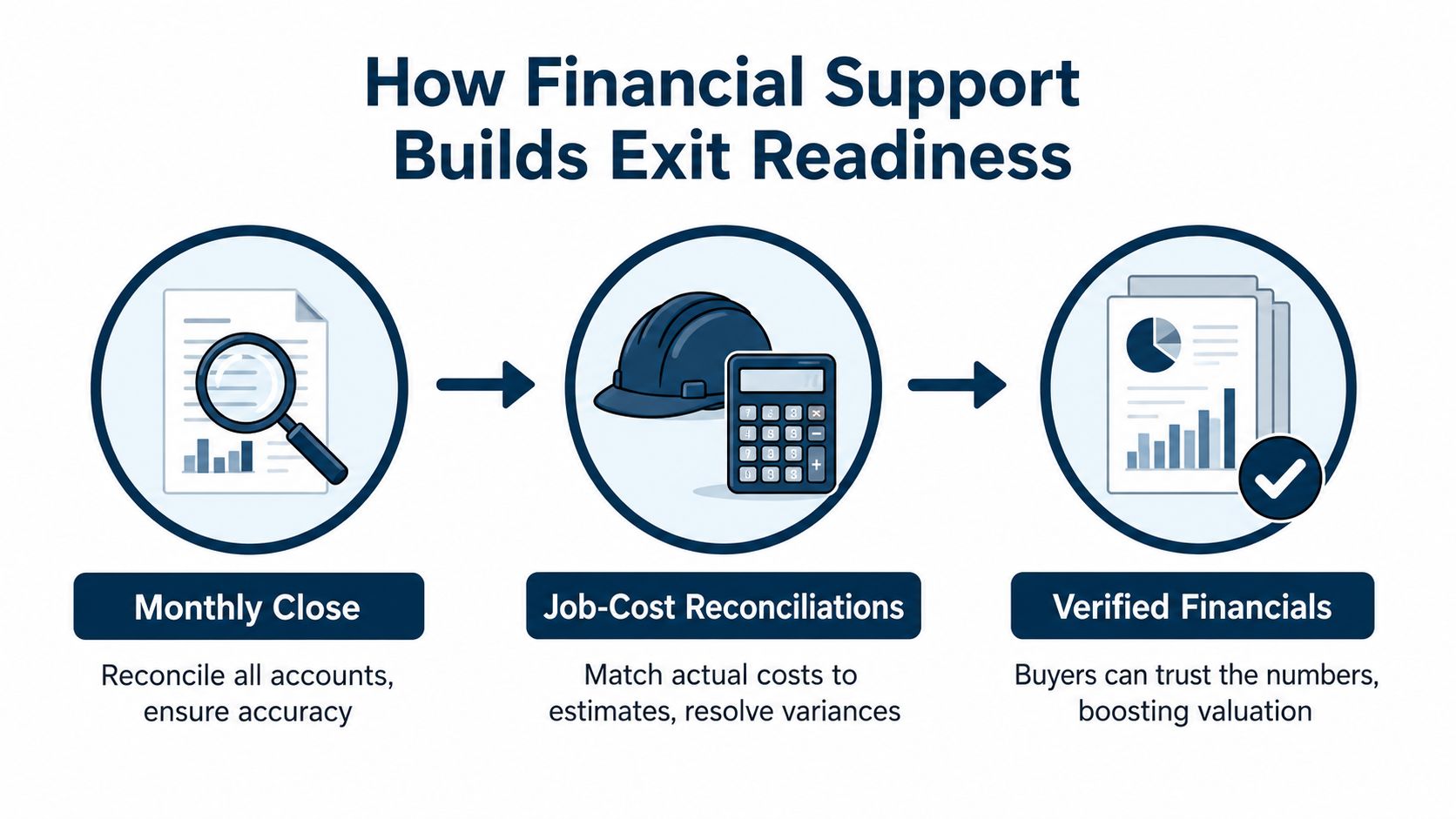
How Financial Support Builds Exit Readiness
Buyers can't verify earnings they can't trace. A clean income statement matters, but construction buyers also need to connect billed work, earned revenue, job costs, WIP movements, retainage, and cash collection.
A reliable monthly close creates the base. Job-cost reconciliations compare actual labor, materials, and subcontractor costs with the original estimate. WIP-to-billing tie-outs help explain why the accounting records show revenue that hasn't yet become cash. Forecasts and KPI reports then turn that history into a view of future performance.
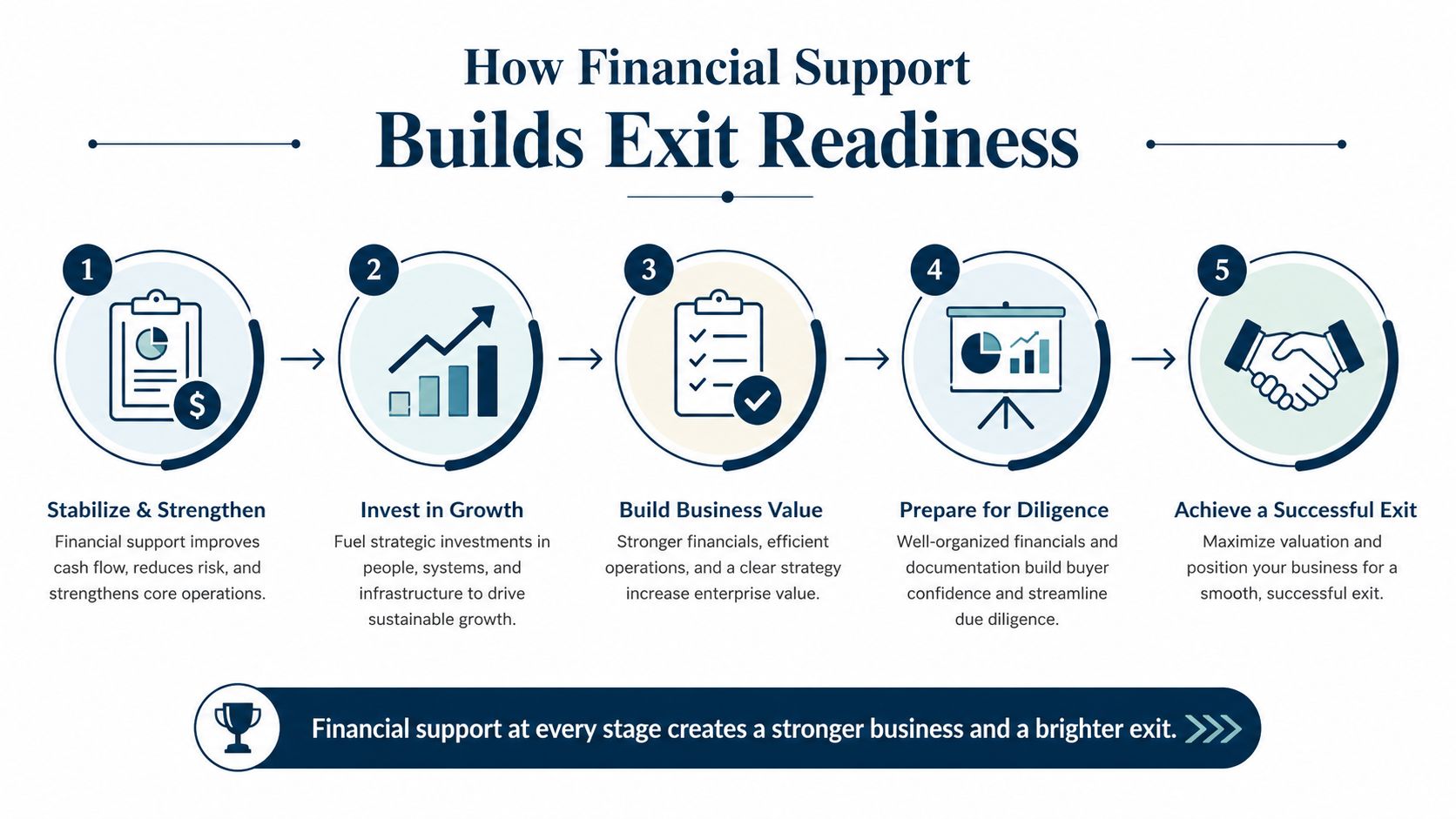
Outsourced bookkeeping can keep transaction records current. Controller support can improve reconciliations, reporting, and internal review. Fractional CFO advisory can connect those records to pricing decisions, cash planning, backlog analysis, working-capital schedules, and a quality-of-earnings process.
MyOfficeOps is one example of a partner that combines construction bookkeeping with financial analytics and CFO-level advisory. The useful test isn't whether an outside provider produces attractive reports. It's whether the owner can answer a buyer's questions with consistent records instead of reconstructing project history from memory.
The Valuation Lesson Owners Should Act On
Valuation shouldn't begin when a buyer walks into the office. By then, the choices that affect price have already been made through years of bookkeeping, contract decisions, job-cost habits, and management development.
Start with five actions:
- Confirm the monthly close is timely and complete.
- Review backlog by margin, customer, contract type, and execution risk.
- Audit the change-order approval and collection process.
- Document standard operating procedures.
- Identify and develop the next person who can run the company.
Every quarter either strengthens the evidence behind your multiple or weakens it. Owners who prepare early have more choices, better answers, and a stronger chance that the next offer reflects the business they built rather than the gaps in its records.
MyOfficeOps provides construction-focused bookkeeping, financial reporting, forecasting, analytics, and CFO advisory that can help turn job-level records into valuation evidence. Visit MyOfficeOps to discuss a practical plan for cleaner books, stronger cash visibility, and exit readiness.