
Do you ever feel like you're working harder than ever, but your bank account isn't showing it? It’s a common story. You're busy making sales, but at the end of the month, there's no extra cash to show for it.
Here’s the thing: profit isn't just about what you make; it’s about what you keep. Understanding your profit is the key to building a real business, not just owning a job.
Think of your business like it has three main buttons you can press to make more profit:
- Pricing: How much you charge for your stuff.
- Spending: How you manage your costs.
- Operations: How well your team works to serve your customers.
You don't need to be an expert in all three at once. Just making a few smart changes in one area can make a big difference to your bottom line.
Where to Start to Make More Profit
I once worked with a local contractor who thought he needed more jobs to grow his business. He was always chasing new work and felt totally burned out. But his real problem wasn't a lack of jobs—it was that he didn't know how much each job was actually costing him. He was guessing on material prices and always underestimating how long things would take.
Finding Your Profit Buttons
Once we gave him some simple tools to track his costs for each job, everything became clear. He could see that certain types of projects were barely making any money. He wasn't losing cash on them, but the amount of effort just wasn't worth the tiny profit.
By making small changes to his prices—using real numbers to back them up—his profit on new projects shot up. He didn't need more work; he needed more profitable work.
Making more money isn't some big secret hidden in a bunch of spreadsheets. It’s just about getting a clear picture of what you earn, what you spend, and where your time and money really go.
This guide will show you exactly how to get that clear picture. We're going to break down how to increase your business's profit into simple, easy steps. You don’t need to become an accountant. You just need to understand the main buttons that control your money, and that's what we'll cover next. This will help you feel more confident about your finances so you can finally see your hard work pay off.
Get Your Pricing and Sales Plan Right
Let's talk about the fastest way to add money straight to your pocket: your prices. So many business owners I meet are scared to charge more because they don't want to lose customers. It’s a normal fear, but if you want your business to grow, you have to take a good, hard look at what you’re charging.
This isn’t about just raising all your prices. It’s about charging what you’re really worth. Your price should show the true value you give to your customers, not just what you think they’re willing to pay.
When we talk about making more profit, there are really only three buttons you can push: pricing, spending, and operations.
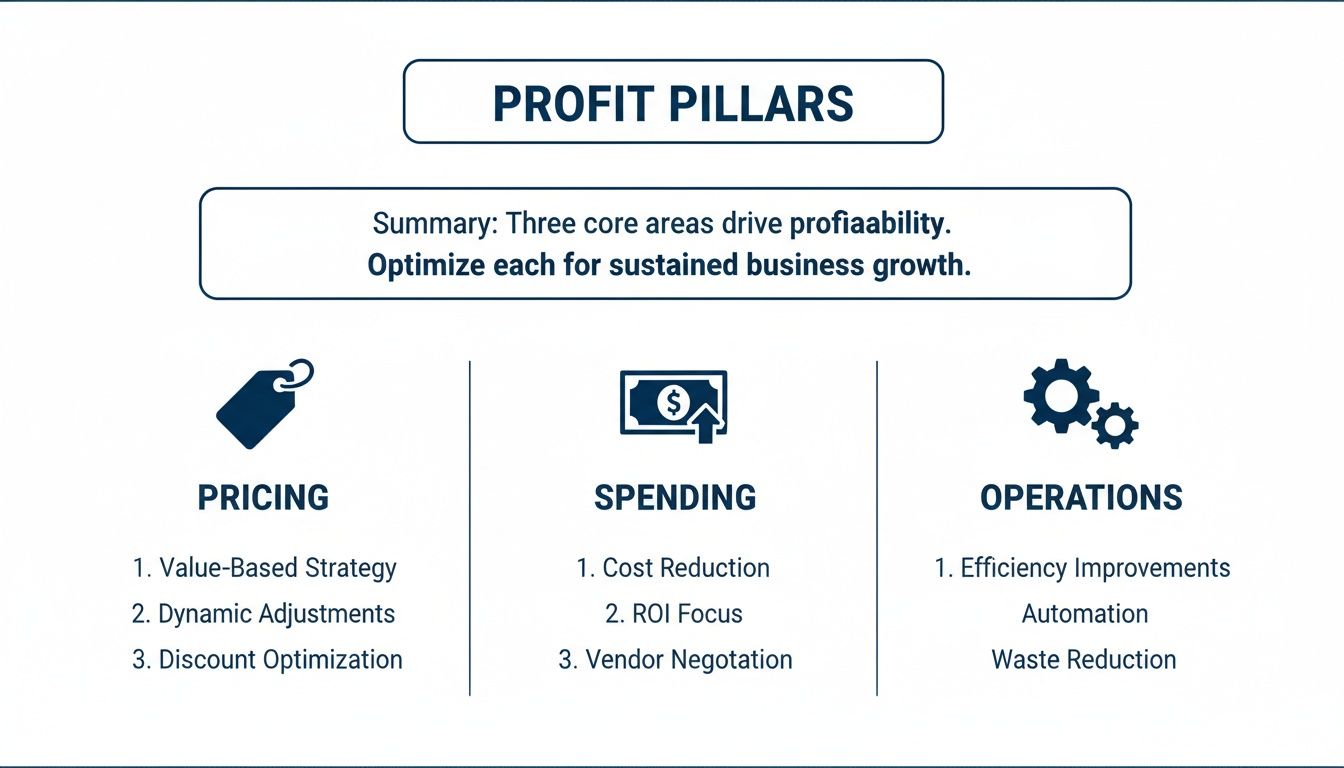
As you can see, pricing is the first and most direct button. Small changes here can quickly and seriously affect how much money your business keeps.
Price Based on Value, Not Fear
Start by looking at what your competitors charge, but please, don't just copy them. The point is to understand what's out there, not to be just like everyone else. The real key is to price your services based on the special value you provide. Do you offer faster service, better quality, or a more personal touch? These are things customers will happily pay more for.
I remember working with a marketing agency that was buried in small, one-time design jobs. When we looked at their numbers, we saw that these small jobs were barely making any money after you counted all the back-and-forth emails and setup time.
But their clients who paid them a set amount each month were super profitable. By just changing their focus to get more of these monthly clients, they made way more profit without needing a single new customer. That’s what happens when you know your numbers.
Find Your Most Profitable Services
Every business has star players and benchwarmers. You need to figure out which of your services or products are actually making you the most money. It’s not always the one you think.
- Track Your Time: If you sell a service, get serious about tracking how long you spend on different types of jobs. You might find out that a task you thought was "quick" is actually eating up a lot of time.
- Calculate Job Costs: For each thing you sell, figure out the real cost to deliver it. This includes paying your team, buying materials, and a little bit of your general business expenses.
- Analyze the Margin: The difference between your price and your cost is your profit. Looking at these profit numbers across all your services will show you where the real money is.
Once you know what makes you the most money, you can change your marketing to focus on selling more of it.
Smart Sales Tactics to Make More Money
A smart sales plan doesn't just sell—it helps customers choose your best and most valuable options. Instead of selling one thing at a time, you can create packages that make the average sale bigger and increase your profit.
You don't need to be a slick salesperson. You just need to show your services in a way that makes it easy for customers to pick the best choice for them, which is often your most profitable one.
Before you start throwing prices at people, it helps to know the different ways you can set them up. Each method works best for certain situations.
Simple Pricing Models to Consider
| Pricing Model | Best For | Potential Pitfall |
|---|---|---|
| Value-Based | Services with big, clear results (like consulting or marketing). | You need to be confident and able to explain the value you bring. |
| Cost-Plus | Physical products or standard services with steady costs. | You might not make as much if people see your service as being worth way more than your cost. |
| Tiered/Packaged | Businesses with different service levels (like software or agencies). | Can be confusing if the packages aren't easy to understand. |
| Project-Based | One-time projects with a clear start and end (like building a website). | If the project gets bigger than planned, it can eat up your profit if your contract isn't clear. |
Picking a model helps you create clear offers. You could make different packages (like Bronze, Silver, Gold) or bundle services together for a small discount. This gives customers choices while pointing them toward the options that are worth more. To improve how you make money, check out these expert sales tips for small and medium businesses.
This kind of thinking is working for business owners who get it right. Even with the economy being tricky, 74% of small and mid-sized business owners expect to make more money in the next year, and almost 60% are planning to grow. This shows that businesses with a clear plan and a good handle on their money are the ones set up for real success.
Take Control of Your Business Costs
Profit isn't just about what you make; it’s about what you keep. Rising costs are like a slow leak in a tire—they quietly drain your business, and before you know it, you're flat.
So, let's get real about managing your expenses. Forget the fuzzy advice to just "cut costs." That’s like telling someone to "drive better" without explaining what the pedals do. To really make a difference, you need a plan.
First, stop thinking of "costs" as one big, scary thing. Instead, let's put them into two simple buckets: fixed costs and variable costs.
Fixed Costs: These are the bills you have to pay every month no matter what. Think rent, your main team's salary, or that software you pay for automatically. They stay the same whether you have one customer or a hundred.
Variable Costs: These costs go up and down with how busy you are. For a roofer, it's the shingles for a job. For an online store, it's the cost of shipping. The more you sell, the more you spend on these.
Just knowing this difference is a huge help. It shows you where your money is going and gives you a clear idea of where you can make smart cuts without hurting your ability to serve customers.
The Hunt for Sneaky Expenses
One of the biggest profit killers I see is "expense creep." These are the small, monthly charges that show up on your credit card and grow over time without you noticing. It's the software you tried a year ago and forgot about, or the supplier whose prices have slowly gone up.
The best way to catch this is to look at your profit and loss (P&L) statement line by line. Don’t just look at the totals. For every single expense, ask yourself:
- Do I absolutely need this to run my business?
- Could I get the same thing for less money somewhere else?
- Is this a "good cost" or a "bad cost"?
That last question is the most important. A bad cost is just waste—money spent for no reason. A good cost is an investment that makes you more money. Paying for a new tool that saves your team five hours a week is a good cost. Paying for a fancy software feature that nobody uses is a bad cost.
The goal isn't to cut every expense to zero. It's to get rid of the bad costs so you have more money to invest in the good ones that help you grow.
Making Smart, Planned Cuts
Once you've found places to cut, it's time to act. This doesn't have to mean firing people or moving to a smaller office. Often, the biggest wins come from small changes that add up over time.
I once worked with a doctor's office that was struggling with low profits. After a quick look, we found they had been using the same medical supplier for ten years just out of habit. By simply getting prices from two other suppliers, they were able to get a better deal and save thousands of dollars a year. They also switched to a better scheduling software that cut down on no-shows, which directly brought in more money.
These small, smart changes add up fast. You just need to know where to look.
This is more important now than ever. Rising costs are a huge problem. A recent survey showed that 75% of small businesses said that rising prices for goods and services was a top money challenge. The same report shows that 56% of small businesses struggle just to pay their regular bills. By tracking your spending, you can find the waste that others miss and keep the profit that rising costs would otherwise take away. You can learn more about how small businesses are dealing with these issues in the full survey results.
Make Your Daily Operations More Efficient
How smoothly your business runs is directly connected to how much money it makes. Messy, disorganized ways of doing things can quietly suck away your profits every single day without you even realizing it. It’s the little bits of wasted time, the mix-ups, and the tasks that take twice as long as they should.
Think of it like a leaky pipe. A few drips might not seem like a big deal, but over a month, you've lost gallons of water. In your business, those drips are wasted minutes and dollars. Fixing those leaks lets profit flow more easily.

Find Your Biggest Time Wasters
First things first: you need to find the daily and weekly tasks that eat up the most time for you and your team. Are you spending hours making invoices, setting up appointments, or chasing down information from clients? These are perfect areas to improve.
Simple software can often be the answer. For example, a lot of service businesses I’ve worked with were losing money because they weren't tracking their work hours correctly. Projects would take longer than they planned, but they wouldn't know until it was too late.
By using a basic project management tool, they could see exactly where their time was going. This one change stopped money from slipping away and made their price quotes much more accurate. Making things this efficient often means using tools for straight through processing and automation to get rid of manual work in money-related tasks.
Hire for Growth, Not Just for Help
Your team is your biggest strength and, often, your biggest expense. A great hire is an investment that should bring in more money, just like a new machine. So when you're thinking about adding to your team, make sure you're hiring for a job that directly helps you grow.
It's easy to hire someone just because you feel busy. But before you write the job ad, ask yourself a few tough questions:
- Will this person free me up to focus on sales or planning? Hiring an assistant to handle schedules and paperwork could be a huge win if it lets you land two new clients a month.
- Will this person make our service better? Bringing on a skilled project manager might seem expensive, but if they make projects run smoother and keep clients happier, it's a great investment.
- Can this person bring in their own money? Hiring a new salesperson has a clear path to making more money, as long as you have a good system to support them.
Hiring smart is one of the best ways to increase business profitability. You’re not just adding another salary; you’re investing in your ability to earn more.
Well-trained and happy employees are also much more productive. Studies show that companies with good employee training programs see a 21% increase in profit. When people feel like you're investing in them, they do better work.
Your Team as a Profit Driver
Investing in your team's skills isn't just a nice thing to do; it’s a key plan for a profitable business. Profitable small businesses are what make our economy go, because they invest in their people to help them grow.
For example, small businesses with fewer than 250 employees were responsible for a huge 88.9% of all new job growth recently. This shows that the businesses that are doing better than their competitors are the ones putting their profits back into hiring good people and helping them grow, all while keeping a close watch on their money. You can find more details on these job trends in a recent BLS report.
Master Your Cash Flow and Get Paid Faster
It’s one of the worst feelings for a business owner. You look at your reports, and on paper, you’re doing great. Making a profit. Growing. But when you check the bank account, the money just isn't there.
This is the classic cash flow problem, and it trips up way too many good businesses.
Profit is just a number on a page. Cash is the oxygen your business needs to survive—it's what you use to pay your bills, your team, and yourself. Without good cash flow, even a super profitable company can come to a stop. Learning to manage the money coming in and going out is a must-do.

Simple Changes to Get Paid Sooner
Every day an invoice sits unpaid, you are basically giving your clients an interest-free loan. Making your invoicing and payment process better is one of the fastest ways to improve your cash situation, and it doesn't require a huge change.
You can make a big difference with a few small but powerful changes:
- Ask for a Deposit: For any big project, ask for a payment upfront. This could be anywhere from 25% to 50% of the total price. It shows the client is serious and gives you cash to cover your first costs.
- Change Your Invoice Terms: Are you still writing "Net 30" (due in 30 days) on your invoices just because you've always done it? Try changing it to "Net 15" or even "Due on Receipt." You'd be surprised how many clients will pay right away just because that's what the invoice says.
- Invoice Immediately: Don't wait until the end of the month to send all your invoices. As soon as the work is done, send the bill. The sooner the invoice goes out, the sooner the cash comes in.
Stop Chasing Late Payments
Chasing down late invoices is a huge waste of time. It pulls you away from the work that actually makes you money and adds a lot of stress. You need a system.
Most modern accounting software lets you set up automatic payment reminders. You can have it send a friendly email a few days before an invoice is due, another on the due date, and then a few more if it's late. This steady, professional approach gets results without you having to pick up the phone and have that awkward conversation.
A simple system for getting paid isn’t just about the money; it’s about getting your time back. Automating reminders frees you up to work on growing the business instead of acting like a bill collector.
To get a clear picture of who owes you money and for how long, you need to track your unpaid invoices. A great way to start is by using our helpful accounts receivable aging report template to see exactly which payments need your attention.
A Real-World Cash Flow Fix
I once worked with a contractor who was always worried about making payroll, even though he had plenty of good jobs. The problem? He would send one giant invoice at the very end of a long project.
For months at a time, he was paying for the entire job—labor, materials, everything—out of his own pocket.
We made one simple change: he started billing in stages.
Instead of one final invoice, he began billing 30% upfront to start the job, another 30% at the halfway point, and the final 40% when it was done. That one little change completely turned his business around. He suddenly had the cash he needed to cover his costs without worry, which freed him up to take on even bigger, more profitable projects. He was finally in control of his money.
Know When to Stop Guessing and Get Expert Help
As a business owner, you're used to doing a lot of different jobs. You’re the boss of sales, marketing, HR, and everything else all at once. But let's be honest, that "finance" job can get a little too heavy sometimes.
Trying to manage all the numbers yourself can feel like you're being productive, but it often costs you more in the end. Missed chances, small money leaks, and expensive mistakes can quietly eat away at your hard-earned profit.
Making big business decisions based on a ‘gut feeling’ instead of real numbers is a huge risk. It’s like driving a car at night with the headlights off. You might be going in the right direction, but you have no idea what's right in front of you.
Signs It's Time for a Co-Pilot
How do you know when it’s time to bring in a professional? It’s usually not one big thing, but a bunch of small, nagging problems that show you've gotten too big for your current money setup.
You might need expert help if:
- Your books are always behind, and you’re rushing at tax time.
- You look at your financial reports, and they don’t make any sense.
- You aren't sure which of your services or clients make you the most money.
- You're worried about having enough cash, even when you're making a lot of sales.
Bringing in an expert isn't a sign you've failed; it's a sign you're growing. It means you’re ready to move from just running a business to building it in a smart way.
What an Expert Actually Does
Getting help doesn't mean giving up control. It means finding a partner—like a part-time CFO or an advisory firm—who can turn your numbers into a clear map for how to increase business profitability.
They take the confusing financial information and turn it into simple, actionable advice. Instead of just telling you what your profit was last month, they help you figure out why it was that number and what buttons you can push to make it better next month.
A good financial partner can help with everything from looking at your pricing and managing your cash to getting your business ready to sell one day. This frees you up to stop guessing and get back to focusing on what you do best—serving your customers and leading your team.
Your Top Profitability Questions, Answered
When you're looking at your numbers and trying to figure out how to make your business more profitable, questions always come up. It's totally normal to wonder if you're doing the right things. Let's go over some of the most common questions I hear from business owners.
What’s The Fastest Way To Increase Profit?
The quickest button to push is almost always pricing. Nothing else affects your bottom line so quickly. Unlike cutting costs or changing how you do things—which can take months to show results—a price increase boosts your profit from the very next sale.
But "fastest" isn't always "best." Raising prices without a good plan can scare away your loyal customers. The key is to be smart about it. Raise prices on the things where you provide the most clear value, not just on everything.
How Can I Increase Profit Without Raising Prices?
If you really don't want to raise prices right now, turn your focus to your costs and how efficiently you work. It's time to trim the fat.
Start with your expenses. Are you getting the best prices from your suppliers? A quick phone call to ask for a better deal can sometimes work wonders. Are you paying for software you haven't used in six months? Cancel it.
Then, look at how you operate. Where is time, and therefore money, being wasted? Even small changes to your team's daily routine can add up to huge savings. For example, a simple process change that saves each team member 15 minutes a day adds up to a huge number of work hours over a year.
Profit isn't just about what you earn; it's about what you keep. Every dollar you save from a wasted expense has the exact same effect on your profit as a dollar from a new sale.
How Often Should I Review My Profitability?
You need to have a good idea of your profitability at least every single month. Waiting until the end of the quarter or, even worse, the end of the year is a recipe for trouble. By then, a small leak can turn into a big flood.
A monthly check-in is your early warning system. It lets you:
- Spot a bad trend before it gets out of control.
- See if the changes you're making are actually working.
- Make small, quick adjustments to stay on track with your goals for the year.
Think of it like checking the GPS on a long road trip. You wouldn't drive for three hours without looking at the map, right? A quick look every so often makes sure you're still going in the right direction.
This doesn't mean you need to lock yourself in a room for three days every month to look at your finances. For most businesses, a quick review of your main reports, like your Profit & Loss statement, is enough to see what's really going on and make smart decisions. Doing it regularly is way more important than making it complicated.
Stop guessing and start building a more profitable business. The team at MyOfficeOps can provide the financial clarity and expert advice you need to turn your numbers into a roadmap for growth. Schedule a discovery call today.