

You can feel it the minute the proposal goes out. The client likes the work, then they push on price, and somebody on your side starts shaving the number to keep the deal alive. That's how a lot of firms drift into bad pricing, one awkward conversation at a time.
A strong professional services pricing strategy doesn't start with a rate card. It starts with the full cost of delivery, the kind of client you want, the risk you're taking, and the rules you'll enforce when pressure shows up. Treat pricing like an operating system, not a one-time quote, and the whole firm gets easier to run.
Why Most Service Firms Underprice Their Work
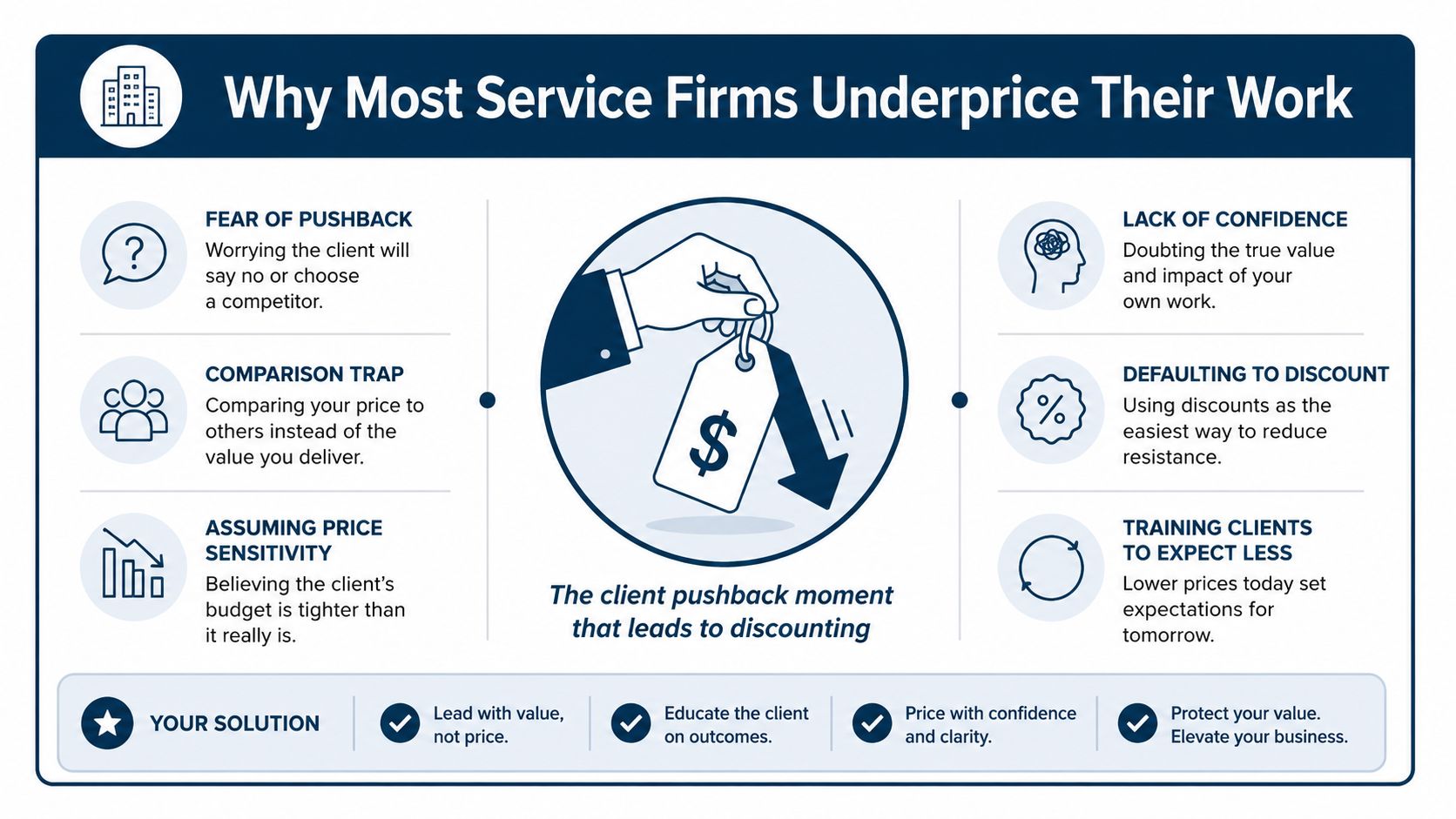
The classic mistake is simple. You build a proposal from memory, the client pushes back, and someone caves because the team is worried about losing the job. That habit turns pricing into a reaction, not a decision.
The deeper problem is that many firms price from the outside in. They look at what competitors charge or what the last project cost, instead of starting with fully loaded delivery cost, utilization, and the actual time that disappears into meetings, tools, and non-billable work. Industry guidance from TSIA says firms should connect prices to real delivery data, review rate cards quarterly, and build prices from cost discipline rather than guesswork (TSIA guidance on professional services pricing).
The early warning signs
If your pricing is reactive, it usually shows up in three ways. First, the proposal changes every time a client sounds uncertain. Second, nobody can explain the margin on a job without digging through spreadsheets. Third, the firm keeps calling discounts “relationship management,” which is just a polite way to say leakage.
Practical rule: If you can't explain why a price is what it is, you're not pricing. You're hoping.
This is why pricing has to work like a system. A real professional services pricing strategy uses cost-to-serve, utilization, realization, and renewal discipline together. If one piece is missing, the whole thing slips back into hourly habit.
For a useful pricing tool when you're trying to compare service tiers and package logic, the AI CRM platform pricing for SMBs page is a good place to see how structured pricing can be presented clearly to buyers. The lesson isn't the product, it's the discipline behind the offer.
The Four Pricing Models and When Each One Wins
Pricing models are tools, not identities. The same firm can use different models for different jobs, and that's usually smarter than forcing every engagement into one box.
Hourly billing is still the most common model in professional services, and Salesforce describes it as reselling team hours with a margin built into the rate (Salesforce pricing model guide). It works when the work is uncertain or the scope is soft, but it backfires when the client values the outcome more than the time. That's why a website build, a compliance review, or a migration project often fits something else better than straight time and materials. If you want a broader comparison of model selection and quote structure, PRWiz is worth a look as a practical pricing reference.
A simple way to choose
| Model | Best Fit | Margin Risk | Watch Out For |
|---|---|---|---|
| Hourly | Unclear scope, advisory work, short tasks | Low to medium, if utilization is strong | Clients pushing lots of small requests |
| Fixed fee | Defined deliverables and repeatable work | High if scope is wrong | Underestimating revisions and hidden effort |
| Retainer | Ongoing support and regular access | Medium, if output drifts past scope | Overuse of access and vague deliverables |
| Value-based | Clear business impact and measurable outcomes | High if you promise too much | Quoting from your labor cost instead of client value |
Fixed fee gives the client certainty. That helps when the work is structured and the deliverables are clear, like a standard brand package or a fixed-scope migration. The downside is obvious, if you miss the scope, you own the loss.
Retainers work when the client needs steady access and you can define what that access includes. They're a strong fit for ongoing advisory, support, or compliance work, but they break when the client starts treating the retainer like an open tab.
Value-based pricing is the cleanest model when the client's gain is measurable. The Vistaar guide frames it as price qualification, where you identify the right client, set a floor from cost plus overhead and profit, and estimate a ceiling from the economic value created (Vistaar professional services pricing guide). Hybrid deals, like a fixed base fee plus a bonus tied to results, solve a lot of problems because they protect the firm and keep incentives tied to outcomes.
Calculating Cost-to-Serve and Your Real Price Floor
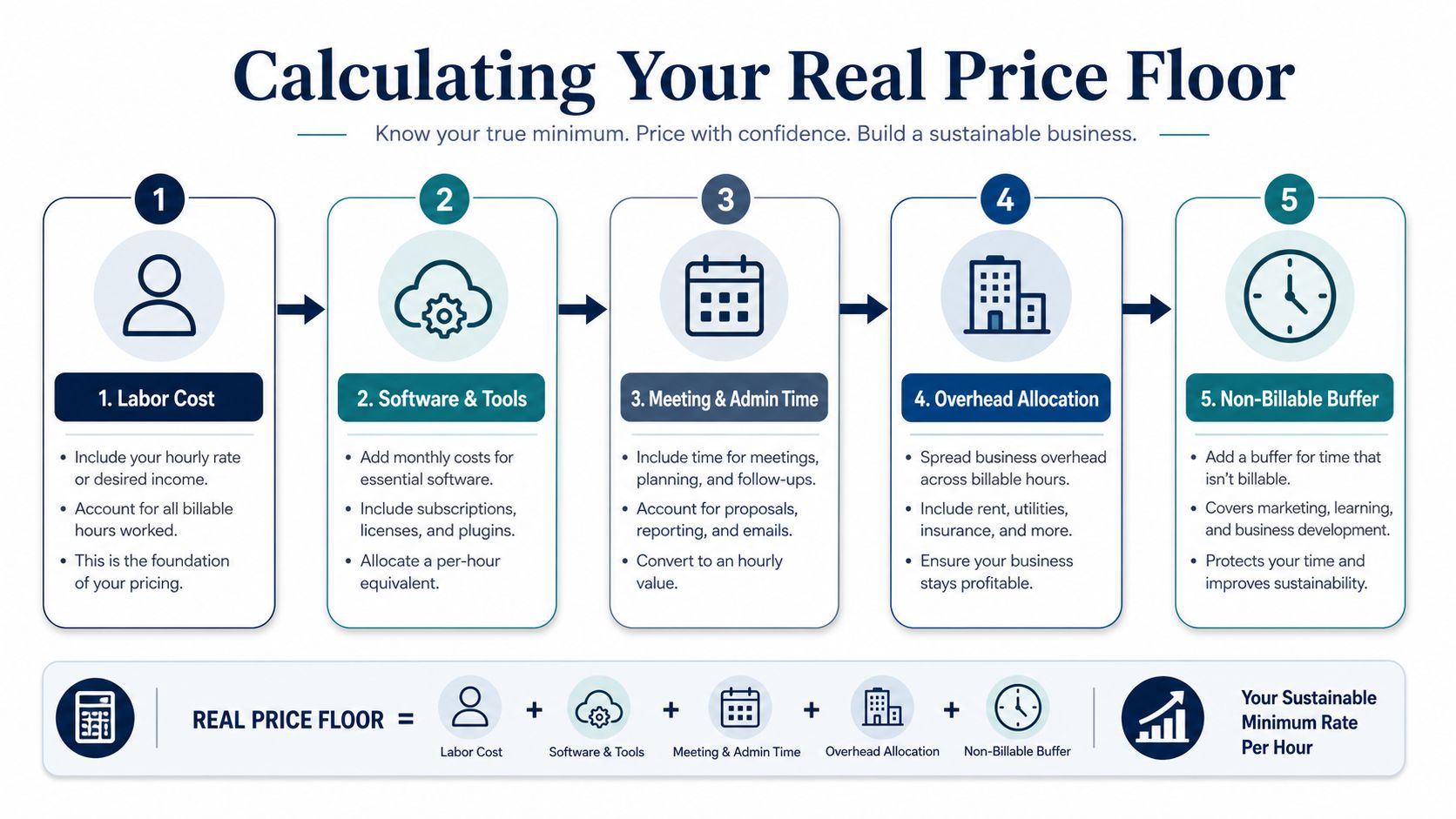
Pricing stops being a feeling when you know your fully loaded delivery cost. Guessing at margin is how healthy firms turn into busy, tired firms.
Start with labor. Then add software, tools, meetings, admin time, overhead, non-billable work, taxes, owner pay, and reserves. The point is not to build a perfect spreadsheet, the point is to stop ignoring the cost items that eat your profit. Deloitte's pricing work pushes the same idea, a granular fact base becomes the source of truth for improvement, and you need transaction-level visibility before you change prices (Deloitte pricing effectiveness report).
What the floor really means
Think of the floor price as the number below which the job hurts you. In one industry guide, the floor is defined as fully loaded cost, the sustainable price is 2x fully loaded cost, and the healthy price is 3x to 4x fully loaded cost (Northern Star pricing guide). That's a useful reality check when a quote feels “competitive” but the margin is thin.
Billable utilization matters here too. TSIA says many firms target 70 to 80% billable utilization as a benchmark for healthy pricing and capacity planning (TSIA guidance on professional services pricing). If you assume too much billable time, your rate looks fine on paper and fails in practice.
A small firm example makes this easier to see. If a three-person team has one person spending too much time in meetings, one person covering admin, and one person doing delivery, the true hourly floor is higher than the obvious labor number. That's why owners who skip owner pay, taxes, or reserves almost always underquote.
If the floor is wrong, every model above it is built on sand.
For a practical accounting angle on that math, the internal guide on job costing for professional services firms is a good companion reference.
Building Tiers and Discount Rules That Hold Up
A proposal that offers only one number invites a fight. A proposal that offers choices changes the conversation, because the client stops asking, “Can you come down?” and starts asking, “Which level do we want?”
That's the point of good-better-best tiering. Thomson Reuters recommends tiering for recurring services and says annual review improves confidence that pricing reflects the value of expertise (Thomson Reuters industry pricing trends). The middle tier should be the expected choice, and the premium tier should feel meaningfully better, not just slightly fancier.
Make the middle tier the obvious pick
Use three offers, not seven. The entry tier should solve the core problem, the middle tier should feel complete, and the premium tier should be the one for clients who want speed, access, or more support. One practical pricing guide recommends pricing the premium at about 2x to 3x the entry tier, which creates a real anchor instead of a fake one (REM Up service pricing guide).
Here's the blunt truth about discounts. If you hand them out early, clients learn to wait for them. The Puny strategic guide says firms should audit pricing annually, give existing clients 60 to 90 days’ notice, and use clear renewal and discount rules, because pricing discipline is more important than the first quote alone (Puny strategic pricing guide). I agree. Discount governance is not admin work, it's margin protection.
A simple discount policy that works
- Approve discounts centrally: Keep the authority with one owner or a very small group, so discounts don't become a sales habit.
- Tie discounts to a reason: Give them only for scope reduction, strategic value, or a long-term commitment.
- Use expiration dates: A discount should end, not live forever.
- Protect new work: New scopes should price at current rates, not old ones.
A scoped buffer helps too. Vistaar's guidance says fixed-fee work should include 10 to 25% buffers for scope creep and estimation error (Vistaar professional services pricing guide). That buffer is not greed. It's what keeps one messy project from wiping out the margin on five good ones.
For a more operational look at pricing and margins, the internal reference on profit optimization for service firms fits well with this approach.
Quoting From Client Value Without Making Promises You Can't Keep
Value-based pricing sounds smart until you are in the meeting and need a number. Start with the client's problem, the cost of doing nothing, and the next-best alternative. Hours come later, because hours only tell you what your delivery costs. They do not tell you what the client gains.
The cleanest workflow I've seen is in the REM Up service pricing guide. Quantify the client's problem in money terms, identify the next-best alternative and its cost, then anchor the price between those two numbers instead of tying it to internal labor alone. That keeps the conversation on business impact, not on how long your team sat in a room.
The discovery questions that matter
Ask what the problem is costing them now. Ask what happens if they wait. Ask what they would do instead if they did not hire you. Those answers tell you the cost of the status quo, the cost of delay, and the value of doing the work now.
Add an extra hour of discovery to your next three proposals and use it to quantify the financial impact before you price the job. That small change forces better questions and better numbers. Most firms do not need more sales polish, they need a tighter value case and a clearer price floor. If you need the accounting side of that workflow, accounting for professional services firms is the place to tie pricing back to margin and delivery reality.
A clean proposal line
You do not need fancy language. Use a line like this.
“Based on the cost of the current process and the value of the improvement, the engagement is priced at X. That includes the scope we discussed, the delivery checkpoints, and the outcome we agreed to target.”
That wording works because it ties the fee to a business case. It also makes it easier to hold the line if the client asks for a discount, since the price is connected to value, not effort.
Value-based pricing works best when the client can see the upside clearly. If they cannot, use fixed fee or retainers and stop pretending the work is outcome-driven when it is really labor-heavy.
The KPIs That Tell You If Pricing Is Working
You do not need a giant dashboard. You need a small set of numbers you review every week, the ones that show whether pricing is holding up or slowly bleeding margin. If pricing is healthy, the shift shows up fast. If it is not, the same numbers show you exactly where the leak is.
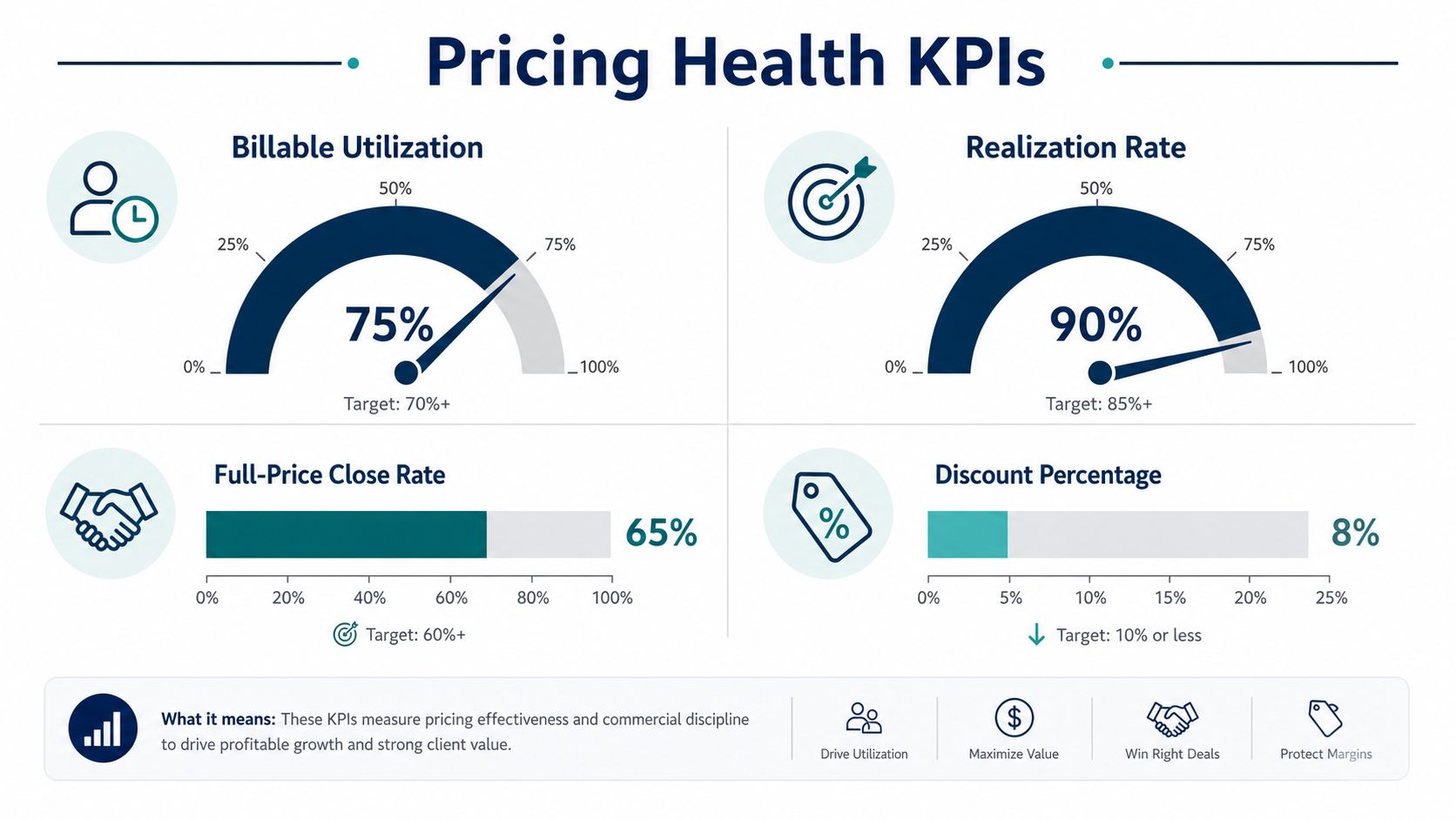
The four KPIs that matter most are billable utilization, realization rate, full-price close rate, and discount leakage. Billable utilization tells you whether your team is spending enough time on paid work. Realization rate shows how much of your planned revenue you collect after scope changes, concessions, and billing friction. Full-price close rate shows how often you win business without discounting. Discount leakage shows how often price cuts slip through without a rule, a reason, or a record. TSIA points to utilization as a core planning benchmark and says firms should track realization by pricing model so they can see where billed revenue diverges from planned revenue (TSIA guidance on professional services pricing). Salesforce also notes that hourly billing remains the most common model, which makes utilization and realization harder to ignore (Salesforce pricing model guide).
What to watch and what to do
- Billable utilization: If this is low, your pricing may be too soft, your staffing may be too heavy for demand, or your team may be spending too much time on unpaid work.
- Realization rate: If billed revenue keeps landing below plan, your estimates, scope rules, or change-order discipline are broken.
- Full-price close rate: If more than 70% of full-price proposals close, one guide says your prices may be too low (Northern Star pricing guide).
- Discount leakage: If discounts spread without clear rules, margin slips out through the back door and nobody notices until the month-end review.
Set realization targets by pricing model, not as one flat number across the firm. Fixed fee, hourly, and retainers behave differently, so the target has to match the way you sell and deliver. A fixed-fee job with tight scoping should hold a different realization profile from a retainer built for ongoing access, and an hourly engagement should be judged on a different threshold again. If you track everything at the same level, you miss the signal and end up arguing about averages.
For a simple weekly view, track realization by pricing model, discount usage by rep, and the gap between proposed and actual delivery. That gives you a working picture of whether the pricing system is holding together or drifting. If you want the accounting side of that setup, accounting for professional services firms is a useful reference for tying those numbers back to margin and delivery reality.
Running Price Increases Without Losing Clients
The firms that lose clients on a price increase usually make one of two mistakes. They either wait until the old price is already hurting the business, or they announce the change like a tax notice and give clients no reason to stay calm.
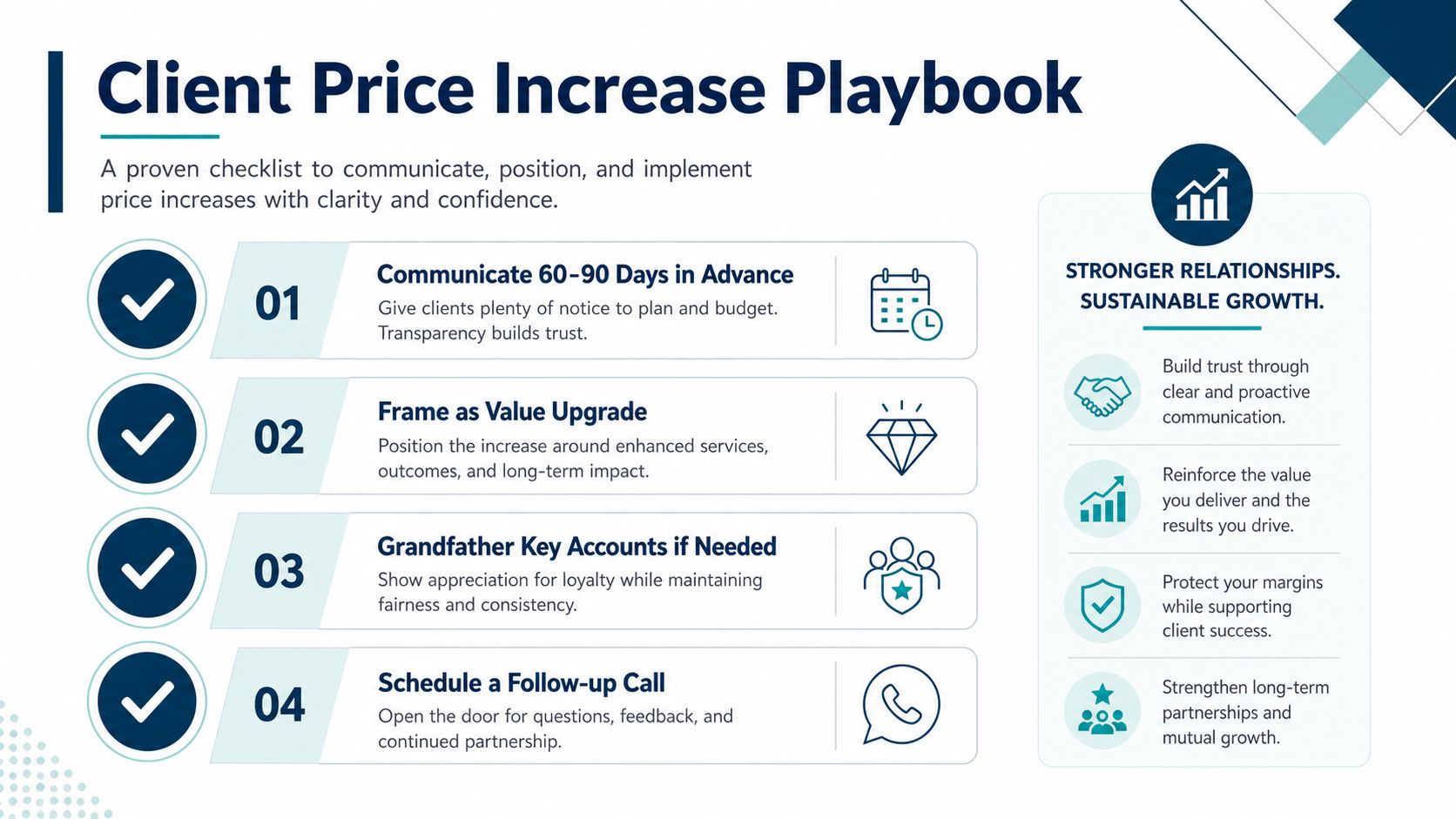
Price increases need a process, not a burst of courage. Review pricing on a set schedule, especially when scope, complexity, or service demand has changed. Then prepare the client conversation before the new rate ever goes out. If you treat it like a one-time announcement, clients will treat it like a surprise attack.
What to say and who gets what
Start with segmentation. Strategic accounts, price-sensitive accounts, and low-value accounts should not all get the same message, the same timing, or the same follow-up. If the relationship matters, handle it personally. If the account is transactional, keep the message short and firm.
- Tell clients early: Give them enough lead time to absorb the change and make a decision.
- Tie the increase to delivery reality: Explain that pricing is being updated to match the work, the service level, and the current scope.
- Protect key accounts where it makes sense: Keep the relationship stable if the account is worth defending.
- Use a direct follow-up call for important clients: Email alone is weak when the account matters.
The script should be plain. Say the current rate no longer matches the work being delivered, and then point to the quality, scope, or service level the client already receives. Do not over-explain. Do not apologize for charging more when the work has changed. If a client pushes back, give them clear options: accept the new price, reduce the scope, or move into a different package.
The first month after a reset matters more than the announcement itself. Clean up the rate card, make renewal language explicit, and keep approvals tight so exceptions do not creep back in through side deals. Then sort the client list by strategic value and price sensitivity, and hold the line on new work. That is how the increase becomes part of the pricing system instead of a one-off scramble.
If your firm is ready to stop treating pricing like a negotiation and start running it like an operating system, reach out to MyOfficeOps. They can help you clean up the accounting, improve pricing visibility, and turn pricing discipline into a repeatable habit.