
You've spent years, maybe your whole life, building a business you're proud of. When it’s time for you to step away, what's the plan? A business succession is just that—a plan for passing the baton to the next person without fumbling the handoff. It’s about protecting everything you've worked so hard to create.
What Is Business Succession and Why Does It Matter

Think of your business like a secret family recipe for the best chocolate chip cookies. You wouldn't just leave the recipe on the kitchen counter for anyone to grab. You’d carefully teach someone you trust, step-by-step, to make sure those amazing cookies can be enjoyed for years to come. That’s what a business succession plan does.
It's a clear guide that answers three big questions: who will take over, how will they do it, and when will it happen. This isn't just for big companies in skyscrapers. It’s for every family-owned pizza shop, local plumbing business, or dental office out there.
The Hard Truth About Not Planning
Many owners I talk to think they’ll just sell their business when they get tired of working. But the reality is much tougher. The numbers don't lie: a shocking 70% of small businesses never find a buyer or a way to pass the company on. Even on websites where businesses are listed for sale, very few actually end up selling. You can see more of these stats for yourself here.
Without a plan, most businesses just fade away or shut down. This leaves the owner with almost nothing to show for a lifetime of work. It can be a painful blow to your family, your employees, and your own retirement.
A succession plan isn't just about how you leave. It’s about how the business keeps going. It ensures the company you built can keep growing long after you’ve moved on to your next adventure.
Why Every Small Business Needs a Plan
Having a clear succession plan isn't just about cashing a big check. It’s about making sure the people who depend on your business are taken care of.
Here’s why it’s so important:
- It Looks After Your People: A good plan gives your employees peace of mind. They know the business is in good hands and their jobs are safe. Happy people do better work.
- It Gets You a Better Price: Businesses with a clear plan for the future are worth more money. A buyer sees less risk, so they are willing to pay more.
- It Puts You in the Driver's Seat: Planning ahead lets you call the shots. You decide how things will go, instead of a sudden health issue or a bad economy forcing you to make a quick, bad decision.
- It Makes for a Smooth Handover: Passing the torch becomes a calm, organized process. It avoids the chaos that can scare away customers and hurt the business.
Bottom line: planning your business's future is one of the most important things you can do as an owner. It’s how you make sure your hard work pays off for you, your family, and everyone who helped you along the way.
4 Ways To Hand Over Your Business
When it’s time to move on, you have a few different ways to hand over your business. It's like deciding on the next chapter for your company’s story. You’re not just picking a new boss; you’re choosing what the future will look like for your employees and the brand you built from scratch.
Each option has its own good and bad points. What’s perfect for the coffee shop down the street might be a terrible idea for your construction company. The trick is to understand your choices long before you have to make a decision.
1. Keeping It in the Family
This is the dream for many family business owners. You pass the company to your kids or another relative, and your name stays on the door. It can be a wonderful way to keep your legacy going for another generation.
But this path needs some very honest talks. For example, I once worked with a business owner who assumed his son would take over his successful contracting business. After months of planning, his son finally admitted his real passion was graphic design. It was a tough conversation, but it saved them both from years of unhappiness. You have to ask: Do your kids really want the business? Or do they just feel like they have to take it? A forced handover can wreck family relationships and the company.
2. Selling to Your Management Team or Employees
Your key employees already know how your business works. They get your customers and your company culture. Selling to them, often called a management buyout (MBO), can be a great way to thank them for their hard work and keep the business running smoothly.
Another option is an Employee Stock Ownership Plan (ESOP), where you sell the business to all of your employees as a group. This can be a huge morale booster and gives everyone a reason to work hard for the company's success. The biggest challenge for both of these is usually money—your team has to find a way to get the loans to buy you out.
Choosing who takes over isn't about finding another you. It's about finding the right person to take care of the company's future. The goal is to keep things stable and growing, not to create a clone of yourself.
3. Selling to an Outside Buyer
This is the most common path when family or employees aren't the right fit. Selling to someone on the outside opens you up to more potential buyers, which can mean you get a better price.
Buyers usually fall into two groups:
- Strategic Buyers: These are often other companies in your industry, maybe even a competitor. They want to buy your business to get your customers or your location to help their own company grow.
- Financial Buyers: These are investors or investment groups. They look at your business like a stock—they’re focused on how much money it makes and how much it can grow.
Selling to an outsider usually means you give up control over how the business is run in the future. It’s a choice between getting the most money and making sure your company’s values stay the same. You can explore different business exit planning strategies in our detailed guide.
4. The Last Resort: Closing the Doors
Sometimes, the simplest option is to just shut the business down. This means you sell off everything you own—inventory, equipment, and any property—and close for good. It's rarely what anyone wants, but it can be the right move if the business isn't making enough money to sell or if you just can't find a buyer.
Comparing Business Succession Options
To make it easier, let’s lay out these choices side-by-side. Seeing the good and bad parts can help you figure out which path lines up with your goals.
| Succession Path | Who Takes Over? | Best For… | Biggest Challenge |
|---|---|---|---|
| Family Succession | Children or relatives | Keeping the family legacy alive. | Making sure the kids are willing and able; handling family drama. |
| Management Buyout (MBO) | Key managers | Rewarding your top people and keeping things running smoothly. | The management team getting a loan to buy the business. |
| ESOP | All employees, as a group | Getting the whole team excited and working toward the same goal. | Being complicated and expensive to set up. |
| External Sale | An outside company or investor | Getting the highest possible sale price. | Losing control over the company's future and culture. |
| Liquidation | No one; you sell everything off | Businesses that aren't making money or have no buyers. | Getting a low price for everything; can be emotionally tough. |
In the end, the right choice is all about what you want. Do you want the biggest possible check? Or do you want to see your family name on the door for another 50 years? Answering those questions honestly is the first step.
An important part of this is choosing your business structure types correctly, as the way your business is set up can make a big difference in the taxes and legal steps for any sale.
Getting Your Financial House in Order

Picture trying to sell a used car. If the inside is full of old fast-food wrappers and the engine is making weird noises, you’re not going to get a good price. The same thing is true for your business. Before you can think about handing it off, your finances need to be squeaky clean.
This isn't just about taxes. It's about proving your business is healthy and worth what you're asking for it. Anyone looking to take over—your kid, your manager, or an outside buyer—will want to look under the hood. Messy financial records are a huge red flag that screams, "Stay away!"
Clean and correct bookkeeping is the first step you absolutely cannot skip. It’s the foundation for everything else. Without it, you can't create accurate financial reports, and you definitely can't show someone what your business is really worth.
Why Clean Books Matter So Much
Think of your financial records like a report card for your business. When the numbers are a mess, the report card is full of confusing, failing grades. A potential buyer wants to see straight A's.
Clean finances do a few very important things:
- They Build Trust: Organized records show you run your business well. It tells a buyer there are no skeletons hiding in the closet.
- They Back Up Your Price: You can’t just pick a sale price out of a hat. Your price has to be proven with years of solid, clear financial reports.
- They Make Things Go Faster: When your books are neat, the part of the sale where the buyer checks everything (called due diligence) goes much more quickly. Deals often fall apart because of delays.
This prep work is the most important thing you can do to get ready for a business handover. It directly affects the amount of money you walk away with.
The Role of a CFO Advisor
Most small business owners are great at what they do—they’re talented bakers, skilled plumbers, or expert lawyers. But they’re not usually expert accountants. That’s totally fine, and that's where someone like a CFO advisor can help.
A CFO advisor is like a financial coach for this process. They don’t just count your money; they help you understand what the numbers are telling you. They can spot the financial "engine noises" you might not even hear.
For example, they can help you figure out where you’re making the most money, improve your cash flow, and create the kind of simple, clean financial statements that buyers want to see. This isn't just about cleaning up the past; it's about making your company look as good as possible for its future owner. You can learn more by checking out our guide on how to prepare financial statements.
Your financial reports aren't just history. To a buyer, they are a map to future money. A clear map is worth a lot more than a confusing one.
This is especially important for family businesses. Around 78% of owners want to keep their business in the family, but a crazy 52% have no real plan. The family businesses that do well are the ones that get their finances in order. They are 43% more likely to do better than their competitors.
Key Financial Areas to Focus On
So, where do you begin? Getting your finances in order can feel like a huge job, but it's easier if you break it down into smaller pieces.
Here are the first things to work on:
- Up-to-Date Bookkeeping: Every dollar that comes in and every dollar that goes out needs to be recorded correctly, right away. No more shoeboxes full of receipts.
- Clean Financial Statements: You need three main reports: an Income Statement, a Balance Sheet, and a Cash Flow Statement. They should be clear and accurate for at least the last 3 to 5 years.
- Knowing Your Profits: Do you know which of your products or services makes you the most money? A buyer will definitely want to see this.
- Personal vs. Business Spending: A lot of owners pay for personal things out of the business account. These need to be separated out to show how much money the business itself is actually making.
By working on these areas, you go from having a messy financial junk drawer to a professional, organized system. This doesn't just get you ready for a sale; it makes your company better and more profitable today.
How Much Is Your Business Actually Worth
At some point, every business owner lies awake at night and wonders, "What's this thing I built really worth?"
Finding the answer isn’t a guessing game. It’s not about picking a number you like or one you heard a friend got for their business. It’s a formal process called a business valuation, and getting it right is one of the most important parts of planning your exit.
Think of it like getting your house appraised before you sell it. An appraiser doesn't just walk in and say, "Yep, looks like a half-million-dollar house." They look at the size, the condition, the neighborhood, and what similar houses have sold for recently. It’s a step-by-step process based on facts, not feelings.
A business valuation does the same thing for your company. It’s a close look at your finances, your equipment, your customers, and your chances for future growth.
More Than Just a Number
Getting this number right is important for more than just curiosity. It affects almost every part of your succession plan, from the sale price to how much you'll owe in taxes.
A professional valuation gives you a real, solid number to start negotiations with. If you're passing the business to your kids, it helps you divide things up fairly, which can prevent a lot of family arguments down the road. It’s all about making the process clear and fair for everyone.
A business valuation isn't just a picture of what your business is worth today. It's a guide that shows you where the value is and points out ways you can make it worth even more before you leave.
What Factors Change Your Company's Value
A few key things determine what a business is worth. Some are pretty obvious, but others might surprise you. Knowing what they are is the first step to getting the best possible price for your company.
Here’s what a valuation expert will look at closely:
- Steady Profits: A history of making money, year after year, is a great sign of a healthy business. Having one amazing year is nice, but having three to five years of solid, predictable profits is what really gets a buyer interested.
- How Much It Depends on You: If the business can't run without you, its value goes way down. If you’re the only one who knows the key customers or how to do the work, a buyer will see that as a big risk. A business that can run smoothly without you is worth a lot more.
- A Good Management Team: Having a great team that can handle things on their own is a huge plus. It shows a buyer that the business won’t fall apart the minute you walk away.
- Clean and Clear Finances: We've said it before, but it's that important. If a buyer can't easily understand your financial reports, they’ll get nervous. They might offer you a lot less money or just walk away from the deal entirely.
You can learn more about how this works in different fields by reading about business valuation multiples by industry.
The Different Ways to Value a Business
Valuation experts don't just use one method. They usually look at your business from a few different angles to get a fair number.
- Asset-Based Approach: This is the simplest way. It just adds up the value of everything the company owns (like cash, equipment, and buildings) and then subtracts all of its debts.
- Market-Based Approach: This is like the house appraisal. The expert looks at what similar businesses in your area have sold for recently.
- Income-Based Approach: This method looks at the future. It calculates the value based on how much money the business is likely to make in the years ahead.
A good valuation will often use a mix of these methods to get the most accurate picture. Getting this professional review is a key step in any successful succession plan.
Building Your Succession Plan Step by Step
Knowing you need a plan is easy. Actually starting one can feel like a huge task. But you don't have to do it all at once. The best way is to break it down into smaller, easier steps.
Think of it as a timeline, starting years before you plan to hand over the keys. It’s a marathon, not a sprint. Trying to do it all at the last minute is a recipe for mistakes and a lower price for your business.
The Long-Range View: 5 to 7 Years Out
This is when you start getting your house in order, long before a buyer or new owner is even on your mind. The goal here is to make your business as healthy and attractive as possible.
Your main job during this time is to clean up your finances. This means getting professional bookkeeping, making sure your reports are 100% accurate, and separating your personal spending from the business. A buyer wants to see a clean, profitable company, not a messy mix of business and personal expenses.
This is also a good time to start quietly thinking about who might take over. You don't have to decide now, just watch. Is one of your kids really interested in the business? Is there a manager who shows great leadership? Planting these seeds early gives them time to grow.
The Mid-Range Plan: 3 to 5 Years Out
Now, it’s time to get more specific. With your finances looking good, you can start to focus on who your successor might be and get them ready.
If you've picked someone inside the company, now is when you start to train and mentor them. Give them more responsibility, see how they handle problems, and start including them in big decisions. You're basically building a team that can run the business without you. This makes your company much more valuable because it proves it’s not just a one-person show.
A business that can run without its owner is a valuable asset. A business that falls apart when the owner leaves is just a job. The goal is to build the asset.
This is also when you should put together your "transition team." You can't do this by yourself. This team will be your guides through all the legal and financial stuff.
- An Accountant or CFO Advisor: They’ll make sure your numbers are perfect and help you with the taxes.
- A Lawyer: They'll handle all the legal papers, like the sales agreement.
- A Financial Advisor: They'll help you plan your own retirement with the money you get from the sale.
The Final Stretch: 1 to 3 Years Out
In this last phase, you'll take the final steps to make the handover happen. The first thing to do is get a formal business valuation. A professional, third-party expert will look at your company and give you a realistic number for what it's worth.
This image shows some of the things a valuation expert looks at over time.
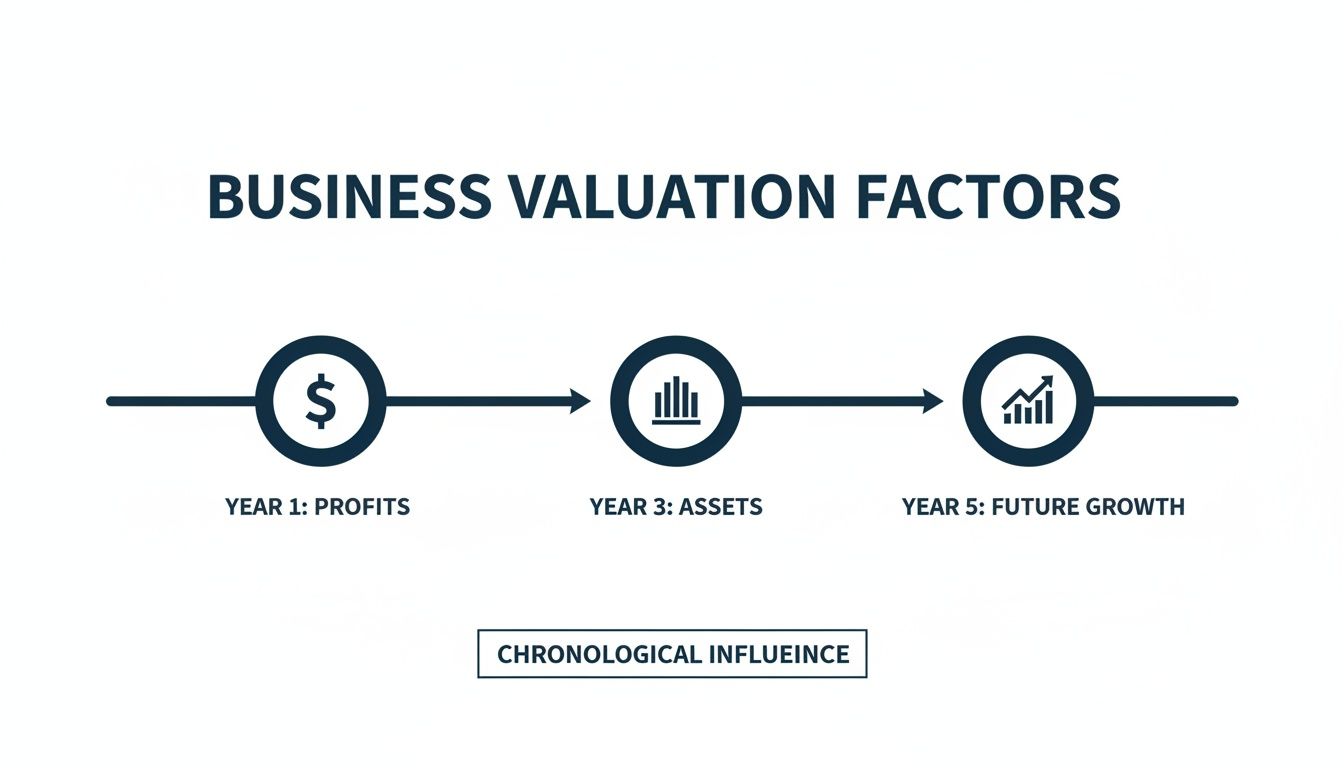
As you can see, a business's value is built on its past profits, its current assets, and its ability to grow in the future.
Once you have a valuation, your lawyer can start writing up the legal documents. This is when your succession plan turns from an idea into a real, legal agreement. To help you get started, you can look at a guide like this Texas Business Succession Plan Template.
It’s a strange fact, but while 76% of business owners are focused on growing their sales, only 34% are focused on planning for who will be the next CEO. In the U.S., two-thirds of small businesses don't have a written plan, which is a big reason why so many fail when it's time to sell.
By following these steps over a few years, you turn a scary task into a smart plan—one that protects your hard work, secures your future, and gets you the best possible price for everything you've built.
Common Mistakes That Can Derail a Business Succession
Even the smartest owners can make mistakes when it comes to succession. It’s a process full of financial and emotional traps. The best thing you can do is learn from the mistakes other people have made, so your own handover can be as smooth as possible.
Think of this as getting some advice from a friend who’s been there. These aren't complicated business errors; they’re simple missteps that can cause big problems. Getting these right is key.
Starting Way, Way Too Late
The biggest mistake I see, by far, is putting it off. Most owners think of succession as something that happens on their last day of work. The truth is, it’s a process that should start five to ten years before you plan to leave.
If you wait until you’re tired and burned out, you’ll be in a tough spot. You’ll have to make quick decisions, you won’t have time to clean up your finances, and you won’t be able to train the next person properly. This almost always leads to a lower sale price and a lot of stress.
A succession plan isn't a to-do list for your retirement party. It's a way to grow the value of your life's work, and you should start when you're still at your best.
Assuming the Kids Want the Keys
For a family business, the dream is often to pass it down to the kids. It’s a nice idea, but it can become a nightmare if you’ve never had a real, honest talk about it. Just assuming your children want to take over is a classic mistake.
They might have their own dreams, or they might feel trapped because they don’t want to disappoint you. A forced handover is a recipe for hurt feelings and business failure. The only way to avoid this is to talk about it openly, years before you need an answer.
Other Common Pitfalls to Sidestep
Besides those two big ones, a few other mistakes pop up all the time. Avoiding these will save you a lot of trouble.
- Forgetting About Uncle Sam: The taxes on selling or transferring a business can be huge. If you don’t get expert advice on how to structure the deal, you could end up with a massive tax bill that takes a big bite out of your retirement savings.
- Neglecting the Next Leader: You can't just throw the keys to someone and hope for the best. The next leader—whether it’s your kid or a top employee—needs years of training and mentoring to be ready for the job. If you don't prepare them for success, you're setting the business up to fail.
- Skipping a Professional Valuation: Guessing what your business is worth is a terrible idea. Because you’re emotionally attached, you’ll probably think it's worth more than it is. Or, you might not know the market and end up leaving money on the table. A formal valuation from an expert is a must. It gives you a realistic, fair number to work with.
Your Business Succession Questions Answered
When you start thinking about the future of your business, you'll have a lot of questions. It's a big topic. Let's go over a few of the most common ones we hear from business owners.
When Is the Right Time to Start Succession Planning?
Honestly? Right now. It might sound like a cheesy answer, but it's true. The best time to start seriously planning the succession of your business is at least 5 to 10 years before you think you'll want to leave.
This isn’t something you can figure out over a weekend. A good plan takes time. Starting early gives you plenty of time to get your finances in order, train the next person, and handle all the legal stuff without feeling rushed. It turns a stressful event into a smart, controlled part of your business journey.
What If My Kids Don't Want the Business?
This happens all the time, so don't worry. The most important thing is to have open, honest talks with your family early on, without any pressure.
If it turns out they have other plans, you have other great options. You could sell to your top managers who already know the business well. You could find an outside buyer who will respect what you've built. You could even sell the company to all of your employees. The goal is to find the right future for the company, not to force a future that doesn't fit.
Your succession plan has to be based on reality, not just on your hopes. Being honest about your family's interest is the first step to finding the best path forward for your company.
How Can I Increase My Business's Value Before Selling?
Start thinking like a buyer. What do they really want? A business that runs well and makes money, even when you’re not there. That means you need steady profits, clean financial records, and a strong team that can keep things going.
You don't have to fix everything at once. Start with small, important steps, like getting your bookkeeping organized and writing down how you do things. Every step you take to make your business more organized and efficient will also make it more profitable—and a lot more valuable to a buyer.
Figuring out your business succession is a journey. At MyOfficeOps, we help business owners in the Philadelphia area get their finances in order so they can get the most value for their business and prepare for a smooth handover. Schedule a discovery call with us today.