
Overhead allocation is the process of spreading indirect business costs, like rent, utilities, admin salaries, insurance, and software, across products, projects, or departments so owners can see true profitability. When overhead is handled well, it helps you stop guessing and start seeing which work pays.
You can be busy all month and still feel like the numbers don't add up. Revenue looks fine, the team is moving, jobs are getting delivered, but the bank balance and the profit report tell two different stories. That usually means some shared costs are sitting in the wrong place, or not being assigned at all.
The Real Reason Your Profit Numbers Feel Wrong
A lot of owners first notice the problem when one service line looks great on paper and another one seems to barely survive, even though both take similar effort. The issue is often not the work itself, it's the way shared costs get spread around. Rent, IT, admin time, insurance, and software don't belong to one client or one job, but they still need a home in the books.
Splitting a dinner bill illustrates this well. If three people order very different meals, splitting the check evenly feels simple, but it isn't fair. The person who had soup and water shouldn't cover the steak and wine, and a business faces the same problem when it spreads overhead without considering who used the resource.
Practical rule: direct costs go to the job that caused them, indirect costs need a reasonable method to be shared.
That's why overhead allocation exists in the first place. It gives managers a way to assign indirect costs to the products, services, projects, or departments that rely on them, so pricing and margin decisions aren't built on a half-picture. A standard managerial accounting reference notes that common allocation bases include units of output, machine-hours, and direct labor-hours (Lumen Learning).
For a business owner, the big takeaway is simple. If a project looks profitable before overhead and weak after overhead, the overhead method may be doing real work, or it may be hiding the truth. That's why people often end up comparing job profit reports with questions like why the business isn't making money.

If you want a quick outside comparison, how Estimatty helps price jobs shows the same idea from a job pricing angle, which can help when you're trying to decide whether your current pricing really covers the full cost of delivery.
How the Overhead Allocation Formula Actually Works
The basic formula is straightforward. Overhead Allocation Rate = Total Overhead Costs ÷ Total Allocation Base. The overhead gets gathered into a cost pool, then divided by a measurable base, also called a cost driver, and that rate is applied to each job or department based on how much of the base it used (Hyperbots).
Let's use a small consulting firm. Say its annual overhead is $120,000, and the total billable labor hours for the year are 6,000. Divide the overhead by the hours, and you get an overhead rate of $20 per hour. That means every billable hour needs to carry $20 of shared cost on top of the direct labor or contractor cost attached to the work.
A client project that used 150 hours would then absorb $3,000 of overhead. That doesn't mean the firm spent $3,000 in cash that week on that client. It means the project should carry its fair share of the shared support costs that made the work possible. Without that step, the project can look more profitable than it really is.
Why the rate gets set ahead of time
In standard cost systems, companies usually set a pre-determined overhead rate before the period begins, then apply it as work happens. That helps managers price jobs during the year instead of waiting for a clean-up exercise at the end. It also keeps the books from changing every time one bill arrives late.
A rate is only useful if the base reflects the work that actually consumes the overhead.
That's where the accounting language starts to matter. The cost pool is the bucket of indirect costs. The allocation base is the measuring stick. The rate is the bridge between them. Once you understand those three pieces, the math stops feeling mysterious.
If you want a broader bookkeeping explanation alongside this formula, how to calculate operating expenses gives a useful support reference for separating shared costs from the rest of the ledger.
Choosing the Right Allocation Base for Your Business
The hardest part of overhead allocation isn't the math. It's choosing a base that matches how your business uses shared resources. A labor-heavy business and a space-heavy business don't need the same driver, and the wrong choice can tilt profitability toward the wrong jobs.
Here's the plain version. If your staff time is the main thing driving overhead, labor hours may make sense. If the business relies more on equipment or production capacity, machine hours can fit better. If your support costs rise and fall with sales volume, revenue-based allocation can be useful, but it can also punish bigger jobs even when they don't use more support.
| Common Overhead Allocation Bases Compared | ||
|---|---|---|
| Allocation Base | Best For | Common Pitfall |
| Direct labor hours | Service firms, consulting, trades, project work | Can overstate support cost for jobs that need little admin help |
| Machine hours | Equipment-heavy operations | Misses labor-heavy complexity |
| Percentage of revenue | Simple reporting across similar work | Higher-priced work can get overloaded even when it's not more expensive to support |
| Square footage | Offices, warehouses, shared facilities | Easy to use, but it only captures space, not service intensity |
| Headcount | Shared services with people-driven support | Ignores how much each person actually uses shared resources |
A contractor can see this problem fast. If overhead is allocated by labor hours, a job with more crew time gets more overhead. If the same contractor uses revenue, a fast, high-priced job can carry a much bigger share even if it used fewer support resources. Both methods can be legitimate, but they don't tell the same story.
Fairness test: the right base should track cause and effect closely enough that the result makes business sense when you explain it to someone outside accounting.
That's why defensibility matters. If your team can't explain why a certain base was chosen, it's probably being used because it was easy, not because it was accurate. For a job-costing lens on the same issue, what is job costing is a useful companion read.
When Simple Methods Fail and Activity-Based Costing Steps In
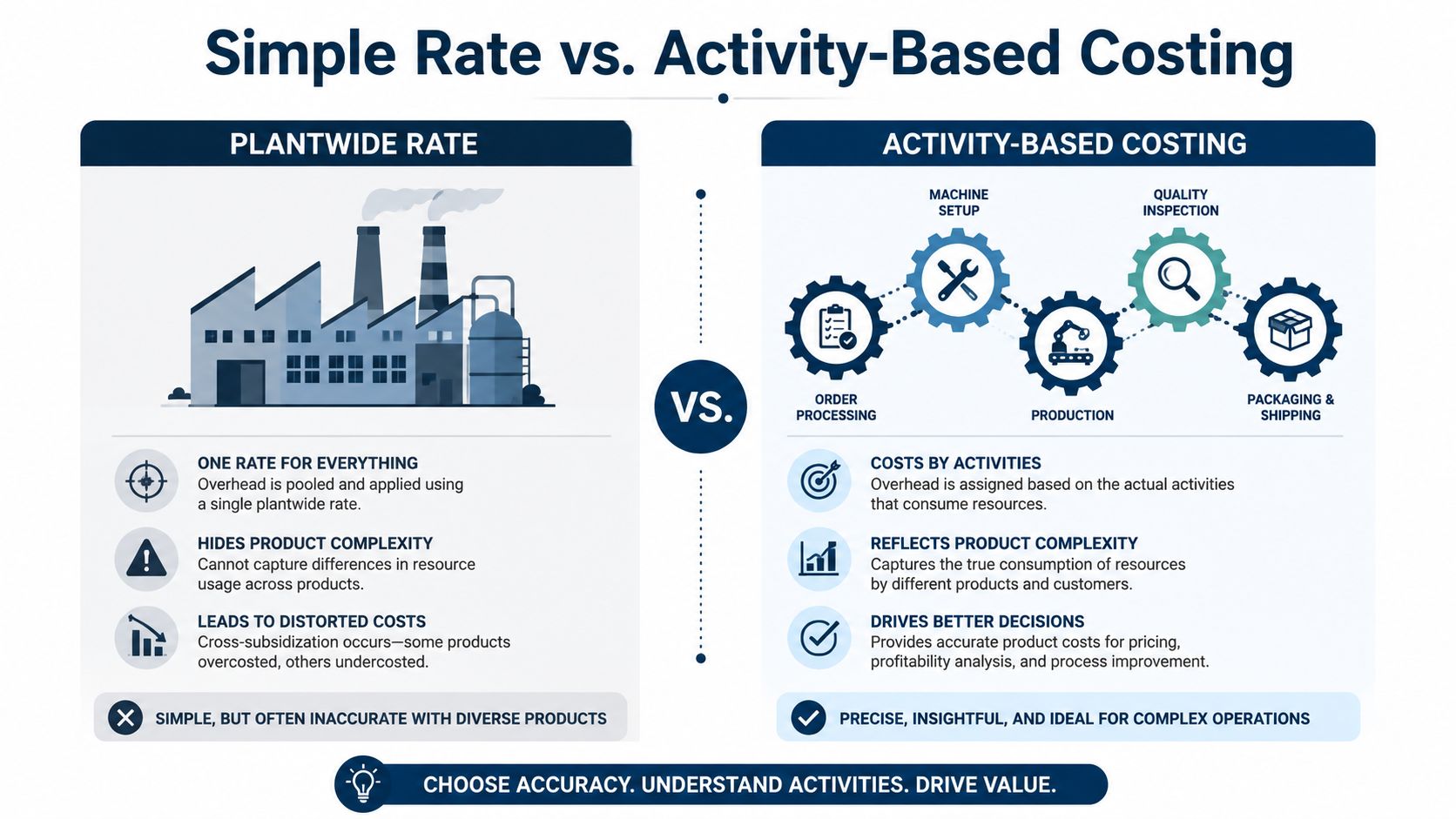
A single plantwide rate works fine when jobs are similar. It starts to break when one client needs lots of setup, another needs repeated inspections, and a third barely touches support. In those situations, averaging everything together makes simple work look expensive and complex work look cheaper than it really is.
That's where activity-based costing, or ABC, earns its keep. Instead of using one blunt driver for the whole business, ABC creates separate pools for the activities that create overhead. A quality-inspection pool can be divided by inspection events, onboarding can be divided by client starts, and IT support can be spread by helpdesk tickets or another practical activity measure.
A small example with separate cost pools
Say a firm tracks quality inspections, client onboarding, and IT support as separate pools. If the inspection pool is £180,000 and there are 3,000 inspections, the rate is £60 per inspection (One Tribe Advisory). That's a lot more useful than hiding those costs inside one blended overhead rate, because now a project that triggers many inspections carries more cost than a simple one.
The point isn't that ABC is always better. It's that it follows causality more closely when the business has very different kinds of work flowing through the same support system. A design agency, a law office, or a healthcare practice can all run into the same issue, even though none of them looks like a factory.
ABC is worth the effort when support costs follow different patterns across services, clients, or departments.
The scholarly review in the brief also notes that direct labor-based overhead allocation methods are the most common worldwide (UITM review), which explains why many businesses still default to simple labor logic. But common doesn't always mean accurate.
Costly Overhead Allocation Mistakes That Quietly Kill Margins
The most dangerous mistake is convenience. A company-wide rate feels neat, but it can hide the fact that different departments consume support in very different ways. If one team creates a lot of tickets, admin work, or review time, and another team doesn't, the same overhead rate can make the wrong work look profitable.
The errors owners keep repeating
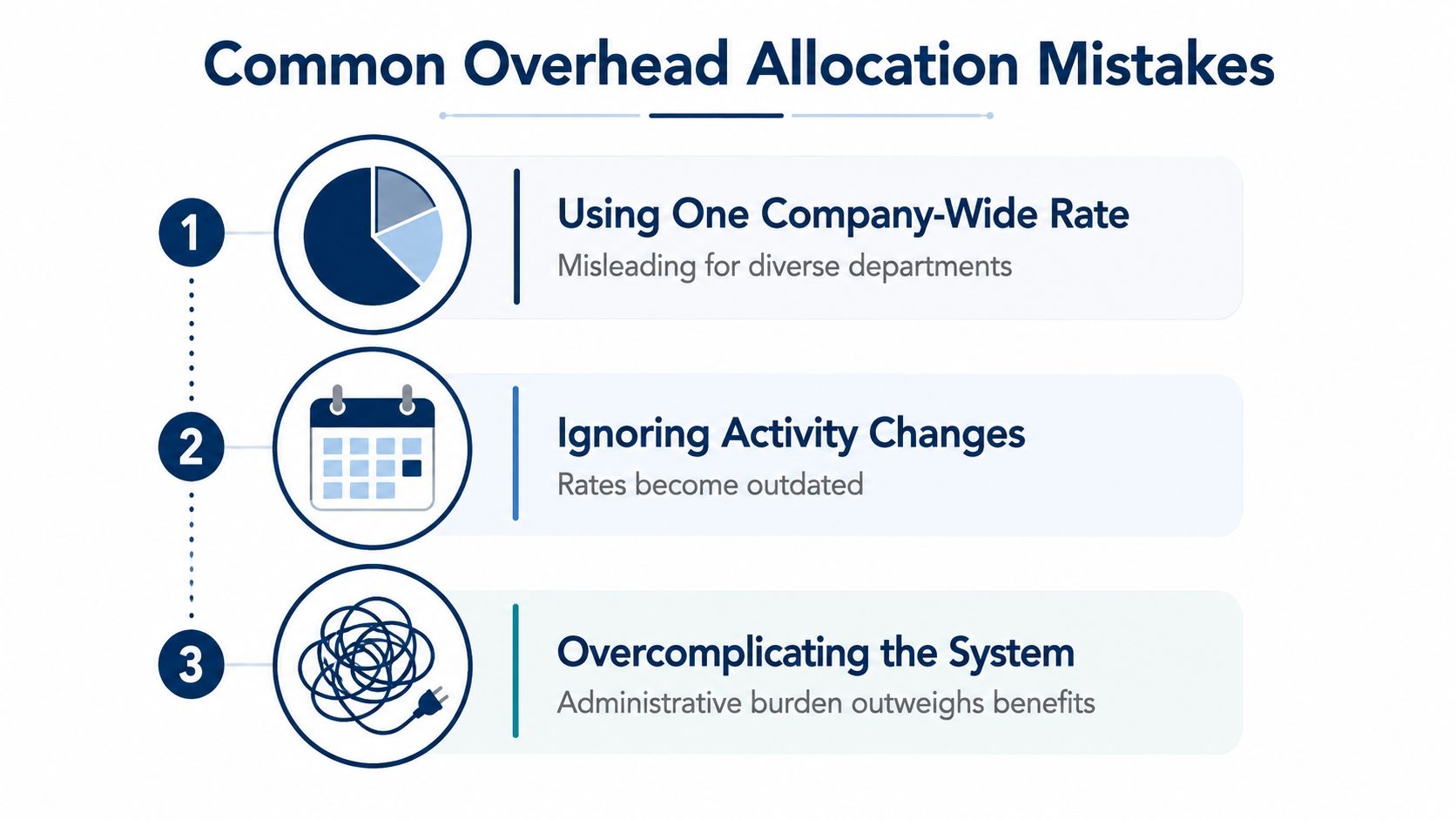
- Using one company-wide rate: This can flatten real differences between teams and create cross-subsidies, where one service line pays for another.
- Ignoring activity changes: When support work shifts, but the allocation base stays frozen, the rate gets stale and the reports drift away from reality.
- Treating overhead as an afterthought: If a new service is priced on direct labor alone, the owner can win the job and lose the margin.
A second mistake is using the easiest base instead of the most logical one. Headcount, revenue, and square footage are convenient because the data is easy to grab, but convenience doesn't prove fairness. If the allocation choice can't be explained in plain language, it probably won't hold up well in a pricing review.
The third trap is emotional. Some owners treat allocation like a bookkeeping chore, something to tidy up for the accountant. That mindset misses the primary use of the data. Overhead allocation should help you decide what to charge, where to hire, and which work to stop chasing.
A good check is simple. If the method makes a project look wildly better or worse than the people doing the work expect, don't ignore that. Ask what the allocation base is really measuring, and whether it still matches the business you run today.
Modern Overhead Challenges for Service and Project-Based Firms
A lot of older overhead advice still sounds like it was written for a factory floor. That misses how many SMBs operate now. For service firms and project-based businesses, shared costs often sit in software subscriptions, cloud tools, remote collaboration systems, IT support, payroll, and admin coordination, not just rent and utilities.
That changes the allocation question. A marketing agency, law firm, engineering practice, or construction contractor may not be dealing with machines, but it still has support work that needs to be spread fairly. The challenge is choosing a base that reflects the way those costs are really consumed, whether that's labor hours, client count, project count, or something else that fits the business.
A simple way to think about modern support costs
If the team uses more software and admin support when a project gets more complex, a pure revenue-based method can miss the point. If the project creates more back-and-forth, more onboarding, or more review time, labor-based or activity-based methods may tell the story better. That's the kind of mismatch that shows up when people ask why one client seems to “eat” the margin on paper.
A recent business-trends study in the brief says firms are still reworking how they manage indirect work through technology and automation, which fits what many owners already feel in real life. Support costs don't look the same as they did a decade ago, so the allocation model shouldn't either.
For project-based businesses, the practical move is to review the overhead categories and ask a simple question about each one. What drives this cost, and what's the cleanest way to trace it without turning the system into a mess? That question matters more than trying to force every business into the same accounting template.
Getting Expert Help to Fix Your Allocation and Reporting
A lot of owners can handle bookkeeping. Fewer want to build and maintain a clean overhead model on top of everything else they already do. Once the business has several service lines, projects, or departments, the job is not just recording expenses, it's turning those expenses into useful profit data.
That's where outside help makes sense. A good advisory partner can separate direct and indirect costs, set up allocation logic that fits the business, and turn the result into reports that a non-accountant can read. MyOfficeOps does this through bookkeeping, payroll integration, financial analytics, and CFO-level advisory, which can be useful when you need allocation to feed pricing, hiring, and cash-flow decisions instead of just closing the books.
If financing is part of the bigger picture, especially for growth or restructuring, it also helps to understand your capital options alongside your cost model. Best SBA financing options in LA is one example of the kind of resource owners sometimes review while they're cleaning up the financial side of the business.
What a practical engagement usually looks like
A clean advisory process usually starts with discovery, then a custom plan, then onboarding, then ongoing review. That's the point where overhead allocation stops being a spreadsheet problem and starts becoming part of a management system. The core value is in having someone keep the method current as the business changes.
**Good reporting should make pricing decisions easier, not harder.
If you're trying to decide whether your current overhead model still fits, that's a signal to get help before the numbers push you into the wrong decisions. Clean allocation doesn't just improve reports. It supports valuation, exit planning, and day-to-day confidence in what each part of the business is really earning.
If you want clearer job costing, cleaner overhead allocation, and reports that make sense without the accounting jargon, MyOfficeOps can help you build that system. Visit MyOfficeOps to talk through your books, your pricing, and the overhead questions that are making your profit numbers hard to trust.