When you get your West Chester PA real estate taxes bill, it’s not just one big number. It’s easy to look at that total and get a little sticker shock, but what you’re really seeing is three separate bills rolled into one.
Each slice of that pie pays for the services that make West Chester a great place to live and work. Let's break down exactly what you're paying for.
What Your West Chester Real Estate Taxes Actually Pay For
If you own property in West Chester, you know that tax bill is a big expense. But have you ever wondered where the money really goes? Think of it less like one big tax and more like a receipt for the community services you and your neighbors use every day.
Each part of your payment is collected by a different group, or "taxing authority," and is set aside for specific things. Getting a handle on these three parts is the first step to understanding your bill.
The Three Parts of Your Tax Bill
Your total real estate tax is a mix of separate taxes from three groups. Each one sets its own budget and tax rate to cover its costs.
Here’s a quick look at who taxes your property and what your money supports.
West Chester Real Estate Tax Breakdown (2026 Example)
| Taxing Authority | What It Funds | Example Millage Rate (2026) |
|---|---|---|
| Chester County | County services like courts, public health, county parks, and road repairs. | 4.551 mills |
| West Chester Borough | Day-to-day town operations, including local police, fire, trash/recycling, and snow plowing. | 8.120 mills |
| West Chester Area School District (WCASD) | Everything for public schools—teacher salaries, keeping buildings in shape, and student programs. This is the biggest part of your bill. | 24.846 mills |
As you can see, your single tax payment gets split up to cover everything from the county courthouse to your local school and police force.
Understanding the Millage Rate
So, how do these three groups decide how much to charge? They use something called a millage rate. It sounds complicated, but it's actually pretty simple.
Think of it this way: one "mill" is equal to $1 of tax for every $1,000 of your property's official value.
For example, if the school district sets its rate at 25 mills, you'll pay $25 for every $1,000 of your home's official value toward schools. The county and the borough each set their own millage rates, too.
Your final tax bill comes from adding all three rates together and applying that total to your property's value. For a deeper look at what's happening in the local market, it's worth checking out Chester County's latest real estate report.
These rates are set every year based on what each group needs for its budget. If the school district needs to hire more teachers or the borough plans to repave more roads, their millage rates might go up. This is why your tax bill can change from year to year, even if your property's value stays the same. We'll get into the exact math next.
How to Calculate Your Property Tax Bill
Alright, time for a little math. Don’t worry—this is way simpler than it sounds. Figuring out your West Chester PA real estate taxes only requires two numbers: your property’s official value and the total tax rate.
Once you have those two pieces of information, you can figure out your bill and see exactly how that final number comes together.
First, Let's Talk About Assessed Value
The first number you need is your property’s assessed value. To be clear: this is not what Zillow says your house is worth. The assessed value is an official number set by the Chester County Assessment Office just for taxes.
Think of it as the county’s official estimate of your property's worth. They base it on things like its size, age, location, and what similar homes nearby have sold for. This number is usually a percentage of the market value, not the full price.
You can find your property's current assessed value on your latest tax bill or by looking up your address on the Chester County property records website. This number is the foundation for your whole tax bill.
The Simple Tax Calculation Formula
Now that you have your assessed value, you just need the other piece of the puzzle: the total millage rate. As we covered, this is the combined rate from the county, the borough, and the school district.
Here’s the formula:
(Assessed Value ÷ 1,000) × Total Millage Rate = Your Annual Tax Bill
That’s it! You divide the assessed value by 1,000 because a "mill" is one dollar of tax for every $1,000 of value.
Let’s try this with a couple of real-world examples to see how it works.
Example 1: A Family Home in the Borough
Let's imagine a single-family home on a quiet street in West Chester. The county figures its market value is around $500,000.
- Assessed Value: For tax purposes, let's say the county sets the assessed value at $250,000.
- Total Millage Rate: Using the rates we talked about earlier (4.551 + 8.120 + 24.846), the total is 37.517 mills.
Now, let's plug those numbers into our formula:
- Divide Assessed Value by 1,000:
$250,000 ÷ 1,000 = 250 - Multiply by the Total Millage Rate:
250 × 37.517 = $9,379.25
The total annual property tax for this home would be about $9,379. This single amount covers everything from police to public schools for the whole year.
Example 2: A Small Shop Downtown
Now, let's look at a commercial property, like a small shop on Gay Street. These properties are often valued differently, but the math is the same.
- Assessed Value: We'll say this storefront has an official assessed value of $400,000.
- Total Millage Rate: The rate applies to all properties in the borough, so it’s still 37.517 mills.
Let’s run the calculation one more time:
- Divide Assessed Value by 1,000:
$400,000 ÷ 1,000 = 400 - Multiply by the Total Millage Rate:
400 × 37.517 = $15,006.80
The annual tax bill for this shop comes out to just over $15,007. As you can see, even with the same millage rate, a higher assessed value means a higher tax bill. This is why a property's assessment is so important.
By following these simple steps, you can read your tax bill and know exactly how the numbers add up. It gives you a clear picture of what you owe as a property owner in West Chester.
Important Tax Deadlines and Payment Options
Missing a tax deadline is an easy way to waste money on penalties. So let's get your calendar straight.
When it comes to your West Chester PA real estate taxes, you’re not dealing with just one bill. You have two to track, and they show up at different times of the year.
Your first bill for the county and borough taxes arrives together around mid-February. Then, later in the summer, you’ll get a second bill just for the school district. If you're a business owner, managing cash flow for these two big payments is key.
Your Annual Tax Payment Calendar
Think of your tax year in two parts: a spring payment for the county/borough and a summer/fall payment for the school district. Each has its own deadlines you need to know.
The most important date for each bill is the discount deadline. If you pay before this date, you get a 2% discount. For my clients with business properties, that’s free money you can put right back into the business.
County & Borough Tax Bill (Arrives in February):
- Discount Period: Pay by April 30th to get a 2% discount.
- Face Value Period: Pay the normal amount between May 1st and June 30th.
- Penalty Period: After June 30th, a 10% penalty is added.
School District Tax Bill (Arrives in July):
- Discount Period: Pay by August 31st to get your 2% discount.
- Face Value Period: Pay the normal amount between September 1st and October 31st.
- Penalty Period: A 10% penalty gets added after October 31st.
Paying both bills during their discount periods is the simplest way to lower what you owe. For a business, this could mean hundreds or even thousands of dollars back in your pocket.
How You Can Pay Your Tax Bill
Once you have your bill, paying it is pretty simple. Just remember that the Borough of West Chester collects for its own tax and the county tax, while the school district collects its own tax separately.
For the County and Borough Tax Bill:
- Pay Online: You can use a credit card or e-check through the borough's official payment website. Just know there’s usually a small fee.
- Pay by Mail: Send a check to the address listed on your tax bill. Always make sure it's postmarked by the due date to avoid penalties.
- Pay in Person: You can always go to the West Chester Borough Hall and pay your bill directly.
For a business owner, juggling these dates and payments on top of everything else can be a headache. The key is planning ahead. You might find our guide on how to prepare for tax season helpful for getting your entire financial year in order.
Staying on top of these deadlines is a simple strategy. It keeps you penalty-free and even puts a little cash back in your business just for paying on time.
Practical Ways to Lower Your Property Tax Bill
Getting that tax bill in the mail can be a tough pill to swallow. Most of us just sigh and write the check, thinking the number is set in stone. But it doesn't have to be.
There are real ways to lower your West Chester PA real estate taxes. These aren't secret loopholes; they are programs designed to help property owners. You just have to know about them and how to use them.
For homeowners, the biggest win is usually the Homestead Exemption. For business owners, it’s all about making sure your property's value is fair. Let's look at where you can find these savings.
The Homestead Exemption for Homeowners
If you own the home you live in, the first thing you should check is your Homestead Exemption status. Think of it as a special discount for your main home. When you sign up, the school district doesn’t tax the full value of your home—they subtract a certain amount before they do the math.
This directly lowers your school taxes, which are the biggest piece of your bill. For example, if your home’s assessed value is $250,000 and the homestead exclusion is $20,000, you’re only taxed on a value of $230,000. It's that simple.
Applying for the Homestead Exemption is a one-time thing that saves you money every single year you live in your home. It’s basically free money, but you have to apply to get it.
So, how do you get it?
- Eligibility: It’s simple. You have to own and live in the property as your main, permanent home. This means no rental properties or vacation homes.
- Application: You’ll need to file an application with the Chester County Assessment Office. Usually, this form is mailed to you right after you buy your home.
- Deadline: The deadline to apply is typically March 1st for the discount to apply to the next school tax year. If you’ve been in your house for years and just realized you never applied, do it now!
Other Relief Programs You Should Know About
The Homestead Exemption is the big one, but don't stop there. Pennsylvania has other tax relief programs to help people who are most affected by property taxes.
- Senior Citizen Tax Relief: If you're over 65 and your income is below a certain amount, you could get a rebate through the state's Property Tax/Rent Rebate Program. This can put real money back in your pocket.
- Veterans with Disabilities: Veterans with a 100% service-connected disability may not have to pay any property taxes on their main home. This is a huge benefit that many veterans don't know about.
- Disabled Individuals: The state also provides tax relief for Pennsylvanians with disabilities who meet certain income limits.
Each of these programs has its own rules and needs a separate application. It’s worth a few minutes of your time to see if you qualify.
Opportunities for Business Property Owners
If you're a business owner, your strategy for lowering property taxes is a bit different. Your commercial property can't get the Homestead Exemption, but your biggest opportunity is making sure its assessed value is fair.
An unfairly high assessment means you're overpaying every year, and that money comes directly out of your profits.
The key is to regularly check your property's assessment. Have similar commercial properties in West Chester sold for less than your assessment says your property is worth? That could be a reason to appeal. A successful appeal can save you thousands of dollars a year.
Of course, property taxes are just one part of a business's finances. Smart business owners are always looking for ways to reduce their overall tax burden. If that's you, check out our guide on the top small business tax deductions you might be missing.
A Step-by-Step Guide to Appealing Your Assessment
Do you ever look at your tax bill and think, "My property is not worth that much"? That number isn't final. You have the right to challenge the county's valuation in a process called an assessment appeal.
Filing an appeal can feel like a big deal, but it’s a right every property owner has. For a business, a successful appeal on a commercial property can free up thousands of dollars. Let's walk through the process, step by step.
This visual guide can help you decide on your first move.
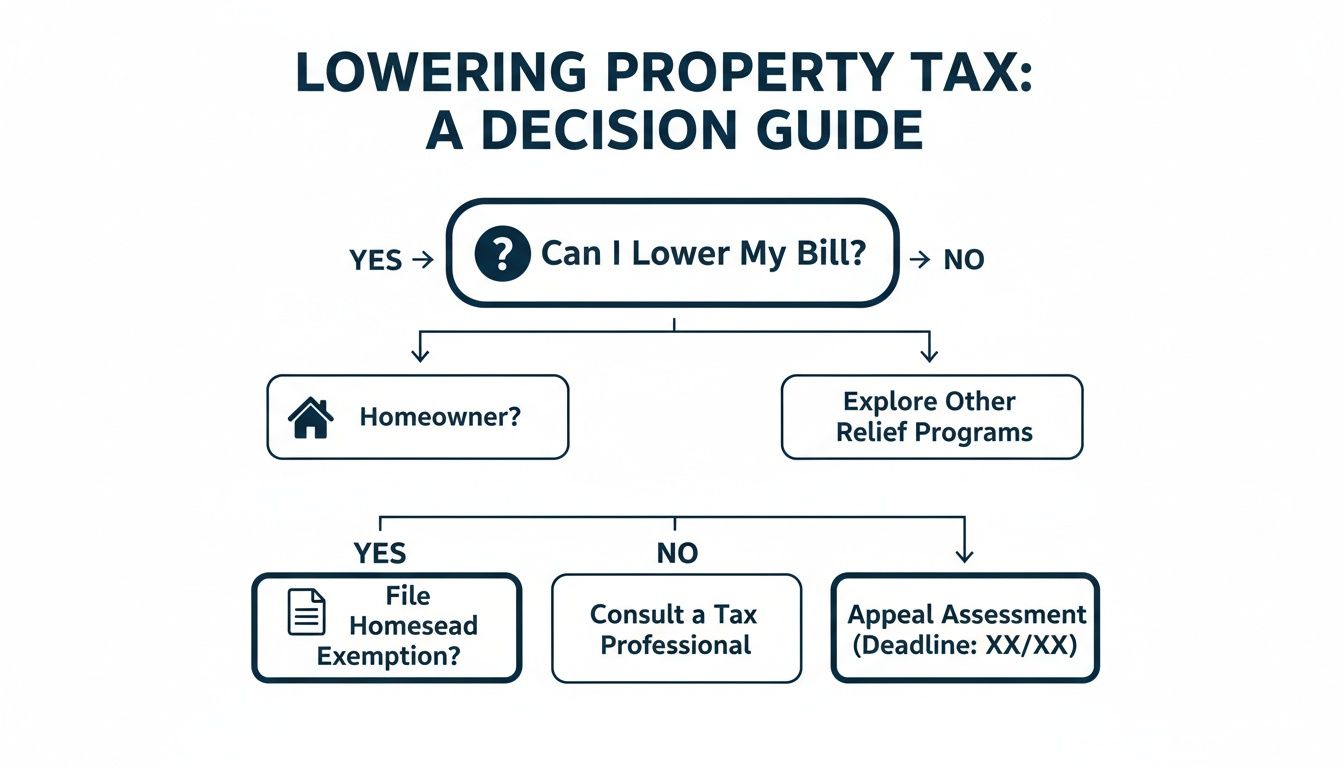
As you can see, exemptions are a good first step for homeowners, but any property owner who thinks their valuation is too high should think about an appeal.
Step 1: Know Your Deadline
The first—and most important—step is knowing your deadline. In Chester County, the annual deadline to file a property tax appeal is August 1st. Miss that date, and you have to wait a whole year to try again.
Don't wait until the last week of July to start. It takes time to gather your evidence, so it's smart to begin as soon as you feel your assessment is unfair.
Step 2: Gather Your Evidence
You can’t win an appeal just by saying your taxes are too high. You need to prove that your property's assessed value is wrong. This means bringing facts to the table.
Here’s what counts as good evidence:
- Comparable Sales ("Comps"): Find 3-5 similar properties in your area that recently sold for less than your property's official market value. Look for places with similar size, age, and features.
- A Private Appraisal: Hiring a licensed appraiser to give a professional valuation is one of the strongest pieces of evidence you can have. It helps to understand what's in a property appraisal report.
- Property Issues: Write down any big problems that lower your property's value. This could be a leaky roof, foundation damage, or even something you didn't think of, like a shared driveway. Photos are your best friend here.
Step 3: Complete and File the Appeal Form
Once you have your evidence organized, it’s time to fill out the official "Assessment Appeal Form" from the Chester County Board of Assessment Appeals. You can find this on the county’s website.
The form is simple, asking for basic information about you and your property. You'll also need to state what you believe your property's value should be and attach copies of your evidence. Make sure you fill it out completely.
Step 4: Attend Your Hearing
After you file, you'll get a notice for a hearing. This is your chance to present your case to the Board of Assessment Appeals. Don't be nervous—it's a professional meeting, but not too formal.
The key is to be organized. Calmly present your evidence—the comparable sales, the appraisal, the photos of property damage. Explain why you believe the county's valuation is too high and your proposed value is more accurate.
Many homeowners can handle an appeal on their own. However, if you own a commercial property or have a complex case, hiring a lawyer who specializes in tax appeals can be a very smart move. They know the process and can handle the hearing for you.
An appeal is even more critical when you consider that West Chester has a median effective property tax rate of 2.87%—nearly three times the national average. For the average homeowner, that means paying over $5,390 a year, which is almost $3,000 more than the national average.
Successfully appealing your assessment requires good paperwork and a clear argument. For business owners, tracking these details is just one small part of managing your money. For a broader view, you might want to explore our advice on how to track all your business expenses well.
Common Questions About West Chester Real Estate Taxes
Let's be honest, no one loves getting their real estate tax bill. And in West Chester, it can feel complicated. When the numbers seem high and the rules are confusing, it’s normal to have questions.
I get asked about West Chester property taxes all the time. Here are the most common questions I hear, with simple answers to help you make sense of it all.
Why Are My Real Estate Taxes in West Chester So High?
It’s the question I hear from almost every property owner: "Why are my taxes so high?" The sticker shock is real. The answer is a mix of high property values and the great services those taxes pay for.
First, West Chester is a popular place to live, which makes property values high. Since your tax bill starts with your property's value, a higher value means a higher bill from the start.
Second, your tax dollars are split between three groups, each providing some of the best services in Pennsylvania. You’re paying for:
- The West Chester Area School District, one of the best in the state, which is a huge reason families move here.
- West Chester Borough services, covering everything from police and fire to trash pickup and clearing snow.
- Chester County programs, which include the court system, public health, and the beautiful county parks we all use.
When you add up the tax rates needed to keep all three of these running well, you get one of the higher tax bills in the state. You’re paying for great services in a great location.
I Rent My Office Space. Do Property Taxes Affect My Business?
Yes, absolutely. This is a blind spot for many business owners who lease. Just because you don't get a tax bill doesn't mean you aren't paying it. Your landlord’s property tax costs are almost always passed on to you.
Most commercial leases are what’s called a “triple net” or NNN lease. Think of it like this: your base rent has three extra costs added on.
- N (Taxes): Your share of the building's property tax bill.
- N (Insurance): Your share of the building's insurance.
- N (Maintenance): Your part of the common area upkeep costs.
This means that when the landlord's tax bill goes up, your monthly rent almost certainly will, too. The property owner isn’t going to absorb that cost—it’s an expense that gets passed right to you.
That's why every business owner, renter or owner, needs to keep an eye on local property taxes. It’s a big part of your overhead that affects your profit.
My Tax Bill Went Up This Year. Why?
It's frustrating to open that bill and see a bigger number. It almost always happens for one of two reasons.
The first reason is a millage rate increase. The school district, the borough, or the county simply needed more money for its budget and voted to raise its tax rate. Your property's value could stay the same, but a higher rate means a higher bill.
The second reason is an increase in your property's assessed value. While the county doesn't reassess every property every year, certain things can cause a new valuation. This often happens after you’ve done a big renovation, or if the county reassesses your neighborhood because homes are selling for much higher prices.
To figure out which it is, pull out last year’s bill and compare it to the new one. Did the millage rates change? Did the assessed value go up? Knowing "why" is the first step to deciding what to do.
When Should I Get Professional Help with My Property Taxes?
Many homeowners can handle their property taxes just fine. But there are times when trying to do it yourself is a mistake. It’s about knowing when the situation is too complex—or the money at stake is too high.
I always tell my clients to get professional help if:
- You're a business owner with commercial property. The finances are more complex, the numbers are bigger, and a successful tax appeal can save you thousands a year. A financial advisor can also help you budget for these big expenses.
- You're planning a complex appeal. If you have strong evidence that your property is over-assessed, you need a lawyer who specializes in property tax law. They know how to build a case that wins.
- You just feel overwhelmed. If you're looking at the forms and the numbers and your head is spinning, that's your sign. A small investment in expert advice can save you a lot of money and stress.
When the financial risk feels high or the process looks confusing, bringing in an expert isn’t an expense—it’s a smart investment.
For business owners in West Chester, managing property tax is just one piece of the puzzle. If you’re juggling tax deadlines, tracking expenses, and trying to make sense of your cash flow, you don’t have to do it alone. MyOfficeOps provides expert bookkeeping and CFO-level advice to help you get financial clarity and focus on what you do best—growing your business. Let's talk about your financial goals. Find out more at https://myofficeops.com.