
Ever feel like your agency's finances are a special kind of complicated? You're not wrong.
Bookkeeping for a marketing agency isn't like for a regular business. A coffee shop sells coffee and records a sale. Simple. But you're juggling client ad budgets, monthly payments, one-off projects, and a dozen software bills. It's a unique financial puzzle.
Getting this right is super important for your agency to grow and stay healthy.
Why Agency Bookkeeping Is So Different
It’s easy to look at your bank account and think you're doing great. I once worked with an agency that almost went out of business because of this. They were counting a huge client ad budget as their own money.
On paper, they looked rich. In reality, that money was just passing through their account on its way to Google Ads and Facebook. This mistake created a huge cash flow problem that nearly shut them down for good.
The Unique Money Traps for Agencies
This isn't a rare story. The marketing world is growing fast. The number of agencies in the United States hit 7,761 back in 2022—a 17.4% jump from the year before. While this is great, it also means more competition and less room for error.
Most agencies only keep between 6% and 12% of their revenue as profit. That's a thin slice, so you can't afford to make financial mistakes.
Let's look at why your books are different from a normal business.
Agency Money vs. Normal Business Money
| Money Area | Normal Business | Marketing Agency Problem |
|---|---|---|
| Income | Sells a product, records the sale. | Money comes from retainers, projects, and fees, making it tricky to track when you've "earned" it. |
| Costs | Pays for items to sell, rent, and staff. | Manages "pass-through" costs like ad spend, which aren't really your expenses. |
| Billing | Simple, one-time bills or monthly invoices. | A mix of regular and one-time payments makes cash flow feel like a rollercoaster. |
| Profit | Profit = Sales – Costs. | Must figure out profit for each client, project, and even each employee. |
As you can see, the usual rules don't quite fit. This is why you need a special way of doing your books. Here are the key tricky spots:
Pass-Through Costs: This is the big one. Money you spend for a client—like on ad campaigns—is not your money. If you count it as your income, your numbers will be wrong and you'll make bad decisions.
Revenue Recognition: Let's say a client pays you $5,000 in January for work you'll do over the next three months. Is that $5,000 of income for January? Nope. You have to count the money as you do the work. This is called deferred revenue. Our guide on what deferred revenue is explains this more.
Project vs. Retainer Billing: Juggling one-time project payments with steady monthly retainers makes your cash flow uneven. One month you feel rich, the next you're worried about paying your team.
Client Profitability: Are all your clients actually making you money? Without tracking the time and costs for each client, it's impossible to know. You could be losing money on your biggest client and not even know it.
The main problem is this: Standard bookkeeping doesn't understand how agencies work. A generic setup gives you a dangerously wrong picture of your financial health.
Getting your bookkeeping right isn't just about avoiding problems; it's about growing your business.
When your books are clean, you can make smart choices about pricing, hiring, and which clients to work with. It turns your finances from a headache into a helpful tool.
Alright, we’ve covered why agency bookkeeping is different. Now, let’s get into the practical steps to build a financial system that actually works for you.
The very first step—the foundation for everything—is your Chart of Accounts (COA). Think of it like the shelves you build to organize your finances. The standard COA that comes with your accounting software is like a one-size-fits-all t-shirt—it technically fits, but it's not made for you. It just dumps everything into messy piles.
Creating a Chart of Accounts That Works
A generic COA won't work because it wasn't made for the unique way an agency handles money. You need to customize it to track things properly. This means creating specific categories that show how you really make and spend money.
Here are the accounts I tell every agency owner they must have:
- Client Ad Spend: This is a big one. You need two accounts here: one for the money in from clients for their ad budget, and one for the money out that you pay to platforms like Google. This keeps their money separate from your money.
- Software Subscriptions: All those tools you use—your SEO platform, project management app, etc.—need their own category. Grouping them helps you see how much your tech tools are really costing you. It adds up fast.
- Freelancer & Contractor Costs: If you hire outside help, give them their own expense account. This is the only way to know what you're spending on contractors compared to your full-time staff.
- Deferred Revenue: This one is super important. It’s a liability account, which means it's money you owe (in this case, you owe work). When a client pays you upfront for three months, the cash goes here first. Each month, you move one-third of that money into your real income account as you "earn" it.
If you're new to this idea, our guide on what a Chart of Accounts is is a great place to start.
This flowchart shows why a simple approach doesn't work. You can see how money for ads, retainers, and projects flows through the business in completely different ways.
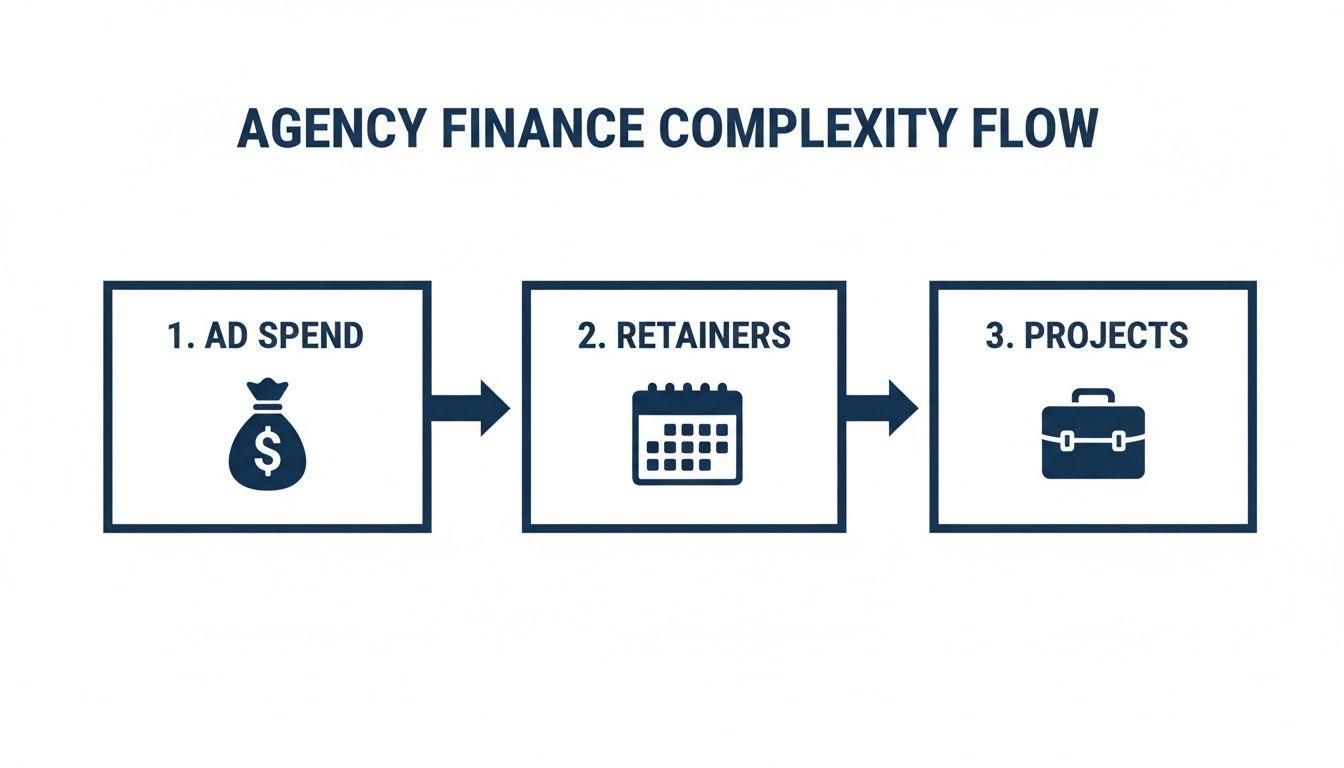
Trying to manage all this with a basic bookkeeping setup is like trying to direct traffic with a single stop sign. It's just a mess.
Handling Invoices and Getting Paid
With a good COA set up, the next step is managing how you get paid. Your invoicing needs to be consistent, whether you're billing for monthly retainers or one-time projects.
For retainers, send your invoices on the same day every month to create a predictable flow of cash. For projects, bill in stages to protect yourself. Asking for 50% upfront and 50% when you're done is a common practice for a reason—it makes sure you don't do all the work before you see any money.
A strong financial foundation also depends on good budgeting and forecasting. These aren't just boring spreadsheets; they're your map to help you plan ahead and avoid cash flow scares.
Pro Tip: I always tell agency owners to set up automatic recurring invoices for retainer clients. It’s a small change that saves a ton of time and makes it nearly impossible to forget to bill someone.
Tracking Profitability Per Client
This is where all your setup work pays off. With a proper COA and good tracking, you can finally answer the most important question: "Which clients are actually making me money?"
By linking every dollar of income and every direct cost to a specific client, you can run a profit and loss report for each client. This is where you really see what's going on.
Imagine you have two clients who both pay you $3,000 a month. They seem equal, right?
- Client A is easy to work with and has no ad spend. Your team spends a few hours a month on their account, and your profit is a healthy 85%.
- Client B needs a lot of attention, has extra software costs, and takes up a lot of your team's time. After all that, your profit is only 15%.
Without this tracking, you’d treat both clients the same. With this data, you now know you need to talk to Client B about raising their price or finding ways to work more efficiently. As client budgets grow—and with 83% of B2B marketers planning to increase them—this detailed bookkeeping is the key to scaling your agency without losing money.
Your Monthly and Quarterly Bookkeeping Routine
Good bookkeeping isn't a last-minute scramble before taxes are due. It's a simple, regular habit for your agency's finances. Doing it consistently is what stops small problems from becoming big ones and helps you make smart decisions with real numbers.
This isn't about adding more work to your plate. It's about building a solid financial habit. This habit prevents small money leaks from turning into big, stressful cash flow problems. A consistent routine gives you clarity, control, and peace.
The Monthly Close: Your Must-Do Financial Check-In
At the end of every month, you need to set aside a few hours to go through your finances. Think of it as a health check for your agency's money. It's your chance to make sure everything is correct before a new month starts. Trust me, it’s much easier to fix a small mistake from last week than to figure out a mystery from three months ago.
Your goal is simple: close the month's books knowing your numbers are 100% right.
Here’s what to do:
Reconcile everything. This is the most important part of good bookkeeping. Go through your bank and credit card statements line by line. Every transaction must match an entry in your books. This is the only way to be sure your records match what the bank says.
Categorize every expense. Every dollar you spend needs a home. Was that $150 charge for a new software tool, office supplies, or a client lunch? Getting this right is how you'll get a true picture of where your money is going.
Follow up on your money. Look at your accounts receivable report. Who has paid you? More importantly, who hasn't? Now is the time to follow up on every late invoice. To make billing and getting paid easier, you might use an online invoice system.
Manage your retainers. Did you get paid for work you haven't done yet? Make sure it's recorded correctly as a liability in your deferred revenue account. Then, you need to "earn" the portion of work you did this month by moving it from that liability account to your income account.
A clean monthly close is the foundation for trustworthy financial reports. It ensures any report you look at—like a Profit & Loss—is based on reality, not just a guess.
Your Quarterly Strategic Review
If the monthly routine is about keeping things neat, the quarterly review is about looking at the big picture. This is your chance to step back from the daily work and think about your agency's financial health and future. I always tell my clients to do this within two weeks after a quarter ends.
This is where you connect the numbers to your business goals. It's how you answer the big questions: Are we on the right path? What do we need to change?
Here’s what your quarterly check-in should cover:
Look at Your Financial Statements. Pull up your Profit & Loss (P&L) and Balance Sheet for the quarter. Is your income growing? Are your costs growing faster than your income? The best insights come from comparing this quarter to the last one and to the same quarter last year. That's how you spot trends.
Analyze Client Profitability. This is where you find the gold. Run your client profitability reports to see your most and least profitable clients from the last 90 days. This data tells you where to focus your team's energy and which clients might need a price change.
Plan for Taxes. Nobody likes a surprise tax bill. Talk to your accountant to guess how much tax you'll owe for the quarter. By setting aside the right amount of cash every three months, you'll be ready when it's time to pay taxes.
Adjust Your Budget and Forecast. How did you do compared to your budget? Use what you learned this quarter to update your financial plan for the rest of the year. This isn't about being strict; it's about being smart and making better spending choices.
Financial Reports and KPIs That Actually Matter

Your accounting software has a lot of reports. But here's a secret I've learned from working with agencies: most of that is just noise. To run your business well, you don't need more data—you need the right data, shown in a way that helps you make decisions.
Let's be honest, staring at a financial report can feel like trying to read another language. The trick is knowing which numbers tell the real story of your agency's health.
Think of it this way: your numbers should be a tool to help you plan, not just a record of the past. Let’s get you looking at them the right way.
Your Agency’s Financial “Big Three”
Every business owner should know their way around three main financial statements. For an agency owner, understanding what they tell you is key. Let's break them down in simple terms.
Profit & Loss (P&L) Statement: This is the report everyone knows. It shows the money that came in (revenue) and the money that went out (expenses) over a period, like a month or a quarter. For agencies, the important part is making sure client ad spend is kept separate from your real income.
Balance Sheet: If the P&L is a video of your finances over time, the Balance Sheet is a photo on a single day. It lists what you own (assets, like cash) and what you owe (liabilities, like credit card debt or deferred revenue). It’s the final check on your agency's long-term health.
Cash Flow Statement: This might be the most important report for an agency. The P&L can say you're profitable, but if clients haven't paid you yet, your cash flow statement will show the truth: you might be "profitable on paper" but still can't pay your bills. This report tracks the actual cash moving in and out of your business.
These three reports are your financial dashboard. You don’t need to be an accountant to read them, but you do need to look at them regularly. They are the only way to get a full, true picture of your agency's performance.
Agency-Specific KPIs You Must Track
The "Big Three" give you a high-level view, but to make smart decisions, you need to track numbers that are specific to the agency business. These are the numbers that help you run your business.
Gross Profit Margin by Client
I tell every agency owner: this is your most important number. It’s not about how much money a client pays you; it’s about how much of that money you actually keep after paying the direct costs to serve them (like salaries, freelancer fees, and software).
The math is simple:
(Client Revenue - Direct Costs) / Client Revenue = Gross Profit Margin
Knowing this number for every client changes everything. It quickly shows you who your best clients are and which ones are secretly draining your time and money, even if they pay a lot.
The Growth Metrics: CAC and LTV
Once you know your profitability, you need to understand the cost of your growth. Two numbers drive this: Customer Acquisition Cost (CAC) and Lifetime Value (LTV).
Customer Acquisition Cost (CAC): This tells you how much you spend, on average, to get one new client. Just add up all your sales and marketing costs in a period (like a quarter) and divide it by the number of new clients you got.
Lifetime Value (LTV): This number guesses the total profit you'll make from an average client over the entire time they work with you. It tells you what a client is really worth.
The magic happens when you look at these two together. A good rule of thumb is to aim for an LTV to CAC ratio of at least 3:1. This means for every dollar you spend to get a client, you should get at least three dollars back in profit over time. If your ratio is lower, you can't afford to keep growing that way.
These financial reports and KPIs are only getting more important. The use of automation in marketing is growing—in fact, trends for 2026 show that 92% of marketers are already using it to analyze data. This lets them focus on the numbers that really matter, like ROI (31% of marketers) and lead conversion rates (34%). To see more on where the industry is going, you can explore the latest marketing statistics from HubSpot.
Common Money Mistakes Agencies Make
I've heard these stories from agency owners so many times. Making money mistakes is part of the learning process. The trick is to learn from them fast and set up simple systems so they don't happen again.
Think of this as your guide to avoiding the most common and expensive errors. Knowing these traps ahead of time will save you a lot of stress and money.
Mixing Business and Personal Finances
This is the number one cause of financial mess for a growing agency. It’s so easy to pay for a business lunch with your personal card or use the company card for a personal purchase, telling yourself you’ll “sort it out later.”
But "later" rarely happens. This one habit makes your bookkeeping a complete mess. It becomes impossible to see your agency's true profit when your personal spending is mixed in. It also creates a big risk during tax time.
The Fix: Open a separate business bank account and get a business credit card. Be strict about it: 100% of business money must go through these accounts. No exceptions.
Losing Track of Reimbursable Expenses
Here’s a story I hear all the time. You pay for a client’s software or hire a freelancer for a project, planning to bill the client back for it. Then you get busy. You send the regular monthly invoice, and that extra cost is completely forgotten.
A $150 software fee here or a $500 freelancer bill there might not seem like a big deal. But these "forgotten" costs add up very quickly and eat into your profits. If you forget to bill back just $1,000 a month, you're giving away $12,000 every year.
Getting Revenue Recognition Wrong
This mistake is dangerous because it makes you feel richer than you are. Here's how it happens: a client pays you $15,000 on January 1st for a three-month project. You see the money in your bank and think, "Great, we had a $15,000 month!"
But you haven't earned that money yet. Proper agency bookkeeping means you only count revenue as you do the work. In this case, you should only count $5,000 in January, $5,000 in February, and $5,000 in March.
Counting the full payment as January income gives you a false sense of confidence. You might spend money based on that big number, only to have a cash shortage a few weeks later. This is exactly how agencies get into cash flow trouble, even when they have plenty of clients.
These mistakes are very common, but the good news is they're easy to fix once you know what to look for. Here’s a quick summary of these mistakes and how to fix them.
Common Agency Bookkeeping Mistakes and Their Fixes
| Common Mistake | Why It's a Problem | The Simple Fix |
|---|---|---|
| Mixing Business & Personal Funds | It creates wrong financial reports and big tax problems. You have no idea how your business is really doing. | Open a separate business bank account and credit card. Use them only for business—no exceptions. |
| "Forgetting" Reimbursable Expenses | You lose money and hurt your client profit margins. Small unbilled costs add up to big yearly losses. | Use your bookkeeping software to immediately mark any client-specific cost as billable. Run a report of unbilled costs before you send any client invoice. |
| Ignoring Revenue Recognition Rules | This makes your monthly income look bigger than it is, leading to bad cash flow decisions. You spend money you haven't truly earned yet. | Set up a "Deferred Revenue" liability account. When a client pays you upfront, put the cash there and only move it to "Income" as you do the work each month. |
The key is to build good habits around these things from the start. Clean, correct books aren't just for tax time—they're the best tool you have for making smart decisions about your agency's future.
When to Outsource Your Agency's Bookkeeping
Every agency owner reaches a point where they're stuck in a spreadsheet trying to figure out expenses from two months ago, while an important client proposal sits waiting.
That's the turning point. It’s when doing your own bookkeeping stops saving you money and starts costing you growth. The real cost isn't the software—it's the value of your time.
Think about it. If you can make $200 an hour working on client strategy, but you spend five hours a month on your books, you're not saving a few hundred dollars on a bookkeeper. You're losing $1,000 in potential income. That’s when it makes a lot more sense to hire someone.
Signs It's Time to Make the Switch
Handing over your finances can feel like a big step. You're used to doing everything yourself. But if you see these signs, it means your time is better spent elsewhere.
- You're Always Behind: Are your books always a month or two out of date? This means you're making important business decisions with old, wrong information.
- You Dread Tax Season: If thinking about taxes makes you panic, it’s a clear sign your daily systems are broken. A good bookkeeper keeps you ready for taxes all year long.
- You Can't Trust Your Numbers: You look at your P&L and just have a feeling that it’s not right. That's a huge problem. You need to have confidence in your financial data.
- You're Missing Growth Opportunities: Are you spending your nights categorizing expenses instead of planning a new service or talking to potential clients? Your focus is in the wrong place.
This change isn't just about getting rid of a task you don't like. It's about bringing in a pro who understands the agency world. It’s no surprise the bookkeeping services market is expected to grow by 9.8% each year through 2030, as more businesses look for expert help. You can read the full research on the bookkeeping services market to see the data behind this trend.
What to Look for in an Outsourced Partner
Hiring a bookkeeper isn't like hiring someone for data entry. You’re looking for a partner who will help you see your business more clearly and find new opportunities. The right partner should feel like part of your team.
A good outsourced bookkeeper doesn't just record what happened; they help you plan for the future. They turn your financial data into a map for better pricing, smarter hiring, and steady growth.
A partner like MyOfficeOps provides specialized bookkeeping for marketing agencies, giving you the insights to improve profit and freeing you up to do what you do best—run your agency.
If you want to learn more about this process, our guide to outsourced bookkeeping for small business is a great place to start. The goal is to trade the stress of managing your books for the clarity that comes from truly understanding them.
Common Questions from Agency Owners
When it comes to your agency's money, it's normal to have questions. You're not alone. Here are simple answers to some of the most common things we hear from founders like you.
What’s the Best Bookkeeping Software for a Marketing Agency?
For almost every marketing agency I've worked with, the answer is QuickBooks Online. It’s made to handle how agencies work—from monthly retainers to one-off projects—and lets you look at your numbers in different ways to see profit by client or by service.
Plus, it connects to almost every other tool you already use. The best part? Any bookkeeper who specializes in agencies knows QuickBooks Online inside and out, which makes your life much easier when you need help.
How Much Should Outsourced Agency Bookkeeping Cost?
This is a big question, and the honest answer is: it depends on your agency's size and how much help you need.
- The Basics: If you just need someone to organize your expenses and check your accounts each month, you're probably looking at a few hundred dollars a month.
- Full Service: For a team that manages your bills, runs payroll, and gives you monthly financial reports you can actually use, expect to pay somewhere between $500 to $1,500 per month.
More strategic advice will cost more, but the right partner isn't just a cost. They should help you make a profit by making smarter decisions that grow your business.
Think of it less as an expense and more as an investment in your agency's smarts. The right financial partner should help you make more money, not just count it. A great bookkeeper who understands agencies will almost always find savings or profit opportunities that more than cover their fee.
Can’t I Just Have My Office Manager Handle the Books?
I understand why this is tempting, but in my experience, it often leads to problems. Your office manager might be great at keeping the agency running, but they are not a trained accountant.
Agency finance has its own tricky rules, like how to handle money from retainers paid upfront or how to manage client ad spend. If you get these wrong, your financial reports become useless. That leads to bad decisions and a big, expensive mess to clean up later. A dedicated bookkeeper has the specific knowledge needed to make sure your numbers are right and tell you the true story of your business.
Are you tired of guessing if your numbers are right? The team at MyOfficeOps provides expert bookkeeping for marketing agencies just like yours, turning your financials into a clear roadmap for growth. Let's talk about your agency's finances.