
Outsourcing your bookkeeping is like hiring a pro to handle your business's money records. Instead of having an employee in your office, a remote expert takes care of the numbers. This frees you up to do what you do best—run your business.
It’s a popular choice for owners who want their finances managed well without the cost of hiring a full-time person.
What Is Outsourced Bookkeeping for a Small Business?
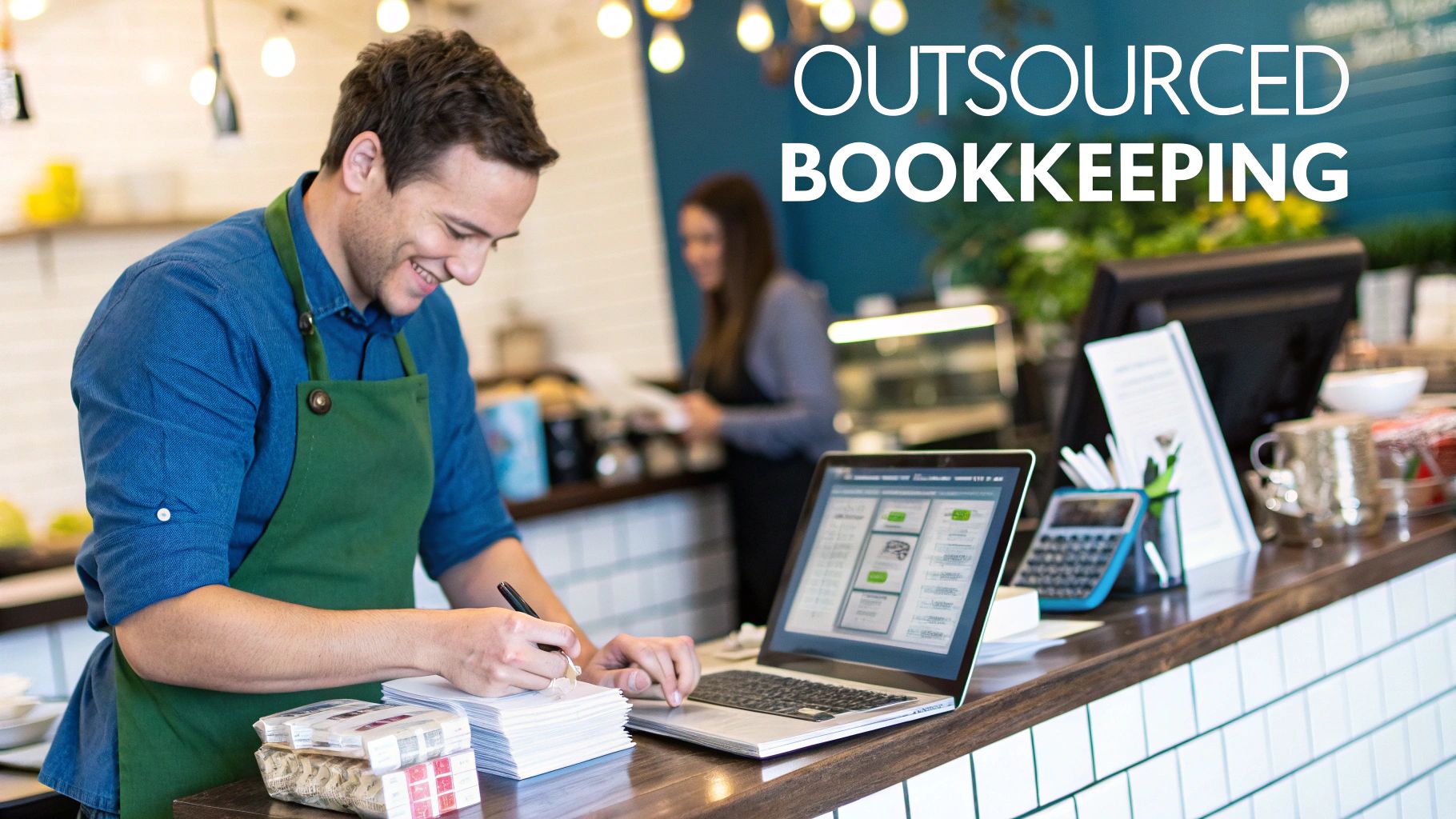
Imagine you own a busy coffee shop. You love making coffee and talking to customers, but you dread spending nights sorting through receipts. Outsourced bookkeeping is like having a money expert who takes all that paperwork off your hands, but works from their own office.
This expert isn't just someone you hire for tax season. They become part of your team, keeping your financial records clean and updated every month. This gives you a clear, real-time look at how your business is doing.
The Core Tasks an Outsourced Bookkeeper Handles
So, what do they actually do? Think of them as the financial organizer for your business. Their job is to make sure every dollar is tracked so you always know where your money is going.
Here’s what they usually handle:
- Tracking Sales and Deposits: Making sure all the money coming in is recorded.
- Managing Bills and Expenses: Paying your suppliers on time and logging every purchase, from coffee beans to your power bill.
- Reconciling Bank Accounts: Checking your bank statements against your records to make sure everything matches up and to catch any mistakes.
- Preparing Financial Reports: Creating simple reports, like a Profit & Loss statement, that show you if you're making or losing money.
This isn't a new trick; it’s a smart way to run a business. Over one-third of small businesses (37%) already outsource something, and accounting is often one of the first tasks they hand off. It helps them get expert help and can save them 20-30% compared to hiring someone in-house.
By handing over these tasks, you get more than just clean books. You get clarity. You can stop guessing and start making decisions based on real numbers.
Outsourced bookkeeping is about freeing you from the headache of managing money. If you're new to the numbers side of things, it helps to know the basics. Take a look at our guide on small business bookkeeping basics to get started. This service gives you the freedom to get back to growing your business.
The Real Benefits of Outsourcing Your Books
So, why let someone else handle your money stuff? Let's talk about the real wins. The most obvious one is getting your time back.
Think about all the hours you spend fighting with spreadsheets each month. That’s time you could use to talk with customers, create a new product, or just take a break for once.
But the perks go deeper than just freeing up your time. When you outsource, you're not just hiring someone to enter data. You're getting a team of pros with years of experience—the kind of expertise you probably couldn't afford to hire full-time.
Make Smarter Business Decisions
Clean, accurate books are like a map for your business. When your numbers are organized, you can stop guessing and start making smart moves with confidence.
You can finally answer big questions like:
- Is it time to expand? Your financial reports will show if you have the cash to handle it.
- Can I afford a new employee? Clear expense data will give you a straight answer.
- Which of my services makes the most money? A bookkeeper can help you see what’s really bringing in the cash.
This clarity turns your financial data from a headache into your best tool for making decisions. It gives you the control you need to guide your company in the right direction.
Turn Tax Season into a Breeze
For many business owners, tax season is a mad dash to find receipts in a shoebox and hope for the best. Outsourcing changes that completely.
With a bookkeeper managing your records all year, everything is already organized and ready. Tax time becomes a calm process of handing clean reports to your CPA. No more last-minute panic.
This organization also helps your business stay on the right side of the law, avoiding expensive fines for late or wrong filings.
Plus, a big benefit of using an outsourced service is that they can help you improve how you handle money. For instance, when you learn how to automate invoice processing, you get paid faster with a lot less work.
Think of a freelance designer I know who used to spend the start of every April completely stressed out. After outsourcing her books, she went from overwhelmed to feeling in control. She could focus on her creative work, knowing the money side of her business was in good hands. That’s the kind of peace of mind this service offers.
Hiring In-House vs. Outsourcing Your Bookkeeping
This is a big choice for any small business owner. Do you hire someone to work in your office, or do you team up with an outside company? There’s no single right answer, but looking at the pros and cons of each makes the choice a lot easier.
Let's break down what really separates keeping it in-house from choosing an outsourced partner.
Comparing In-House and Outsourced Bookkeeping
When you're looking at your options, it helps to see them side-by-side. This isn't just about money; it's about skills, flexibility, and where you want to spend your energy.
| Factor | In-House Bookkeeper | Outsourced Bookkeeping Service |
|---|---|---|
| Cost Structure | Full employee cost: salary, benefits, payroll tax, vacation time, equipment. | A set monthly fee. No extra costs. |
| Expertise | The skills of one person who knows your business well. | Access to a whole team's knowledge and experience. |
| Technology | You have to buy and manage the accounting software. | They use top software and security that you don't have to worry about. |
| Scalability | You have to hire and train more people to grow, which can be slow. | The service can easily grow with your business. |
| Control | You have direct, daily oversight. | Less direct control; you focus more on the results. |
| Continuity | If your employee quits or gets sick, the work stops. | The service never stops; the team provides constant coverage. |
Looking at this chart, you can see the trade-offs. In-house gives you direct control but costs more and relies on one person. Outsourcing is more flexible and brings more expertise for a set price, but you manage it differently.
The Cost Factor
The most obvious difference is the price. Hiring an employee isn't just their salary. You have to add payroll taxes, health insurance, paid time off, and the cost of a desk and computer. It adds up fast.
Outsourcing usually comes with a set monthly fee. You pay for the service you need without the extra costs of an employee. This makes budgeting much easier, especially for a small business where every dollar matters.
Expertise and Skills
When you hire one person, you get that person's skills. A good in-house bookkeeper will learn your business inside and out, which is great.
But an outsourced firm gives you a whole team. This means you get a wider range of know-how. If a tricky payroll question comes up, chances are someone on their team has dealt with it before.
You're not just hiring a person; you're tapping into a team's combined knowledge. This shared experience can help you avoid common mistakes and find better ways to manage your money.
For many owners, this simple decision tree helps make the choice clearer.
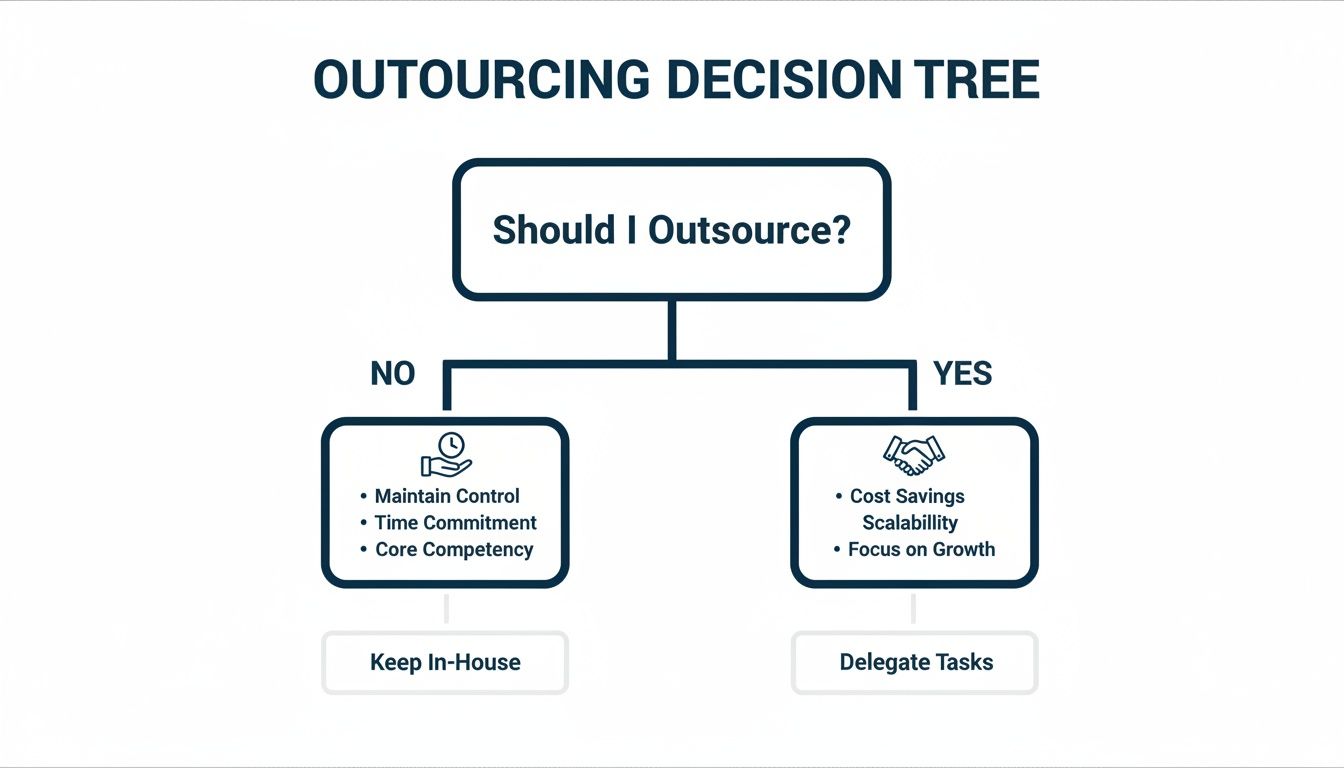
This visual helps you quickly see whether the direct control of an employee or the flexibility of a service is a better fit for you right now.
Control vs. Flexibility and Technology
Having someone in your office gives you direct control. You can walk over to their desk anytime to ask a question. For some business owners, that’s really important.
But outsourcing offers a different benefit: flexibility and better tools. Good firms use top-notch accounting software and security systems—tech that might be too expensive for a small business to buy. They handle all the software updates and data security for you.
This frees you from managing another piece of technology and keeps your financial information safe. In the end, the best choice depends on your business, your budget, and how you like to work.
So, What Does Outsourced Bookkeeping Actually Cost?
Let's get straight to it: how much will you pay? It's important to know the price to make a good decision. The good news is that most pricing is simple, so you can find a plan that fits your budget without surprise fees.
You’ll usually see one of three types of pricing. Many companies offer a flat monthly fee, which is great for budgeting. Others charge an hourly rate, which can work if your needs change month to month. Some also create custom packages based on what your business needs.
What Drives the Final Price Tag?
The cost isn't a random number. It’s tied to how much work your business's finances require. Think of it like mowing a lawn—a small, simple yard costs less than a huge one with gardens and a pool. The same idea applies to your books.
Here are the main things that affect your monthly cost:
- Transaction Volume: How many sales and purchases do you have each month? A busy online store with hundreds of daily sales will need more work than a consultant with just a few clients.
- Number of Accounts: The more bank accounts, credit cards, and payment systems (like Stripe or PayPal) you have, the more time it takes to check everything.
- Add-On Services: Do you just need the basics? Or do you also want help with payroll, paying bills, or planning your finances? Each extra service will add to the cost.
For many small businesses, this is a common and smart investment. In 2022, U.S. small businesses spent an average of $198,550 on outsourcing, and 83% planned to keep or increase that spending. You can explore more outsourcing statistics to see how big this trend is.
The real goal isn’t just to find the cheapest option. It’s about finding the best value—a service that saves you time, prevents costly mistakes, and gives you the financial clarity you need to grow.
Once you understand what affects the price, you can have a better conversation with potential bookkeepers. You'll know what to ask and how to compare their prices, making it easier to find the right fit.
How to Choose the Right Bookkeeping Service

Picking a bookkeeping service is a big deal. You're trusting them with your company's financial health. It’s important to find a team that really understands your business.
To make a good choice, you have to ask the right questions. This isn't about being tough, but about having a real conversation to see if it’s a good match. Think of it like an interview where you’re both deciding if you want to work together.
A great partner will be happy to answer your questions and will likely ask you some, too. They need to understand your business just as much as you need to understand their service.
Key Questions to Ask Any Potential Provider
Before you sign anything, get clear answers to these key questions. This checklist will help you compare different services on what truly matters.
- Do you have experience with my industry? This is huge. A bookkeeper who knows construction understands things like job costing. One who works with restaurants knows how to handle tips. Industry experience saves you time and trouble.
- What accounting software do you use? Make sure they use modern, cloud-based software like QuickBooks Online or Xero. Also, ask if it will connect with the other tools you use, like your payment system.
- How will we communicate? Figure this out from the start. Will you have regular calls? Are they quick to answer emails? A clear communication plan will prevent a lot of frustration.
- How do you protect my financial data? Don't be afraid to ask this. They should be able to explain their security, like using encryption and secure websites for sharing documents. Your financial info is sensitive, and protecting it should be their top priority.
Finding the right fit is about more than just skills; it's about partnership. You want a team that is helpful, communicates well, and truly wants to see your business do well.
Looking Beyond the Basics
Once you've covered the main points, dig a little deeper. Ask them for references from other small business owners, especially one in your industry. Hearing from a current client gives you a real look at what it's like to work with them.
Finally, ask for a sample report. What do their monthly financial reports look like? Are they simple and easy to understand? The whole point of outsourcing is to get clarity, not more confusion.
If you want to see how different companies compare, our overview of top bookkeeping services for small businesses is a great place to start. Choosing the right partner isn't just a task to check off your list; it's a step toward a less stressful and more profitable future.
Getting Started with Your New Bookkeeper
You've done your homework, asked the right questions, and hired a bookkeeping service. So, what’s next? Getting started is usually a simple process. It’s all about setting up a strong partnership from day one.
The first step is often a kickoff call. This is where you’ll meet the person you'll be working with, and they’ll tell you exactly what they need from you. Think of it as a planning session to get everyone on the same page.
Your First Few Weeks
The first phase is all about gathering your information safely. They’ll use a secure website to protect your data. You’ll need to give them access to things like your business bank accounts, credit card statements, and any accounting software you already use.
From there, they'll get to work setting up (or cleaning up) your books. This is where they build a solid financial foundation for your business.
- Document Sharing: You'll upload bank statements and receipts through a secure client website.
- Software Setup: They will either take over your current QuickBooks or Xero account or set up a new one for you.
- Chart of Accounts: They’ll create a list of all your financial accounts, which is the backbone of your bookkeeping system. If that sounds complicated, check out our simple guide on what is a chart of accounts.
What a Typical Month Looks Like
After the setup is done, you'll fall into a simple monthly routine. Your main job will be to provide information when needed, like explaining what an expense was for. Their job is to turn that information into clear reports. Each month, you'll get key documents like a Profit & Loss statement and a Balance Sheet.
Don't worry if these reports sound complex. A good bookkeeper will walk you through them and explain in simple terms what the numbers mean for your business. For example, they'll show you exactly where your money is going and which parts of your business are making the most profit.
This whole process is designed to be efficient. Studies show that 78% of firms are happy with their outsourced work. A big reason 65% of companies outsource bookkeeping is to get expert help with financial software. The goal isn't just to give you reports; it's to give you clear information you can use to make smarter decisions for your business.
Have Questions? We Have Answers.
Moving to outsourced bookkeeping is a big step, and it's smart to have questions. Here are some of the most common ones we hear from business owners just like you.
Is My Business Too Small for This?
Not at all. In fact, small businesses and one-person shops often benefit the most. When you're running a small operation, your time is your most valuable resource.
Outsourcing the books frees you from getting stuck on paperwork. It lets you put 100% of your energy back into serving your customers and growing your company.
How Secure Is My Financial Data?
This is a very important question, and any good firm takes it seriously. Professional bookkeeping services use secure, encrypted websites for sharing all documents. It’s like the security your online bank uses.
They also have strict rules to keep your information safe. A big red flag is any provider who asks you to email financial documents.
A good outsourced firm can actually make your finances more secure by reducing the risk of employee fraud. Having an outside pro manage the books creates a natural check and balance that protects your business.
What if I Already Have a CPA?
That’s perfect. An outsourced bookkeeper and a CPA play different but complementary roles on your financial team.
Your bookkeeper is with you all year, managing the daily money records. This makes sure your CPA gets clean, accurate books when it's time for tax planning or big-picture financial advice.
Think of it this way: your bookkeeper handles the day-to-day, which gives your CPA the solid information they need to plan for the future. Most CPAs love it when their clients use a professional bookkeeper because it makes their job easier and more effective. It’s a win-win that keeps your finances strong.
Ready to get the financial clarity you need to grow your business? The team at MyOfficeOps provides expert bookkeeping and advisory services to help you stop worrying about the numbers and start focusing on what you do best. Let's schedule a call to see how we can help. Learn more about our services at MyOfficeOps.