
You’re probably in one of these moments right now.
You’re staring at a spreadsheet, your bank balance, and a list of decisions that all feel urgent. Hire the developer or wait another month. Push into a new market or hold cash. Sign a lease in Philadelphia, stay lean in West Chester, or keep the team remote a little longer.
The hard part isn’t that you have no numbers. It’s that the numbers don’t answer the question you care about. What’s the smart move, and what will it do to the business six months from now?
That’s where financial advisory for startups stops being a nice extra and starts becoming useful. Good advisory gives founders a way to turn messy data into clear choices. It helps you see what you can afford, what’s risky, and what needs to happen first.
Why Your Startup Needs a Financial Co-Pilot
A lot of founders are excellent at building. They can sell, recruit, ship product, and handle pressure. Then finance shows up like fog on the windshield.
A founder might know revenue is growing and still not know whether the company can safely add payroll. Another might see cash in the account and assume things are fine, even though customer payments are slow and a tax bill is around the corner. That’s how people get blindsided.
Financial advisory works like a co-pilot. You’re still flying the business. But someone next to you is reading the instruments, spotting the weather, and telling you what happens if you change course.
Cash problems usually don’t show up all at once. They build quietly through small decisions that looked harmless at the time.
The stakes are real. 29% of startups fail because they run out of funding, and 82% of business failures in 2023 were linked to poor financial management, according to the startup statistics guide from FF.
What a co-pilot actually changes
Without financial support, founders often make decisions from instinct plus whatever their bank app says that morning. Sometimes that works. Often it doesn’t.
A financial co-pilot helps with things like:
- Hiring timing: Can you add a salesperson now, or does that shorten your runway too much?
- Pricing choices: Are you selling a lot but keeping too little?
- Growth pacing: Should you push harder, or protect cash until your next milestone?
- Operational clarity: Which part of the business makes money, and which part only looks busy?
That’s also why many founders start looking beyond basic bookkeeping and toward a more strategic partner. If you want a deeper look at that shift, this piece on why every founder needs a strategic business advisor is a useful next read.
Gut feel is useful, but it’s not enough
Founders should trust their instincts about customers, markets, and timing. But gut feel alone won’t tell you if one big client is covering losses somewhere else. It won’t tell you when growth is creating stress instead of value.
Financial advisory for startups gives structure to those instincts. It turns “I think we’re okay” into “here’s what happens if we hire, raise, wait, or cut.”
What Financial Advisory for Startups Really Means
Traditional accounting tells you what happened. Financial advisory helps you decide what to do next.
That’s the simplest way to think about it.
If accounting is a report card from last semester, advisory is the tutor sitting next to you every week saying, “You’re strong here, weak here, and if you keep doing this, the test won’t go well.” One looks backward. The other helps you act before a problem gets expensive.

It’s more than bookkeeping and taxes
Bookkeeping matters. Tax compliance matters. Clean records matter. But they aren’t the whole job.
A startup advisor should help you answer questions like:
- Where is cash going every month
- Which services, products, or customer types are most profitable
- When you’ll hit a squeeze before it becomes a crisis
- Whether your current plan supports fundraising, hiring, or expansion
A lot of founders hire a bookkeeper and assume they’ve covered finance. They haven’t. A bookkeeper organizes transactions. A tax CPA handles filings and compliance. An advisor looks at the full picture and helps you make decisions with it.
The story behind the numbers
A profit and loss statement can say revenue went up. That sounds good.
But advisory asks the next layer of questions. Did margins shrink? Did one client carry the month? Did collections slow down? Did payroll rise faster than sales? That’s where the actual story lives.
Practical rule: If your reports tell you what happened but don’t help you choose what to do next, you have accounting data, not advisory.
For startups, this matters even more because the business changes fast. Pricing changes. teams change. customer behavior changes. A model that made sense three months ago can become useless if no one updates it.
Forward-looking, not just clean and correct
Good financial advisory for startups is proactive. It should show you what happens under different choices.
Maybe you’re deciding between two growth paths. One requires more hiring now. The other delays hiring but keeps the business more flexible. Advisory helps you model the trade-off in plain language. Not finance theater. Not giant spreadsheets nobody reads. Just clear cause and effect.
That’s also why founders often say they want “better reporting” when what they really want is confidence. They want to know if they can spend, borrow, hire, raise, or wait.
What founders should expect
A useful advisor usually does three things well:
| Type of support | What it looks like in real life |
|---|---|
| Clarity | Reports make sense, and you know what the key numbers mean |
| Prediction | You can see likely cash pressure before it hits |
| Decision support | You get help weighing trade-offs, not just a stack of reports |
That’s what financial advisory for startups really means. It’s not outsourcing responsibility. It’s getting a partner who helps you see the road before you’re already in the ditch.
The Core Services That Power Your Growth
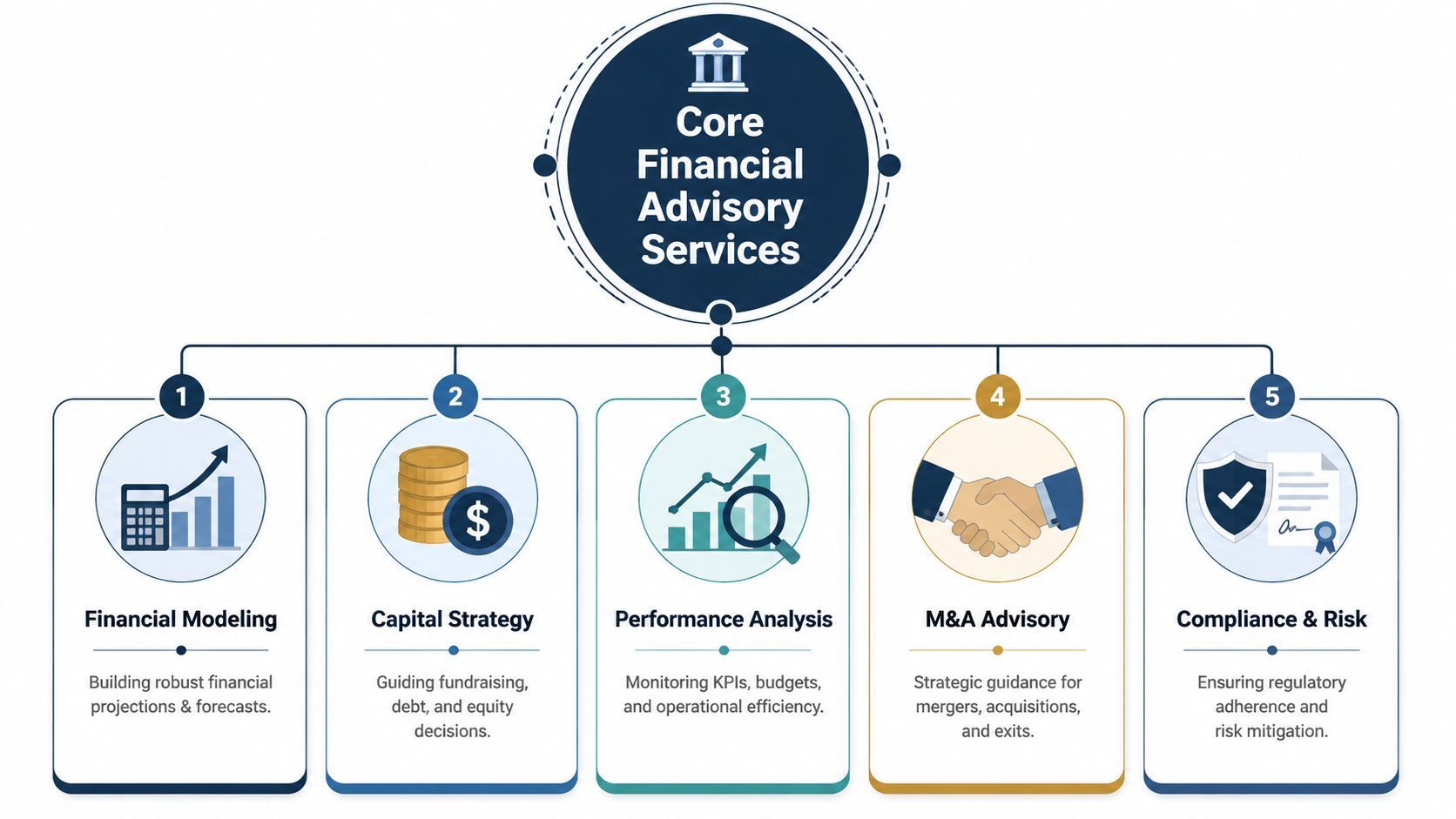
Most founders don’t need a huge finance department. They need a handful of tools used well and used consistently.
The basics are not glamorous. That’s fine. In startup finance, boring usually wins. Clean books, a useful forecast, and a short list of key metrics will do more for your business than a fancy model nobody updates.
Clean bookkeeping first
Everything sits on this.
If your books are messy, every decision gets harder. You can’t trust margins, cash reports, or forecasts if expenses are miscategorized, invoices are delayed, or payroll entries are off. Founders often want strategy when what they really need first is a reliable set of numbers.
This is why advisory starts with cleanup so often. Not because cleanup is exciting, but because bad data creates fake confidence.
Cash flow forecasting is your financial map
Forecasting is where founders stop guessing.
A good forecast doesn’t need to be perfect. It needs to help you see when money is expected in, when it’s expected out, and where the pressure points are. If you’re planning a hire, equipment purchase, office move, or raise, the forecast should show the effect before you commit.
It's like driving with headlights instead of driving at night with your phone flashlight.
KPI dashboards show what matters fast
Most startups don’t need more reports. They need fewer reports that answer better questions.
A useful KPI dashboard helps you check the health of the business quickly. It can help you see whether sales are getting more expensive, whether projects are profitable, or whether cash collections are slowing. In a construction business, that might mean job profitability and work-in-progress visibility. In a healthcare practice, it might mean reimbursement timing and payroll pressure. In a services firm, it could be utilization and client margin.
Here’s the point. Your dashboard should help you make a decision within minutes.
If a founder needs fifteen tabs and a finance degree to understand performance, the reporting system is broken.
Budgeting gives your team guardrails
A budget is not a punishment tool. It’s a spending plan.
Done right, budgeting helps a startup choose where money should go before emotions and urgency take over. You decide what matters most, then build around that. It also makes conversations easier. Instead of “can we afford this,” the question becomes “does this fit the plan, or is it important enough to change the plan?”
That shift sounds small. It changes behavior.
Fractional CFO support brings judgment
At this stage, the work becomes strategic.
A fractional CFO helps founders interpret the numbers, test assumptions, and make better calls on timing. That can include fundraising prep, pricing review, scenario planning, board reporting, lender conversations, or expansion decisions. You get senior finance thinking without hiring a full-time executive before the business is ready.
According to Graphite Financial’s work on startup CFO advisory, expert advisors can help reduce burn rates by 25% to 40% post-engagement by using weekly cash flow dashboards and cutting non-core spending when cash gets tight.
What this toolkit looks like in practice
A strong advisory setup often includes:
- Books you can trust: Monthly reports are clean, current, and usable.
- A live forecast: You can model hiring, pricing, and spending choices.
- A scorecard: Key metrics are visible without digging through software.
- A budget with real trade-offs: Team leads know the boundaries.
- CFO-level judgment: Someone can connect finance to strategy.
Some startups build this stack internally with tools like QuickBooks, reporting dashboards, and spreadsheet models. Others use outside partners. Firms such as CFO services for startups offer that mix of bookkeeping, forecasting, analytics, and decision support in one engagement.
What doesn’t work is having these pieces disconnected. A dashboard without clean books is noise. A budget without a forecast is hope. A CFO without current data is guessing.
How Advisory Helps You Fundraise Scale and Exit
The finance work a startup needs changes as the company grows. Early on, you’re trying to prove the business is real. Later, you’re trying to grow without breaking it. Eventually, if things go well, you want the company to be valuable, clean, and easy for a buyer or investor to understand.
That’s why financial advisory for startups works best as a continuing relationship, not a one-time project.

Fundraising needs more than a pitch deck
Investors don’t just back stories. They back teams that understand their numbers.
When a founder enters a raise with sloppy reporting, unclear burn, or weak assumptions, the room changes fast. Questions get sharper. Trust drops. A strong advisor helps prepare investor-ready financials, forecast different scenarios, and explain how new capital will be used.
If you’re getting ready for that process, a practical companion read is this startup fundraising guide, which gives founders a broader look at how the raise itself works.
Valuation matters here too. According to SVFG’s data analytics and valuation guidance, funding round failures can happen in 30% to 40% of cases due to misaligned expectations. The same source notes that advisors use market-based valuation work, such as 6x to 10x ARR for a Series A SaaS company, and that this kind of advisory can boost deal closure rates by up to 35%.
Scaling creates new kinds of mistakes
A small startup can survive some mess. A growing one usually can’t.
Once headcount rises, customers diversify, and spending spreads across more teams, weak financial habits become expensive. Pricing gets inconsistent. Hiring gets ahead of demand. One department spends freely while another gets squeezed. Founders start feeling busy but less clear.
Advisory helps by turning growth into a set of choices instead of a blur. It can show whether a new location is affordable, whether a service line should be expanded, or whether margins are shrinking underneath top-line growth.
Common scale questions include:
- Hiring: Does revenue support this role now, or after the next milestone?
- Pricing: Are you charging enough for complexity, service time, or delivery costs?
- Expansion: Can the business support a second office, new territory, or new product line?
- Operations: Which systems need to tighten before growth adds more noise?
Founders often think scaling means doing more. Good advisory often says do fewer things, but do the profitable ones with better discipline.
Exit value starts earlier than founders think
A sale or transition doesn’t start when you decide you’re ready. It starts with the habits you built years before.
Buyers and investors want clean books, understandable margins, consistent reporting, and a business that doesn’t depend on one person keeping everything in their head. If records are messy or profitability is hard to prove, value drops and diligence gets painful.
That’s why founders who care about exit should care about reporting now. The same systems that help you run the business also help someone else evaluate it later.
An advisor can help you prepare for that long before a deal is on the table. Work often includes normalizing financials, separating owner-related expenses, tightening reporting, and building a story around earnings quality and business value. If exit planning is on your radar, these business exit planning strategies are a solid framework.
A startup doesn’t move through fundraising, scaling, and exit as three clean chapters. Real life is messier than that. But advisory helps keep the financial side of the business coherent as the story changes.
Real Examples of Advisory in Action
Theory is useful. Founders usually want to know what this looks like in practice.
Below are three simple scenarios based on the kinds of issues that show up all the time around Philadelphia and West Chester. These are examples, not client case studies. The point is to show how advisory changes decisions, not just reports.
A West Chester contractor with busy crews and weak profit
The owner felt swamped and assumed the company was doing well. Crews were booked. Revenue looked solid. The phone kept ringing.
But the numbers told a different story once job costs were broken down clearly. Two kinds of projects were eating labor hours, generating change-order friction, and producing thinner margins than expected. The business wasn’t losing because there wasn’t demand. It was losing because some work was priced like simple jobs and delivered like complex ones.
After reviewing project types, labor patterns, and overhead allocation, the owner changed the quoting process.
The shift looked like this:
- Low-clarity jobs got repriced: If scope was likely to drift, the quote reflected that risk.
- Certain projects were declined: Busy stopped being the same thing as profitable.
- Reporting changed: Each completed job got reviewed, so estimates could improve over time.
The result wasn’t magic. It was discipline. The company started choosing work instead of taking everything.
A Philadelphia healthcare clinic planning a second location
This practice had demand. Patients were there. The expansion idea made sense on paper.
What the owner didn’t want was to open a second site and then feel cash pressure from equipment, staffing, and reimbursement delays all at once. That’s a classic case where advisory helps because the question isn’t “can this business grow?” It’s “can it grow without creating a cash squeeze?”
A forecast gave the owner a clearer view of timing. Not just revenue potential, but how long expenses would hit before collections caught up. That changed the conversation from excitement to sequencing.
A good forecast doesn’t tell you yes or no. It tells you what has to be true for yes to work.
The clinic moved forward with a more cautious rollout, matched staffing to expected volume, and avoided treating the bank balance like permanent free cash.
A professional services firm with the wrong pricing model
This kind of problem hides in plain sight.
A consulting or agency owner may be fully booked and still underpricing the work. The team works hard, clients are happy enough, and revenue appears stable. But if every new project adds effort faster than it adds margin, growth becomes tiring instead of useful.
In this scenario, the firm’s pricing hadn’t kept up with delivery complexity. Advisory work uncovered that senior team time was being used on accounts priced like simpler engagements. The answer wasn’t “raise every price overnight.” It was to segment clients, review scope, tighten proposals, and move toward pricing that matched value and labor reality.
That kind of fix often changes more than revenue. It also changes founder stress, team capacity, and the quality of future sales conversations.
What these examples have in common
Each business had a different issue. But the pattern was the same.
| Business type | Surface problem | Real financial issue |
|---|---|---|
| Construction | Busy schedule | Weak visibility into job profitability |
| Healthcare | Expansion pressure | Timing gap between spend and cash collection |
| Professional services | Full pipeline | Pricing not aligned with delivery economics |
That’s the heart of financial advisory for startups and small growing firms. It helps you find the problem under the visible one.
How to Choose the Right Financial Advisor
Most founders make one of two mistakes here. They either hire too cheaply and get basic data entry dressed up as strategy, or they hire someone impressive on paper who can’t explain anything in plain English.
You need a partner, not a mystery machine.
A strong advisor should understand numbers and understand people. They should be able to challenge your assumptions without talking over your head. If you leave meetings more confused than when you started, that’s not sophistication. That’s poor communication.
Look for fit, not just credentials
Technical skill matters. But in a startup, communication matters almost as much.
The right advisor should be able to explain cash flow, margin pressure, or hiring trade-offs in simple language. They should also understand your industry well enough to spot the patterns that matter. Construction needs job costing discipline. Healthcare needs visibility into reimbursement timing and payroll pressure. Professional services often need pricing and utilization clarity.
According to The Startup Ladies on financial literacy for founders, the right partner acts as a coach, challenges assumptions, and teaches founders how to track KPIs. That matters because many non-finance founders don’t just need reports. They need to get better at reading the business.
Warning signs to take seriously
If you’re interviewing advisors, watch for these issues early:
- They only talk about compliance: That usually means they’re reactive, not strategic.
- They avoid specifics: A good advisor can explain how they’d approach forecasting, reporting, or pricing review.
- They can’t teach: If they make finance sound harder than it is, that’s a problem.
- They don’t ask business questions: Real advisors want to know how you sell, deliver, collect cash, and make decisions.
- They promise certainty: Good finance work improves judgment. It doesn’t remove uncertainty.
You’re not hiring someone to be impressed by. You’re hiring someone who helps you think more clearly under pressure.
Questions worth asking in the first meeting
Use the conversation to test how they think, not just what services they list.
| Question Category | Sample Question to Ask |
|---|---|
| Communication | Can you explain a complex financial issue in a way I can repeat to my team? |
| Industry fit | What patterns do you usually see in businesses like mine? |
| Forecasting | How do you build a forecast when the business is changing fast? |
| Decision support | How would you help me think through hiring, pricing, or expansion choices? |
| Reporting | What reports would I get each month, and how would we use them? |
| Founder education | How do you help non-finance founders get better at reading the numbers? |
| Responsiveness | If cash gets tight or something changes suddenly, what does support look like? |
| Scope | What falls under bookkeeping, what falls under advisory, and where does CFO support begin? |
Cheap bookkeeping is not the same as advisory
This is an area where a lot of businesses get tripped up.
A low-cost bookkeeping service might categorize transactions and reconcile accounts. That’s useful. But it doesn’t mean anyone is looking at margin patterns, forecasting cash, or helping you decide whether to hire. Founders often discover that gap when they ask a strategic question and get silence, or a spreadsheet with no interpretation.
The right advisor should leave you with more confidence, more understanding, and fewer blind spots. If all you’re buying is transaction cleanup, call it what it is.
Choose someone you’d actually want to talk to
You’ll discuss hard things with this person. Missed targets. tight cash. payroll stress. pricing mistakes. If the relationship feels stiff, vague, or overly formal from the start, that usually gets worse, not better.
Pick the advisor who can tell the truth clearly, teach without ego, and help you make better decisions when the business feels noisy.
A Local Look at Advisory in Philadelphia and West Chester
Startups in Greater Philadelphia don’t operate in a vacuum. The region has real strengths, and those strengths shape the kind of finance support founders need.
Around Philadelphia and West Chester, you see a strong mix of healthcare, professional services, construction, real estate, and related small business ecosystems. Those industries don’t all break in the same way. A healthcare practice may struggle with timing and reimbursement visibility. A contractor may need stronger job costing and cash discipline. A service firm may need help fixing pricing before it adds headcount.
That local mix matters because financial advisory for startups should match the actual business model, not some generic founder playbook from the internet.
Why local context changes the advice
A Philly-area founder often faces practical questions that look small but carry real consequences.
Should you lease more space or stay remote longer? Should you add administrative staff now or wait for billing to catch up? Should you expand toward the city, grow further into the suburbs, or tighten your current operation before doing either?
Those aren’t abstract finance questions. They’re regional operating questions with financial consequences.
What founders in this market often need
In this area, useful advisory often centers on:
- Cash flow discipline: Especially when customer payments or reimbursements lag.
- Profit clarity by service line or project type: So growth doesn’t hide weak margins.
- Better decision support for hiring: Because labor costs move fast.
- Clean reporting for future lending, investment, or sale discussions: Since opportunities often come from relationships and timing.
The broader market is moving this way too. According to Bizplanr’s financial advisor statistics, the financial advisory market is projected to reach $146.8 billion by 2032. For founders in a strong regional hub like Philadelphia, that signals growing access to more advanced, CFO-level support.
West Chester and Philadelphia need practical finance, not theory
A founder in West Chester usually doesn’t need a slide deck full of finance jargon. A founder in Philadelphia usually doesn’t need ten dashboards that nobody opens. They need straightforward reporting, local awareness, and someone who understands how regional businesses operate.
That’s the sweet spot for advisory in this market. Clear books. Clear decisions. Less noise.
Your Next Step Toward Financial Clarity
If your startup feels financially blurry right now, that doesn’t mean you’re failing. It usually means the business has reached a stage where instinct and hustle aren’t enough on their own.
That’s normal.
Financial advisory for startups is really about reducing avoidable stress. It gives you a better grip on cash, sharper visibility into profitability, and more confidence when you need to make hard calls. Hiring, pricing, expansion, fundraising, and exit planning all get easier when the numbers are clean and the story is clear.
You don’t need a giant finance department to get there. You need a system that fits your stage and a partner who can help you use it.
If you’re in Philadelphia, West Chester, or anywhere nearby, the next smart move is simple. Talk through your current setup, your biggest pressure points, and the decisions in front of you. A good conversation should leave you clearer than you were before it started.
If you want that kind of clarity, schedule a no-pressure conversation with MyOfficeOps. They work with growing businesses on bookkeeping, reporting, forecasting, and CFO-level advisory, and the goal is straightforward: help you understand your numbers well enough to make the next decision with confidence.