
You bought the property, got the tenant in, and set up autopay on the mortgage. On paper, things look fine. Then tax season rolls around and you're digging through bank statements, email receipts, and a grocery bag full of Home Depot slips, trying to answer one basic question.
Is this property making money?
That's where bookkeeping for real estate stops being busywork and starts acting like your control panel. Clean books tell you which property is pulling its weight, which one is draining cash, and whether you can afford the next down payment without guessing. If your numbers only come together once a year, you're not really running a business. You're reacting to one.
Why Your Real Estate Business Needs Clean Books
A lot of new investors think bookkeeping means “save receipts for my CPA.” That's too small a view.
What I usually see is this: someone buys a rental, opens a spreadsheet, does their best for a month or two, then life gets in the way. Rent comes in. A plumber gets paid. Insurance renews. A tenant sends a partial payment. By the time they look back, every transaction is mixed together and the property's real performance is blurry.

The real question is not tax prep
The question isn't “Can I hand a pile of documents to someone in April?”
The important question is, can you look at one property and know what happened this month? Can you tell whether the vacancy hurt you more than repairs did? Can you see whether your cash is stuck because of debt payments, not because the property itself is weak?
That's the difference between records and usable books.
Clean books turn a rental from a side project into a business you can steer.
When your bookkeeping is organized, you can answer practical questions fast:
- Should I raise rent: You can't decide that with confidence if you don't know the true cost to operate the unit.
- Can I refinance: Lenders want reports that make sense, not a story about what you think happened.
- Which property should get attention first: The one with the loudest tenant issue isn't always the one hurting your portfolio most.
Good books reduce stress before they increase profit
There's also a peace-of-mind piece that people underrate. When the bank balance drops, messy books make everything feel worse. You don't know if it's a temporary dip, a missed rent payment, or months of expense creep finally catching up.
Good bookkeeping for real estate gives you a clean trail. Income goes where it belongs. Expenses are categorized the same way every month. Deposits, loans, and owner money don't get mashed into one bucket. That clarity helps you make calm decisions instead of emotional ones.
If you invest with partners, or plan to someday, this matters even more. The reporting standards used in larger real estate operations are stricter for a reason. If you want a useful look at that world, Homebase platform's fund accounting insights are worth reading because they show how disciplined reporting supports better decisions when multiple properties, entities, and investors are involved.
What clean books actually do for you
Think of bookkeeping like the dashboard in your car. You don't stare at it for fun. You use it so the engine doesn't die on the highway.
With clean books, you can:
- See profit by property
- Track cash without guessing
- Spot mistakes early
- Hand cleaner records to your tax pro
- Make expansion decisions based on facts
That's why bookkeeping for real estate matters. It's not a chore you survive. It's how you build a portfolio that behaves in a predictable way.
Setting Up Your Real Estate Chart of Accounts
Your chart of accounts is your digital filing cabinet. Every dollar that moves through your business needs a proper drawer.
If this filing cabinet is sloppy, everything downstream gets harder. Your reports get muddy. Your tax prep gets slower. You start asking your software questions it can't answer because the setup was wrong from the start.
Start simple and build clean
Most investors don't need a giant account list. They need a clean one.
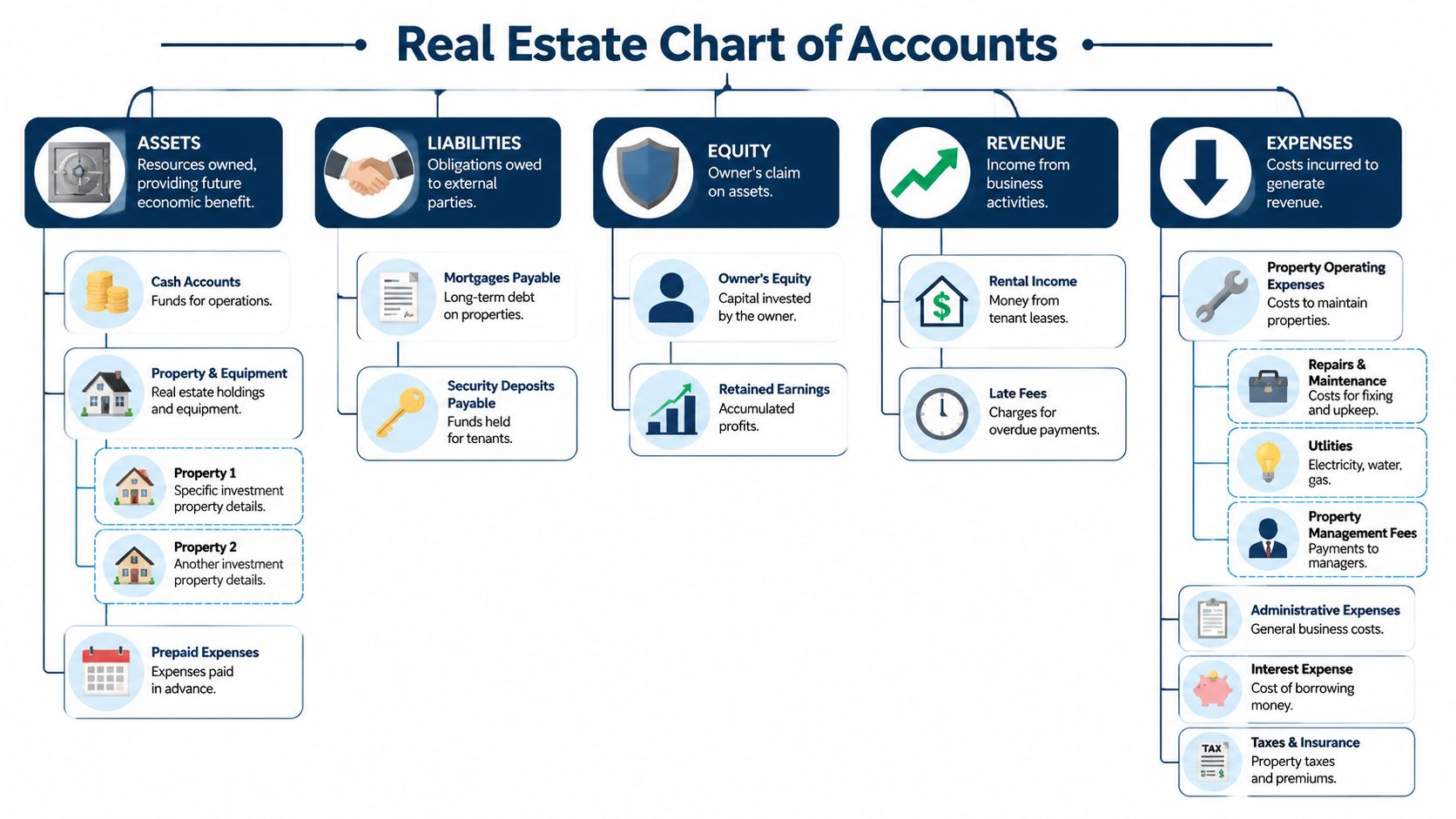
A good real estate chart of accounts usually includes these main groups:
| Account group | What goes there |
|---|---|
| Assets | Bank accounts, property assets, prepaid items |
| Liabilities | Mortgages, security deposits held, credit cards |
| Equity | Owner contributions, owner draws, retained earnings |
| Revenue | Rental income, late fees, other property income |
| Expenses | Repairs, utilities, insurance, taxes, management fees, interest |
Here's a basic structure you can model:
A practical starter chart
Assets
- Operating Checking
- Security Deposit Bank Account if used separately
- Undeposited Funds
- Prepaid Insurance
- Building
- Land
- Capital Improvements
Liabilities
- Mortgage Payable
- Security Deposits Payable
- Credit Card Payable
- Property Tax Payable if accrued
Equity
- Owner Contributions
- Owner Draws
- Retained Earnings
Revenue
- Rental Income
- Late Fee Income
- Application Fee Income if applicable
Expenses
- Repairs and Maintenance
- Utilities
- Property Management Fees
- Insurance
- Property Taxes
- Interest Expense
- Cleaning and Turn Costs
- Legal and Professional Fees
- Office and Admin
- Bank Charges
That's enough structure to get useful reports without turning the books into a maze.
Separate bank accounts are not optional
If you own property through an LLC, that LLC should use its own bank account. If you use one account for everything, you make every report harder to trust.
This matters even more under the FinCEN Beneficial Ownership Information reporting rule, which becomes effective December 1, 2025 and requires detailed record-keeping for entities holding properties, including LLCs. For investors in markets like Philadelphia, that means dedicated LLC bank accounts and class tracking in software to avoid commingled funds. The same source notes that 70% of multi-property owners without per-property accounts faced average IRS penalties of $10,000 in 2024 according to QuickBooks' overview of bookkeeping for real estate.
Practical rule: If a transaction hits the wrong bank account, fix it right away. Small cleanup jobs stay small only when you handle them quickly.
Use classes instead of making your account list messy
This is one of the best habits you can build.
If you have multiple properties under one entity, don't create a separate “Repairs” account for every address. That gets ugly fast. Instead, use class tracking or a similar tagging feature in QuickBooks Online or another system. Keep one “Repairs and Maintenance” expense account, then tag each transaction to the right property.
That gives you reports by property without blowing up your chart of accounts.
For example:
- A plumbing invoice goes to Repairs and Maintenance
- The class is 123 Main Street
- A lawn bill goes to the same expense account
- The class is 456 Oak Avenue
Same account. Different property tags. Clean reporting.
One resource worth keeping handy
If you want a plain-English breakdown of the structure itself, this guide on what a chart of accounts is is useful because it shows the logic behind the setup instead of just listing account names.
A chart of accounts doesn't need to be fancy. It needs to be consistent. That's what gives you reports you can trust.
How to Categorize Real Estate Transactions
Most errors occur at this stage.
The software pulls in a transaction, you click a category, and it feels harmless. But one bad habit repeated all year creates reports that lie to you. Then your tax preparer has to untangle the mess, or worse, the bad data stays in place and you make decisions off numbers that aren't real.

Money in is not all the same
A rent payment is income. A security deposit is not.
That sounds simple, but I've seen plenty of investors book the full move-in amount as rent because that's what hit the bank. The problem is the deposit still belongs to the tenant unless you legally keep part of it later. Until then, it sits on your books as a liability.
Holding someone's backpack while they tie their shoe is a helpful comparison. It's in your hands, but it's not yours.
Common incoming transactions
- Monthly rent: Book to rental income.
- Late fees: Book to late fee income if you track it separately.
- Security deposits: Book to security deposits payable, not income.
- Owner contributions: If you move your own money into the business, that's equity, not revenue.
- Reimbursements: Review carefully. Don't dump them into rent just because cash came in.
If you need a better feel for how tenant-level records work, this landlord's guide to financial records is a helpful companion because it shows how charges, payments, and balances should line up at the tenant level.
Money out needs the right bucket
Expenses matter for taxes, but they also matter for operations. If everything gets shoved into “miscellaneous,” you lose the ability to see patterns.
A few examples:
| Transaction | Usual treatment |
|---|---|
| Plumber fixes a leaking toilet | Repairs and Maintenance |
| Electric bill for a vacant unit | Utilities |
| Property manager monthly fee | Property Management Fees |
| Annual insurance premium | Insurance or prepaid then expensed over time, depending on your process |
| County tax payment | Property Taxes |
| Loan interest | Interest Expense |
| Loan principal | Mortgage Payable reduction, not expense |
That last one trips people up all the time. Your mortgage payment is not one big expense category. Part of it reduces the loan balance. Part of it is interest. If you book the whole payment to expense, your reports will be wrong.
The bank statement shows cash movement. Your books need to show what that movement means.
Repairs versus improvements
This is the line people worry about most, and for good reason.
A repair fixes something and keeps the property operating. A capital improvement adds value, extends useful life, or upgrades the property in a more lasting way. Bookkeeping for real estate depends on getting this distinction right because the treatment is different.
Here's a plain example:
- Toilet repair after a tenant reports a leak. Usually a repair.
- Full roof replacement. Usually a capital improvement.
- Patching a section of drywall after damage. Usually a repair.
- Full kitchen remodel with new cabinets and layout changes. Usually a capital improvement.
A good gut check is this: did you restore normal function, or did you create something meaningfully better or longer-lasting?
A simple before-and-after test
If the answer is “it works again,” think repair.
If the answer is “the property is upgraded now,” think improvement.
When in doubt, don't guess carelessly. Flag it and review it with your bookkeeper or tax pro.
Keep support with the transaction
A category is only as good as the backup behind it. That means:
- Attach receipts: Use your phone right after the purchase.
- Write notes: “Turnover paint for Unit 2” is much better than “paint.”
- Save invoices: Especially for contractor work and bigger purchases.
- Record owner-paid items fast: If you use a personal card by mistake, book it correctly as an owner contribution or reimbursement item.
A workable rule set for everyday bookkeeping
When you're staring at a transaction feed and want a fast decision, use this:
- Ask whose money it is. Yours, the tenant's, the bank's, or the business's.
- Ask whether it affects profit now. Rent and repairs do. Loan principal doesn't.
- Ask whether the item was consumed now or will help over a longer period. That helps separate ordinary expense from larger asset-type items.
- Tag the property. Don't leave it unassigned if you want useful reports later.
If you follow those four questions, most day-to-day categorizing gets much easier.
Turning Data into Decisions with Monthly Reports
Entering transactions is the easy part. Knowing what they're telling you is where the value shows up.
A clean month-end process gives you something most landlords never really get: a current, believable picture of each property. Once you have that, you stop running the business on hunches.

A 2024 National Multifamily Housing Council study found that properties with monthly reconciled books had an average net operating income of $18,500 annually, compared to $12,200 for properties with only annual reviews, and linked routine bookkeeping to a 25% to 35% increase in portfolio profitability according to The Real Estate CPA's summary of real estate investor bookkeeping data.
A simple month-end close
You don't need an all-day accounting marathon. You need a repeatable routine.
A solid monthly close usually looks like this:
- Reconcile bank and credit card accounts: Make sure the software matches the statements.
- Review uncategorized transactions: Don't let them pile up.
- Check loan activity: Confirm principal and interest were posted correctly.
- Review tenant balances and deposits: Look for errors before they become habits.
- Run reports by property: Profit and Loss, Balance Sheet, and Cash Flow.
That routine is what turns your books into management data instead of storage.
What your Profit and Loss report is saying
Your Profit and Loss statement, or P&L, shows income and expenses over a period of time. For real estate, the biggest mistake is only looking at one combined P&L for the whole business.
Run it by property.
If one property brings in steady rent but has rising repair costs every quarter, that matters. If another property looks average at first glance but stays consistent with fewer surprise expenses, that may be your stronger performer.
Here's the kind of question a per-property P&L answers well:
| Question | Report clue |
|---|---|
| Which property earns the most after normal operating costs | Compare rental income against operating expenses by class or property |
| Where are costs creeping up | Review category trends over several months |
| Is one property unstable | Look for swings in maintenance, utilities, or vacancy-related costs |
Focus on NOI first
For a rental property, NOI, or net operating income, is one of the clearest ways to judge operating performance. It helps separate the property's operating results from financing noise.
If your property produces healthy income but debt service is tight, that's a financing issue. If the property itself can't carry its normal expenses, that's an operations issue. Those are two different problems, and your reports should help you tell them apart.
A decent bank balance can hide a weak property for months. A clean P&L usually tells the truth faster.
Your Balance Sheet shows what you actually own and owe
The Balance Sheet gets ignored by a lot of investors because it feels less exciting than the P&L. That's a mistake.
This report shows your bank balances, loans, security deposits held, and owner equity. It tells you whether cash is strong, debt is shrinking, or liabilities are building up. It also catches odd things, like a deposit account that doesn't match what tenants should have on file, or owner transactions that were booked badly.
A good Balance Sheet helps answer questions like:
- Am I building equity cleanly
- Do I owe tenants money I forgot to track properly
- Is cash dropping because of operations or because I pulled money out
Reports should lead to action
At the end of the month, you don't need ten pages of accounting jargon. You need a short list of decisions.
Maybe one property needs rent review. Maybe another needs tighter maintenance approval. Maybe a vendor cost jumped and deserves a closer look. The point is simple. Good bookkeeping for real estate gives you reports that tell you what to do next.
Real Estate Bookkeeping Software and Workflows
Software matters, but workflow matters more.
I've seen investors buy good tools and still end up with bad books because they assumed automation would do the thinking for them. It won't. The software can move data quickly. It cannot tell whether a charge belongs to repairs, a deposit liability, or an owner contribution unless you set it up and review it properly.
The standard automation framework for real estate bookkeeping includes automated bank feeds, property-level class tracking, and on-demand reporting, and the warning is clear: without disciplined monthly reconciliation, you get “garbage in, garbage out” reporting, as explained in Shoeboxed's real estate bookkeeping guide.
General accounting tools versus property-specific tools
Here's the short version.
QuickBooks Online and Xero are strong accounting systems. They're good when you want flexible bookkeeping, strong reporting, and tighter control over the accounting side.
Stessa and AppFolio are more property-oriented. They can make sense if rent tracking, property operations, and tenant-related workflows are central to how you manage the business.
A simple comparison helps:
| Tool type | Best fit | Watch out for |
|---|---|---|
| General accounting software | Investors who want cleaner accounting control and custom reporting | You may need more manual setup for property-level workflows |
| Property management software | Owners who want operations and accounting closer together | Accounting depth can vary, and setup still matters |
The workflow that actually saves time
The tool doesn't fix the process. The process fixes the process.
A good setup usually includes:
- Bank feeds turned on: Let the software pull transactions instead of typing them by hand.
- Receipt capture from your phone: Snap the invoice while you're still in the truck or parking lot.
- Rules for recurring items: Mortgage interest, insurance drafts, and management fees often follow a pattern.
- Monthly review on the calendar: If it isn't scheduled, it often doesn't happen.
One useful companion to bookkeeping is investment analysis. If you want help thinking through the front-end numbers before or alongside your back-end books, this guide to calculating investment property returns is worth a look.
Don't confuse automation with accuracy
Auto-categorized transactions still need human review. The software sees a vendor name. It doesn't know that this month's charge was for a long-term upgrade instead of a normal repair.
That's why the best systems combine automation with a short review habit. Fast intake. Clean coding. Monthly reconciliation.
If you're comparing systems and want a straightforward overview of the options, this roundup of best accounting software for real estate investors is a practical place to start.
When to Outsource Your Real Estate Bookkeeping
There comes a point where doing it yourself stops being lean and starts being expensive.
Not always expensive in direct dollars at first. Expensive in missed problems, late decisions, bad categories, and time you should be spending on financing, leasing, renovations, or acquisitions.
The red flags are usually obvious
If any of these sound familiar, your bookkeeping system is probably stretched past its limit:
- You're behind on reconciliations: If you haven't matched accounts in a while, your reports are stale.
- You mix personal and business spending: Even occasional crossover creates cleanup work and weakens the reliability of the books.
- You can't get property-level answers quickly: If someone asks how one address performed and you need a weekend to figure it out, the system isn't serving you.
- Your tax preparer keeps sending questions back: That usually means the books weren't organized enough upstream.
Outsourcing is not just data entry
A good outsourced bookkeeping relationship gives you structure. Transactions get reviewed on time. Reports come out in a format you can use. Weird items get flagged instead of buried. The handoff to your CPA gets easier because the books are cleaner before tax work begins.
That matters even more as your portfolio grows. More properties mean more vendors, more deposits, more loan activity, and more chances for small mistakes to stack up.
If bookkeeping keeps getting pushed to “later,” later usually arrives with penalties, confusion, or a very long cleanup project.
What to look for in a bookkeeping partner
You want someone who understands real estate basics, asks good questions, and doesn't flood you with jargon.
Look for a team that can help with:
- Property-level reporting
- Loan and equity tracking
- Monthly closes
- Clear communication with your tax professional
- Practical insight, not just reconciled numbers
If you're weighing that move, this guide on outsourced bookkeeping for small business gives a solid overview of when outsourcing starts to make sense.
If your real estate books feel reactive, messy, or always one step behind, MyOfficeOps can help you clean them up and turn them into useful decision-making tools. Their team works with growing businesses that need reliable bookkeeping, clear reports, and advisory support without a lot of jargon or hand-holding.