

You finish a long week of driving, open Uber's tax section, and suddenly you're staring at a pile of forms, fee summaries, and numbers that don't seem to match your bank deposits. That's where a lot of drivers freeze. The money felt simple while you were earning it. Tax time makes it feel messy.
The good news is that schedule c for uber drivers is a lot less scary once you see what it's really doing. It's not some mystery form built to trap you. It's just the place where you tell the IRS two basic things. First, how much your driving business brought in. Second, what it cost you to earn that money.
That second part matters more than most new drivers realize. If you only look at what came in and ignore the costs, you can end up paying tax on money you never really kept. That's why good records matter. They don't just make filing easier. They help you keep more of what you earned.
I usually tell new rideshare clients to think of Schedule C like a scorecard for the year. It shows whether your driving business made a profit, where your biggest costs were, and whether you're heading for a tax bill you should plan for. If you need broader help sorting through forms, deductions, and filing questions, these comprehensive tax preparation solutions for taxpayers can be a useful starting point alongside your bookkeeping.
Your Guide to Uber Taxes and Schedule C
A lot of new Uber drivers get tripped up by one basic question. “Why does the tax form show more income than what hit my bank account?”
The short answer is that Uber driving is taxed like a small business. You report the full business activity on Form 1040 Schedule C, then subtract the costs of earning that money. What's left is your profit, and that number is what affects both income tax and self-employment tax. The IRS instructions for Schedule C lay out that structure plainly, even if the form itself looks busier than it really is.
That distinction matters because good tax prep for rideshare work is not just data entry. It is decision-making.
Schedule C shows whether your driving actually paid off
Schedule C starts with income and works down to profit. For Uber drivers, that means the form captures more than payouts. It also forces you to account for the costs that made those trips possible, such as vehicle use, tolls, parking, phone use, and other ordinary business expenses.
Here's the practical part. The most important choice on this form is usually how you handle vehicle costs. Standard mileage is simpler. Actual expenses can produce a larger deduction in some cases, especially if your car is expensive to operate. The right answer depends on your records and your numbers, not on what another driver claimed.
I usually tell clients to do the math both ways before filing if they are unsure. If one method saves more tax and you have the records to support it, that is the method worth using.
Practical rule: Don't judge your tax situation by deposits alone. Judge it by profit after expenses.
A clean Schedule C also gives you better answers off the tax return. You can see whether driving is producing real take-home income, whether estimated tax payments need attention, and whether your recordkeeping is good enough to defend the deductions you are claiming. If you want a simple system before filing season gets busy, this tax season preparation checklist for small business owners and contractors can help.
Some drivers only want to “get the return done.” I get that. But the stronger approach is to use Schedule C as a yearly checkup for the business side of your Uber work. If you need broader filing help while sorting that out, these comprehensive tax preparation solutions for taxpayers can be a useful starting point alongside your bookkeeping.
Gathering Your Uber Tax Paperwork
You sit down to do taxes, open Schedule C, and the first number already looks wrong. Your bank deposits say one thing. Uber's documents say another. That usually means the paperwork is incomplete, not that the return is impossible.
Good prep makes the rest of Schedule C much easier. It also helps with the biggest decision on the return later, whether mileage or actual vehicle expenses gives you the better deduction. If your records are scattered, you cannot do that comparison with confidence.
Uber drivers usually file Schedule C because they are self-employed. The paperwork often includes a 1099-K, a 1099-NEC, and an annual tax summary. Even if one of those forms never shows up, the income still has to be reported. That is the rule I remind drivers about every year.
The paperwork that actually helps
Start with Uber's annual tax summary. In real life, that document is often more useful than the 1099 by itself because it shows the full activity for the year in one place. It helps you separate gross earnings from fees, adjustments, and other amounts that explain why your bank deposits look lower.
Then gather these records:
- Uber annual tax summary
- Any 1099-K forms
- Any 1099-NEC forms
- Mileage log or mileage app report
- Receipts for tolls, parking, car washes, supplies, and phone accessories
- A year-end phone bill summary and your business-use estimate
- Payout history or app screenshots if a number looks off
That last item matters more than drivers expect.
If you are choosing between mileage and actual expenses later, your paperwork decides how much flexibility you have. A clean mileage log keeps the standard mileage method available. Strong receipt records make it easier to test the actual-expense method. I usually want both if possible, because good records let you run the math instead of guessing.
How to organize it without making this a big project
Use one folder for income documents and one folder for expenses. Digital is fine. Paper is fine. The system does not need to be fancy. It just needs to let you answer simple questions fast, like “Where did this number come from?” and “Can I prove this deduction if asked?”
If you want a simple filing-season workflow, this guide on how to prepare for tax season works well alongside your Uber records.
Clean books reduce tax stress. They also show whether driving is producing real profit or just busy cash flow.
What to do when the numbers do not match your deposits
This is one of the most common sticking points for rideshare drivers. Uber documents often show gross activity. Your bank account shows what reached you after platform fees and other reductions. Those are different numbers serving different jobs.
A quick example helps. If riders paid $12,000 through the app, but Uber kept fees before sending you payouts, your deposits might be much lower. Schedule C income still starts with the gross business activity, then the related business expenses get deducted in the proper places. That is why pulling only from bank statements creates mistakes.
If a form still looks wrong after you compare it to the annual summary and payout history, keep the records together and make notes before filing. Missing or confusing paperwork is a reason to verify the numbers carefully. It is not a reason to leave income off the return.
Reporting Your Income on Schedule C
The income section of Schedule C is where many Uber drivers get nervous. It looks official, the line labels aren't written in plain English, and one number can seem way too high at first glance. That's normal.
The IRS instructions say Schedule C is the form to use to report income or loss from a business operated as a sole proprietorship. For rideshare drivers, the workflow is to aggregate all platform receipts on the income lines, then subtract business expenses to compute net profit, as shown in the IRS Schedule C instructions.
Start with the basic business info
At the top of Schedule C, you'll enter the basic identifying details. Name. Social Security number. Business name if you use one. Many drivers don't have a separate business name, and that's fine. Your own name can be the business name.
If you drove for Uber and Lyft, or did rides and delivery under the same basic self-employed activity, the usual practical approach is to combine that activity on one Schedule C rather than treating each app like a separate company in your tax return.
Line 1 is usually the part that feels wrong
Gross receipts means the full amount connected to the business activity before expenses are deducted. For an Uber driver, that often means a number larger than the deposits that hit your bank account.
That's the point that trips people up.
You might think, “I never got all of that.” In many cases, that's because the platform took fees, or because some amounts were handled in a way that doesn't match what landed in your checking account. Those costs get dealt with in the expense section. You're not being taxed on the same dollars twice if the return is prepared correctly.
Keep one simple rule in mind
Use your records to pull together the total income for the activity. Don't build the income section off memory. Don't rely on one screenshot. And don't enter only your net bank deposits just because that number feels safer.
A simple way to explain it:
| What you're looking at | What it means |
|---|---|
| Gross receipts | Total business income tied to the trips and related activity |
| Bank deposits | What you received after platform handling and other adjustments |
| Expenses | The costs you claim later to reduce that gross amount to profit |
If the top number feels too big, don't panic. On Schedule C, the income section tells the first half of the story. The expense section tells the second half.
One practical habit helps a lot here. Keep a year-end spreadsheet or note that shows income by platform, then a second section for fees and deductions. That way, when you or your preparer enters the return, you're not trying to rebuild a year of driving from scattered emails.
Choosing Your Biggest Deduction Mileage vs Actual Costs
This is the decision that usually has the biggest effect on an Uber driver's Schedule C. You generally choose between the standard mileage method and the actual expense method for your vehicle deduction. Both can work. The right one depends on your records and the way your car is used.
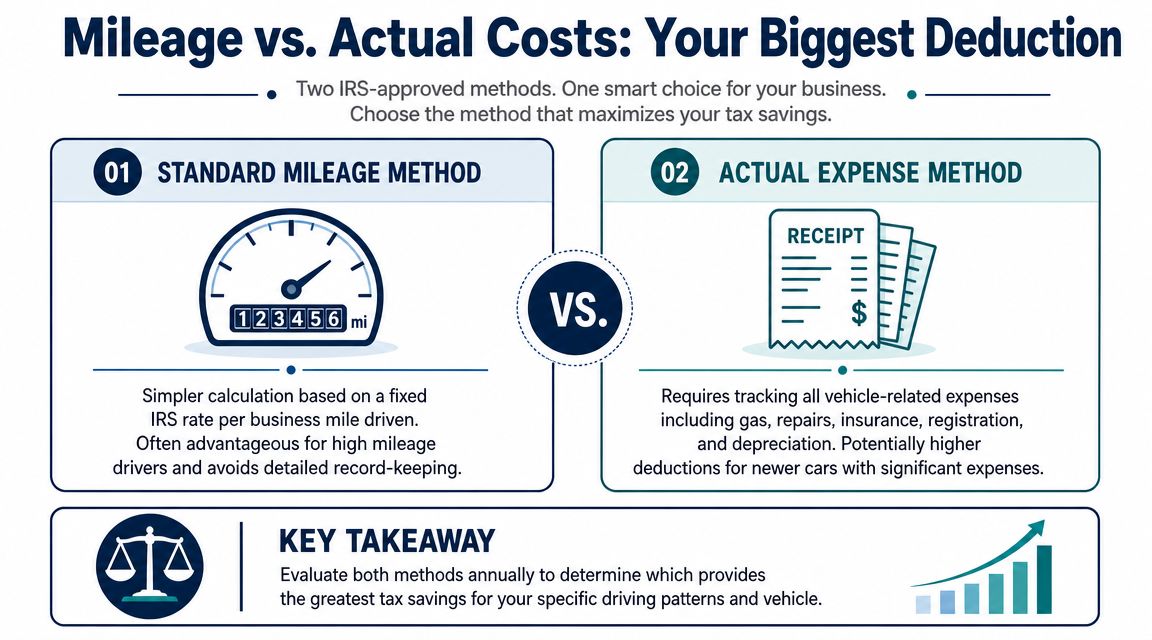
Vehicle deduction support is one of the most error-prone areas on Schedule C. If you claim car expenses, especially under the mileage method, you need contemporaneous mileage records. For 2024, the standard mileage rate was 67 cents per mile, so 10,000 documented business miles could support a $6,700 deduction under that method, according to this rideshare Schedule C guide.
What the mileage method really means
The standard mileage method is the simpler path for many drivers. You track your business miles and multiply them by the IRS mileage rate for the tax year you're filing.
The big benefit is simplicity. You don't have to build your deduction from every gas receipt, insurance bill, tire purchase, and repair invoice. But simple doesn't mean loose. If you claim mileage, your log has to hold up.
A good log should clearly separate:
- Business miles for driving activity
- Commuting miles
- Personal miles
If that sounds fuzzy, that's exactly why drivers get into trouble. Vague estimates written down at tax time aren't nearly as helpful as records kept while you're driving. If you want a cleaner process, these tips for tracking business miles in 2026 can help you build a system that doesn't fall apart in April. You can also keep an eye on changing rates through this summary of business mileage rates.
What actual expenses mean in plain English
The actual expense method works more like this: add up the true costs of owning and operating the vehicle, then allocate those costs based on business use.
That means you're tracking things like:
- Gas
- Insurance
- Repairs and maintenance
- Tires
- Depreciation
- Other vehicle-related costs tied to business use
This method can be a better fit when the car is expensive to operate, but it asks more from your records. You need receipts, statements, and a solid way to show what part of total use was business versus personal.
A side-by-side way to think about it
Here's the simplest comparison:
| Method | Best when | Hard part |
|---|---|---|
| Standard mileage | You want a cleaner system and drive a lot for work | Keeping a consistent mileage log |
| Actual expenses | Your vehicle costs are high and you keep detailed records | Tracking every cost and business-use percentage |
A practical example without made-up numbers
Let's say two drivers both use their cars for Uber work.
Driver A has a strong mileage log, drives often, and keeps only a few non-vehicle receipts. For this driver, the mileage method is usually easier to defend and easier to maintain through the year.
Driver B has a newer vehicle, high insurance costs, significant repairs, and good records for every expense. That driver may want to compare actual expenses against mileage before filing.
The key point is that you don't choose based on guesswork. You compare the methods using real records.
Working advice: If your paperwork is weak, actual expenses usually become more painful, not more valuable.
What counts and what doesn't
One common mistake is mixing methods in a way that doesn't work. Drivers hear “mileage” and then still try to tack on gas and repairs separately. That creates problems fast. The mileage method is meant to stand in for many of the normal operating costs of the car.
What you want is one clean vehicle deduction method, supported by records, plus any other separate deductible items that are allowed outside that vehicle calculation.
The rule of thumb I use with new drivers
If you're new to this, start with these questions:
Did you keep a real mileage log?
If yes, mileage may be the cleanest route.Did you save detailed vehicle receipts all year?
If yes, actual expenses may be worth comparing.Do you use the car heavily for work and want the least messy system?
Mileage often wins on simplicity.Do you use the car for both personal life and rideshare without clear tracking?
Stop and clean up the records before you assume either method is safe.
For many drivers, the best tax result comes from a method that is not only potentially larger, but also defensible. A deduction you can support is better than a bigger one you can't back up.
Finding Every Last Deduction Beyond Mileage
Mileage gets most of the attention, but it isn't the whole return. A lot of Uber drivers leave money on the table because they stop looking after the car deduction. That's a mistake.
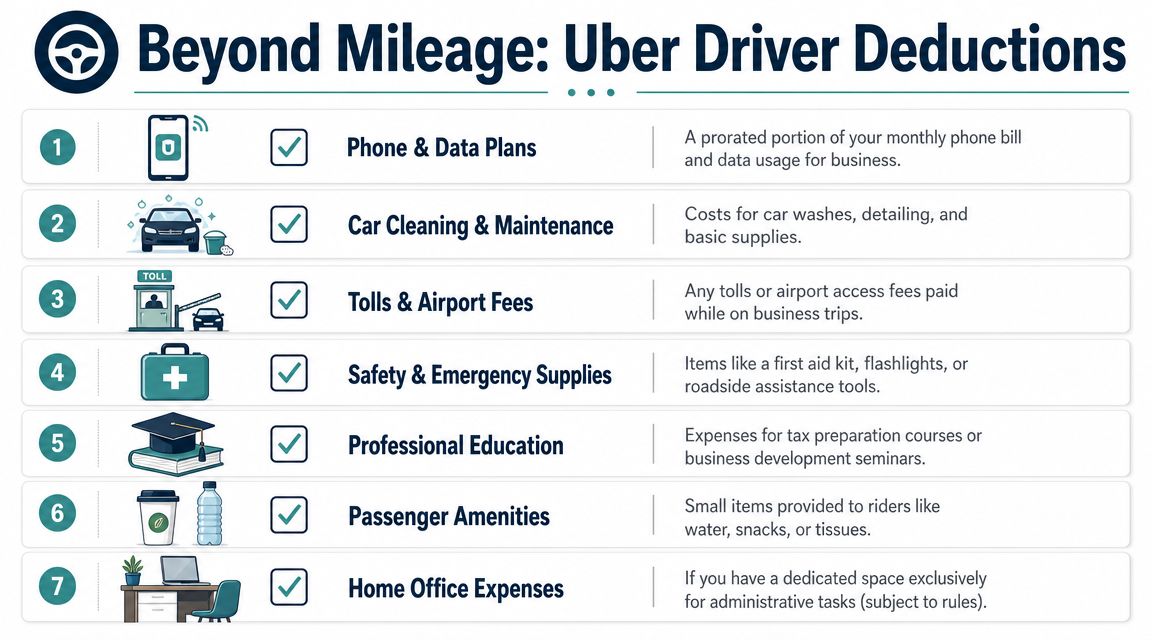
Many guides focus too narrowly on mileage, even though drivers may also deduct items such as tolls, parking, leasing costs, and supplies for rider comfort. Jackson Hewitt also notes that actual vehicle expenses can include fuel, repairs, insurance, depreciation, parking, and tolls in this driver deduction overview.
The deduction people miss first
If your records show gross receipts at the top, you need to pay attention to Uber's commissions and fees in the expense section. This is one of the most important adjustments on the whole form because it helps bridge the gap between gross income and the amount you kept.
If you skip those fees, your Schedule C can overstate profit.
A practical deduction checklist
Use this as a review list while you work through Part II of Schedule C.
Platform fees and commissions
If Uber took its cut before money reached you, make sure those costs are captured properly as business expenses.Tolls and parking
These often get forgotten because they feel small one at a time. Over a year, they add up.Phone and data use
Your phone is part of the job. Navigation, rider communication, app use, and trip management all run through it. What matters is claiming the business-use portion, not the full personal bill by default.Supplies for rider comfort
Water, tissues, or similar small items can count if they were bought for the business use of serving riders.Cleaning and upkeep items
Car wash supplies, interior cleaning products, and similar items may belong in your records if they were part of keeping the vehicle ready for work.Leasing costs or actual vehicle costs
These matter if you use the actual expense route instead of mileage.
If you want a broader reminder list beyond rideshare-specific costs, this guide to small business tax deductions is worth reviewing when you organize your records.
Keep your expense system simple
The best system is usually not fancy. It's consistent.
Try this:
- one folder for monthly statements
- one folder for receipts
- one mileage tracking method
- one spreadsheet tab for expenses that don't show up clearly in the app
That gives you a cleaner year-end picture than a glove box full of faded receipts.
Your goal isn't to collect random write-offs. Your goal is to keep a clear, defensible record of what the business actually cost you.
One expense that sits outside Schedule C for many drivers
Some drivers also ask about health coverage. That isn't the same as putting gas or tolls on Schedule C, but it can still matter on the return. If you're self-employed and trying to understand that side of the picture, this guide on deducting health insurance premiums gives useful background.
The big takeaway is simple. Mileage is important, but it's only one piece of the tax picture. Drivers who keep better expense records usually find more legitimate deductions without stretching the rules.
Finishing Up Net Profit Self-Employment Tax and What's Next
Once your income and expenses are entered, Schedule C gives you the number that matters most. Net profit. That's the amount that moves into the rest of your return and helps determine what you owe.
For self-employed drivers, that number also connects to self-employment tax. This is how independent contractors pay into Social Security and Medicare. The self-employment tax rate is 15.3%, made up of 12.4% for Social Security and 2.9% for Medicare, and many drivers set aside roughly 25% to 30% of net earnings after deductions because the tax impact can go beyond that one line item, as noted in this rideshare tax planning guide. The same guide also notes that Uber says annual tax documents are made available by January 31, 2026.
Why the final number matters all year, not just in April
A finished Schedule C tells you more than what happened last year. It helps you make better choices for the next one.
If your net profit is stronger than you expected, you may need to plan for estimated taxes so next filing season doesn't come with a nasty surprise. If your profit is thinner than expected, that's a signal to look at fees, vehicle costs, and whether your recordkeeping is missing deductions.
A simple way to think about self-employment tax
Employees split payroll taxes with an employer. Independent contractors don't have that setup. You're handling that responsibility yourself through the return.
That's why a lot of drivers are shocked by their first tax bill. They think only about income tax and forget that self-employment tax is part of the picture too.
Good bookkeeping helps twice. It supports your deductions, and it helps you see your tax bill coming before it lands.
What to do next
After you file, don't shove everything into a drawer and hope next year goes better. Take one hour and fix the system.
Choose your mileage method for tracking. Set up one place for receipts. Review your profit every month or quarter. If your income jumps around, move tax money into a separate savings account as you go so it's there when you need it.
A completed Schedule C isn't just a tax form. It's proof that you're running a real business, and the better you understand it, the easier it gets to protect your cash flow.
If you want help turning messy driver records into clean books and clearer decisions, MyOfficeOps can help you build a system that makes tax season easier and gives you a better handle on profit, cash flow, and what your business is really earning.