

You're checking the bank account between customer calls and notice a payment you don't recognize. Your bookkeeper says it was approved. The office manager says the vendor looked familiar. Nobody can show you who added the vendor, who approved the bill, or who matched the payment to the books.
That's the point at which many owners start searching for internal controls for small business. They're not looking for corporate paperwork. They want to know who can move money, whether the numbers are right, and how to stop a small mistake from becoming an expensive surprise. Good controls also give lenders, investors, and future buyers confidence that the business can operate without the owner personally checking every transaction.
What Internal Controls Actually Look Like in a Small Business
Maria owns a cleaning services company with a team of 12. One afternoon, she sees a $9,400 check to a vendor she doesn't recognize. She pulls the bank statement and finds two more questionable charges.
The problem isn't only the money. Maria discovers that her office manager has been approving vendor setups and vendor payments alone for two years. No one else reviewed the vendor list. No one independently checked the bank reconciliation. The business had a process, but it didn't have a control.
Internal controls are simple, repeatable rules that make sure the right person completes each step, someone else checks important work, and the business keeps a record of what happened. They aren't a sign that you distrust your staff. They give honest employees a clear process and make unusual activity easier to spot.
The three rules that matter most
For a small team, start with three building blocks:
- Assign ownership: Decide who enters bills, who approves them, who releases payments, and who records the transaction.
- Add a second set of eyes: Any payment, vendor bank change, refund, or unusual expense should receive review from someone other than the person who prepared it.
- Reconcile every month: Compare the accounting records with the bank, credit-card, and payment-processor statements. Document who prepared the reconciliation and who reviewed it.
These rules work whether you have five employees or 30. They also scale better than relying on the owner's memory. A written approval trail can help you find a problem quickly, rather than discovering it after years of untouched records.
The COSO Internal Control Framework remains a useful starting point. COSO's model includes the control environment, risk assessment, control activities, information and communication, and monitoring. Its historical framework, first published in 1992, became a foundational model for businesses of different sizes, and later guidance addressed how smaller public companies could apply the same principles at a smaller scale. You can also use this internal controls compliance resource to understand how control design connects with broader compliance work.
Practical rule: If one person can create a vendor, approve an invoice, release payment, and reconcile the bank account, you don't have enough oversight.
The owner-light model doesn't require a full accounting department. It uses role separation, software permissions, outside review, and a short monthly finance meeting. The owner still makes important decisions, but the owner isn't the only person standing between the business and its bank account.
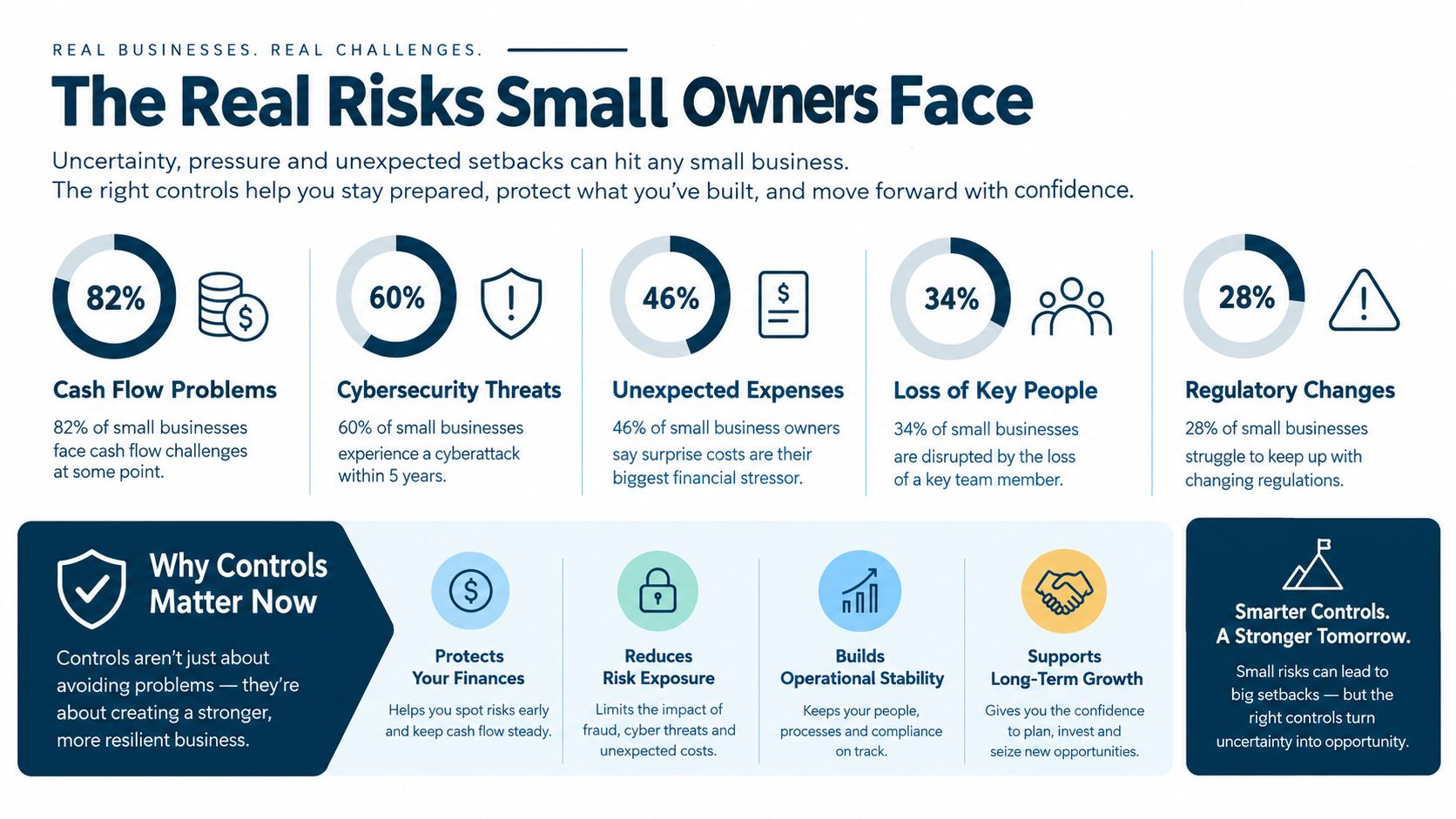
The Real Risks Small Owners Face and Why Controls Matter Now
Small businesses don't need to spend their energy preparing for every complex accounting scheme. The common risks are more ordinary, and they're usually connected to one person having too much access.
The ACFE 2018 Report to the Nations found that organizations with fewer than 100 employees represented 28% of the fraud cases studied, with a median loss of $200,000 per scheme, and lack of internal controls was cited in 42% of cases. At organizations with 100 or more employees, lack of controls was cited in 25% of cases. These figures are summarized with the ACFE findings by ARBCPA's fraud analysis.
A $200,000 loss can be painful for a large company. For a small firm, it can threaten payroll, debt payments, hiring plans, or the owner's ability to take a distribution. The dollar amount matters, but the damage to cash flow and attention matters just as much.
Focus on the risks that actually happen
For a team of five to 30 people, pay close attention to:
- Vendor fraud: A bookkeeper creates a vendor that resembles a real supplier and sends payments to an unauthorized account.
- Payroll leakage: Someone inflates hours, leaves a former employee active, or approves time for a friend without a second review.
- Duplicate vendors: The same supplier appears under slightly different names, making duplicate payments harder to spot.
- Expense abuse: A company card pays for personal travel, meals, or purchases that never get coded back or reimbursed.
- Cash skimming: Receipts, deposits, and accounting records don't agree because one person controls the cash from start to finish.
You probably don't need a complicated fraud laboratory. You need vendor-change verification, approval limits, payroll review, bank reconciliations, and an independent look at exceptions.
Controls also matter before you approach a lender, investor, or buyer. Diligence teams want to know whether your reports are dependable, whether cash movements are explainable, and whether the company depends entirely on the founder. Weak controls can reduce financing options and make an eventual sale harder before you ever see a term sheet.
The Core Controls to Put in Place First
Brightline Office Support has an owner, an operations manager, and two administrative employees. All four people touch some part of the books. The owner wants visibility without becoming the full-time accounting department.
The sequence below is the order I'd use.
Start by splitting duties
Brightline's admin staff can enter bills, but they can't create a vendor and pay that vendor without review. The operations manager checks the invoice and supporting documentation. The owner approves any new payee above the company's chosen threshold. Someone else reviews the bank activity afterward.
This follows the GAO's definition of segregation of duties, which separates authorization, processing and recording, review, and custody of assets. The GAO guidance on separating transaction duties makes the central point clearly: one person shouldn't control every major part of a transaction.
If your team is too small for full separation, use compensating controls. The owner can review the bank statement, vendor changes, and payment exceptions without preparing the transactions.
Put approvals in writing
Brightline routes every invoice above $1,000 through a digital approval queue. The owner approves those invoices, and the operations manager acts as the backup approver when the owner is unavailable. The approval record stays attached to the bill.
Don't rely on a verbal “yes” in a hallway. Write down who can approve purchases, refunds, credit memos, write-offs, and payments. Your accounts-payable process should also explain what happens when an invoice lacks a purchase order or supporting receipt. This accounts payable management guide offers a useful reference for organizing those steps.
Reconcile the accounts monthly
An outside bookkeeper ties Brightline's bank, credit-card, and merchant-processor balances to the general ledger by the 10th of each month. The owner reviews the completed reconciliations and asks about outstanding checks, deposits in transit, unusual charges, and old reconciling items.
The preparer and reviewer shouldn't be the same person when you can avoid it. A reconciliation that nobody reviews is only a completed worksheet, not a reliable control.
Limit system access
Brightline uses QuickBooks Online roles to limit what each person can do. Admin staff can enter bills and attach documents, but they can't change vendor bank details or issue checks. The owner and outside bookkeeper review the user list when staff responsibilities change.
Access should match the job. Remove access promptly when someone leaves. Review audit logs when a vendor record, payment, or payroll entry looks unusual.
Protect vendors and payments
Require a W-9 before setting up a new vendor. When a supplier requests a bank change, call a known contact using a phone number already on file. Don't use the phone number in the change request.
Brightline also uses positive pay with its bank. That gives the bank a defined list of checks to compare before payment. The vendor master file gets reviewed for duplicates and inactive suppliers.
Separate payroll steps
One person approves timecards. Another processes payroll. Brightline then compares gross pay with the bank file for each payroll run and checks the active employee list for former workers or unexpected additions.
Implement these controls in this order:
- Separate vendor setup, payment approval, and bank reconciliation.
- Set written approval limits and attach documentation.
- Complete monthly reconciliations with independent review.
- Restrict QuickBooks Online and banking access.
- Verify vendor changes and protect payment files.
- Separate timecard approval from payroll processing.
That order protects the areas where money leaves the business first. Add complexity only when the risk justifies it.
How Controls Differ Across Services, Healthcare, and Construction
A control checklist can look the same across industries, but the priority changes with the revenue model. A consulting firm worries about billing time and reimbursing expenses. A contractor worries about whether labor, materials, and subcontractor costs belong to the right job.
Control priorities by industry
| Control Area | Services Firm, 15 people | Construction Contractor, 15 people |
|---|---|---|
| Approvals | Review expense reimbursements, owner draws, and large software purchases. | Approve subcontractor payments and purchases tied to progress on a job. |
| Revenue | Match invoices to contracts, time records, and project milestones. | Match billings to approved work, change orders, retainage, and job progress. |
| Cost tracking | Code expenses to the right client, project, or class. | Code labor, materials, equipment, and subcontractor costs to the correct job. |
| Documentation | Keep signed contracts, expense receipts, and billing support together. | Keep certified payroll, lien waivers, delivery records, and approved change orders together. |
| Bank and cash review | Reconcile bank and card activity, then investigate owner-related transactions. | Reconcile bank activity and compare payments with job-cost reports and vendor records. |
A consulting firm may have no inventory and few cash receipts, but a wrong project code can distort profitability. Its most useful controls are expense approval, project billing review, and a clean separation between company spending and owner draws. The project accounting guide explains why those codes matter for service businesses.
A construction company needs tighter control over job-cost allocations and vendor payments. A payment may be valid but still belong to the wrong project, which can hide a margin problem until the job is nearly finished. Require approval tied to progress, collect lien waivers where applicable, and review job costs before releasing payments.
Healthcare practices add another layer. Financial controls should protect billing, payroll, and cash, while access controls also limit who can view patient-linked information. Small retail businesses need reliable POS-to-bank reconciliation, with someone investigating gaps between sales records, deposits, refunds, and card settlements.
The right control is the one aimed at your largest checks, your most valuable data, and the person with the most access.
File sharing deserves attention too. Store invoices, approvals, contracts, and payroll support in a controlled location, not in a shared inbox or an employee's personal drive. For teams handling sensitive documents, OAIC-compliant file sharing provides a useful example of how access rules can support document control.
A 90-Day Phased Rollout Plan You Can Start This Month
Give this plan to your bookkeeper on Monday. The first goal isn't a perfect policy manual. It's to stop one person from moving money without review and to produce financial records you can trust.
Weeks 1 and 2, document the current process
Write down who currently initiates, approves, processes, records, and reviews:
- Vendor setup and bank-detail changes
- Bills, checks, card payments, and electronic transfers
- Payroll and timecard approvals
- Customer receipts and deposits
- Bank, credit-card, and merchant reconciliations
Then lock down online banking roles. No single person should be able to create a payee, release a payment, and reconcile the account without another person seeing the activity.
Weeks 3 through 5, install the highest-value controls
Create a written approval matrix for vendors and payments above your chosen threshold. Require a documented approver and a backup approver.
Start monthly bank and credit-card reconciliations. The person who prepares them shouldn't be the only person who sees them. Run a duplicate-vendor check and compare the payroll register with the active employee list.
Weeks 6 through 9, build the monthly rhythm
Set a close calendar with due dates for reconciliations, accounts receivable review, accounts payable review, payroll checks, and management reporting. Clean the vendor master file by removing duplicates and marking inactive suppliers.
Complete a one-page fraud-risk review. Ask where cash enters, where money leaves, who can change records, and which transactions receive no independent review.
Weeks 10 through 12, make the system visible
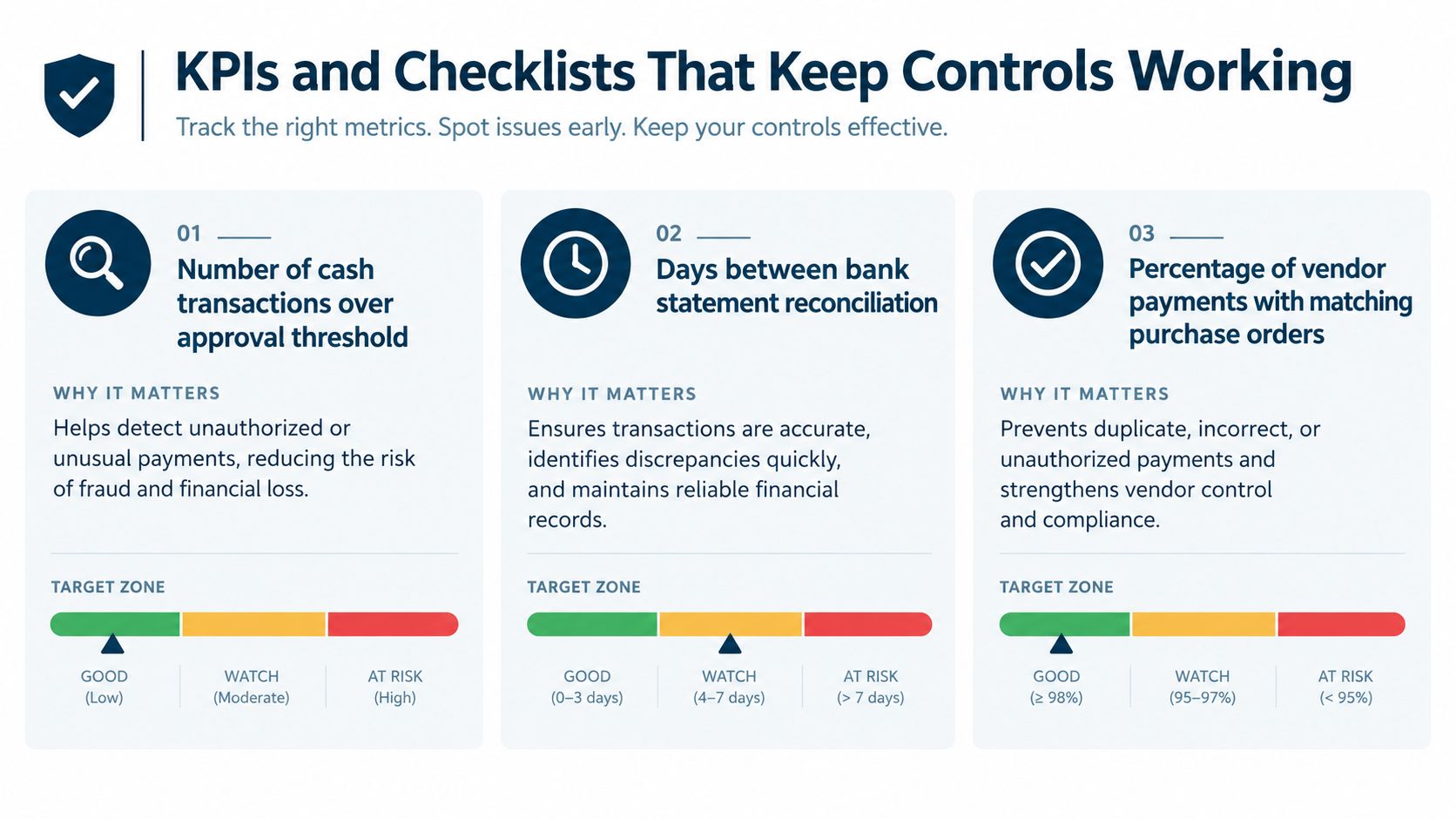
Deliver the first KPI dashboard, a one-page policies checklist, and a quarterly review schedule with the person responsible for finance. The owner should be able to see open exceptions, late reconciliations, unusual payments, and unresolved access issues without opening every transaction.
By day 90, the business should have fewer surprises and clearer numbers without adding headcount. If a control creates work but never changes a decision, simplify it. If a control catches repeated exceptions, strengthen it.
KPIs and Checklists That Keep the System Working
Controls decay when nobody checks whether people still follow them. A contractor can have a written payment policy and still pay the same invoice twice if the vendor list remains messy and no one reviews exceptions.
One small contractor added a dashboard that tracked duplicate vendor records and payment exceptions. The dashboard flagged two vendor records with similar names and the same payment details. A review found that one invoice had been entered twice. The company stopped the second payment before it became a write-off.
Track the signals that expose weak controls
Use a short list of measures:
- Cash approvals: Count cash transactions above the approval threshold that lack a documented approver.
- Close speed: Track the days between month-end and completion of the books.
- Revenue variance: Compare booked revenue with banked revenue and investigate unexplained differences.
- Vendor quality: Review duplicate vendor records and inactive suppliers.
- Payroll accuracy: Compare the payroll register with the active headcount.
- Coding completeness: Track the percentage of expenses assigned to the correct job, class, or project.
Your dashboard doesn't need to become a second accounting system. It needs to point your attention toward exceptions. A metric with no owner is decoration, so assign each item to the bookkeeper, office manager, operations lead, or owner.
Use a monthly checklist
The reviewer should be able to complete these checks in under an hour:
- Reconcile accounts: Review bank and credit-card reconciliations, including old outstanding items.
- Review vendors: Search for duplicates, inactive vendors, and recent bank-detail changes.
- Check payroll: Compare the payroll register with active employees and approved timecards.
- Sample expenses: Review five expense reports for receipts, coding, and approval.
- Confirm access: Check that banking and accounting user roles still match current responsibilities.
If an item stays red for two months in a row, escalate it. The owner should ask why it remains unresolved, who owns the fix, and whether the process needs to change. For a practical explanation of choosing and using operating measures, see this guide to understanding key performance indicators.
When It Pays to Bring in a Bookkeeping and CFO Partner
Outsourced support makes sense when owner-only oversight has stopped working, but a full-time controller or CFO would be excessive. The warning signs are easy to recognize: unreconciled bank accounts, late closes, surprise cash shortages, unclear vendor changes, inconsistent payroll, or a lender asking for cleaner reporting.
A bookkeeping partner can own the daily mechanics. That includes transaction coding, reconciliations, bill pay controls, payroll handoffs, open-item tracking, and the month-end checklist. The owner still approves major decisions, but the owner no longer has to remember every unfinished accounting task.
A CFO advisor works at the next level. The advisor interprets the reports, improves cash forecasting, prepares lender reporting, tests whether controls match actual risks, and connects financial discipline with pricing, hiring, profitability, and growth decisions.
Match outside support to the business
For a services firm, the partner might separate invoice approval from payment release and review the monthly close. For construction, the work may center on job-cost reporting, subcontractor approvals, progress billing, and cash timing. For healthcare, the partner can help protect patient-linked billing workflows while keeping accounting access limited to appropriate staff.
The engagement should produce clear accountability:
- Named owners: Every control has one person responsible for completing it.
- Documented exceptions: Unusual payments, missing receipts, and late reconciliations get recorded.
- Review dates: The owner or advisor checks whether the control still fits the business.
- Escalation paths: Staff know who to contact when a payment or vendor request looks wrong.
- Staff training: Employees understand both the procedure and the reason behind it.
This structure supports lender confidence because the records show more than clean totals. They show how transactions were approved, reviewed, and explained. It also supports diligence and eventual exit value because a buyer is less likely to see the company as dependent on one founder holding every financial detail in their head.
MyOfficeOps offers bookkeeping, payroll integration, financial analytics, and CFO-level advisory for small and midsize businesses. Its work can include reconciliations, bill pay, forecasting, KPI dashboards, profitability analysis, and exit-readiness support, which fits an owner-light control model without adding unnecessary bureaucracy.
If your bank reconciliations are late, vendor approvals are informal, or your lender wants cleaner reporting, start with a practical review rather than another spreadsheet. Visit MyOfficeOps to discuss bookkeeping and CFO support that can document your controls, maintain reliable monthly reporting, and help you build a business that is easier to finance or sell.