
You can have a full schedule, a solid crew, and jobs that look profitable on paper, then spend Friday night wondering why the bank balance says something else. That's the part most owners in construction, agencies, and clinics know too well. The work gets done, invoices go out, and still the cash feels tight.
That gap is where project accounting earns its keep. Done right, it shows what each job is really doing, not just what the company looks like as a whole. It gives you a cleaner grip on labor, materials, vendor bills, and the money tied up between doing the work and getting paid.
The Profit on Paper Problem
A contractor in the Philly suburbs can wrap up a solid month and still come up short on payroll. An agency owner can close a few strong retainers and still be chasing vendor bills. A clinic can open a new service line and find the cash flow messier than the headline profit suggests. I've seen all three, and the same problem keeps showing up, the books tell a company story while the owner needs a job story.
Project accounting is a job-level cost capture system that isolates revenue, labor, materials, equipment, and overhead to a specific project instead of lumping everything into the company total. Microsoft's project management accounting guidance says projects group transactions that record costs and post them to the general ledger, which makes project-level visibility part of the accounting design, not a nice extra Microsoft project management accounting guidance. That matters because a job can look fine on a broad P&L and still bleed margin if indirect costs or unbilled time never get assigned where they belong.
The trap is the cash-vs-profit gap. Profit on paper does not pay electricians, designers, or medical staff, and it does not cover materials already bought, vendor bills already due, or time already spent waiting on client payment. I've watched owners rely on month-end reports and miss the simple fact that the job is profitable after the work is done, but the bank account is strained while the work is still in motion. If you want the cash side to make sense, pair project reporting with a plain reading of a cash flow statement, using this guide to reading a cash flow statement as a companion when the numbers say the business is healthy but the checking account says otherwise.
What owners usually miss
- The job looks busy, so it must be healthy. Busy does not pay the bills if labor is landing in the wrong place.
- The invoice went out, so the money is basically earned. Timing still matters, and slow collections can bury a good job.
- The company P&L looks okay, so the job must be okay. That is how bad margin hides until closeout.
The fix starts with cleaner job codes and stricter cost assignment. If you can't point to a project code for a cost, it will drift into the wrong bucket and blur the truth. That is also how owners end up trying to prep financials for a route sale later, only to discover the books never told the full story in the first place.
That is why I do not treat project accounting as bookkeeping theater. It tells you which jobs deserve more work, which ones need a change order, and which ones are eating your margin before the damage turns into a cash problem.
Project Accounting vs Regular Accounting
Regular accounting asks one big question, how did the whole company do this month? Project accounting asks a sharper one, how did this specific job do, and is it still worth doing? That difference sounds small until you're staring at a renovation, an engagement, or a rollout that looked fine at kickoff and turns ugly by week six.
Think of regular accounting like a pizza shop. You care about the store as a whole, cash register totals, food cost, rent, payroll, and whether the business made money overall. That works when the product is repeated and the workflow is steady.
Now think of project accounting like a custom home build. Every job has its own estimate, schedule, labor mix, vendors, and change orders. You don't just want to know whether the company is healthy, you want to know whether the Westgate renovation, the client rollout, or the clinic buildout is paying its own way.
Why the split matters
Project accounting works by putting financial activity onto the project level instead of the whole company, so expenses and revenue are assigned to the job rather than only to a department or the business overall Study.com project accounting principles. That structure helps you catch budget problems early. NetSuite describes it as a way to monitor financial progress, analyze variances, and warn when a project is going over budget NetSuite project accounting concepts.
For service firms, contractors, and clinics, that distinction is the whole game. A company can be busy all month and still lose money on the wrong mix of jobs. Project accounting forces the question regular accounting can't answer well enough, which job made money, which one only looked good, and which one needs help before it gets worse.
A simple mental shortcut works here, regular accounting is the company scoreboard, project accounting is the job ticket. You need both, but if you're running job-based work and only watching the scoreboard, you're driving with one eye closed.
The Six Pieces of a Working Project Accounting System
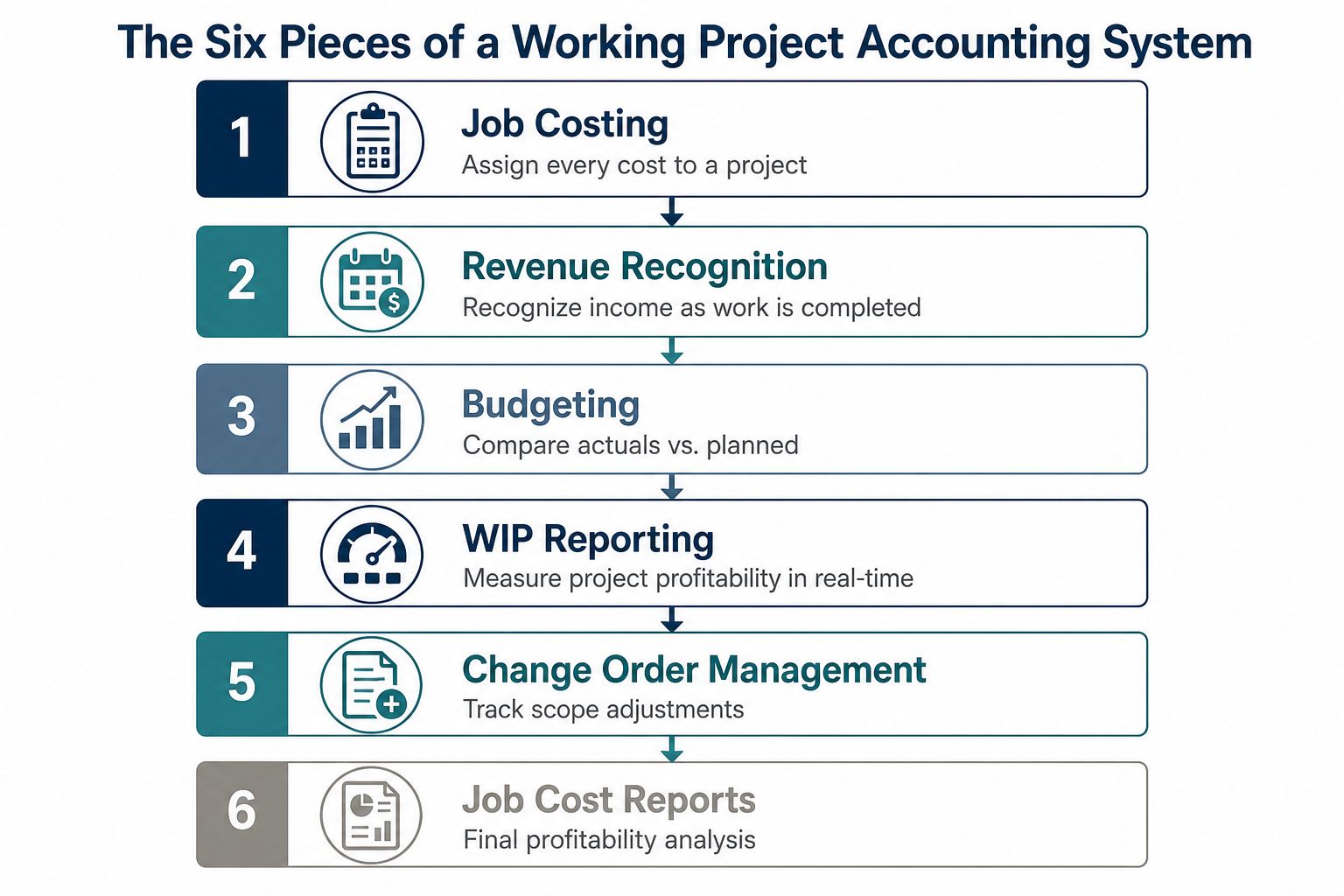
A working setup is not magic, and it is not a stack of reports nobody reads. It is six parts that have to line up, or the whole thing turns into noise.
1. Job costing
Job costing means every dollar lands on the right project. That includes labor, materials, subcontractors, equipment, and the overhead you choose to assign. In construction, that can also include employee wages, materials, capital equipment, and permit costs Indeed job accounting overview.
The rule is simple. If a crew spends two days on Job A and one day on Job B, the payroll split has to follow the work, not the calendar. If it does not, Job A looks better than it is and Job B looks worse than it should.
2. Revenue recognition
Revenue recognition answers when the work counts as earned. That matters because a technically strong process depends on accrual-based revenue and cost recognition, so profitability follows economic activity instead of cash timing.
If a consultant has finished half the deliverables on a fixed-fee engagement, the books should reflect progress, not just the invoice date. Waiting for cash alone hides work-in-progress risk and makes a busy project look healthier than it is.
3. Billing models
Fixed fee, time and materials, milestone billing, and cost-plus all change how the ledger behaves. A fixed-fee job needs tight scope control. A time-and-materials job needs clean hours and rates. Milestone billing lives or dies on the timing of approvals.
4. Time tracking
If labor is the main cost, time tracking is not optional. It is the proof behind the job cost. For agencies and law firms, one missed week of time entries can wipe out the usefulness of the month's reports.
5. Work-in-progress reporting
WIP tells you where the job stands before the final invoice lands. It shows whether you are ahead, behind, overbilled, or underbilled. That is the number management should check before it checks the mood in the office.
6. Job cost reports
The final job cost report closes the loop. It compares budget, actuals, and revenue so you can see whether the work was worth doing again.
If your team is still using spreadsheets and scattered job notes, a practical guide for project cost control can help you tighten the tracking side without overcomplicating the process. For the planning side, project budget tracking matters just as much as the ledger.
Bottom line: If the system cannot show committed, incurred, and remaining cost, it is not a real project accounting setup yet.
Managers and accountants also use project accounting to send regular reports showing whether the project is on track financially, tying billing and revenue to a specific project rather than the company as a whole. That is the kind of report a foreman, account manager, or office manager can act on.
How a Project Moves Through the Books
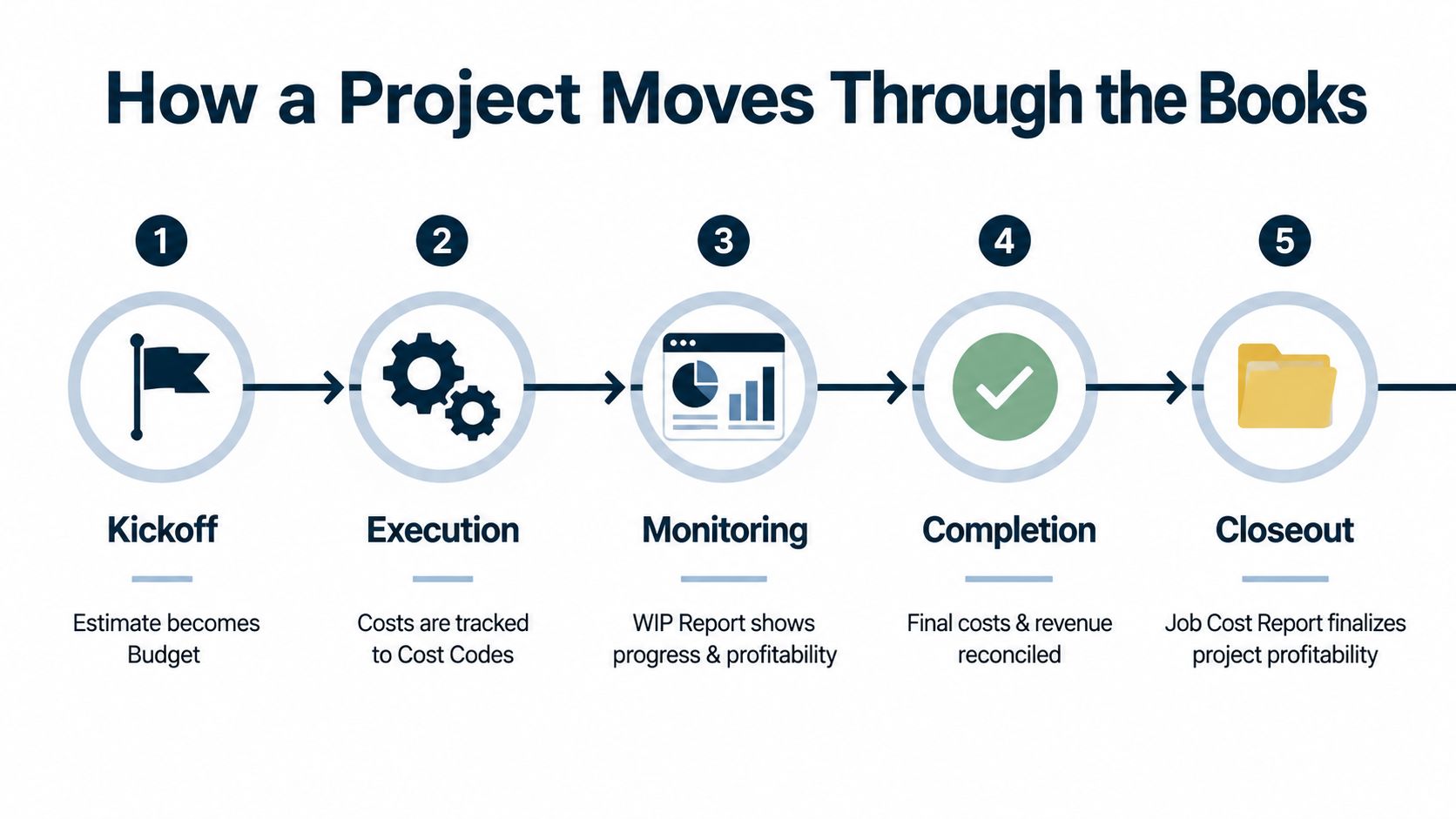
A job starts as an estimate, then turns into a budget, then turns into cost codes that people either use or ignore. The difference shows up fast. If the team does the work as it happens, time gets entered daily, vendor bills land in the right bucket, and invoices follow the billing cadence. If the team waits until month-end, the books start to drift, and the project gets harder to trust.
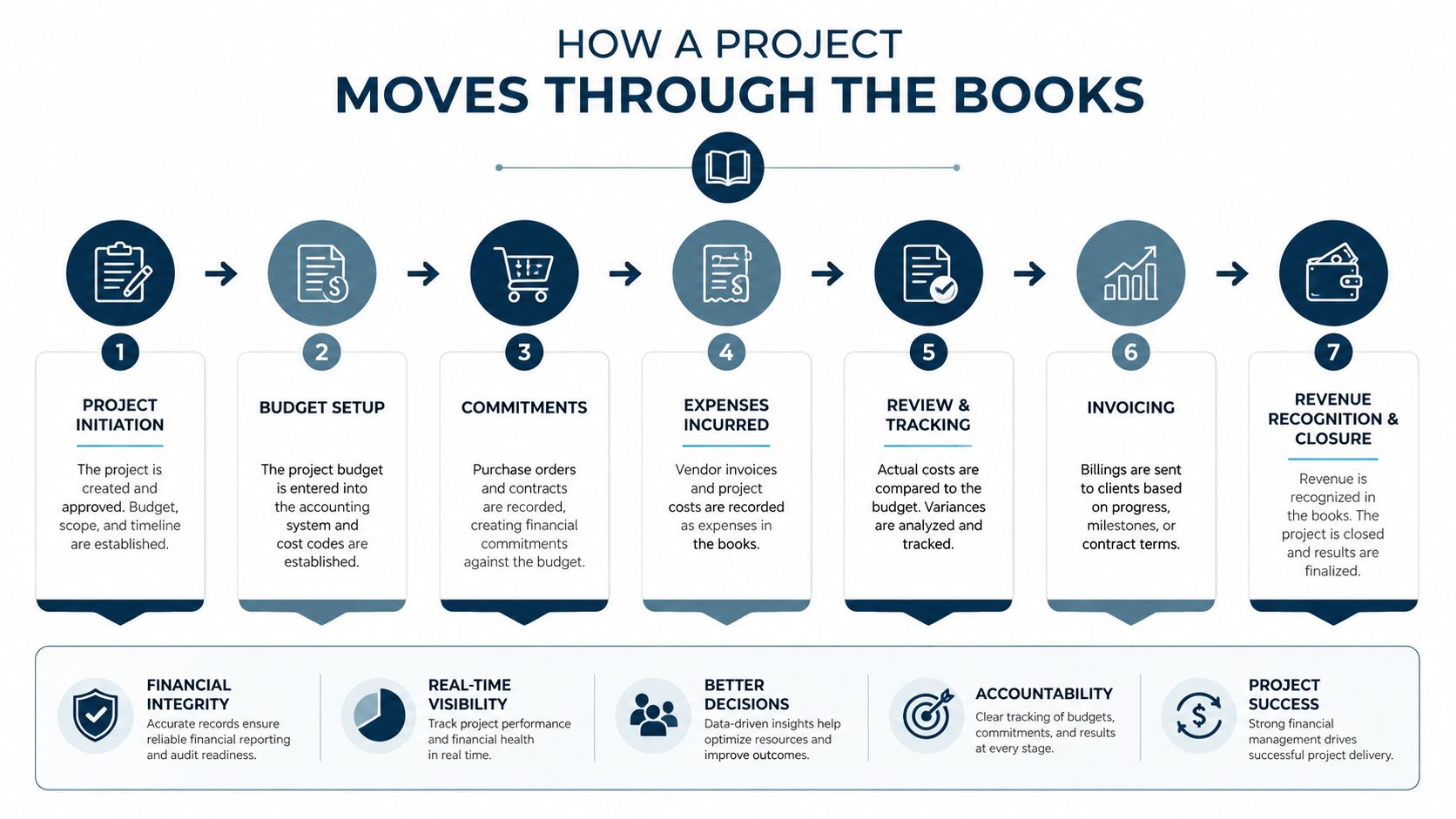
The leaks are usually plain to see once you know where to look. Late change orders are the first one. The crew keeps working, the scope has already shifted, and nobody updates the budget fast enough. The project then looks leaner on paper than it really is.
Unbilled time is the second leak, and it hits hard at month end. I have watched office teams miss clean billable hours because the entry was never made, the approval came in late, or somebody assumed the next month would clean it up. That is how underbilling sneaks in and stays there.
Closeout is the third weak spot. Open purchase orders, old accruals, uncoded receipts, and missing vendor credits can all throw off the final job cost report. By the time the job wraps, you do not get a second chance to make the margin look better.
If you want the books to hold up, the rhythm has to be strict. Start with a solid job costing setup, then keep costs coded while the work is still moving. Review WIP every month. Finish with a hard job-cost check at closeout. That cadence catches leaks before they turn into excuses.
Keep the cadence boring. Boring books catch problems early.
That monthly rhythm matters more than fancy reports. Estimate to budget at kickoff. Costs go in as the work happens. WIP gets reviewed monthly. Then the final job-cost check closes the loop. Owners who stick to that pattern stop getting surprised by jobs that looked fine until they did not.
How It Looks in Construction, Services, and Healthcare
A project accountant in the field has one job: keep each line of work separate enough that the margin means something. In construction, that usually starts with the job itself. Every build has a defined scope, a cost trail, and a finish line, so wages, materials, equipment, and permit costs need to land on the right job code. If they do not, a project that looked healthy from the outside can turn thin fast. On a draw-based job, the books should show what has been spent, what has been billed, and what is still waiting to be invoiced.
That same discipline matters outside construction, but the numbers look different. In a marketing agency or law firm, the pressure shows up in time entries, utilization, retainers, and fixed-fee work that keeps running after the invoice goes out. The books have to show which clients are eating more hours than planned and which engagements are sliding into underbilling. That is the difference between busy and profitable.
Healthcare adds another layer. A clinic rolling out a new location, service line, or grant-backed program needs project codes that keep the rollout separate from day-to-day care. If those costs get buried in overhead, nobody can tell whether the new initiative is carrying its weight or just burning cash in the background.
What to watch in each setting
- Construction: job codes, draws, vendor bills, and permit costs.
- Professional services: hours, scope changes, and retainer burn.
- Healthcare: service-line codes, rollout costs, and grant or program tracking.
If you want a clean definition of how labor and materials land on the job, what job costing means in practice is worth reading before you redraw the chart of accounts.
The point is simple. The industry changes, but the bookkeeping discipline stays the same. A good bookkeeper asks what kind of work you sell before setting up the books, because the right project codes, billing rhythm, and reporting structure have to match the work you do. That is what keeps project accounting useful instead of decorative.
Why Profitable Jobs Still Drain Your Bank Account
A job can show profit and still leave you short on cash. That happens when the money arrives on a different schedule than the costs. If you bill slowly, hold retainers until closeout, or wait on approvals before sending the next draw, the project can look healthy while the bank balance says otherwise.

A contractor can be 60 percent complete, have billed 45 percent, and still be waiting on a $90,000 draw. The job may look fine on the profit report. Payroll and vendors do not care about that report. They need cash, and they need it on time.
That gap is where owners get burned. The work is moving, the margin may still be there, and the checkbook is empty because the timing is wrong. Project accounting is supposed to keep billing and revenue tied to the specific project, with regular reports showing whether the work is on track financially. But a report does nothing if the billing cadence is weak and the cash sits outside the door.
Two moves that actually help
- Bill more often. If the client agrees to monthly or milestone billing, use it. Do not let completed work sit unbilled because someone wants a prettier package first.
- Use deposits where the risk is real. Long vendor lead times and early material purchases need cash up front, not hope.
The part most explainers skip is simple. Project profit and cash collected are not the same thing. A profitable job can still squeeze your operating account hard, especially in construction and service work where payroll does not wait for client approval. If you ignore that gap, growth turns into a funding problem fast.
Build, Outsource, or Modernize
A 10-to-50-person firm can run basic project accounting in QuickBooks Online with the right job-costing add-on, clean cost codes, and monthly review. The part that usually breaks is not the software, it's discipline, because someone still has to keep the coding clean, reconcile WIP, and force the closeout report to happen on time.
If the work is getting more complex, an outside partner makes sense. MyOfficeOps handles bookkeeping, financial reporting, payroll integration, and advisory work for firms that need project-level visibility without hiring a full internal finance team. That matters more now because Deloitte's 2025 CFO survey found 61 percent of finance leaders say AI is transforming finance, and 46 percent expect it to be within five years. AI can speed up forecasting and exception checks, but it won't fix a bad setup.
Pick your cost codes. Set a monthly job-cost review. Decide who owns WIP. Do those three things before you buy more software.
If you want cleaner job-level books without building the whole thing yourself, MyOfficeOps can set up the reporting, cost tracking, and monthly review rhythm around the way your firm works. Visit MyOfficeOps and get help turning project numbers into something you can use before the next job starts slipping.