

When you hear “business mileage rate,” think of it as a simple number the IRS gives you. It's meant to cover what it costs to use your own car for work. This isn't just about gas. The rate also covers things like oil changes, insurance, new tires, and the normal wear and tear on your car.
What Business Mileage Rates Mean for Your Wallet
Every time you drive your car for work, it costs you money in little ways. Each mile wears down your brakes, uses up a tiny bit of oil, and gets you closer to needing new tires. The business mileage rate rolls all those small costs into one simple, per-mile number.
For a small business owner, this is a great tax deduction. Instead of saving every single gas receipt and repair bill, you just need to track the miles you drive for business. At tax time, you multiply those miles by the standard rate. That gives you a deduction that lowers the amount of income you pay taxes on.
If you're an employee, your company might use this rate to pay you back for using your car. Let's say you drive from your office in West Chester to meet a client in Philadelphia. Your boss would use the standard rate to figure out how much to reimburse you for that trip, and that money is usually tax-free.
Why This Little Number Matters So Much
A few cents per mile might not sound like much, but it adds up fast. Imagine you're a consultant and you drive 1,000 miles for work every month. That deduction can make a real difference to your finances over the year.
The IRS changes this rate sometimes to keep up with the real costs of owning a car, like changing gas prices. For example, some people think the 2026 IRS mileage rate might go up by 2.5 cents per mile. If you're a salesperson who drives 15,000 miles a year, that's an extra $375 in your pocket. If a small business has five employees who drive that much, that's an extra $1,875 they need to plan for. You can find more details on predictions like these on sites like Expensify.com.
Think of it this way: Each business mile you drive is like putting a few cents back into your pocket. If you forget to track your miles, you're basically throwing away money.
Understanding the business mileage rate helps you in a few ways:
- It makes bookkeeping easier. You don't have to save every car-related receipt.
- It lowers your tax bill. As a business owner, it’s a simple way to save money.
- It makes sure you're paid back fairly. As an employee, you get the right amount for using your own car.
Paying attention to business mileage rates is one of the smartest and easiest money moves you can make, whether you own the company or just drive for it.
Calculating Your Deduction the Easy Way
Figuring out your mileage deduction is pretty simple. You don't need a fancy calculator to get it right. It all comes down to the standard mileage rate—a set amount per mile that the IRS allows you to write off.
The formula is super easy:
Business Miles Driven x The Standard Rate = Your Deduction
That’s it. For every mile you drive for business, you get to deduct that amount from your income. But first, it helps to understand what is a deductible in general. Knowing that makes it clear why tracking your miles is so valuable.
Putting the Formula into Action
Let's look at a couple of real-world examples to see how this works for small business owners.
Imagine you're a freelance photographer. You drive 20 miles from your home office in West Chester to downtown Philadelphia to meet a new client. For that one trip, you would just multiply those 20 miles by the current business mileage rate to get your deduction.
Or think about a contractor who has a few different job sites:
- Trip 1: Drives 15 miles from his home office to a job in King of Prussia.
- Trip 2: Drives 10 miles from that job to a store to pick up supplies.
- Trip 3: Drives 25 miles back to his home office.
In one day, that contractor drove 50 business miles (15 + 10 + 25). He would multiply 50 by the standard rate to get his deduction for the day. It’s that easy.
Here's the official breakdown of the standard mileage rates directly from the IRS.
As you can see, the table clearly lays out the specific rates for business, medical, moving, and charitable driving, so you always know you're using the right number.
What the Standard Rate Covers (and What It Doesn't)
One of the best things about the standard mileage rate is that it’s simple. The IRS made the rate to cover all the usual costs of using your car for work.
Think of the standard rate as a package deal. It includes gas, maintenance like oil changes, insurance, registration fees, and even the value your car loses over time (which accountants call depreciation).
This means you don't have to keep a shoebox full of receipts for gas or new tires. But it's important to know what the rate doesn't cover.
- Parking Fees: If you pay to park for a client meeting, that’s a separate deduction.
- Tolls: Any tolls you pay during a business trip can also be deducted separately.
- Car Washes: These usually aren't deductible unless you can prove it was absolutely necessary for your business (which is hard to do).
So, while you track your miles, keep separate records for those extra costs like parking and tolls. You can deduct them in addition to your mileage.
This method is the most popular one for a reason—it’s simple and means less paperwork. But it’s not your only choice. There’s another way called the "actual expense" method, where you track every single car-related cost. We'll talk about that next to help you decide which one is better for you.
Choosing Your Best Deduction Method
When you write off your car expenses, the IRS gives you two main choices: the Standard Mileage Rate or the Actual Expense Method. Think of it like ordering at a restaurant. The standard rate is like a combo meal—simple and one price. The actual expense method is like ordering everything separately and adding up the bill yourself.
The Standard Rate is the easy choice. You just track your business miles and multiply that by the IRS rate for the year. It's perfect if you're busy and drive a car that doesn't cost a lot to run.
The Actual Expense method is for the business owner who likes details and doesn't mind extra paperwork. With this method, you track every single cost for your car—gas, oil changes, tires, insurance, repairs, registration, and even the drop in your car's value over time (depreciation). It’s more work, but sometimes it can give you a bigger deduction.
Comparing Mileage Deduction Methods
So, which one is right for you? It usually depends on your car and how much time you want to spend on bookkeeping. This table shows the main differences.
| Feature | Standard Mileage Rate | Actual Expense Method |
|---|---|---|
| Simplicity | High. Just track miles and multiply. | Low. You have to track every single car expense. |
| Recordkeeping | You need a detailed mileage log. | You need a mileage log and receipts for all expenses. |
| Best For | Cars that get good gas mileage, busy owners, people who drive a lot. | Cars that are expensive to run (like big trucks or luxury cars), people who don't drive a lot. |
| Depreciation | A bit of depreciation is already included in the rate. | You can deduct the actual depreciation of your car separately. |
| Flexibility | You can switch to the Actual Expense method later. | You usually can't switch back to the Standard Rate for that same car. |
If you have a newer, more expensive car or a vehicle with high costs (like a big work truck that uses a lot of gas), the extra work of the Actual Expense method might be worth it. But if you drive an older, fuel-efficient car, the standard mileage rate is often the smarter and much simpler choice. You get a good deduction without the headache of saving every receipt.
This decision tree helps you see how simple the standard rate is for your business mileage deduction.
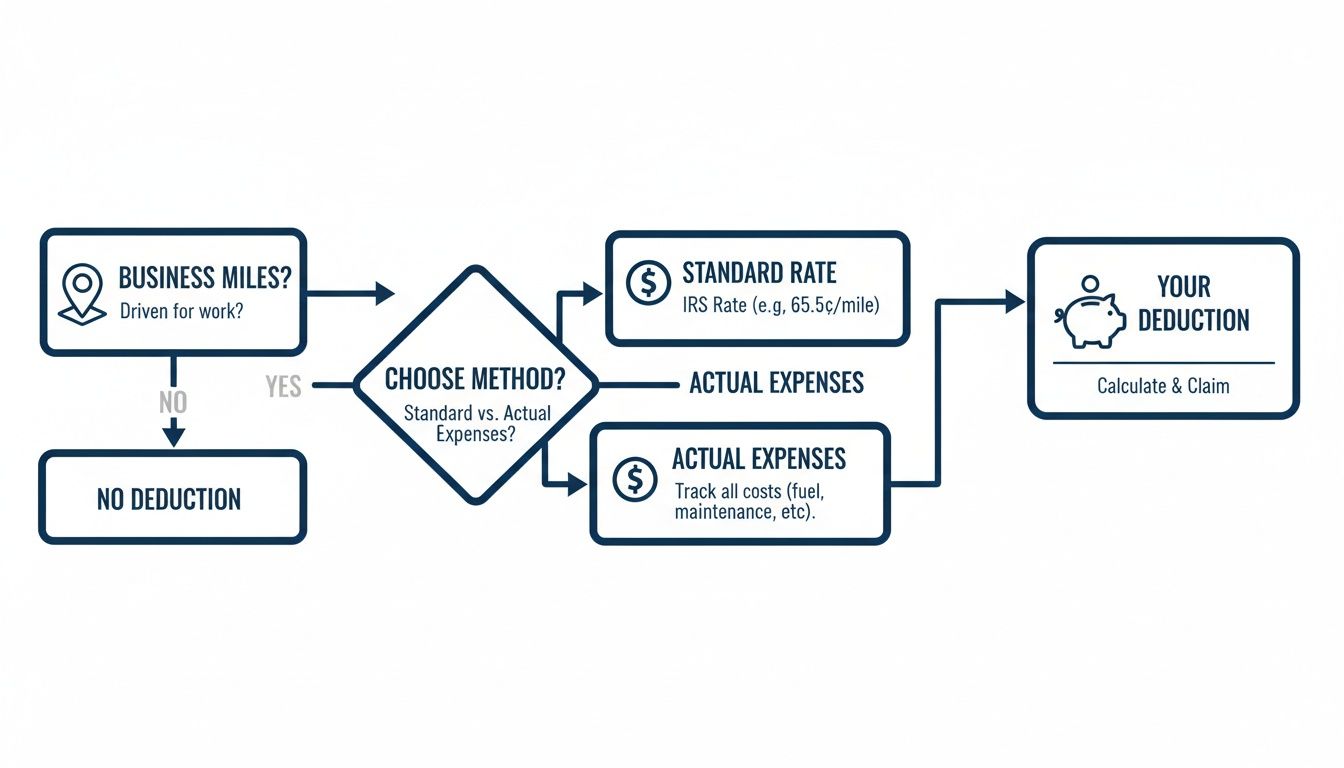
As you can see, the standard method turns your business miles right into a deduction, which makes the whole thing easier.
A Look at Real-World Scenarios
Let's imagine two local business owners to see how this works.
Scenario 1: Sarah the Consultant. Sarah drives her Toyota Camry to meet clients around Chester County. Her car gets good gas mileage and doesn't need many repairs. For her, the Standard Rate is the obvious choice. She uses an app to track her miles, and at the end of the year, her books are clean and simple. The time she saves is more valuable than any small extra deduction she might get.
Scenario 2: Tom the Contractor. Tom uses a big Ford F-250 to haul tools to job sites all over the Philly area. His truck's fuel, maintenance, and insurance costs are high. In his case, adding up all those actual costs will almost definitely give him a bigger deduction than the standard rate. For Tom, the extra paperwork is worth the money he saves on taxes.
Here's a key rule: you have to pick one method the first year you use your car for business. You can switch from the Standard Rate to Actual Expenses later, but you usually can't switch from Actual Expenses back to the Standard Rate for that same car.
Choosing the right method from the start is important. For more ideas on write-offs, you can check out our list of small business tax deductions to see how mileage fits into your overall finances.
Besides these two methods, there are other options. For instance, some businesses look into the tax benefits of a business lease Tesla, treating the car as a lease expense instead of a mileage deduction. This is becoming more common as electric cars change what "actual expenses" means.
How to Keep a Mileage Log the IRS Will Love
When it comes to business mileage, the IRS wants proof. If your log is messy, incomplete, or you don't have one at all, your deduction could be denied if you get audited.
Think of your mileage log as your evidence. It’s what proves your driving was for business and earns you a tax write-off.
The good news is that keeping a log the IRS will approve isn't hard. You just have to be consistent. The trick is to make logging your miles a habit, just like grabbing your keys before you leave.
The Four Essential Pieces of Information
For every business trip, your log needs four specific details. If you miss one, the IRS might say the whole entry doesn't count.
- The date of the trip. This is simple but important for creating a clear record.
- The total miles you drove. This can be the round-trip distance or two separate entries for the drive there and back.
- Your destination. Be specific. "Philadelphia" isn't enough. "123 Market St, Philadelphia, PA for client meeting" is what they want.
- The business purpose of the trip. Why did you drive there? Be clear. "Meeting with ABC Corp," "Site visit," or "Picking up supplies" are all good examples.
That’s it. Get these four things for every trip, and you’ll have a solid, audit-proof record.
Choosing Your Mileage Logging Tool
How you record your miles is up to you, as long as the records are accurate and up-to-date. You don’t need a fancy system; you just need one you'll actually use.
Here are the most common options I see people use:
- A Simple Notebook: A small notebook kept in your car's glove box works perfectly well. Just remember to write down the details after each trip.
- A Digital Spreadsheet: You can use Google Sheets or Excel to make a simple log. This makes it easy to add up your miles at the end of the year.
- A Mileage Tracking App: This is the most popular and easiest method now. Apps like MileIQ or Everlance use your phone's GPS to automatically track your drives. All you have to do is swipe to label each trip as business or personal.
No matter what you choose, the habit is what matters. The IRS likes to see records that are made at the time of the trip, or soon after.
Waiting until the end of the year to try to remember all your trips is a bad idea. It's easy to make mistakes, and it looks suspicious to the IRS. A log that is updated daily or weekly is much better.
By keeping good records, you can easily defend your deduction. For more on this, check out our guide on mileage rates for employees, where good logging is just as important for getting paid back.
Why Do Business Mileage Rates Change Every Year?
The business mileage rates from the IRS aren't just random numbers. The rate is the IRS’s best guess at what it really costs you, on average, to drive one mile for your business. Because the real-world costs of owning a car are always changing, the rate has to change, too.
This is why you can’t just use last year's rate for this year's budget. One year, the rate might not change much. The next, it could jump up, especially if gas prices go crazy. These changes affect your business, whether you’re taking a tax deduction or paying your employees back.
The Main Drivers Behind Rate Changes
So, what makes the IRS change the rate? It comes down to a few key things that affect every car owner. The IRS looks at data on these costs to keep the standard rate fair.
A few of the biggest factors are:
- Fuel Prices: This is the most obvious one. When gas prices go up or down, the mileage rate often follows.
- Inflation: Inflation affects the cost of everything, from oil changes and new tires to your car insurance. The rate changes to keep up.
- Vehicle Depreciation: Cars lose value over time, and the standard rate includes a small amount to cover this. The speed at which cars lose value can also change.
By watching these trends, the IRS tries to make sure the business mileage rates are close to your actual costs.
A Look at Recent Trends
You don't have to look back very far to see this happening. For years, the changes were small and steady, but lately, they've been bigger. For instance, the rate was just 54.5 cents per mile in 2018. It has gone up a lot since then, with some of the biggest jumps between 2021 and 2025.
This lines up with a time of high gas prices and inflation that made owning a car more expensive. You can see the history of the rates for yourself on the IRS website.
What this means for your business is simple: you can't assume last year's mileage rate will work for next year's budget. Watching for the new rate each year is just smart planning.
Let’s say you’re a consultant who drives to see clients all over the Philadelphia suburbs. Knowing the rate might go up helps you price your services correctly for the next year. You can build those travel costs into your prices so you don't lose money.
For businesses with a team on the road, knowing about these changes helps you budget for payroll. Staying informed helps you plan ahead so that rising car costs don’t hurt your profits.
Connecting Your Mileage Log to Your Business Finances
Keeping a mileage log can feel like another chore. But it’s a key piece of your business's finances. Once you have a record of the miles you've driven, that information needs to go somewhere.
Those numbers don't help you if they just sit in a notebook or an app. You have to enter them into your bookkeeping system, like QuickBooks, Xero, or whatever you use. This is the step that officially turns your miles into a real tax deduction that saves you money.
It’s about connecting your daily drives to your company's finances. When you log a trip, it directly affects your profit and loss statement and gives you a better idea of how your business is really doing.
From Your Logbook to Your Financials
Think of your mileage log as the raw numbers and your accounting software as the machine that turns it into savings. To make your mileage deduction official, you have to record it as a business expense.
For someone who is self-employed, this is often done by creating a journal entry. You'd add an expense to an "Auto Expense" or "Mileage Expense" account. This puts the expense on your books without any actual cash being spent.
This simple accounting step is what turns your miles from just a number into something that lowers your tax bill. It’s the bridge between driving your car and keeping more cash in your business.
If you don't record these miles in your financial system, it’s like you never tracked them at all. This is a common mistake, but it's easy to fix. For more help, check out our guide on how to track business expenses the right way.
Handling Employee Reimbursements
If you have employees driving their own cars for work, the process is a little different but just as important. Your team will give you their mileage logs, and you'll pay them back through your payroll system.
This isn't just about giving them cash. For the reimbursement to be tax-free to the employee, it has to be part of what the IRS calls an accountable plan. This just means you need to follow a few simple rules:
- The driving must be for business reasons.
- Employees must report their mileage to you in a timely manner (this is where their mileage log comes in).
- Employees must return any extra money if you gave them cash upfront.
When you do this correctly through payroll, the money your employees get for their miles isn't considered wages and isn't taxed. It’s a clean, tax-free payment for using their own car, which is a win for both your company and your team.
Got Questions About Business Mileage? We've Got Answers.
When it comes to tracking drives for business, a few questions always come up. Getting the rules right is about making sure you get the full deduction you deserve. Let's clear up some of the most common questions I hear from small business owners.
Can I Deduct My Commute to Work?
This is the big one, the question I hear most often. The IRS is very clear on this: no. Your drive from home to your main office or workplace is a personal commute, and those miles are never deductible.
But things change if you have a home office. If your home office is your main place of business, the rules are different.
Let's say you're a consultant and your main office is in your home in West Chester. When you drive from that home office to a client meeting in Philadelphia, that trip is 100% deductible. The key is whether you're driving to your main office (which is a commute) or from your main office to another work location (which is a business trip).
What if I Forget to Log a Trip?
It happens. You have a busy day, and you realize you forgot to log any of your drives. While it’s always best to log your miles as you go, a forgotten trip isn't a total loss.
As soon as you remember, try to recreate the trip details. Look at your calendar, emails, text messages, or even credit card receipts from a store you stopped at to piece it together. A carefully reconstructed log made the next day is much better than nothing.
The IRS prefers "contemporaneous" records—logs made at or near the time of the trip. The more consistent you are, the more trustworthy your entire mileage log will be if you're ever audited.
This is where technology can really help. Using a GPS mileage app on your phone, like MileIQ or Everlance, can solve this problem. These apps track your drives for you. Later, you just have to swipe to mark them as business or personal. It's a great fix for those "oops, I forgot" moments.
Do I Need Gas Receipts if I Use the Standard Rate?
Nope, and this is one of the best things about using the standard mileage rate. It was designed to make your life easier by rolling all of your main car costs into one simple, per-mile number.
This single rate covers all of these things:
- Gas and oil
- Insurance
- Registration fees
- Repairs and maintenance (like new tires or an oil change)
- Depreciation (the value your car loses over time)
Since all of that is included in the rate, you don’t need to keep a shoebox full of receipts for any of it. Your only job is to keep a good mileage log.
However—and this is important—you should definitely keep receipts for any driving costs that are not covered by the rate. You can deduct these separately, in addition to your mileage. The two most common examples are parking fees for a client meeting and any tolls you pay during a business trip. Make sure you hang on to those receipts!
Does the Business Mileage Rate Apply to Electric Vehicles?
Yes, it does. The standard business mileage rate is the same whether you drive a gas-guzzling truck, a hybrid, or a fully electric vehicle (EV). The IRS has not created a special rate for EVs.
This can be a hot topic for EV owners. The costs of running an EV are very different—no oil changes, and electricity is often cheaper per mile than gas. Some drivers feel the standard rate doesn't quite match their costs. For example, charging an EV at home might cost only $0.05 per mile, while the standard rate gives you a much bigger deduction.
If you drive an EV, you have the same choice as anyone else. You can take the simple standard mileage rate and probably come out ahead, or you can use the actual expense method. With that method, you’d track and deduct costs like your home charging station, the electricity used for charging, insurance, and the car's depreciation.
Feeling like you're trying to connect the dots between your mileage, expenses, and overall business finances all on your own? You don't have to. At MyOfficeOps, we help small business owners in the Philadelphia area turn confusing financial data into clear, actionable insights. Schedule a discovery call with us today and see how we can give you the financial clarity you need to get back to growing your business.