

You're probably not searching “financial analyst consultant salary” for fun.
You're searching because something in the business feels tight. Cash flow is uneven. Payroll keeps rising. You're making decisions about pricing, hiring, or expansion with reports that tell you what happened last month, but not what to do next. You know you need sharper financial help, but you don't know what that help should cost, or whether it should be a hire at all.
That's the real issue for a lot of owners around Philadelphia and West Chester. Not “What does an analyst make?” but “What's the smartest way to buy financial brainpower without locking myself into the wrong overhead?”
Salary benchmarks matter because they provide a strategic map. They help you distinguish between a reasonable investment and an expensive mistake. They also help you avoid hiring a full-time employee when what you need is focused, senior-level help for forecasting, margin review, job costing, or lender-ready reporting.
Why Understanding Analyst Salaries Matters for Your Business
A common small business problem looks like this. Revenue is coming in, but cash still feels unpredictable. The owner wants to hire, open another location, buy equipment, or stop worrying every Friday about what's clearing the bank.
At that point, bookkeeping alone usually isn't enough. You need someone who can pull the numbers apart, explain what they mean, and show what happens next if you raise prices, add labor, or take on debt.

The cost question usually stops owners first
Most owners don't hesitate because they doubt the value of financial insight. They hesitate because the cost feels fuzzy.
If you've ever thought, “I know we need help, but I don't know if this is a $70,000 problem, a $100,000 problem, or an hourly consultant problem,” that's normal. Salary data clears that up fast. It gives you a starting point for planning, not guessing.
The other reason this matters is hiring timing. If you hire too early, you carry fixed payroll before the business is ready. If you wait too long, bad pricing, weak reporting, and poor forecasting can keep draining profit. A good grasp of analyst pay helps you choose the right level of help for the stage you're in.
Salary knowledge helps you buy the right outcome
Think about it like this. You're not paying for spreadsheets. You're paying for better decisions.
That may mean cleaner forecasting before a line of credit conversation. It may mean spotting which service line is making money and which one only looks busy. If you want a plain-English refresher on reading the numbers behind those decisions, this guide to financial statement analysis for small businesses is a good place to start.
Practical rule: If your reports answer “what happened” but not “what should we do next,” you're already in analyst territory.
Owners in Philly often sit in the middle. They've outgrown basic bookkeeping, but they don't yet need a full internal finance department. That's exactly where salary benchmarks become useful. They help you compare options with a cooler head and a sharper pencil.
Full-Time Hire vs Consultant Understanding the Pay Models
Before you compare numbers, you need to compare pay models. A full-time employee and a consultant may both help with forecasting, reporting, and analysis, but the cost structure is not the same.
A full-time hire is like buying a car. It's there every day. You control the schedule. But you also take on everything that comes with ownership.
A consultant is more like using a ride service. You pay for the trips you need. You still get expertise, but you're not carrying the full weight of ownership when the work slows down.
What a full-time analyst model looks like
When you hire an employee, salary is only the visible part. You also take on payroll taxes, benefits, onboarding time, management time, software access, and the risk of the role being too junior or too senior for what you really need.
That matters because many owners think they're buying “financial help,” when they're buying a fixed operating cost.
A full-time analyst can make sense if you need someone embedded every day, working across departments, building recurring reports, and supporting a larger team. It's often the right move when volume is steady and the work never really turns off.
What a consultant model looks like
A consultant gets paid differently. That might be hourly, by project, or on a monthly retainer. The business isn't buying full-time presence. It's buying a defined result, a skill set, or access to a more senior operator for a smaller slice of time.
According to Glassdoor salary data for financial analyst consultants, financial analyst consultants average $118,336 in base salary in the United States as of 2026, while the standard financial analyst average is $81,548. That gap reflects the premium attached to specialized advisory work, modeling, compliance knowledge, and client-facing problem solving.
If you only need high-level financial thinking for a few hours a week, a salary can be the most expensive way to solve the problem.
Here's the simple comparison:
- Full-time employee: Best when the work is constant, repeatable, and needs daily coverage.
- Consultant: Best when the business needs expertise, flexibility, and faster access to senior judgment.
- Fractional support: Best when the business needs ongoing financial leadership, but not enough to justify a permanent hire.
For owners sorting through those options, this overview of part-time CFO services for small businesses helps frame where fractional support fits between bookkeeping and a full executive hire.
The mistake I see most often is not overpaying. It's mismatching the model. A company hires an employee when it needed strategic depth, or hires a consultant for a problem that really needs daily internal ownership. The salary number matters, but the operating model matters more.
2026 Salary Benchmarks for Financial Analysts
National salary data gives you an anchor. It doesn't make the decision for you, but it keeps you from budgeting blindly.
The clearest broad benchmark comes from the U.S. Bureau of Labor Statistics financial analyst data. The median annual wage for financial and investment analysts was $101,350 as of May 2024, and the mean annual wage was $116,490. The median is useful because it shows the middle of the market. The mean is higher because specialized and higher-paid roles pull the average up.
What those numbers mean for a Philly owner
If you're running a business in Greater Philadelphia, don't read those figures as a quote. Read them as a budgeting lane.
The market here usually sits between lower-cost hiring assumptions and big-city pricing pressure from places like New York. That's why national numbers help, but local planning matters more. You're not just asking what a financial analyst consultant salary is in the abstract. You're asking what kind of financial person your budget can support in this region.
Here's a practical table using the verified salary figures available for national benchmarks and the Philadelphia-area estimate provided in the verified data set.
Financial Analyst Salary Comparison National vs Greater Philadelphia 2026
| Experience Level | National Average Salary | Greater Philadelphia Average Salary |
|---|---|---|
| General Financial Analyst | $81,548 | $69,000 est. |
| Financial Analyst Consultant | $118,336 | Qualitatively varies by scope and remote access |
| Mid-level benchmark | $98,734 | Qualitatively below major coastal markets |
| Junior benchmark | $71,165 | Qualitatively market-dependent |
A few things stand out right away.
First, there's a real gap between a general analyst average of $81,548 and a consultant average of $118,336. That tells you specialized advisory work costs more, even before you talk about benefits or hiring friction.
Second, the estimated $69,000 Philadelphia-area level in the verified data helps explain why local owners often feel pulled in two directions. Local talent may look cheaper on paper, but the scope may be narrower than what a consultant brings. At the same time, major-metro consultant pricing can feel out of reach if you assume every advisor is billing at top-city levels.
Use salary benchmarks as a budgeting filter
Don't use these numbers to chase the cheapest person. Use them to narrow the type of help you need.
For example:
- If your need is reporting discipline: A general analyst profile may fit.
- If your need is forecasting, cash planning, and decision support: Consultant-level expertise may be worth the premium.
- If your need changes month to month: A flexible engagement often fits better than payroll.
If you want another outside reference point while sizing the market, Go Hires' finance analyst salary overview is a helpful supplementary read. It's useful for comparing how salary guides frame analyst roles, especially if you're looking at multiple job titles that sound similar but carry very different expectations.
The best budget isn't the one with the lowest salary line. It's the one that buys the exact level of decision support your business is missing.
That's the point of benchmarks. They help you stop shopping by title and start planning by business need.
Key Factors That Influence Consultant Compensation
Two consultants can both call themselves financial analysts and charge very different rates. That's not random. The market pays more for people who can solve harder problems, faster, with less supervision.
The biggest driver is usually not the title. It's the mix of technical skill, business judgment, and industry familiarity behind the title.
Skills move pay faster than titles do
Verified salary data from Indeed's financial analyst salary page notes that progression in financial analyst consultant pay is driven by technical proficiency. It also states that consultants who build stronger forecasting and analytical models can justify 25% to 40% premiums over in-house analysts, and that SQL/Tableau proficiency can add an 18% salary edge.
That matters because many owners compare people by years of experience alone. Experience matters, but skill depth matters more.
A consultant who knows Excel but not SQL, Tableau, or dashboard logic may still be useful. But if you need live KPI reporting, scenario planning, or cleaner data flow across systems, the stronger technical profile usually saves time and reduces rework.
Industry knowledge changes value
A healthcare practice doesn't need the same analysis as a contractor. A law firm doesn't need the same reporting as a real estate operator.
That's why niche knowledge can change compensation quickly. Someone who understands job costing, utilization, recurring revenue, payer cycles, or project margins can often find answers faster than a generalist. They don't need as much ramp-up time, and they're less likely to miss the core issue hiding inside the data.
Here are the practical drivers that usually justify a premium:
- Technical tools: SQL, Tableau, Power BI, and strong modeling skills matter when you need more than static reports.
- Forecasting ability: Cash flow forecasting is not the same as summarizing last month's P&L.
- Industry pattern recognition: Sector-specific knowledge often cuts through noise faster.
- Communication: A strong consultant doesn't just build the model. They explain what action the owner should take.
A consultant earns more when they can shorten the distance between raw numbers and a decision.
What's worth paying up for
If you're reviewing proposals or candidates, pay more attention to work samples and thinking than polished resumes. Ask what they've built. Ask how they approach a cash crunch, pricing review, or margin problem. Ask what data they'd want in the first week.
What usually doesn't work is paying a premium for vague “strategic finance” language with no clear output behind it. If the person can't explain how they'll improve forecasting, reporting, or decision speed, the higher rate isn't buying much.
In plain terms, higher consultant compensation should buy one or more of these things: better visibility, better judgment, or less owner guesswork.
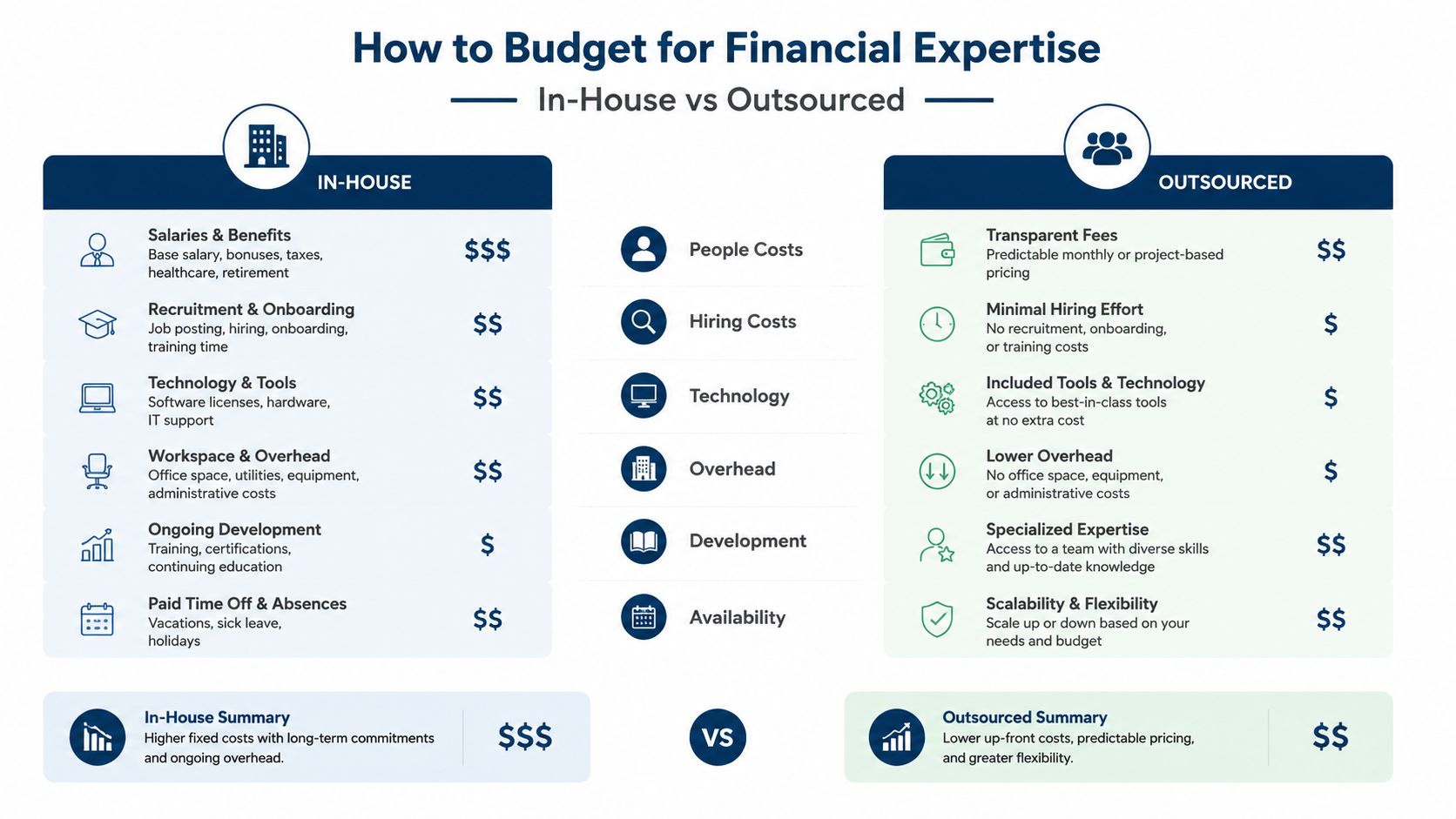
How to Budget for Financial Expertise In-House vs Outsourced
Budgeting for financial help gets messy when owners compare a salary to a consulting invoice as if they're the same thing. They're not.
A salary is a fixed commitment. A consulting engagement is a flexible operating tool. You can't compare them fairly unless you step back and ask what problem needs solving, how often it shows up, and how much flexibility your cash flow can handle.
Scenario one with an in-house hire
Let's say you want one person inside the business to own reporting, forecasting support, dashboard updates, and ad hoc analysis. A full-time hire can work well if the need is constant and the business has enough management capacity to train, direct, and retain that person.
But budgeting doesn't stop at salary. You also need to think about benefits, payroll setup, software access, time spent recruiting, onboarding, and the fact that a new analyst may still need outside guidance for bigger strategic decisions.
Owners often find themselves surprised at this stage. The salary looks manageable. The full commitment feels different once all the moving parts show up.
Scenario two with outsourced support
Now take a different case. You need monthly forecasting, margin review, KPI dashboards, budget support, and occasional leadership input for hiring or pricing decisions, but not a full-time person sitting in the office.
That's where outsourced or fractional support can make more sense. You buy access to expertise without taking on a permanent payroll commitment. You also gain room to scale the support up or down as the business changes.
The timing matters too. According to the Robert Half 2026 Salary Guide for finance and accounting, U.S. finance and accounting roles are projected to see a 2.1% average salary increase in 2026. For owners, that means waiting doesn't always make hiring cheaper. In a rising pay environment, flexibility gets more valuable.
A practical budgeting lens
Use this checklist before you decide:
- Choose in-house when: The work is daily, internal coordination is constant, and the role needs to sit close to operations.
- Choose outsourced when: The need is specialized, leadership-level, or uneven across the month or quarter.
- Choose fractional support when: You need recurring financial judgment without full-time overhead.
If you're thinking through broader leadership spend, especially when the business needs milestone-based support instead of permanent executive payroll, this piece on budgeting for milestone-based startup leadership adds a useful outside perspective.
Owner lens: Budget for the decision quality you need, not just the labor category you're used to buying.
What usually works for smaller firms in Philly is simple. Keep fixed payroll for roles with daily operational value. Use outsourced expertise for analysis, planning, and financial leadership that doesn't need forty hours a week. That structure protects cash flow and reduces the risk of hiring too much, too soon.
Smart Hiring and Negotiation Tips for Business Owners
Once you know the pay model you want, the next challenge is getting the right person at the right scope. Many owners lose money at this stage. This happens not because they chose a bad candidate, but because they asked for the wrong thing.
A weak job description attracts broad resumes and vague promises. A clear scope attracts people who know how to solve the problem.

Hire for outcomes, not tasks
Don't start with “must prepare reports” or “must be good at Excel.” Start with the business result.
Examples of better outcomes include:
- Cash visibility: Need a rolling forecast so you can see pressure points before they hit.
- Margin clarity: Need job, service line, or client profitability broken out in a way you can act on.
- Decision support: Need someone who can model hiring, pricing, or expansion choices before you commit.
That changes the conversation. It also helps you avoid paying consultant rates for bookkeeping tasks, or analyst salaries for work that really requires strategic judgment.
Ask sharper interview questions
Good interview questions are simple and specific.
Try questions like these:
- “What data would you ask for first if cash feels tight?”
- “Tell me how you'd build a forecast for a business with uneven monthly revenue.”
- “How do you explain a gross margin problem to an owner who isn't a finance person?”
- “Which tools do you use when Excel starts becoming a bottleneck?”
The goal isn't to hear buzzwords. The goal is to hear a clean thought process.
For Greater Philadelphia owners, there's another angle worth using. Verified data notes that firms now often hire remote consultants at hybrid rates 15% to 25% above local wages but 20% to 30% below major metro rates, while the national average analyst salary is $81,548 and New York rates sit at $113,769 in the cited comparison data from Glassdoor's New York City financial analyst salary page. That creates room to negotiate around geography, especially if the work can be done remotely.
If the candidate is remote, don't negotiate like you're hiring only from your zip code, and don't assume you have to pay Manhattan pricing either.
Negotiate the shape of the deal
Negotiation isn't only about price. It's about structure.
You can negotiate:
- Scope: What's included each month, and what falls outside the agreement.
- Cadence: Weekly support, monthly reporting, or project-based work.
- Outputs: Dashboards, forecasts, board packs, lender reporting, or margin reviews.
- Review points: A check-in after the first stretch of work to adjust scope if needed.
What doesn't work is signing a vague engagement and hoping the value becomes obvious later. Spell out the deliverables. Define the decision areas. Make sure both sides know what success looks like.
The Right Financial Partner for Your Growth
By the time an owner starts looking up financial analyst consultant salary, the underlying problem usually isn't compensation. It's uncertainty.
You need better numbers. You need faster answers. You need to know whether to hire, raise prices, cut waste, or prepare for growth without guessing your way through it.
That's why this decision works best when you frame it around fit. A full-time hire fits when financial analysis is a daily internal function. Outsourced support fits when you need experience, flexibility, and strong decision support without adding another fixed salary line.
For many small and midsize businesses in the Philadelphia area, the sweet spot is somewhere in the middle. They've outgrown basic bookkeeping, but they don't need a permanent senior analyst or full CFO in-house. They need clear reporting, forward-looking insight, and someone who can turn financial data into practical next steps.
That's also why local context matters. National numbers are useful, but they don't tell you how to manage a Philly-area budget, a growing team, or uneven cash flow in a real operating business. You need a model that gives you enough expertise to lead confidently, without forcing you into overhead your business can't use every day.
If you're weighing those options, it helps to look at how small business financial advisors near Philadelphia support owners who need financial clarity but don't want to build a full internal finance bench yet.
The smart move isn't always the cheapest move. It's the one that gives you the financial visibility to make better decisions, at the stage your business is currently in.
If your business needs cleaner books, stronger reporting, and CFO-level insight without the cost of a full-time finance hire, MyOfficeOps can help. The team works with Philadelphia-area and West Chester business owners who want practical support with bookkeeping, forecasting, KPI dashboards, profitability analysis, and growth planning. If you're trying to decide between hiring in-house and outsourcing financial expertise, a conversation with MyOfficeOps can help you choose the option that fits your cash flow, your goals, and the way your business operates.