
If you're running jobs, paying crews, ordering material, and sending invoices, you already know the problem. Money is moving, but that doesn't mean you're making money. A healthy bank balance can fool you for months. Then one ugly job closes out, and suddenly the profit you thought you had isn't there.
That gap between activity and truth is why construction work in progress accounting matters. It gives you a clear read on each job before the damage is done. Not after. While you still have time to fix labor, billing, change orders, and cost overruns.
The Financial Blind Spots in Every Construction Business
A lot of contractors manage by checking the bank account, looking at unpaid bills, and asking the PM whether the job is “going fine.” That works until it doesn't. You can have cash in the bank because you billed ahead, while one project is losing margin every week, unnoticed.

I've seen the same pattern in small and midsize construction companies over and over. The field team knows the work is moving. The office knows invoices went out. But nobody has one place that shows whether the job is on budget, whether billed revenue matches earned revenue, or whether the gross profit is holding.
What the bank balance hides
The bank account only shows cash. It doesn't show:
- Jobs that are underbilled: Work is done, but the invoice hasn't caught up.
- Jobs that are overbilled: Cash came in early, but future costs may eat it up.
- Change orders sitting in limbo: The work happened, but the money hasn't been approved or booked.
- Bad estimates: The original budget no longer matches reality.
- Profit fade: A job looked good early and gets worse as real costs roll in.
Many owners encounter difficulty here. They don't need more theory. They need a flashlight.
A contractor can be busy, booked, and still be flying blind on profitability.
Where the blind spots start
Most blind spots come from disconnected systems. Estimating lives in one file, job costs live somewhere else, and billing gets handled in another place. If you're pricing work with tools like Exayard construction estimating software, that's helpful, but the estimate still has to connect to cost tracking and billing if you want the full picture.
Without that connection, the office ends up asking basic questions too late. Did labor run high because the estimate missed something? Did material costs jump? Did the crew do extra work that never made it into a change order? Those aren't bookkeeping questions. They're margin questions.
WIP is the control system
A proper WIP process gives you one report that ties the job together. It shows what you've spent, what you've earned, what you've billed, and whether the story those numbers tell makes sense. That's the difference between reacting at closeout and managing the job while it's still in motion.
What Is Construction WIP Accounting Really
Cash can look fine on Friday and still leave you short on payroll two weeks later. A job can show a decent bank balance and still be losing margin because costs are landing faster than billing and collections. That disconnect is where many small and midsize contractors get burned.
Construction work in progress accounting gives you a way to measure a job while it is still underway. Instead of waiting for closeout to learn what happened, you compare contract value, costs incurred, estimated cost to complete, earned revenue, and billings in the same view. That is the practical difference between basic bookkeeping and job-based financial control.
What WIP is doing behind the scenes
WIP accounting answers a simple question. Based on the work completed so far, what should this job have earned, and how does that compare with what has been billed and spent?
That matters because construction rarely moves in a clean sequence. Material gets purchased early. Subcontractor invoices come in late. Change orders sit unsigned. The PM says the job is 60 percent done, but QuickBooks only shows what has been entered so far. Excel can track part of the story, but only if someone updates it consistently and ties it back to the books.
A good WIP process pulls those pieces together and forces a monthly reality check.
Why it differs from regular bookkeeping
Standard bookkeeping records activity by date. WIP accounting records job performance by progress.
That is a big deal for contractors using the revenue recognition principle in construction accounting. The point is not to make the books merely look impressive. The point is to keep your financial statements from overstating profit on one job and hiding trouble on another.
For a contractor bidding public work, this discipline also matters outside the office. Clean job costing and reliable WIP reporting support better forecasting, stronger conversations with lenders and sureties, and better decisions about which projects to pursue if you want to win public sector construction projects.
Practical rule: If your books only show cash received and bills paid, you still do not know whether the job is performing the way you expected.
What a contractor should be able to answer from WIP
A useful WIP process should help you answer these questions fast:
- Are we earning the gross profit we estimated?
- Are we overbilled or underbilled on this job?
- Did our cost to complete increase this month?
- Are approved and unapproved change orders being handled correctly?
- Can we rely on this month’s financial statements to make decisions?
In the field, implementation commonly breaks down. The estimate lives in one spreadsheet. Job costs are coded inconsistently in QuickBooks. Billing is managed in a separate file. Then someone tries to build a WIP report at month-end from partial data. The report is not wrong because WIP is complicated. It is wrong because the inputs were never set up to work together.
That is why many contractors need more than a template. They need a repeatable monthly process, clean cost coding, and someone who can turn raw job data into decisions about billing, staffing, and margin before the job gets away from them.
Choosing How to Recognize Your Revenue
You finish the month with plenty of work in the field, payroll is due, and the bank balance looks tight. On paper, the P&L may still show a decent month, or it may show almost nothing at all. That gap usually comes back to one question. How are you recognizing revenue?
For small and midsize contractors, this choice affects more than year-end tax reporting. It shapes whether your monthly financials help you catch margin erosion early or hide it until the job is nearly done. If you run your books in QuickBooks and keep estimates or billings in Excel, the method also determines how much discipline your team needs each month to keep the numbers usable.
The two methods contractors usually choose between are Percentage-of-Completion and Completed-Contract.
Percentage-of-Completion in plain English
With Percentage-of-Completion, revenue is recognized as the job progresses. In practice, contractors usually measure that progress using cost incurred compared with current estimated total cost.
The math is straightforward. If a job is one-quarter complete based on cost, you recognize one-quarter of the contract revenue. The hard part is not the formula. The hard part is keeping estimated total cost current, handling change orders correctly, and making sure costs are coded to the right job in QuickBooks before month-end.
That matters because a bad estimate update creates a bad revenue number. The accounting method is not the problem. The inputs are.
Completed-Contract, and why some contractors still use it
With Completed-Contract, you wait until the job is substantially finished before recognizing revenue. For very short jobs, that can be acceptable. If a project starts and finishes in the same reporting period, waiting until the end may still give you a fair picture.
On longer jobs, it creates blind spots. A job can be slipping for months while the financial statements stay quiet. Cash may look fine because billings are going out, but profit problems stay buried until late in the project, when your options are limited.
Side by side comparison
| Feature | Percentage-of-Completion (PoC) | Completed-Contract |
|---|---|---|
| When revenue is recognized | As work is completed over time | When the project is substantially finished |
| Best fit | Longer projects that cross accounting periods | Very short jobs where waiting until the end still gives a useful picture |
| Main strength | Shows job performance while the work is still active | Simpler to understand for short-duration work |
| Main weakness | Depends on timely cost estimates and accurate updates | Hides margin problems until the end |
| Cash flow visibility | Better for ongoing monitoring | Weak for in-progress decision-making |
| Usefulness for lenders and stakeholders | Stronger because earnings are tied to actual progress | Less helpful on larger or longer jobs |
How to choose the method that fits your business
For many contractors, the primary issue is not theory. It is execution.
If you take on projects that run for several months, have progress billings, or need lender and surety confidence, Percentage-of-Completion usually gives a more honest operating picture. It shows whether the job is earning what you expected while there is still time to fix production issues, billing delays, or estimate mistakes.
If your work is short-cycle service, small remodels, or jobs that begin and end quickly, Completed-Contract may be easier to manage. Even then, simplicity comes with a trade-off. You give up visibility during the job.
I usually tell contractors to pick the method that matches how they manage the business, not the one that feels easiest in the bookkeeping file. If you need monthly financials to make staffing decisions, control cash, support bonding, or win public sector construction projects, delayed revenue recognition can work against you.
For a plain-English explanation of the accounting rule underneath all of this, see this guide to the revenue recognition principle.
An outsourced construction accounting partner often helps here. Not because the method itself is complicated, but because someone has to tie together the estimate, job costs, billings, and revised cost to complete each month. That is the gap many small contractors run into. The data exists, but it is spread across QuickBooks, Excel, and project files, so nobody trusts the final number.
Building and Using Your First WIP Schedule
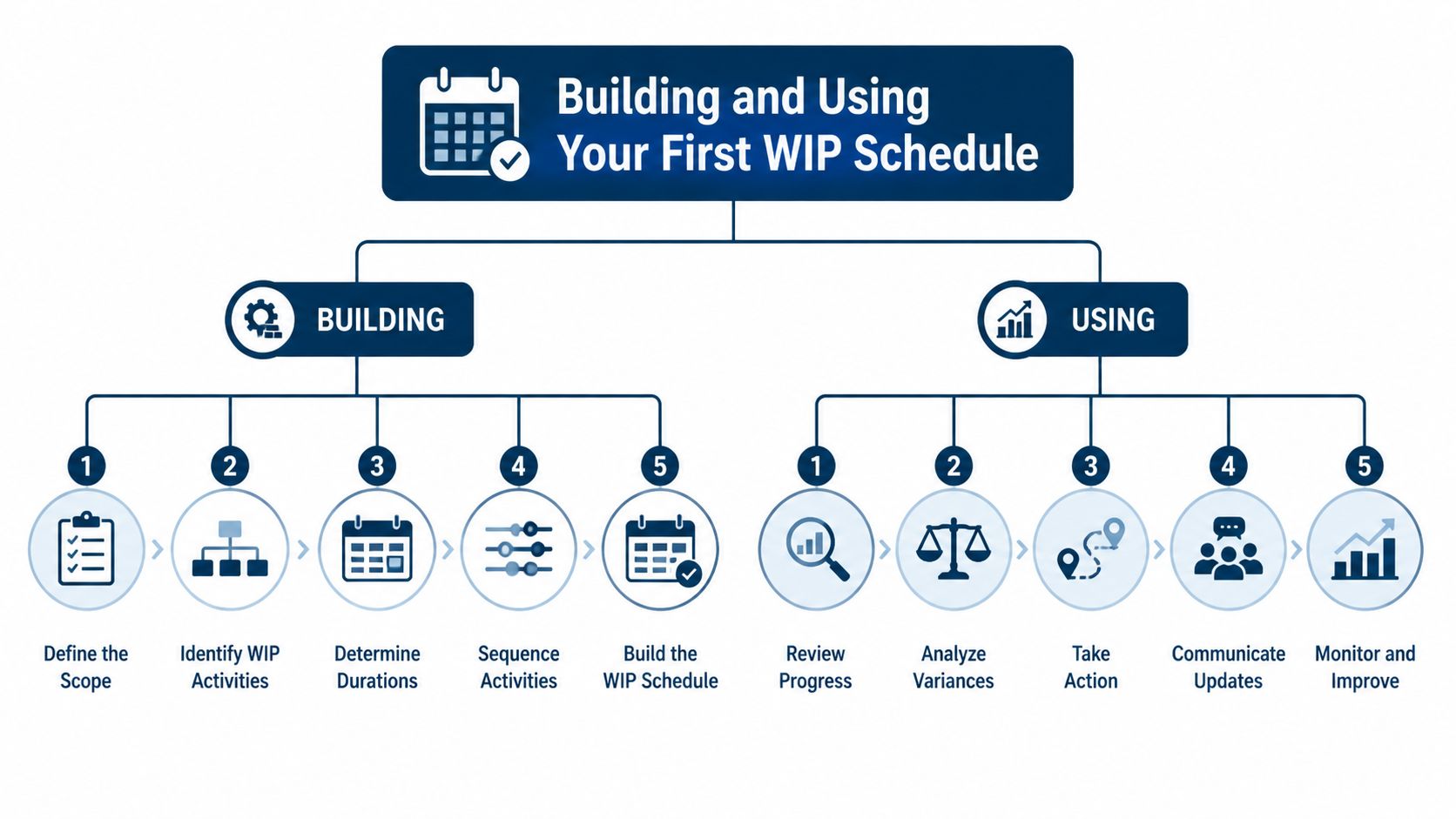
Most contractors hear “WIP schedule” and assume it has to be complex. It doesn't. Your first useful WIP can start in Excel or QuickBooks exports, as long as the data is current and someone owns the process.
The point is not to build a fancy spreadsheet. The point is to create a report that tells the truth about the job.
The columns you actually need
A basic WIP schedule should include the core job data that lets you compare work completed against money billed.
Start with these fields:
- Contract amount: The current total contract value.
- Estimated total cost: What you now believe the full job will cost.
- Costs to date: What you've spent so far.
- Percentage complete: Derived from costs to date compared with estimated total cost.
- Earned revenue: Revenue tied to achieved progress, not just invoices sent.
- Billings to date: What you've invoiced the customer so far.
- Overbilling or underbilling: The gap between earned revenue and billings.
If that sounds simple, good. It should be. The hard part isn't the layout. It's keeping the estimates honest.
How to build it in practice
Here's the process I recommend for a small contractor:
- Pull job cost detail at month end. Labor, material, subs, equipment, and any burden you track.
- Review estimated cost to finish with the PM. This can't be an office-only exercise.
- Update the contract amount for approved change orders. If the change isn't approved, treat it carefully and don't assume it's collectible.
- Calculate percentage complete and earned revenue.
- Compare earned revenue to billings.
- Flag big variances and discuss action items before the next billing cycle.
For firms building their bookkeeping workflow, this guide to bookkeeping for construction companies gives a helpful foundation.
Why monthly matters
The WIP schedule is most useful when it's updated every month. According to Intuit’s construction project accounting overview, industry practice has standardized monthly WIP schedule generation aligned with payment application cycles, and the WIP schedule is critical for cash flow because progress billing helps reduce Days Sales Outstanding.
That monthly rhythm is where a lot of contractors either gain control or lose it. If you only update WIP at quarter end, you miss too much. Payroll has run several times. Subs have billed. Materials have landed. Your billing window may already be gone.
Good WIP reporting is less about accounting talent and more about discipline. Same date each month. Same inputs. Same review process.
What works better than a perfect spreadsheet
A plain spreadsheet with clean habits beats a beautiful file nobody updates. The contractors who get real value from WIP do a few practical things well:
- They close each month on time.
- They force PM review before finalizing estimated cost to complete.
- They tie billing conversations to the WIP review.
- They don't let approved change orders sit in email threads.
That's enough to turn WIP from an accounting chore into a working management tool.
What Your WIP Report Is Trying to Tell You
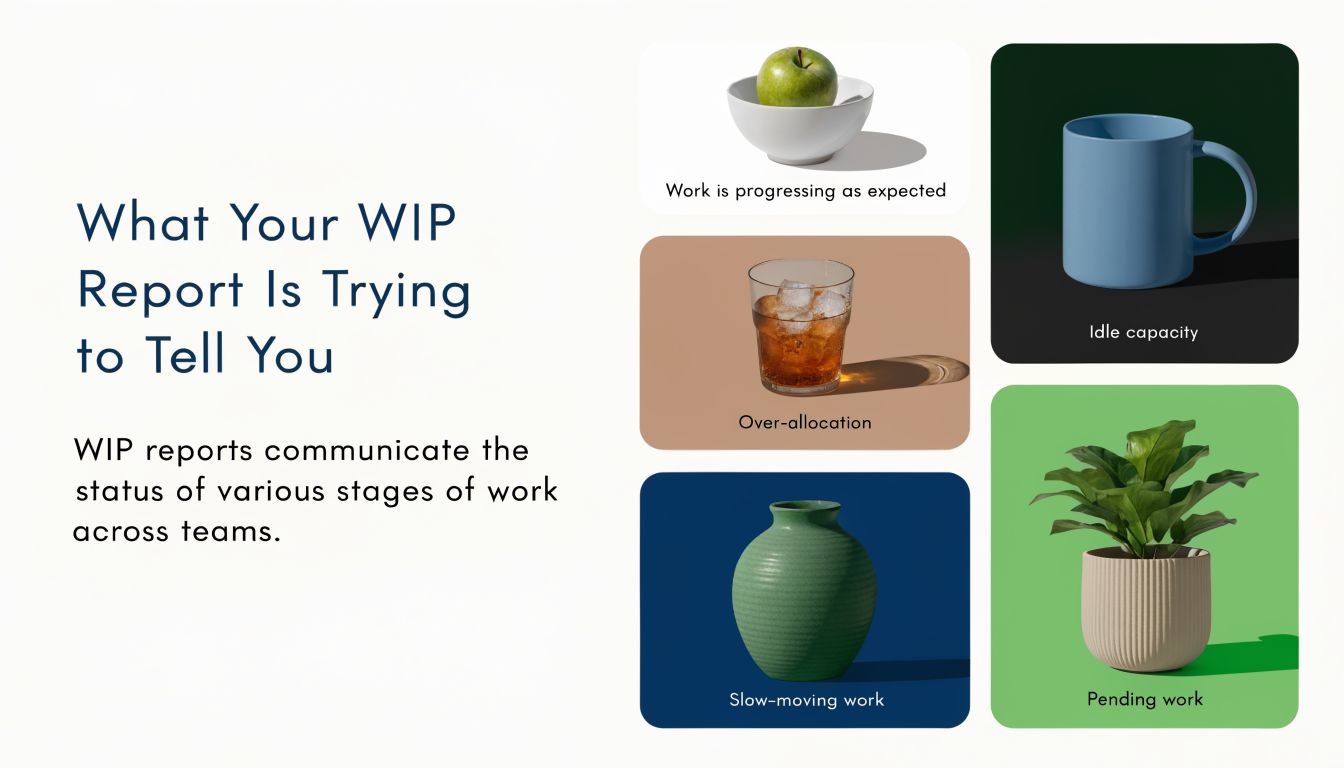
A WIP report is not just a record. It's an early warning system. It tells you whether the cash in your account came from real earned progress or whether you're getting ahead of yourself on billing.
That difference matters because two jobs can show the same cash position and tell completely different stories.
Underbilling and overbilling in plain English
If you've earned more revenue than you've billed, you're underbilled. That usually means the company has already done the work but hasn't collected for it yet. You're funding the project with your own cash.
If you've billed more than you've earned, you're overbilled. That can feel good because cash came in early. But it can create false confidence if the back half of the job gets more expensive.
According to Deltek’s explanation of construction work in progress reporting, the WIP report reveals overbilling and underbilling status, and overbilling can mask future cash shortages.
How profit fade shows up
Here's the pattern. Early in the job, the estimate looks solid. Labor is tracking close enough. Material buyout feels under control. Then the remaining cost starts climbing. Rework shows up. A subcontractor issue drags the schedule. A field condition adds labor hours. The gross profit gets thinner each month.
That slide is profit fade.
Deltek notes that connected WIP systems can reduce profit fade by 10% to 25% and help prevent the 15% to 20% profit overstatements that are common in manual spreadsheet tracking through better visibility into cost variances.
Read the report like an owner
When you review a WIP report, don't stop at the totals. Ask:
- Which jobs changed the most from last month?
- Did estimated cost to finish go up, and why?
- Are billings keeping pace with progress?
- Which jobs are showing margin erosion?
- Is one project carrying cash that another project is consuming?
If you want cleaner context around how these issues affect the rest of your books, this overview of construction company financial statements helps connect the dots.
If a job keeps “making money” on paper while the cost to finish keeps rising, the report is warning you. Don't wait for closeout to believe it.
Common WIP Pitfalls and How to Avoid Them
Small firms usually don't fail at WIP because they can't do the math. They fail because the process breaks down between the field and the office. The PM knows one thing, the bookkeeper knows another, and the owner gets a report built on stale assumptions.
That gap is expensive.
The mistakes that show up most often
The biggest one is delayed updates. Someone says, “We'll clean that up later,” and later never comes. Change orders sit unapproved. Labor overruns get treated like temporary noise. Material overages get blamed on timing instead of estimate misses.
Another common problem is using Excel, QuickBooks, and email without one agreed workflow. Those tools can work fine. What doesn't work is when each person updates their own version of reality.
According to EisnerAmper’s write-up on WIP reports and bonding, 40% of small contractors underbill by over 10% due to poor WIP tracking. The same source says 25% of WIP reports for firms under $10M in revenue contain errors from unapproved change orders, and those errors can cut bonding capacity by 15% to 20%.
What to fix first
You don't need to overhaul the whole company in one month. Start with a few controls that remove the most common failure points.
- Lock down change orders: No field work should disappear into a text message chain. Create one log, one owner, and one weekly review.
- Require PM sign-off on cost to complete: Bookkeepers should not guess the field status.
- Close the month the same way every time: Same reports, same review meeting, same deadline.
- Separate approved from pending revenue: Hope is not billable.
- Keep one master WIP file: Even if it's in Excel, there should be one final version.
What doesn't work
A few habits almost always lead to bad WIP:
- Using old estimates because updating them is uncomfortable
- Treating underbilling as normal
- Assuming busy crews mean healthy jobs
- Waiting until quarter end to review job profit
- Letting accounting and operations work from different numbers
A rough but honest WIP report is better than a polished report built on guesses. Accuracy starts with hard conversations, not software.
Turn Your Financial Data into a Growth Engine
Once your WIP process is working, the value goes far beyond month-end reporting. You start seeing which jobs fit your business, which PMs protect margin, and where cash gets trapped. Bidding gets sharper because your historical job data gets cleaner. Hiring gets safer because you can see whether the work is producing profit.
That kind of clarity changes how a contractor grows. You're no longer chasing volume just to stay busy. You're choosing work with better control over labor, billing, and margins.
Better decisions come from cleaner job data
A solid WIP process helps answer growth questions that owners deal with all the time:
- Can we afford to take on another project manager?
- Are our estimates translating into real margins?
- Which job types create the most billing strain?
- Do we need better preconstruction tools or tighter field reporting?
If you're reviewing systems on the front end, it can help to compare features of modern estimating software so your estimating process supports cleaner downstream job tracking.
The real trade-off
Most owners understand WIP once they see it in action. The problem is time. Running the jobs already takes enough attention. Keeping books clean, reconciling job costs, reviewing billings, and challenging cost-to-complete assumptions every month is a separate discipline.
That's why WIP usually breaks down in one of two ways. Either nobody owns it, or the wrong person owns too much of it.
The contractors who stay in control build a repeatable process and protect it. They don't treat construction work in progress accounting like a year-end cleanup item. They treat it like part of operations.
If your books are messy, your job data doesn't line up, or your WIP reports aren't giving you answers you trust, MyOfficeOps can help. Their team supports contractors with bookkeeping, accounting, reporting, and advisory work that turns raw numbers into clear decisions. Instead of guessing which jobs are carrying the company, you get clean financials, practical insight, and a process you can use month after month.