
Bookkeeping for a construction company isn't just about counting money. It’s about keeping track of money on long, tricky projects where your costs and your client's payments are spread out over months, sometimes even years.
You have to know if you're actually making a profit on each job while it's happening, not just when you finally deposit the last check.
Why Construction Bookkeeping Is So Different
Let's be honest—doing the books for a construction business is nothing like running a coffee shop. In most businesses, you sell something, get paid, and that’s it. The money cycle is short and simple.
Construction is a whole different beast.
Think about building a custom home. That project could take a year. You're buying lumber and concrete today for a foundation that won’t be done for weeks. You pay your crew every Friday, but you might not get paid by the client for another month. This gap between when you spend money and when you get paid is a huge challenge.
A simple spreadsheet or regular accounting software can’t keep up. It might show a nice number in your bank account one month, but it won’t tell you that all of that cash is already spoken for—it's needed for subcontractors and materials for the next phase of a project you're already in the middle of.
The Money Puzzle You Solve Every Day
What really makes construction bookkeeping different is that you must track money on a project-by-project basis over a long time. A normal business looks at its overall profit and loss. You need to know if you’re making money on the Miller's house, the downtown office remodel, and the school addition—all at once.
Here’s a simple look at what makes your financial world so different:
- Long Projects: A single job can last through several months or even years, making it hard to match what you earned with what you spent to earn it.
- Big Upfront Costs: You spend a lot of money on materials, permits, and labor long before you get all of it back.
- Weird Payment Schedules: You don’t get paid all at once. You get payments in stages through progress billing. You also have to deal with retainage, where a client holds back some of your money until the job is 100% finished.
- Job Costing is Everything: You have to track every single cost—from a box of nails to a subcontractor's bill—and connect it to a specific job.
For example, imagine you finish a big kitchen remodel. That last check feels great. But without good job costing, you might not realize that surprise material price hikes and a few extra days of labor ate up your entire profit. You felt like you won, but you really just broke even.
This is why you need a special way of doing your books. It's the only way to see if your business is truly healthy and make sure every project is actually making you money.
Without it, you're just guessing and hoping there's money left over at the end of the year.
Setting Up a Construction Chart of Accounts
If you’ve ever used accounting software right out of the box, you’ve seen a basic Chart of Accounts. It has general categories like "Office Supplies" or "Sales." For a construction company, that kind of list is pretty much useless.
Think of your company’s Chart of Accounts as the financial blueprint for your business. It's a list of every single category where money comes from (Income) and where it goes (Expenses). Since your business is all about projects, your financial blueprint needs to be built around projects.
Getting this right is the most important first step in your bookkeeping. Why? Because a good Chart of Accounts is the foundation for everything else, especially job costing. It separates the costs of building things from the costs of just running your business.
Direct vs. Indirect Costs: A Simple Breakdown
The secret to a good construction Chart of Accounts is splitting your costs into two main buckets: Direct Costs and Indirect Costs.
Direct Costs: These are the expenses you can point to and say, "That belongs to the Johnson kitchen remodel." It’s the lumber, the concrete, the subcontractor bills, and the pay for the crew working on that specific site.
Indirect Costs (Overhead): These are the costs of doing business that you can't tie to just one job. Think about your truck fuel, office rent, insurance, or the salary for a project manager who handles multiple sites.
This separation is what finally lets you see how profitable each project really is. When you can track every direct cost, you can figure out if you're making or losing money on a job long before it’s done.
The goal isn't just to track spending; it's to understand where every dollar is going. A well-organized Chart of Accounts tells you the story of your business, one project at a time. It turns a messy pile of receipts and bills into clear information you can actually use.
Building Your Construction Chart of Accounts
You don't need to be an accountant to build this. You’ll start with the main categories—Assets, Liabilities, Equity, Income, and Expenses—but the real work happens when you customize the expense section for construction. For a deeper look, you can learn more about what a chart of accounts is and why it's so important.
To get you started, here is a simple example of how a construction company should organize its accounts. The real magic is in the "Cost of Goods Sold" section, which is where all your direct job costs will live.
Sample Construction Chart of Accounts
| Account Type | Account Name | Example |
|---|---|---|
| Income | Construction Revenue | Payment from a client for a completed project milestone. |
| Cost of Goods Sold (Direct Costs) | Job Materials | Drywall, lumber, piping, and fixtures for a specific job. |
| Cost of Goods Sold (Direct Costs) | Subcontractors | Paying your go-to plumbing or electrical subcontractor. |
| Cost of Goods Sold (Direct Costs) | Direct Labor | Wages for the framing crew working on the new build. |
| Cost of Goods Sold (Direct Costs) | Equipment Rental | Renting a mini-excavator for a foundation dig. |
| Expenses (Indirect Costs) | General & Administrative | Office rent, utilities, and accounting software subscription. |
| Expenses (Indirect Costs) | Vehicle Expenses | Fuel, maintenance, and insurance for your work trucks. |
| Expenses (Indirect Costs) | Insurance | General liability and workers' compensation policies. |
This structure is the secret to good construction bookkeeping. By categorizing every expense as either tied to a job or part of your general overhead, you create a system that tells you how your business is doing in real time.
You’re no longer guessing. You’re making decisions based on real numbers.
Mastering Job Costing to Maximize Profits
In construction, job costing is the main event. It’s where you make your money or lose it. Simply put, job costing is tracking every single dollar—every screw, every hour of labor, every subcontractor bill—and tying it directly back to a specific project.
If you don't know what a job actually costs you, you're just guessing at your profits. You might feel good when a big check comes in, but feelings don't pay the bills. Real numbers do. Proper bookkeeping for construction companies depends on getting this one thing right.
The Power of Cost Codes
So, how do you track everything without going crazy? The secret is cost codes.
Think of cost codes as simple labels you attach to every expense. They break a huge project down into smaller, easier-to-manage pieces. Instead of seeing a giant pile of "material costs," you can see exactly how much you spent on framing versus how much you spent on plumbing.
Here's what that looks like in the real world:
- 01-Demolition: All costs for tearing down the old stuff.
- 02-Concrete: The bill for the concrete truck, the rebar, and the labor to pour it.
- 03-Framing: The lumber delivery and the wages for your framing crew.
- 04-Plumbing: The invoice from your plumbing sub.
These codes are your best friend. When you assign a cost code to every transaction, your accounting system can instantly tell you how much you've spent on framing for the "Miller Kitchen Remodel" versus the "Downtown Office Buildout." This is how you get the clear picture you need to make smart decisions.
A Story About Hidden Losses
I have a contractor friend—we'll call him Dave—who landed a huge custom kitchen remodel. It was his biggest project ever. The client was happy, the final pictures were great, and that last payment felt like a big win. For months, he told everyone how successful that job was.
A little while later, we sat down and set up a real job costing system with cost codes. Just to see what would happen, we went back and applied it to that "successful" kitchen project. We gathered up all the bills, timesheets, and material receipts.
The results were a punch to the gut.
Once we sorted every single expense, we found that material price increases he hadn't tracked and a few extra days of labor from his crew had eaten up almost his entire profit. He didn't lose money, but he barely broke even. He had worked his tail off for three months on a high-stress job for almost nothing.
That project taught him a hard lesson: You can't manage what you don't measure. Without job costing, you're flying blind, and what feels like a profitable job can easily be a money-loser.
This is exactly why tracking your budget versus your actual spending in real-time is so important. It lets you spot problems while they're small enough to fix. If you see your concrete costs are already at 80% of the budget but the foundation is only half-poured, you know you have a problem right now—not three months from now when it's too late.
Building Your Job Costing System
Setting up a job costing system isn't as hard as it sounds. The goal is to create a simple process that your whole team can follow. It's all about building good habits.
First, decide on a standard list of cost codes for your company. Keep it simple enough for your crew to use but detailed enough to give you the information you need. You don't need hundreds of codes; start with the major phases of your usual projects.
Next, you have to train your team to use them for everything. Every purchase order, every timesheet, and every bill that comes in must have a job name and a cost code assigned to it. This is a rule you can't break.
Finally, you need to review your numbers regularly. A Job Cost Report is a simple summary that shows you:
- Budgeted Costs: What you planned to spend on each phase.
- Actual Costs: What you've really spent so far.
- Variance: The difference between your budget and your actuals.
This report is your project's health check. A quick look tells you where you're on track and where you're starting to lose money. Seeing a negative number in the framing stage gives you a chance to figure out why. Was the lumber more expensive than you bid? Did the crew take longer than expected? This is the information that lets you fix problems on the fly and protect your profit before it disappears.
Navigating the Maze of Construction Payments
In construction, getting paid is rarely simple. You don't just send one invoice and get one check. The flow of money is unique, stretched across long project timelines with payments coming in stages. If you don't stay on top of this process, your cash can dry up, even when your crew is super busy.
This is where construction bookkeeping gets serious. It's not just about tracking receipts. It’s about managing a tricky payment cycle that involves billing for partial work, chasing down money clients hold back, and always, always knowing where you stand with your money.
Keep Cash Flowing with Progress Billing
You wouldn't agree to build a house and wait a year to get paid, would you? That’s the simple idea behind progress billing. It’s the normal way things are done in construction, where you send a bill to your client at key points based on the percentage of work you’ve completed.
For example, on a $100,000 job, you might send the first bill for 25% after the foundation and framing are done. This keeps money coming in so you can cover payroll, materials, and subs for the next phase. It’s what keeps your business running.
This is a must-do for keeping your cash flow healthy. You can learn more about how billing affects your bank account in our complete guide to improving construction cash flow management.
Don't Let Retainage Sink Your Profits
Ever finished a project and the final check was a little less than you expected? That’s almost definitely retainage. It's a common practice where clients hold back a small piece of each payment—usually 5-10%—until the job is 100% done and they’ve signed off on everything.
Think of it as the client's insurance policy to make sure you finish the job right. While it's a normal part of the business, retainage can turn into a huge headache if you don't track it carefully. After all, it's your money. You earned it.
You must have a system to track the retainage that's owed to you. Without one, that money gets lost in the shuffle of juggling multiple jobs. At the end of a big project, that final 5% could easily be your entire profit.
A simple way to manage this is by setting up a "Retainage Receivable" account in your chart of accounts. Every time you send an invoice, the part being held back gets recorded there. This keeps it visible, so you never forget how much you're owed when all the last-minute fixes are finally done.
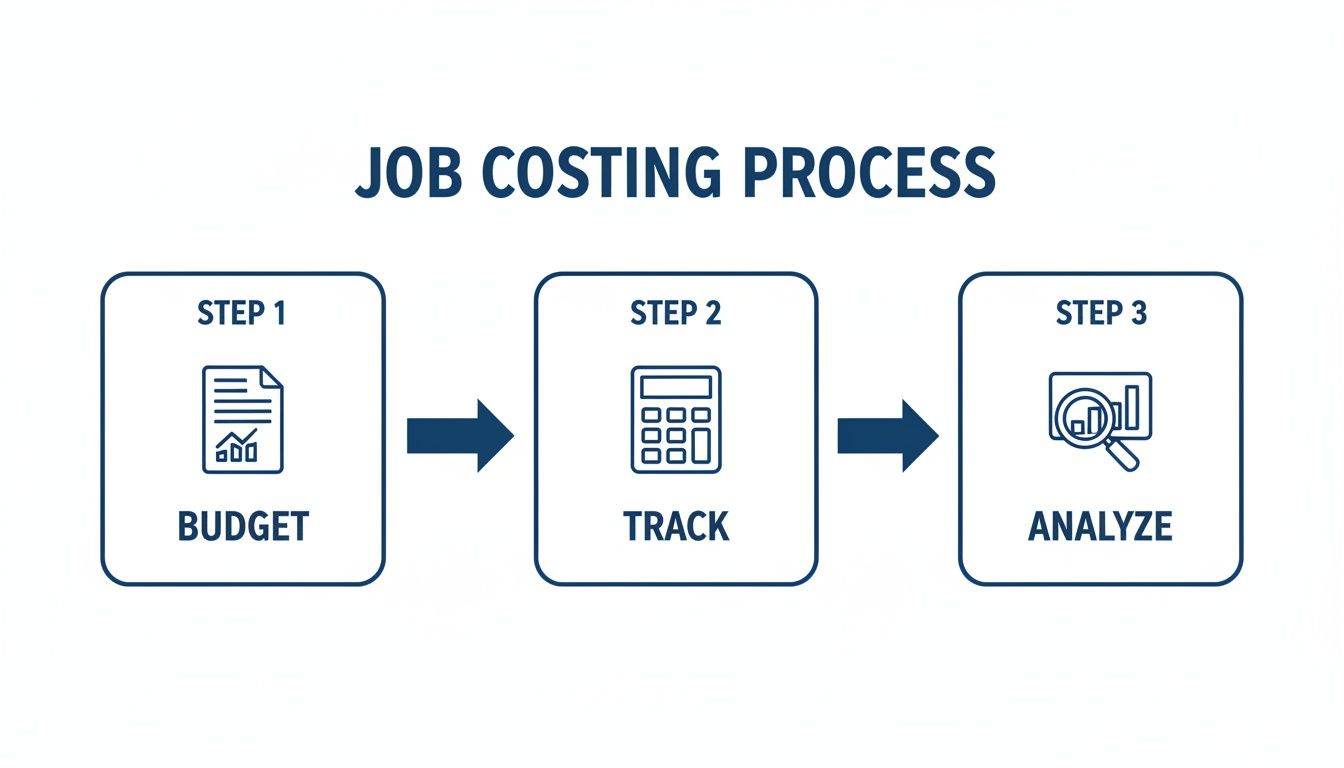
The process shown above is what makes your progress billing accurate. It connects your original budget to what you're spending in real time, giving you a clear picture of whether you're ahead or behind schedule and budget.
Your Most Important Report: The WIP
So, how do you know if you're actually making money on a job that's only half done? The answer is your Work-in-Progress (WIP) report. This might sound like a boring accounting term, but the idea is actually pretty simple.
A WIP report is a financial snapshot that compares the percentage of costs you've spent on a project against the percentage of the total price you've billed for. It quickly tells you if a job is "overbilled" (you've billed for more work than you've done) or "underbilled" (you've done more work than you've billed for).
Here’s the key info a WIP report gives you:
- Total Contract Value: The full price of the job.
- Costs to Date: What you've spent so far.
- Total Estimated Costs: Your best guess at what the final cost will be.
- Billings to Date: How much you've billed the client.
Honestly, this is one of the most powerful money tools a contractor has. It helps you catch problems early and gives you a true picture of your company's financial health, much better than just looking at the number in your bank account.
Getting Certified Payroll Right
If you're doing any government-funded work, you'll run into certified payroll. It's just a special type of payroll report that proves you're paying your crew the local "prevailing wage," which is required by law.
These reports are serious business—they’re very detailed and have to be turned in weekly. You'll need to list each worker's name, their hours, pay rate, and exactly what kind of work they did. A mistake can lead to big fines or even get you banned from bidding on future government jobs.
While it sounds scary, the good news is that most construction-specific accounting software handles this for you. The system pulls information straight from your timecards and creates the forms you need, saving you from a mountain of paperwork and making sure you follow the rules.
Choosing the Right Tools for Your Business
You wouldn’t use a hammer to cut drywall, right? So why are you trying to run your construction finances with accounting software made for a coffee shop? Using a tool that wasn’t built for your industry is like trying to fit a square peg in a round hole—you can make it work, but it’s always messy and never quite right.
Standard software like QuickBooks Online is great for many small businesses, but it doesn't work well for contractors out of the box. It simply doesn’t speak our language. It doesn't have built-in ways to handle things like retainage, progress billing, or the detailed job costing you need to survive. You end up trying to make it work with messy spreadsheets, which wastes your time and can lead to expensive mistakes.
Why a Special Tool Is a Game-Changer
Let me put it this way: a generic accounting tool might tell you if your company made money last month. A construction-specific tool tells you if you’re currently making money on the Miller's house, while there's still time to fix a budget that's going off track.
That shift from a fuzzy, big-picture view to a sharp, project-by-project focus is everything.
A special tool for construction isn't just another expense; it's an investment that will save you headaches and make you more profitable. There's a reason the market for these tools is growing so fast. The global construction accounting software market is expected to jump from USD 2.0 billion in 2025 to USD 4.0 billion by 2035. This isn't just a trend; it's a sign that contractors are finally getting the tools they need to manage the tricky finances of our industry. You can dig deeper into these construction software market trends.
Your Must-Have Software Feature Checklist
When you start looking at different software, it's easy to get distracted by flashy features you'll never use. Forget all that. The goal is to find the right fit for your business, not the one with the longest list of features.
Here’s a simple checklist of the key things you need to solve the biggest headaches in construction bookkeeping:
- True Job Costing: The software must let you track every cost—materials, labor, subs, equipment—against a specific job and cost code. It needs to show you your budget vs. actual spending in real time.
- Progress Billing & AIA Invoicing: It has to handle billing by percentage of completion. If you do commercial work, it should also create industry-standard forms like the AIA G702/G703 without needing another program.
- Retainage Tracking: The system must automatically track the retainage you're holding on subcontractors and, just as importantly, the retainage clients are holding on you. This can't be something you do by hand.
- Change Order Management: When a client changes their mind (and they always do), the software should make it simple to create a change order, get it approved, and automatically update the project budget and contract price.
- Certified Payroll Reporting: If you do any government work, this is a must-have. The tool should create certified payroll reports directly from your timecard data, saving you hours of painful paperwork.
Choosing the right software is about finding a tool that works the way you work. It should make your daily tasks simpler, not more complicated.
For larger companies that need one system to connect money, project management, and customer relationships, it might make sense to look at integrated ERP solutions like Microsoft Dynamics 365. These systems offer a much deeper level of control over the whole business.
However, for most small to mid-sized contractors, a dedicated construction accounting program gives you the perfect mix of power and simplicity. It gives you the specific tools you need without being too overwhelming.
A Few Common Construction Bookkeeping Questions
Every single contractor I’ve worked with has questions. It’s a complicated business, and sometimes you just need a straight answer. Here are a few of the most common questions we get about construction bookkeeping, answered in plain English.
How Often Should I Be Looking at My Job Costs?
You need to look at your job cost reports every single week. I know that sounds like a lot, but this isn't something you can check once a month and hope for the best. A project can go from making money to losing money in just a few days.
Think of it like the gas gauge in your truck on a long trip. You wouldn't wait until the engine sputters to check if you need gas, right? A weekly check-in is your financial "gas gauge." Are material costs going up? Is labor taking way longer than you planned? Catching these things early is the only way to fix them before they destroy your profit.
What's the Best Way to Handle Change Orders?
The number one rule for change orders is to get it in writing and get it signed before you do the work. Never, ever start work based on someone just saying "go ahead." That’s how you end up not getting paid for your extra time and materials. A simple change order form should clearly show:
- A detailed description of the new or changed work.
- The exact cost of the change—materials, labor, and your markup.
- How this change will affect the project schedule.
Once you have that signed piece of paper, immediately update the project budget in your accounting software. A change order isn't just "extra work"; it's an official change to the contract. If you don't add it to the budget, your job cost reports will instantly show you're over budget, which isn't true.
Treating change orders as official updates to your budget keeps your financial reports accurate. It makes sure you know your real profit on the project, including all the extras the client asked for.
Does My Bookkeeper Really Need to Understand Construction?
Yes. Absolutely. A bookkeeper who doesn't get the construction industry can do more harm than good. Period.
They might have no idea what retainage is, how to do progress billing, or why job costing is so important to your company. They'll try to force your unique business into a generic accounting box, and you'll end up with messy, unreliable financial numbers you can't use to make real decisions.
Having someone who speaks the language of construction—who understands cost codes, WIP reports, and subcontractor rules—is a must. They'll set up your books correctly from day one and give you the specific reports you need to actually manage your business.
How Can I Avoid the Dreaded Cash Flow Problems?
Cash flow is the number one killer of construction companies. The only way to avoid problems is to be on top of it, not playing catch-up. First, make sure you are sending out your progress bills on time, every single time. Don't let them pile up until the end of the month; bill as soon as you finish a stage of the project.
Second, stay on top of who owes you money. Know exactly who needs to pay you and when it's due. A simple "Aged Receivables" report is your best friend here—it will instantly show you any overdue bills. Sometimes, a friendly phone call is all it takes to get paid.
Finally, accurate bookkeeping is your early warning system for budget problems. Globally, a shocking 88.2% of project failures are tied to going over budget from things like surprise inflation or material shortages. Special bookkeeping gives you the heads-up you need to stop these issues from draining your cash. You can find more insights on how financial tracking impacts project success in industry reports.
Struggling to keep your construction finances organized? The team at MyOfficeOps specializes in bookkeeping for construction companies, helping you master job costing, improve cash flow, and get the financial clarity you need to grow. Let's build a stronger financial foundation for your business together. Learn more at https://myofficeops.com.