

You're probably looking at a property right now that feels right.
Good street. Solid curb appeal. Maybe the rent roll looks decent. The seller says it's a strong performer. You can already see the upside in your head.
Then the harder question shows up. Is it a good investment, or are you just reacting to a good-looking property?
That's where real estate investment analysis earns its keep. It turns a gut feeling into a decision process. Not a Wall Street exercise. Not a giant spreadsheet built to impress people in a boardroom. Just a practical way to answer three things that matter: will this property make money, how much, and how much trouble could come with it?
Business owners usually understand this faster than they think. If you were buying another company, you wouldn't stop at “the office looks nice” or “the owner seems confident.” You'd look at revenue, costs, debt, and risk. A building deserves the same treatment.
Is This a Good Deal or Just a Good-Looking Property
A buyer tours a small mixed-use building. The apartments upstairs are clean. The storefront tenant has been there a while. The block looks better than it did a few years ago. Everything about it invites a quick yes.
Then the seller hands over a summary sheet with projected income, low expenses, and a story about future growth. That's the moment where many people drift into trouble. They start buying the story instead of the asset.
The problem with attractive properties
Good properties can still be bad deals. I've seen buyers get pulled in by cosmetic improvements, a busy neighborhood, or a polished broker package. None of those things pay the mortgage on their own.
A sound review starts with a benchmark. The average annual return on investment for real estate in the United States is 10.6%, which gives investors a baseline for comparing a deal to the broader market, according to the University of San Diego property analysis overview. That doesn't mean every deal needs to look exactly like that benchmark. It means you need a reason if your projected return falls short, and you need proof if your model says it will do better.
Practical rule: If the only reason a deal works is “I think this area is getting hot,” you don't have analysis. You have hope.
What confidence actually looks like
Real confidence doesn't come from liking a property. It comes from being able to explain, in plain English, why the income is believable, why the expenses are realistic, and how much room you have if things go sideways.
That's why underwriting matters. If you want a good outside reference for how lenders and experienced investors think through approval, this investor's guide to approval is useful because it shows how a deal gets tested before anyone commits money.
Here's the shift that matters:
- Old thinking: “This place feels like a winner.”
- Better thinking: “The numbers support the asking price.”
- Best thinking: “The numbers still work even if rent lags, costs rise, or vacancy shows up.”
A lot of stress disappears once you start looking at properties this way. You stop asking, “Do I love this building?” and start asking, “Does this building perform well enough for the risk I'm taking?”
That's a much safer question.
What Real Estate Investment Analysis Actually Means
Hearing “real estate investment analysis” often leads to thoughts of spreadsheets, formulas, and finance jargon. That's not the useful way to think about it.
It's better to think of it as writing the financial story of a property. You're looking at what the building earns, what it costs to run, and what might happen next. In plain terms, you're building a business plan for one asset.
Three questions every deal has to answer
A proper review should answer three simple questions:
- Will this property make money
- How much money could it make
- How risky is that outcome
That's it. Every worksheet, rent roll, inspection report, and lender requirement feeds into one of those questions.
If you run a business already, this will feel familiar. You probably don't make hiring, pricing, or expansion decisions from instinct alone. You look at what happened before, what you expect next, and what could go wrong. A building deserves the same discipline.
Think like a detective, not a mathematician
You don't need to be a finance person to do solid real estate investment analysis. You do need to be skeptical.
The seller says expenses are low. Fine. Verify them. The broker says rents are below market. Maybe they are. Prove it. A contractor says repairs are minor. Good. Put that in writing and price it in.
A property can lie to you in two ways. Through bad numbers, or through missing numbers.
That's why strong analysis is less about clever formulas and more about asking clean questions.
What belongs in the property's story
When I explain this to owners, I usually frame it like this: every deal has an income story, an expense story, a financing story, and a risk story. If one of those is weak, the whole investment gets weaker.
A simple working view looks like this:
| Part of the story | What you're checking |
|---|---|
| Income | Current rent, other income, lease strength, realistic collections |
| Expenses | Taxes, insurance, repairs, management, vacancy allowance |
| Financing | Loan payment burden and room for error |
| Risk | Physical issues, tenant issues, market pressure, bad assumptions |
The people who get hurt usually skip one layer. They inspect the building but not the leases. Or they review rent but ignore turnover risk. Or they focus on purchase price and forget operating drag.
Good analysis brings all of it into one view. It helps you say yes for the right reason, or no before a bad deal gets expensive.
The Four Core Metrics You Must Know
You don't need a dozen formulas to judge a property well. You need a small set of numbers that tell you what the building earns, how the market values that income, how your cash is performing, and whether the debt is too tight.
Here are the four metrics I'd keep on the front page of any deal review.
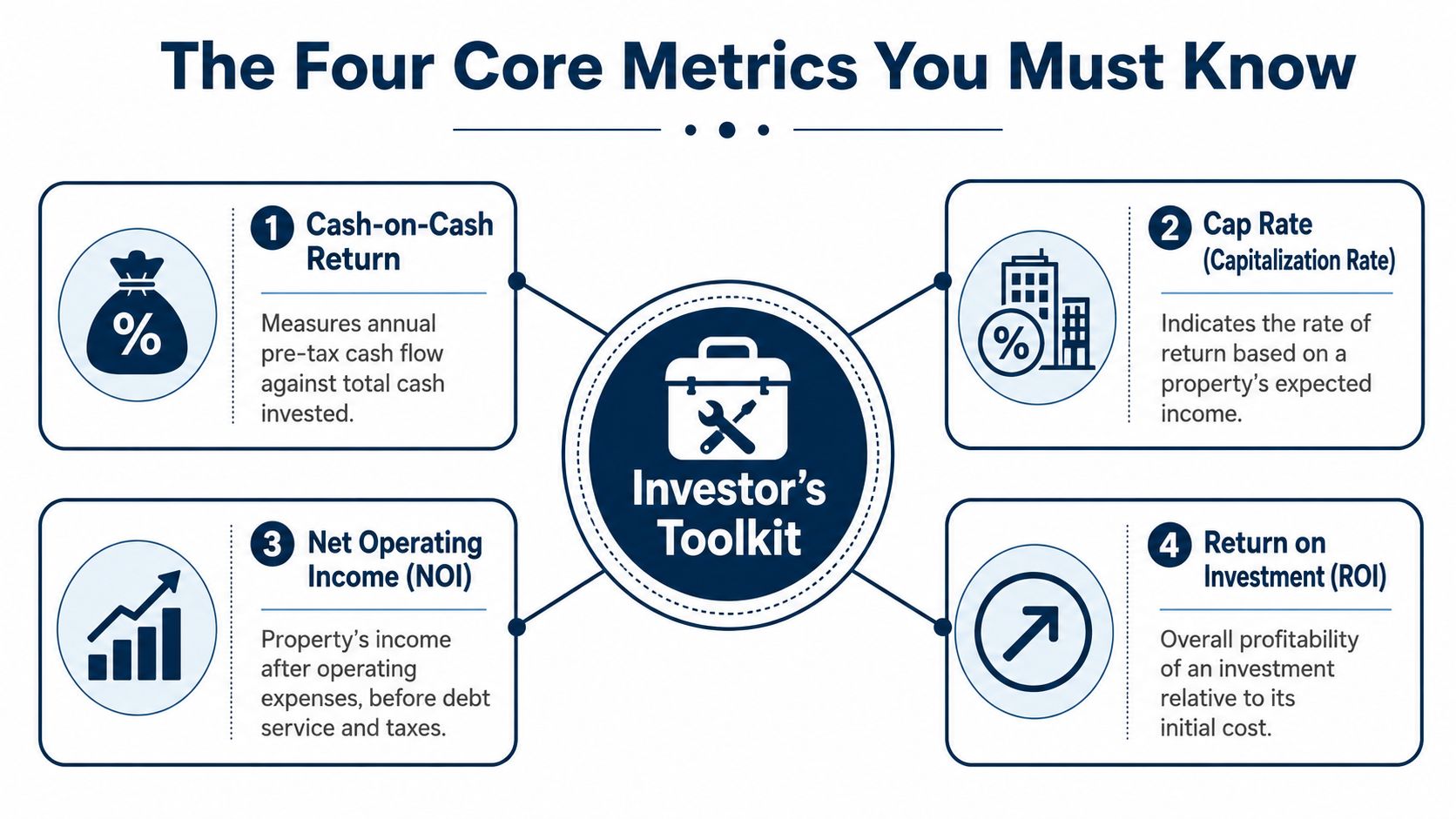
Net operating income
Net operating income, or NOI, is the property's operating profit before debt and taxes. It tells you what the building itself produces.
The formula matters because people often overstate it. NOI is total rental income minus all operating expenses, and you must also subtract an allowance for vacancy and credit loss because that's the figure banks use to judge profitability, as explained in this NOI discussion from The Real Estate CPA podcast.
Think of NOI as the building's paycheck before the mortgage gets paid.
If the seller's numbers ignore vacancy, they're not giving you a real paycheck. They're giving you an optimistic draft.
Cap rate
Cap rate helps you compare properties before financing. It is calculated as NOI divided by market value or purchase price. That makes it a clean way to compare deals before loan structure muddies the picture.
The easiest analogy is miles per gallon in a car. It doesn't tell you everything about the car, but it does help you compare efficiency across options.
This is also where location changes the math. In some major markets, stabilized multifamily cap rates tend to be lower, while emerging markets may show higher cap rates because buyers price in more risk, as outlined in this cap rate metric review from REIkit.
Cash-on-cash return
This metric answers a personal question. How hard is your cash working?
Cash-on-cash return is annual pre-tax cash flow divided by total cash invested. That includes your down payment and other upfront cash you had to put in. It matters because two buyers can own the same property and get different results depending on financing.
For a non-specialist owner, this is often the easiest number to connect to reality. If you invest cash into a deal, this tells you what that cash is earning.
If you want a simple refresher on the broader return concept, this guide on how to calculate return on investment is a useful companion.
DSCR
Debt Service Coverage Ratio, or DSCR, is the safety score. It tells you whether the property earns enough to cover the annual loan payments.
Lenders care about this for obvious reasons. You should too. If a property only works when everything goes right, the debt is probably too aggressive.
Here's a practical way to remember the four:
- NOI tells you what the property earns before financing.
- Cap rate tells you how the market prices that income.
- Cash-on-cash return tells you how your invested money performs.
- DSCR tells you whether the financing has breathing room.
One more practical point. Beginners often underestimate repairs before they ever reach these metrics. If you're working through renovation assumptions, this article on how real estate rehab estimators work helps make that part more grounded.
A Step-by-Step Framework for Analyzing Any Deal
A buyer walks a property, likes the neighborhood, sees clean units, and starts mentally spending the future cash flow before the numbers are built. That is how weak deals survive the first meeting.
A workable process solves that problem. It gives you a way to screen quickly, verify the facts, and decide with discipline instead of momentum.
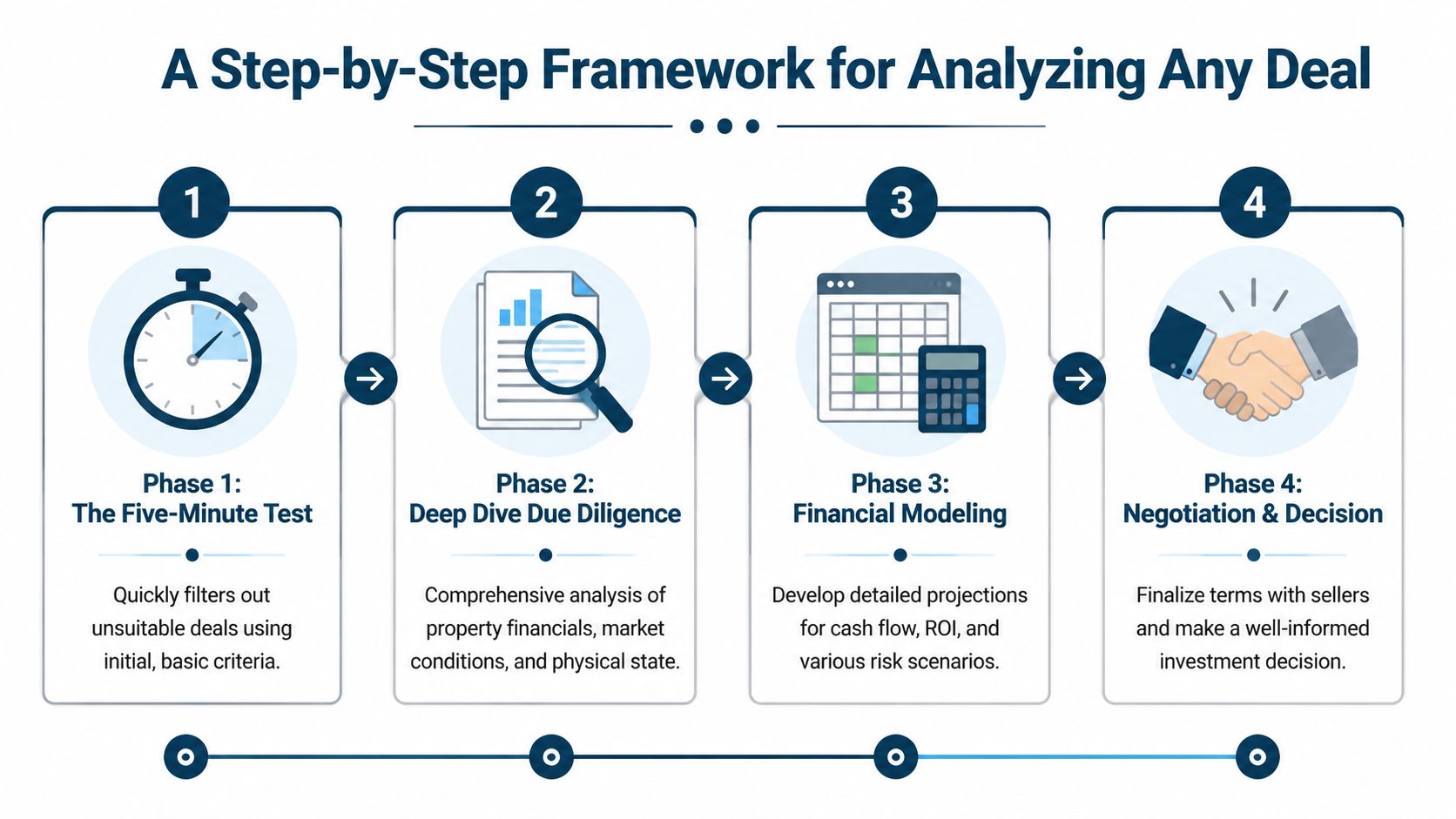
Phase one: use a fast screen
The first pass should take minutes, not hours. The goal is to kill weak opportunities early so you can spend real time on the few that deserve it.
A common shortcut is the 1% rule. Add the purchase price and expected repair budget, then compare that total to the monthly rent. Many investors use it as a rough filter for whether a property is worth a closer look, as explained in this 1% rule overview from Rocket Mortgage. If a property misses the screen by a wide margin, it usually does not deserve a full model.
Use that rule carefully. It is a triage tool, not an investment thesis. A property can pass the quick screen and still fail once taxes, insurance, maintenance, and vacancy are grounded in reality.
Phase two: verify the story with source documents
Now stop relying on the listing sheet.
Request the trailing operating statements, rent roll, current leases, property tax bills, insurance declarations, utility history, service contracts, and any recent repair invoices. If a seller cannot produce clean records, assume more work and more risk. In practice, messy records often point to messy operations.
Then inspect the property with the same attitude. Cosmetic appeal is cheap. Deferred maintenance is expensive.
Look for the items that create surprise capital needs: roof age, HVAC condition, plumbing, electrical panels, drainage, parking lot condition, and code issues. Review access, utilities, and local constraints as well. Operational problems rarely announce themselves in the broker summary.
The fastest way to overpay is to accept a polished story instead of verified facts.
Phase three: build a plain pro forma
Once the documents are in hand, translate them into a forecast you can defend.
Start with actual in-place rent and other income. Then adjust for vacancy, bad debt, repairs, maintenance, taxes, insurance, management, utilities, and any contract services the owner currently pays. If an expense shows up every year, put it in the model. If a cost is likely to rise after closing, reflect that too.
This is the point where clean bookkeeping starts to matter. Owners comparing multiple properties need numbers they can sort, trace, and update without rebuilding every spreadsheet by hand. The right accounting software for real estate investors makes that job easier, especially once you are reviewing several deals at once.
A simple pro forma should cover:
- Income assumptions: Current rent, lease expirations, renewals, and other property income
- Operating expenses: Recurring costs required to run the property
- Vacancy and collection loss: A realistic allowance based on the asset and market
- Capital items: Near-term repairs or replacements that affect your cash needs
- Debt terms: Loan amount, rate, amortization, and any lender constraints
Phase four: compare the deal to your standards
Now run the core metrics and make a decision against pre-set rules.
That last part matters. Investors get into trouble when the standard changes to fit the property they want. A disciplined buyer decides in advance what cap rate, cash-on-cash return, DSCR, and renovation risk are acceptable for that type of asset.
Here is the workflow in one view:
| Phase | Main question | What you need |
|---|---|---|
| Fast screen | Is this worth more time | Price, rent, rough repair budget |
| Document review | Are the numbers and leases real | Financials, leases, tax and insurance records |
| Pro forma | What does ownership likely look like | Income, expenses, capital needs, debt terms |
| Investment decision | Does return justify the risk | Core metrics, financing fit, margin for error |
Good analysis sits between two bad habits. One is buying off a rule of thumb. The other is building a model so complicated that no one trusts the inputs. The better approach is simple: start with a quick filter, verify the facts, build a grounded forecast, and let clean numbers drive the decision.
Stress-Testing Your Investment for the Real World
A weak analysis assumes the property will perform exactly as planned. Real life rarely cooperates.
Tenants leave. Repairs show up early. Insurance jumps. A lease renewal takes longer than expected. The point of stress-testing isn't to be negative. It's to see whether the deal still holds together when the plan gets bumped around.
Start with lender logic
Lenders already think this way. They use DSCR as a safety test, and lenders typically require 1.20x to 1.25x, which means the property's income should cover debt service with a margin of safety, as described in this DSCR guide from 37 Parallel. That threshold exists because loans need room for normal problems, including a drop in net operating income.
If your deal only barely clears that level, you don't have much cushion. If expenses drift up or income slips, the loan can become the problem.
Sensitivity analysis in plain English
Sensitivity analysis sounds technical, but it's simple. Change one input at a time and watch what happens.
Try these questions:
- If vacancy runs higher, does cash flow still stay positive?
- If insurance or repairs come in above plan, does the debt still look safe?
- If rent growth stalls, are you still comfortable owning the property?
You're not trying to predict one perfect future. You're trying to see which assumptions matter most.
A strong deal can survive a few bad months. A weak deal needs a perfect year.
Scenario analysis for decisions
Then zoom out and build three versions of the deal.
One version is the most likely outcome. One is the better-than-expected case. One is the version where several things go wrong at once. That last one is often the most useful because it forces honesty.
A simple comparison might look like this:
| Scenario | What changes | What you're watching |
|---|---|---|
| Most likely | Reasonable rent, normal costs, ordinary turnover | Expected operating result |
| Best case | Strong leasing, steady costs, smooth operations | Upside potential |
| Worst case | Vacancy pressure, cost overruns, slower collections | Downside survival |
Experienced investors don't just ask, “What if this works?” They ask, “What happens if I'm partly wrong?”
That question saves money.
Four Common Mistakes That Can Ruin a Good Deal
A property can look like a winner on the tour, hold up in a quick spreadsheet, and still turn into a weak investment after closing. In practice, deals usually go sideways for simpler reasons. The buyer trusted bad inputs, skipped real costs, or forced the numbers to support a decision they already wanted to make.
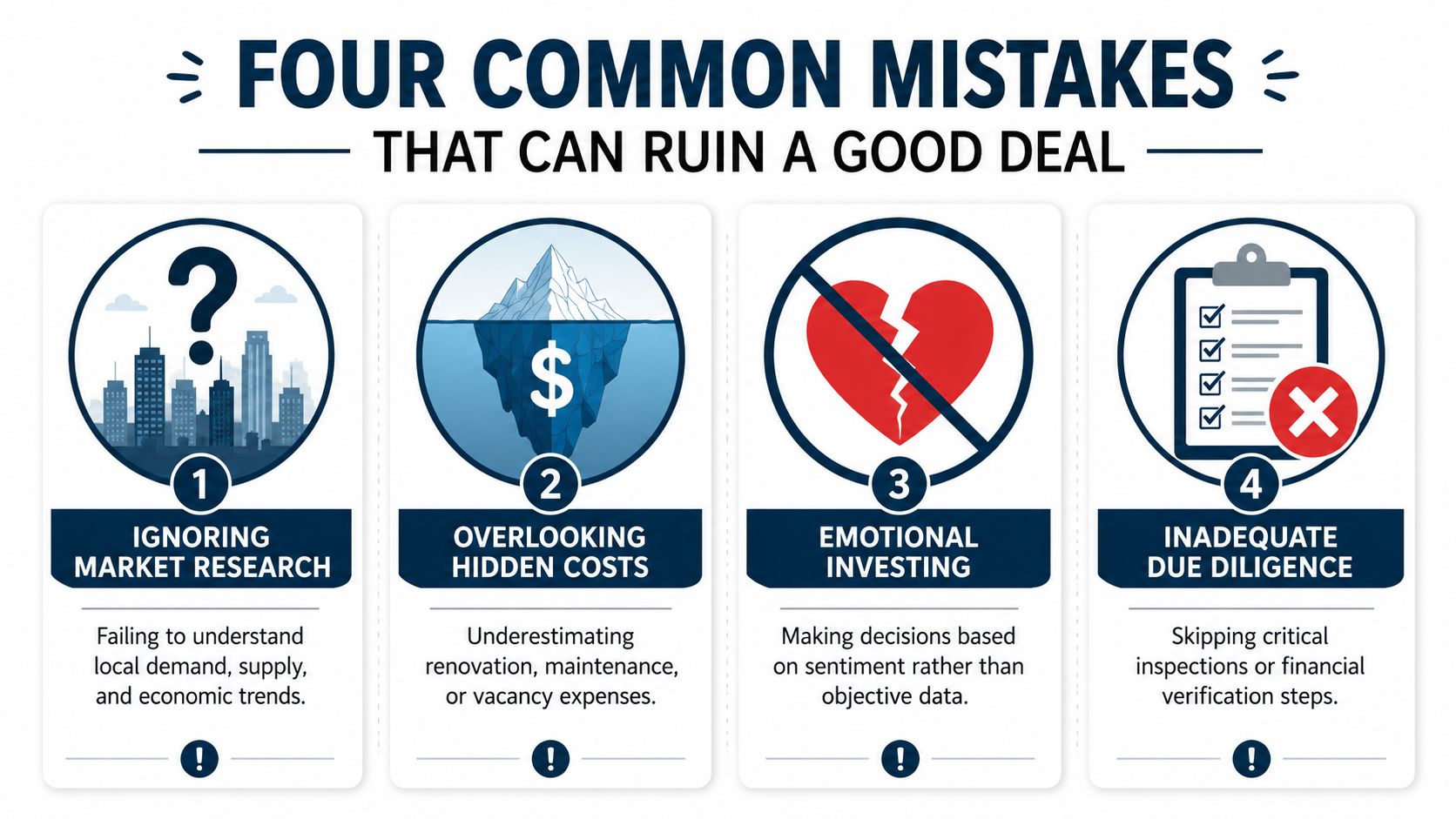
Trusting the seller's version of reality
A seller's pro forma is a sales document. Useful, but incomplete.
Sellers often present the property at its best. They may assume full collections, lean repair costs, and stable occupancy, while leaving out tax increases, turnover, or deferred maintenance. That does not make the numbers dishonest. It does mean they were built to support a price.
Serious analysis starts with verification. Review trailing financials, rent rolls, service contracts, tax history, and maintenance records. If those records are messy, clean reporting matters even before you buy. Good bookkeeping for real estate investors helps you compare the seller's story to the property's actual operating pattern.
Using the 1% rule as the whole analysis
The 1% rule can help screen deals quickly. It cannot replace underwriting.
I use rules of thumb to eliminate obvious bad fits, not to approve a purchase. A property can meet a rough rent target and still underperform once you account for insurance, management, repairs, leasing costs, capital needs, and financing. That is the gap between a quick filter and a real investment decision.
This article is built around that middle ground. More practical than simplistic shortcuts, less academic than a model built for a finance seminar. Buyers need a process they can readily use.
Forgetting the big-ticket costs
This mistake hurts cash flow fast.
Older roofs, HVAC units, parking lots, plumbing lines, and electrical systems do not show up neatly in a broker flyer. Yet those items often decide whether the first two years of ownership feel stable or strained. If the property needs major work, those costs belong in today's analysis, not on a mental list labeled “later.”
I have seen buyers underwrite a property to a thin but acceptable return, then lose that margin to one parking lot repair and one HVAC replacement. The property did not fail because the rent assumption was off by a little. It failed because the capital plan was missing.
Falling in love with the deal
This is the mistake that overrides all the others.
Once a buyer gets attached to the building, the location, or the story they want to tell themselves about the investment, discipline slips. Weak collections become temporary. A vacancy problem becomes a leasing opportunity. Narrow cash flow becomes manageable if everything breaks right.
That is not analysis. It is justification.
If you start arguing for the property before the numbers are settled, reconsider the deal.
A disciplined investor stays willing to walk away. Clean numbers, a repeatable framework, and honest assumptions protect you from paying too much for a property that only looks good at first glance.
Clean Books Are Your Secret Weapon for Smart Investing
Every part of real estate investment analysis rests on one thing. Clean numbers.
If your books are messy, your deal judgment gets messy too. You can't measure available cash clearly. You can't compare opportunities well. You can't tell whether a property is adding strength to your business or draining it.
That problem gets worse when investors mix business and property activity without clear reporting. They think they know their position, but they're really operating from partial information.
Good analysis starts before the deal
Before you evaluate a property, you need a reliable view of your own financial capacity. That means current books, consistent categorization, and reports you can trust.
The same goes for the property itself. If the records are incomplete or poorly organized, your analysis will be weaker from day one. A clean model built on dirty inputs is still a dirty model.

Why advisory matters
Bookkeeping gives you clean records. Advisory turns those records into decisions.
That difference matters when you're choosing between holding cash, buying one property, refinancing another, or stepping back from a deal that looks attractive but doesn't fit your risk profile. A strong advisor helps you pressure-test assumptions, not just organize transactions.
For owners active in property investing, having a process for bookkeeping for real estate can make the jump from scattered records to usable decision data much smoother.
Real estate investing rewards people who stay clear-eyed. Not the loudest buyer. Not the fastest buyer. The buyer with the cleanest numbers and the most honest model usually makes the better decision.
If you want a partner that helps you keep the books clean, make sense of the numbers, and think through investment decisions with CFO-level discipline, take a look at MyOfficeOps. They help business owners turn financial data into practical decisions, which is exactly what good real estate investing requires.