
Figuring out your return on investment is pretty simple. You take the money you gained, subtract the money you spent, and then divide that by how much you spent. This gives you a percentage that shows if your decision paid off. It's the easiest way to score your spending.
What Is ROI and Why Should You Care?

Ever wonder if that new software or the latest marketing campaign was worth the money? That’s where Return on Investment (ROI) comes in. Think of it as a report card for your spending.
ROI tells you how much money you made for every dollar you put into something. It's not just a fancy term for big companies; it’s a simple tool for making smarter choices in your business every day. Knowing your ROI helps you stop guessing and start making decisions that help you grow.
Why It’s a Big Deal for Your Business
Without knowing your ROI, you're basically flying blind. You might feel like a marketing campaign is working or a new piece of equipment is helpful, but you won't know for sure. ROI replaces feelings with facts.
Here’s what calculating ROI helps you do:
- Show Your Work: It provides clear proof that an investment was a good idea—perfect for showing your partners or team.
- Compare Choices: Deciding between two different software tools? A quick ROI check can show you which one will likely give you more back.
- Spend Smarter: It shows you where your money is working hardest, so you can do more of what’s working and cut back on what isn't.
ROI is the bridge between what you spend and what you earn. It’s the scorecard that tells you if your financial moves are winning or just costing you money.
The Basic Formula in Action
The return on investment (ROI) math starts with a simple formula:
ROI = [(Money You Have Now – Money You Spent) / Money You Spent] × 100%
This table breaks down the parts of the ROI formula so you can see what each one means.
The Simple ROI Formula at a Glance
| Component | What It Means | Simple Example |
|---|---|---|
| Money You Have Now | The final value of your investment. This could be sales, profit, or the final price you sold something for. | You sold a stock for $1,200. |
| Money You Spent | The total amount of money you paid at the start. This includes all upfront and extra costs. | You bought the stock for $1,000. |
| The Calculation | The difference between your gain and your cost, divided by the original cost. | ($1,200 – $1,000) / $1,000 = 0.20 |
| The ROI Percentage | Multiply the result by 100 to get the final percentage. | 0.20 x 100% = 20% ROI |
Seeing this with real numbers makes it click. Let’s say you’re a small business owner who wants to see how the stock market is doing.
Imagine back in 2020, you looked at the S&P 500 market index. It started the year at 2,105 and ended at 2,540. The return would be [(2,540 – 2,105) / 2,105] × 100%, which is a 20.7% return.
This same logic applies to your business decisions, turning your spending into a clear grade. You can explore more about historical investment data at the Corporate Finance Institute to see how this works on a larger scale.
Finding the Numbers for Your First ROI Calculation

Alright, let’s actually calculate a return on investment. It’s not as scary as it sounds. The first step is just finding two numbers: what you spent (your cost) and what you earned back (your profit).
Think of it like baking a cake. You need to know how much the ingredients cost and how much people liked the cake to know if it was a success. For your business, this means tracking every penny spent and every dollar earned from a decision.
Pinpointing Your Total Cost of Investment
Figuring out what you spent sounds easy, but this is where people often make a mistake. The “cost of investment” is more than just the price tag on a new machine or the bill from a marketing company.
You have to include everything. These are sometimes called “hidden costs” or “soft costs,” and they add up. Forgetting them can make your ROI look much better than it really is, which can lead to bad choices later.
What should you look for?
- Purchase Price: This is the obvious one—the sticker price of the item or service.
- Setup Fees: Did it cost money to get the new software installed or the new machine delivered? That counts.
- Training Time: If your team had to spend hours learning a new system, that time has a cost. Think about their wages for the hours they spent in training instead of doing their regular jobs.
- Ongoing Fees: Don’t forget monthly subscriptions, maintenance plans, or support contracts.
I once worked with a construction client who bought a new excavator. They only wanted to use the $100,000 purchase price for their ROI calculation. But we had to add $5,000 for delivery and setup, plus another $3,000 in training for their operators. Their true cost was $108,000, not $100,000. It’s a small difference, but it makes the final number honest.
The most accurate ROI calculations come from the most honest list of costs. Make sure you include every single expense, not just the big ones.
Figuring Out Your Financial Gain
Now for the fun part: what did you get back? This number is your profit or financial gain that came directly from the investment. The key word here is “directly.” You need to connect the new money back to the specific thing you spent money on.
Sometimes this is easy. If a new ad campaign brought in $20,000 in new sales, your gain is clear.
Other times, it’s about money saved. Maybe that new excavator I mentioned earlier used less fuel, saving $1,000 a month. Maybe it also broke down less, saving another $2,000 a month in repair costs. In that case, the gain is $3,000 a month in savings.
You can often find these numbers in your accounting software or sales reports. Having clean and organized books is a huge help here because it makes finding these numbers much easier. For more guidance on what to track, check out our guide on the most important key performance indicators for small business.
Let’s Walk Through the Math
Once you have your two numbers—the total cost and the profit—the calculation is simple.
Let’s use a real-world example. Imagine a local landscaper buys a new truck for $50,000. They also spend $2,000 on custom tool racks and company logos for the side. The total cost of investment is $52,000.
Over the first year, the new, reliable truck lets them take on extra jobs, bringing in $70,000 in new business.
Now we just plug those numbers into the formula.
- Calculate the Net Profit: Financial Gain – Cost of Investment = Net Profit
- $70,000 – $52,000 = $18,000
- Divide Net Profit by the Cost: Net Profit / Cost of Investment = ROI (as a decimal)
- $18,000 / $52,000 = 0.346
- Turn it into a Percentage: Multiply the decimal by 100.
- 0.346 x 100 = 34.6%
The return on investment for the new truck in its first year was 34.6%. Now the landscaper has a real number to judge their decision. To help figure out your return, especially for marketing, you might want to use a Campaign ROI Calculator which can make these steps easier.
Applying ROI to Real Business Decisions
The basic ROI formula is a great start, but the real magic happens when you use it for your actual business. ROI isn’t a one-size-fits-all rule. Think of it as a flexible way to look at almost any decision you make. A marketing campaign’s return will look different from a new hire’s, and that’s okay.
Let’s see how this works in the real world with a few examples. The main idea—comparing what you spent to what you got back—is always the same, but the details change.
For a Marketing Agency Launching a Google Ads Campaign
Imagine you run a small marketing company and spend $5,000 on a Google Ads campaign for a client. That’s your cost.
But what’s the return? It’s not just about clicks. You have to see how many of those clicks turned into paying customers.
Let’s say the campaign brought in 20 new clients. Your company knows that, on average, you make a profit of $1,500 from each client over time.
So, the total value from that $5,000 ad spend is:
- 20 clients x $1,500 per client = $30,000 in total value.
Now we can use our ROI formula.
- Gain from Investment: $30,000
- Cost of Investment: $5,000
- Net Profit: $30,000 – $5,000 = $25,000
The final math is ($25,000 / $5,000) x 100, which equals a 500% ROI. For every dollar you put into those ads, you got five dollars back in profit. That’s a huge win.
For a Medical Practice Investing in New Equipment
Now let’s switch gears. A local doctor’s office is thinking about buying a new diagnostic machine for $80,000. The cost is clear. The “return,” however, is a little different than just direct sales.
Here, the return comes from two places: working faster and offering new services.
First, the new machine lets the practice see five extra patients per week. Each visit brings in $200. Over a year (let’s use 50 weeks), that adds up:
- 5 patients/week x $200/patient = $1,000 in extra weekly revenue.
- $1,000/week x 50 weeks = $50,000 in new annual revenue.
Second, the machine lets them do certain tests in their office instead of sending patients somewhere else. This saves the practice $15,000 a year.
So, the total gain for the year is $50,000 (new money) + $15,000 (money saved) = $65,000. But the machine cost $80,000, which means they haven’t made their money back in the first year.
This is a perfect example of why the time frame matters. The first-year ROI is negative, but by the end of year two, the machine will have brought in $130,000 in value, more than covering its cost. When you think about big purchases like this, it’s also helpful to know when you’ll break even. You can learn more in our guide on how to calculate your breakeven point.
ROI isn’t always about instant profit. For long-term investments like equipment, the return often builds over time through savings and new opportunities.
For a Construction Company Running a Safety Program
Finally, let’s look at an investment that doesn’t bring in any money directly: a new safety training program for a construction company. The company spends $25,000 on training materials and paying employees for their time.
How do you calculate the return on something that doesn’t make sales? You measure it in the costs you avoided.
Before the program, the company was spending about $60,000 per year on costs from accidents on the job. This included:
- Workers’ compensation payments
- Project delays
- Safety fines
- Higher insurance bills
After the new training, they tracked these same costs for a year. The result? Accident-related costs dropped to just $10,000.
The financial gain here is the money they didn’t have to spend.
- Cost Savings (The Return): $60,000 (old cost) – $10,000 (new cost) = $50,000.
- Net Profit: $50,000 (savings) – $25,000 (training cost) = $25,000.
- The ROI: ($25,000 / $25,000) x 100 = 100% ROI.
In the first year, the program paid for itself and then some, just by preventing problems. This shows that ROI is a tool you can use to measure all kinds of decisions, not just sales. When thinking about ROI, you might also consider how accounts receivable automation benefits like getting paid faster can improve your returns in a similar, behind-the-scenes way.
When Simple ROI Is Not Enough
The basic ROI formula is a great start, but not all decisions pay off right away. What if you invest in a project that takes five years to show its full value? Using the simple formula can be misleading.
This is where the standard ROI calculation has a weak spot. It treats a 20% return earned in one month the same as a 20% return earned over five years. We know those are very different. The first one is amazing; the second one is… not so great.
Bringing Time into the Equation with Annualized ROI
To get a clearer picture of long-term investments, we can use something called Annualized ROI. It’s not as scary as it sounds. It just takes your total return and figures out the average profit you earned each year.
This helps you compare different projects fairly. Now you can judge a project that took three years against one that took only one.
Let’s use an example. Imagine you bought a small office building for $300,000. You owned it for four years and then sold it for $400,000.
First, the simple ROI:
- Net Profit: $400,000 – $300,000 = $100,000
- Simple ROI: ($100,000 / $300,000) x 100 = 33.3%
A 33.3% return sounds good! But that was over four years. To annualize it, we just do one more step. A quick way to estimate this is to divide the total ROI by the number of years: 33.3% / 4 years = 8.3% per year.
Now you have a much more realistic number. An 8.3% annual return is solid, but it’s not the same as making 33.3% in one year. Calculating the annualized return helps you choose between short-term wins and long-term growth.
This chart can help you decide which type of ROI calculation to use.
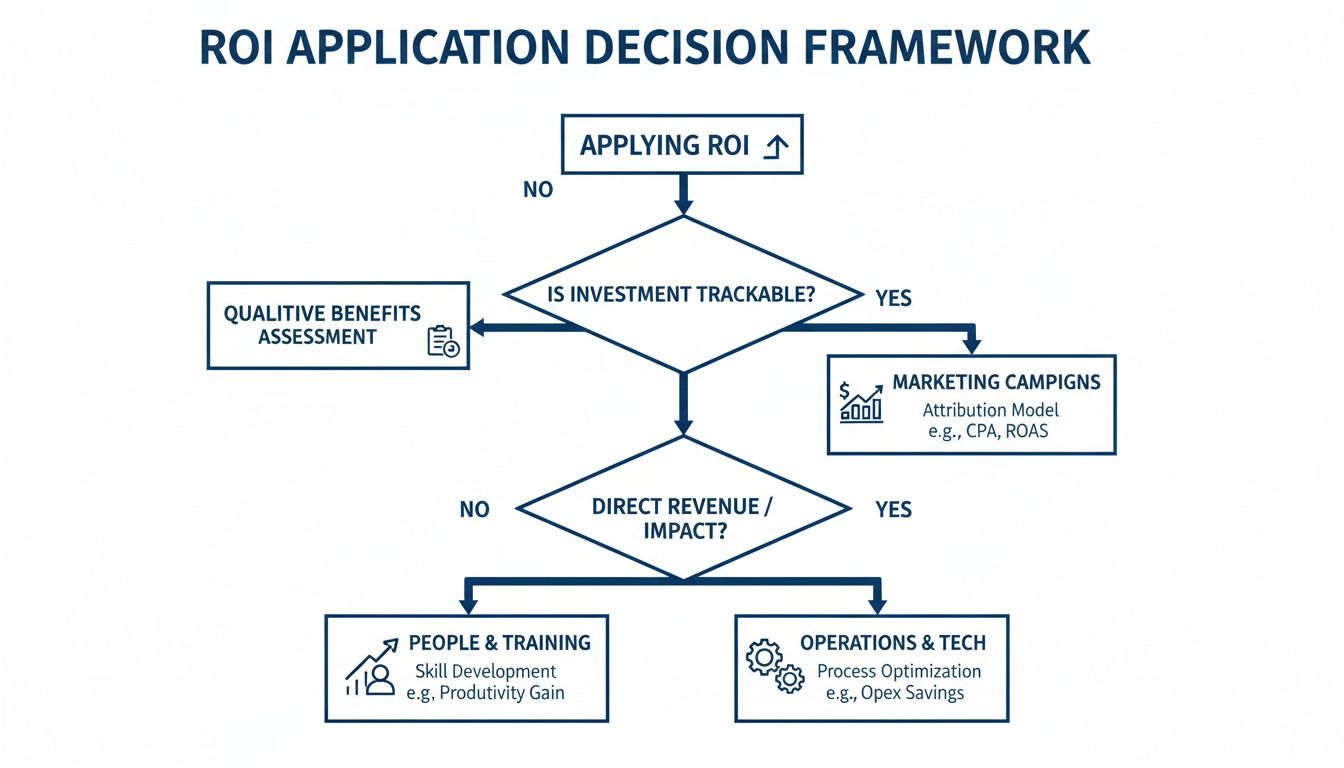
Whether you’re investing in marketing, equipment, or your team, the goal is always to track the return.
Why a Dollar Today Is Worth More Than a Dollar Tomorrow
Another big idea that simple ROI misses is the time value of money. It’s a simple concept: money you have right now is more valuable than the same amount of money you might get later.
Why? Because you can use the dollar you have today. You could put it in a savings account or reinvest it in your business to earn more money. That dollar starts working for you right away. A dollar you get a year from now has missed out on a whole year of potential growth.
This is why getting your money back sooner is usually better. An investment that gives you a $10,000 profit in one year is often a better choice than one that gives you a $10,000 profit in three years, even if they cost the same.
The time value of money isn’t just a finance theory—it’s a reality check. It makes you ask, “Is the future reward big enough to be worth the wait?”
When You Need Bigger Tools Like NPV and IRR
When decisions get really big and complicated—like buying another company or launching a major new product—you might need to go beyond Annualized ROI.
This is where you might hear about Net Present Value (NPV) and Internal Rate of Return (IRR). Don’t worry, we won’t get into the complex math. Just think of NPV as a smart calculator that understands the time value of money.
It takes all the money a project is expected to make in the future and figures out what it would be worth today. Then, it subtracts what you paid for it.
- If the NPV is positive, the project is expected to make more money than your goal. It’s likely a good investment.
- If the NPV is negative, the project probably won’t meet your goals. It’s a sign to be careful.
You probably won’t need NPV for buying a new laptop. But for those huge, business-changing decisions, it’s a powerful way to see if a long-term plan really adds up.
Deciding which tool to use can be confusing, so here’s a quick guide.
When to Use Different Investment Metrics
| Metric | Best Used For | Key Question It Answers |
|---|---|---|
| Simple ROI | Quick, short-term decisions with clear costs and returns. | "Did this specific action make more money than it cost?" |
| Annualized ROI | Comparing investments with different timelines (e.g., 1 year vs. 5 years). | "What is my average yearly return from this long-term investment?" |
| Net Present Value (NPV) | Large, multi-year projects where the timing of profits is important. | "Is the future value of this project, in today's dollars, worth more than what I paid?" |
| Internal Rate of Return (IRR) | Comparing how profitable multiple large projects are. | "What is the true percentage return for this project?" |
Each of these tells a different part of the story. Using the right one helps you get the right answer for the decision you're making.
Common ROI Mistakes and How to Avoid Them
Calculating your return on investment is a big step toward making smarter business decisions, but only if you get the numbers right. It's easy to make small mistakes that give you the wrong picture of how you're doing.
Let's talk about the most common traps people fall into and how you can avoid them. Getting ROI right isn’t just about the math; it’s about being honest with your numbers. A bad calculation can lead you to repeat bad investments or give up on good ones too early.
Forgetting About the Hidden Costs
This is the biggest mistake I see. When adding up the "cost" of an investment, most people stop at the price tag. They’ll look at the $10,000 bill for new software, use that number, and move on.
But the real cost is almost always higher. You have to include all the "soft costs"—the other expenses that are part of your investment.
- Your Team's Time: Did your staff spend 20 hours in training for that new software? That's 20 hours of paid time they weren't doing their normal work. You need to add the cost of their wages for that time to your investment.
- Setup and Integration: Were there fees for getting the new system running? Did you have to pay someone to make it work with your other tools? These are all part of the starting cost.
- Ongoing Maintenance: Don't forget about monthly fees or annual support contracts. These need to be included in your cost for as long as you're measuring.
Forgetting these costs will make your ROI look higher than it really is, making an average investment seem amazing. Always ask yourself, "What else did this cost us, besides the check we wrote?"
Overstating the Financial Gain
The second common mistake is giving one investment all the credit for a great result. This happens when you don't separate the impact of your investment from other things that were happening at the same time.
Imagine you launch a new Facebook ad campaign in the same month you hire a great salesperson. At the end of the month, sales are up by $50,000. It’s tempting to say that entire $50,000 came from the ad campaign, but that’s probably not true. The new salesperson almost certainly had something to do with it.
To avoid this, you have to be realistic. Did sales in other areas also go up? Can you trace specific sales directly back to the ad campaign using special links or discount codes? The more you can prove the direct impact, the more accurate your ROI will be.
A great ROI calculation is like a good science experiment. You have to control for other things to make sure you're measuring the true impact of the one thing you changed.
This kind of careful work is important. For businesses like construction companies or law firms, it's easy to get this wrong. For instance, some financial models have been shown to be off by 13% just because they didn't account for everything. It shows why being careful and thorough with your numbers is so important. You can find out more about how accurate measurement tools can improve your ROI calculations.
Ignoring the Time Frame
Finally, an ROI percentage without a time frame doesn't mean much. As we've talked about, a 50% ROI in one month is fantastic. A 50% ROI over five years? Not nearly as impressive.
Whenever you calculate ROI, always include the time period.
- "Our Google Ads campaign had a 300% ROI in the first quarter."
- "The new machine achieved a 75% ROI over its first two years."
This simple addition provides important context. It tells you how quickly your investment is paying you back, which is just as important as how much it's paying back in total. Without that context, you're only seeing half the story.
How We Help You Track What Really Matters

Knowing how to calculate ROI is one thing. Actually trusting the numbers you’re using? That’s a whole other challenge. If your bookkeeping is a mess, your ROI calculation is just a guess.
That's where we come in. At MyOfficeOps, we believe good decisions start with good data. We don't just "do your books"—we build the financial foundation that makes tracking ROI simple and accurate. Our goal is to get you out of confusing spreadsheets so you can make confident moves based on clear data.
From Messy Books to Clear Answers
It all starts with our Core Accounting service. This is the groundwork. We organize your costs and sales so every dollar has a purpose. This means when you calculate ROI, the "Cost of Investment" isn't a guess—it's a real number you can count on.
From there, our Profit Optimization services help you connect the dots. We look at the numbers to show you exactly which parts of your business are giving you the highest returns and which are quietly costing you money.
We help you answer the questions that really matter: Which service is your most profitable? Is that new marketing channel actually bringing in good clients, or just noise? Which projects seem busy but are actually losing you money?
Real-Time Tracking and Real Human Support
We can even build custom dashboards that put your key numbers right at your fingertips. Forget waiting for a report at the end of the month to see how you did. You can watch your performance as it happens, letting you change your strategy when you need to.
Ultimately, our job is to provide the financial clarity you need to grow. We give you the systems, the analysis, and the support from a team that actually answers the phone.
If you're ready to make smarter, data-driven decisions, exploring what CFO services for small businesses can do for you is a great next step. We’re here to help you track what really moves the needle.
Answering Your ROI Questions
We get a lot of questions from business owners trying to understand return on investment. Here are a few of the most common ones.
What’s a “Good” ROI, Anyway?
This is the big question, and the honest answer is: it depends on your industry and how risky the investment is. For a very safe investment, a 7% or 8% annual return could be a great win.
But if you’re talking about a high-risk marketing campaign with no guarantee of success? You might want to see a 500% return before you’d call it a success. As a general rule, most businesses I work with aim for a 10% to 15% ROI on their internal projects.
Can You Calculate ROI on Things Like Brand Awareness?
Yes, but you have to be a little creative. For goals that don't have a direct dollar sign, like getting your brand name out there or improving team happiness, you have to assign a reasonable dollar value to the result.
For example, you could measure the increase in website traffic from a new brand campaign. Then, figure out what that same traffic would have cost if you’d paid for it through Google Ads. It requires making some smart guesses, but it’s a good way to put a number on your efforts.
How Often Should I Be Calculating ROI?
It really depends on the investment. For something that's always running, like a digital marketing campaign, you’ll probably want to calculate its ROI every month. This lets you make quick changes.
On the other hand, for a big equipment purchase, checking the ROI once a year is probably enough. The most important thing is to be consistent. Check it on a regular schedule to make sure the investment is still worth it.
Ready to stop guessing and start making decisions with clear, accurate data? The team at MyOfficeOps can help you build the financial systems to track your ROI with confidence. Find out how we can give you the clarity to grow your business at https://myofficeops.com.