
Before you can figure out your breakeven point, you need to know what it is. It's the magic number where your total sales exactly cover your total costs. At this point, your business isn't losing money, but it's not making a profit either. Think of it as your financial starting line.
What Is a Breakeven Point and Why It Matters

Imagine your breakeven point is a finish line you have to cross each month. Every dollar you earn before you hit this number goes toward paying your bills—rent, supplies, salaries, you name it. But every single dollar you earn after you've broken even is pure profit.
This isn't just some boring number for accountants. It's one of the most useful tools you can have as a business owner. It helps you answer big questions with real facts instead of just guessing.
Answering Your Big Business Questions
Knowing your breakeven point helps you make smarter decisions. It gives you a clear target to aim for each month or year. Without it, you're just hoping you're selling enough to stay in business.
Here are a few ways this number becomes your best friend:
- Pricing Your Products: Are your prices high enough to cover your costs and make a profit? A breakeven analysis tells you the lowest price you can charge to stay afloat.
- Managing Your Costs: It shines a light on how much your fixed costs, like rent, are really costing you. Maybe that cool downtown office isn't worth it if it means you have to sell twice as much just to get back to zero.
- Setting Sales Goals: Instead of just picking a random sales target, you can set a real goal that's tied to what your business needs to survive. "We need to sell 500 T-shirts this month to cover our costs" is a much clearer goal than just "let's sell more."
This simple calculation changes how you think. You stop focusing on just making sales and start focusing on making profitable sales. It's the first step to building a healthy business.
Why It’s a Must-Know Number
Knowing your breakeven point gives you control over your business's money. It connects your daily work—like making a sale or paying rent—to whether you're making a profit. The numbers you need for this are usually on your main financial reports, and knowing what is a profit and loss statement is a great place to start.
To learn more about this important tool, check out this guide on What Is Break Even Analysis for Your Business. It gives more detail on how this simple math can help you plan for the future and grow your business.
The Three Key Numbers You Need to Get Started

Before you can use the formula, you need to find three key numbers for your business. Don't worry, this isn't complicated math. It's just about knowing what money comes in and what money goes out.
You'll need your Fixed Costs, your Variable Costs, and your Selling Price for one item. Once you have these three numbers, the rest is just simple division. Let’s look at what they are and where to find them.
Finding Your Fixed Costs
Fixed costs are the bills you have to pay every month, no matter what. It doesn't matter if you sell one thing or a thousand things—these costs don't change. Think of them as what it costs just to keep your doors open.
Common fixed costs include:
- Rent for your office or shop.
- Salaries for your employees who aren't making the products.
- Insurance for your business.
- Software subscriptions like your website hosting or accounting tool.
These bills are usually the same each month. To find your total fixed costs, just add them all up. If you already know how to track business expenses, finding this number will be quick and easy.
Identifying Your Variable Costs
Next up are your variable costs. Unlike fixed costs, these numbers go up and down depending on how much you sell. If you have a busy month, your variable costs will be higher. If you have a slow month, they'll be lower. They are tied directly to making your product or service.
Let's say you have a business that sells custom T-shirts. Your variable costs would be things like:
- The cost of a blank T-shirt.
- The ink used to print the design.
- The box or bag you ship the shirt in.
- The credit card fee for that one sale.
Basically, these are the costs to make one item. The more you make, the more you spend on these things. As your business grows, you might find that buying in bulk helps lower these per-item costs, which is an idea called economies of scale.
Your Selling Price and the Contribution Margin
The last piece of the puzzle is your selling price—this is what you charge a customer for one item. This is usually the easiest number to find.
When you have these numbers, you can find a really useful metric called the contribution margin. This is the amount of money from a single sale that helps pay off your fixed costs. It’s just your selling price minus your variable cost for one item.
The entire breakeven formula is built on this idea. You divide your total fixed costs by your contribution margin for one item. The answer tells you exactly how many items you need to sell to cover all your bills and finally start making a profit.
Before we do the full calculation, here’s a quick chart to keep these terms straight. I’ve seen business owners mix these up before, and it can really mess up their numbers.
Your Breakeven Calculation Cheat Sheet
This table explains the key terms in plain English, so you can be sure you're using the right numbers.
| Term | What It Means in Plain English | Example for a Small Business |
|---|---|---|
| Fixed Costs | The bills you pay no matter how much you sell. | Monthly rent of $2,500 for your workshop. |
| Variable Costs | The costs that go up with each sale. | $5.00 for materials to make one handmade candle. |
| Selling Price | What you charge a customer for one item. | $20.00 for that one handmade candle. |
| Contribution Margin | The cash from one sale that helps pay your fixed costs. | $15.00 per candle ($20 Price – $5 Variable Cost). |
Getting these three things right—fixed costs, variable costs, and selling price—is the most important part. Once you have them, the math is easy.
Putting the Breakeven Formula to Work: A Real-World Example
Reading about it is one thing, but let's walk through an example you can relate to. This is where the numbers stop being just numbers and start telling a story about a real business.
Imagine you run a small business that offers tutoring services. Your goal is to figure out how many hours you need to tutor each month just to cover your costs. We're not talking about profit yet—this is just about hitting zero.
Setting Up the Scenario
First, you need to find your three key numbers. Let's say you've looked at your finances and found these figures for your tutoring business:
Fixed Costs: These are the bills that come every month. Think of your rent for a small office, internet service, and your scheduling software. Let's say your total fixed costs are $2,000 per month.
Selling Price: You charge by the hour. For one hour of tutoring, you charge $50. In breakeven math, this is your "price per unit."
Variable Costs: For every hour you tutor, there are some small costs. This might include printing worksheets or the transaction fee for getting paid online. Let's say these costs add up to $10 per hour.
That's it. With these three numbers, you're ready to find your breakeven point.
First, Calculate Your Contribution Margin
Before we use the main formula, we need to find your contribution margin. This number shows you how much money from each hour of tutoring is left over to help pay down your fixed costs.
The math is simple:
Selling Price per Unit – Variable Cost per Unit = Contribution Margin per Unit
For your tutoring business, it looks like this:
$50 (your hourly rate) – $10 (your hourly variable costs) = $40
This means for every hour you tutor, you get $40 that goes directly toward covering that $2,000 of fixed costs. This is a powerful number because it shows you the direct impact of each hour you work.
Finding Your Break-Even Point in Units
Now we can answer the big question: How many hours do you need to tutor each month to break even?
All you do is divide your total fixed costs by the contribution margin we just found.
Here's the formula:
Fixed Costs / Contribution Margin per Unit = Break-Even Point in Units
Let’s plug in your numbers:
$2,000 (Fixed Costs) / $40 (Contribution Margin per Hour) = 50 hours
There it is. You need to tutor for 50 hours each month just to cover your expenses.
This number is your starting line. Any hour you tutor beyond the 50th hour is where your profit begins. A fuzzy goal like "make more money" now becomes a clear, real target for you to hit.
What to Do When You Sell Multiple Products
Most businesses don't sell just one thing. What if you run a bakery that sells cakes, cookies, and coffee? Each product has its own price and costs, which makes finding a single breakeven point a little harder.
You can't really calculate a separate breakeven for each item, because your fixed costs—like the bakery's rent and your baker's salary—are shared by everything you sell. The trick is to find one breakeven point for the whole business. To do that, we need a new idea: the sales mix.
Understanding Your Sales Mix
Your sales mix is just the percentage of your total sales that comes from each product. For example, you might see that 50% of your money comes from cakes, 30% from cookies, and 20% from coffee. This mix is important because each product brings in a different amount of profit to help cover your fixed costs.
To solve this, we'll figure out a weighted average contribution margin. That sounds complicated, but it's really just a way to find the average profit you make across all your products, based on how much of each you sell.
This picture shows the basic idea of using your costs to find your target.
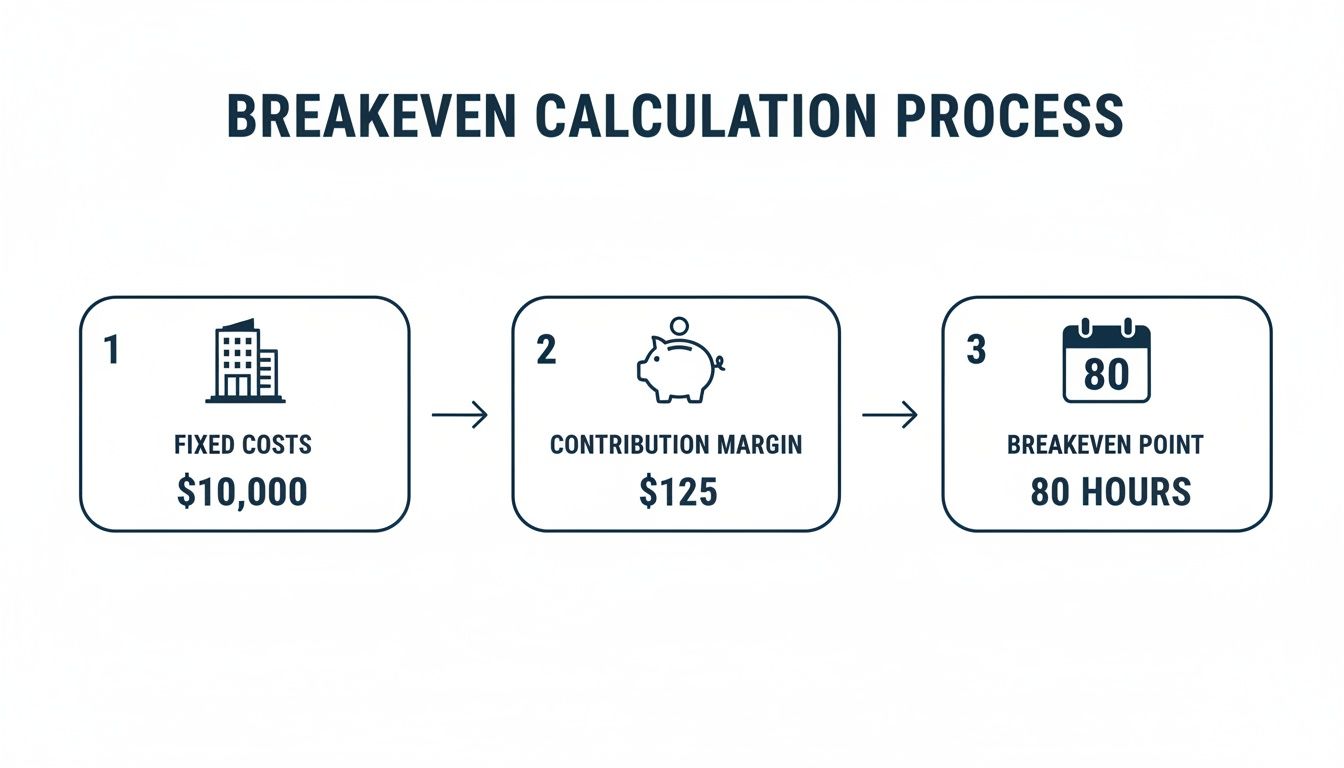
The visual breaks down the math into its three simple parts, showing how you get from your costs to a clear goal.
Calculating a Multi-Product Breakeven
Let's stick with our bakery example to see how this works.
Imagine your bakery has total fixed costs of $4,000 per month. Here's a look at your products:
| Product | Price | Variable Cost | Contribution Margin | Sales Mix |
|---|---|---|---|---|
| Cakes | $40 | $15 | $25 | 50% |
| Cookies | $3 | $1 | $2 | 30% |
| Coffee | $5 | $1 | $4 | 20% |
Now, we'll find the weighted average contribution margin. We do this by multiplying each product's contribution margin by its sales mix percentage, then adding them all together.
- Cakes: $25 (Margin) x 0.50 (Sales Mix) = $12.50
- Cookies: $2 (Margin) x 0.30 (Sales Mix) = $0.60
- Coffee: $4 (Margin) x 0.20 (Sales Mix) = $0.80
Add them up: $12.50 + $0.60 + $0.80 = $13.90. This is your weighted average contribution margin for every item sold.
Think of it like this: for the average "basket" of things a customer buys, you make $13.90 to put toward your fixed costs.
Finally, we use the same breakeven formula, but with our new number:
Total Fixed Costs / Weighted Average Contribution Margin = Breakeven Point in Units
$4,000 / $13.90 = 288 units
This means you need to sell a total of 288 items—a mix of cakes, cookies, and coffee—each month to cover all your costs. This one number gives you a clear target for your whole business, not just one product. Knowing this is a game-changer for any business that sells more than one thing.
Using Breakeven Analysis to Make Smarter Decisions

Knowing your breakeven point is like having a map for a road trip—it shows you where you are and helps you plan your next move. The real magic isn't just in knowing the number, it's in using it to make smart choices for your business.
This tool turns "what if" questions into clear answers. You can use it when you're thinking about spending money, changing prices, or setting goals. Instead of just guessing, you can use simple math to see how a decision will really affect your money.
Planning for New Investments
Let’s say you’re thinking about buying a new machine for your workshop. It's a big purchase, and you're not sure if you can afford it. Breakeven analysis can give you a clear answer.
Imagine the new machine adds $1,000 per month to your fixed costs because of the loan payment. You can plug that new, higher fixed cost into your breakeven formula. It will show you exactly how many more products you need to sell just to cover that new expense.
This quick step helps you see if the investment is really worth it. It turns a scary decision into a simple math problem.
Testing Out Price Changes
Thinking about raising or lowering your prices? Don't just hope for the best. A small change in price can have a huge impact on your profit.
- Raising Prices: If you increase your price, you make more money on each sale (a higher contribution margin). This means you'll need to sell fewer items to break even. Your analysis will tell you exactly how many fewer.
- Lowering Prices: If you lower your price to get more customers, you make less on each sale. You'll have to sell a lot more to cover your costs. The formula will show you the exact number of sales you need to make the price cut a good idea.
Playing with these numbers helps you find that perfect price that's fair for customers but also good for your business. If you want to learn more about this, figuring out how to improve gross profit margin is a great next step.
Introducing Your Margin of Safety
One of the best ideas that comes from breakeven analysis is the margin of safety. This tells you how much your sales can drop before you start losing money. It’s your financial safety net.
Think of it like this: If your breakeven point is selling 100 T-shirts a month, and you're currently selling 150, your margin of safety is 50 T-shirts. This means you have a cushion. Your sales could fall by 33% before you're in trouble.
Margin of Safety = Current Sales – Breakeven Sales
This number shows you how risky your business's financial situation is. A big margin of safety means you can handle a slow month without panicking. A small one means there's not much room for error, and you might need to find ways to sell more or cut costs.
It's all about knowing how much breathing room you really have.
Common Questions About Breakeven Analysis
Once you start using breakeven analysis, a few questions always come up. It’s a simple tool, but it's good to know the details. Here are some plain-English answers to things I hear all the time from business owners.
How Often Should I Calculate My Breakeven Point?
You should think of your breakeven point as a living number, not something you find once and forget. It's a good idea to calculate it at least once every three months to make sure you're on track.
But the real answer is: recalculate it anytime something important in your business changes.
Did your rent go up? That changes your fixed costs. Did the price of your materials increase? That changes your variable costs. Are you planning a big sale? That changes your selling price. For some businesses, checking this number every month is a smart habit.
What Are the Most Common Mistakes to Avoid?
The biggest mistake I see people make is mixing up their fixed and variable costs. For example, a sales commission is a variable cost because it only happens when you make a sale. If you treat it like a fixed salary, your whole calculation will be wrong. Another common mistake is using old numbers; your costs last year probably aren't the same today.
Here are a few specific mistakes to look out for:
- Confusing Costs: Be very clear about this. A "fixed" cost must stay the same no matter how much you sell. A "variable" cost must be directly tied to making one more item.
- Forgetting "Hidden" Costs: It's easy to forget small variable costs like credit card fees or the cost of boxes for shipping. They might seem small, but they add up and lower the actual profit you make on each sale.
- Calculating It Once and Forgetting It: Your breakeven point isn't a one-time thing. It's a tool that should help you make decisions all year long.
The only good breakeven analysis is one that's up-to-date and correct. Always use your most recent numbers to get a true picture of your business.
Can Breakeven Analysis Help Me Get a Business Loan?
Yes, absolutely. In fact, it’s one of the best things you can show a lender.
When you go to a bank with a clear breakeven analysis, it proves you've done your homework. It shows them you really understand how your business makes money and what it will take to be profitable.
Lenders want to see a solid plan, not just a good idea. When you can show them the exact number of sales you need to cover your costs and start making a profit, it makes them feel much more confident about giving you a loan. It replaces guesswork with facts, which makes you look like a much safer bet.
Calculating your breakeven point is the first step toward understanding your business's finances. If you're ready to stop guessing and start making decisions based on data, the team at MyOfficeOps can help. We provide bookkeeping and expert advice that turns your numbers into a plan for growth. Learn more at https://myofficeops.com.