
Sales can be up and your bank account can still feel wrong.
That's the trap a lot of small business owners fall into. Work is coming in. Invoices are going out. Payroll gets covered. Vendors get paid. Then you look up at the end of the month and ask the only question that matters. What did we keep?
If you can't answer that fast, you don't have a sales problem. You have a visibility problem. And the number that fixes it is your net profit margin.
The Real Bottom Line for Your Business
I see this all the time with owners in services, healthcare, and construction. A firm has a busy month, everyone feels productive, and revenue looks strong. But after payroll, rent, software, taxes, loan payments, and all the little costs that pile up, the leftover profit is thin or hard to pin down.
That's exhausting. You work hard, but the business still feels like a moving target.
Net profit margin answers that. It tells you how much of every sales dollar stays with the business after everything is paid. Not just direct costs. Everything. According to Study.com's explanation of net profit margin, net profit margin is the exact percentage of every dollar a business earns that remains as profit after subtracting COGS, operating expenses, interest, and taxes. If your margin is 15%, you keep $0.15 of every $1.00 in sales as net profit.
Why owners care so much about revenue
Revenue is easy to celebrate. It feels like winning.
Profit is quieter. But profit pays down debt, builds cash, funds hiring, and gives you room to breathe when a client pays late or a project goes sideways. Revenue without profit is just expensive activity.
Practical rule: If your business is growing but you still feel constant cash pressure, check net profit margin before you do anything else.
Think about a local clinic. Patient volume rises. Collections look solid. But staffing costs increase, supplies cost more, and interest expense starts biting. On paper, the business is “busy.” In reality, the owner is carrying more stress for less reward.
That's why I push owners to stop bragging about top-line revenue until they know the bottom line.
Understanding Your Net Profit Margin
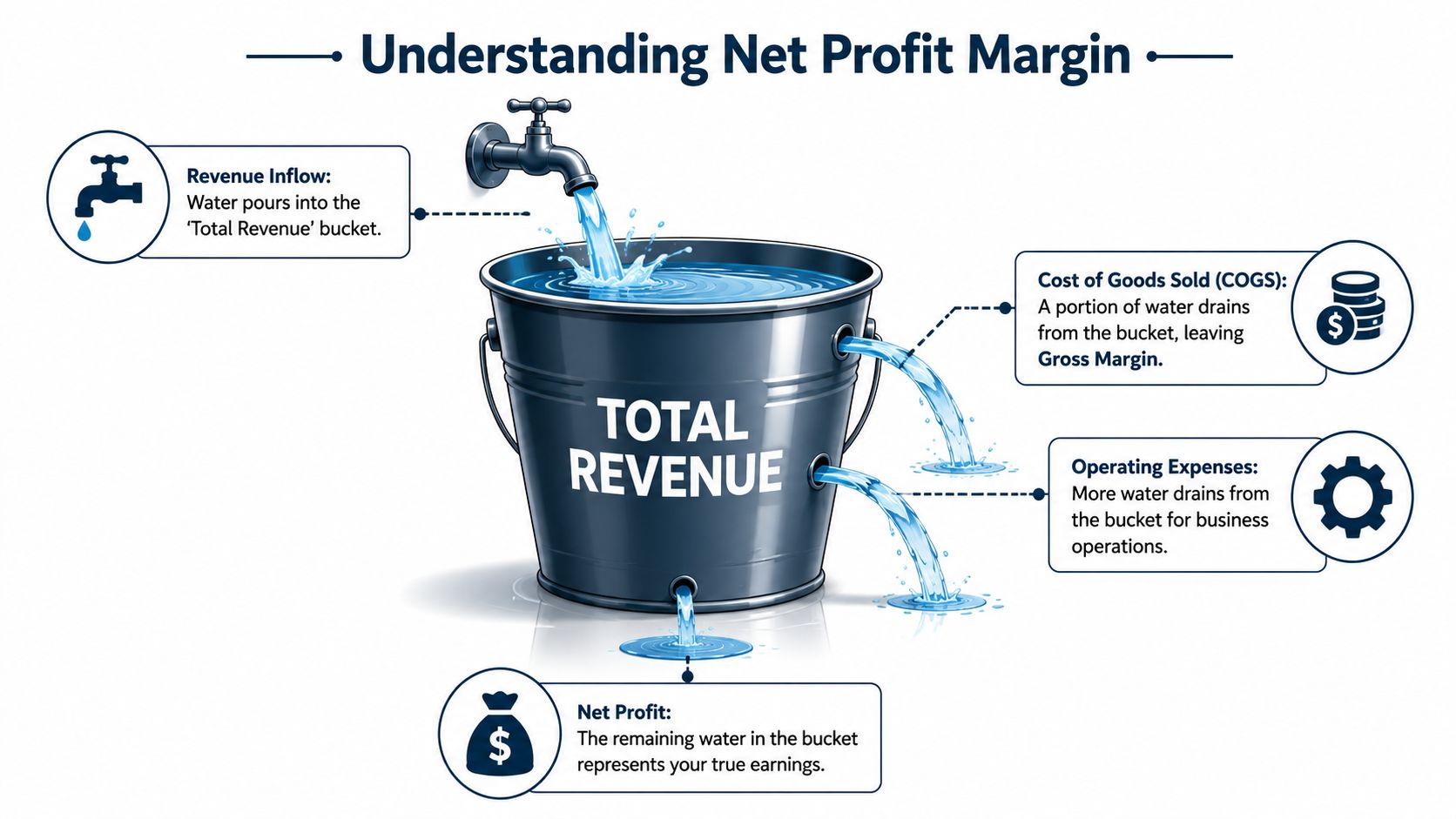
Revenue is like water flowing into a bucket. That bucket is your business.
Some of that water leaks out right away to cover the cost of delivering the product or service. More leaks out through payroll, rent, subscriptions, marketing, insurance, interest, and taxes. Whatever water is still sitting in the bucket at the end is your real profit.
Gross margin is not the finish line
A lot of owners stop at gross margin because it looks better.
That's a mistake. Gross margin only tells you what's left after direct costs. It does not tell you what happens after payroll, admin salaries, office overhead, debt payments, and taxes. As NetSuite's guide to profit margin explains, unlike gross margin, net profit margin deducts all expenses including taxes and interest, making it the truest measure of overall business success. A negative net margin means the company is losing money, while a positive one means it's profitable.
What the bucket analogy means in real life
Here's the simple breakdown:
- Revenue in means invoices paid, jobs billed, or services delivered.
- First leak out is COGS or direct delivery cost. In a contractor's business, that might be labor and materials tied to the job.
- More leaks out through overhead like rent, software, admin staff, insurance, and marketing.
- Final leaks out through interest and taxes.
- What stays is net profit.
A business can have a healthy gross margin and still struggle because the rest of the bucket is leaking too fast.
A pretty gross margin can hide a messy business.
Why this number matters more than owners think
Net profit margin is a stress test. It shows whether your pricing, staffing, overhead, debt load, and tax planning are working together or fighting each other.
If you're in professional services, this tells you whether your team is billing enough to support the payroll you've built. If you run a medical practice, it tells you whether reimbursement and staffing are in balance. If you're in construction, it tells you whether jobs are making money after the office costs hit.
That's why smart owners track it regularly, not once a year when the tax return shows up.
How to Calculate Net Profit Margin Step by Step
You finish a busy month, the bank balance looks decent, and you assume the business did fine. Then payroll clears, taxes hit, a loan payment goes out, and the picture changes fast. That is why you need a clean margin calculation, not a guess.
Net profit margin answers one question: after every expense is paid, how much of each revenue dollar do you keep?
The step-by-step version
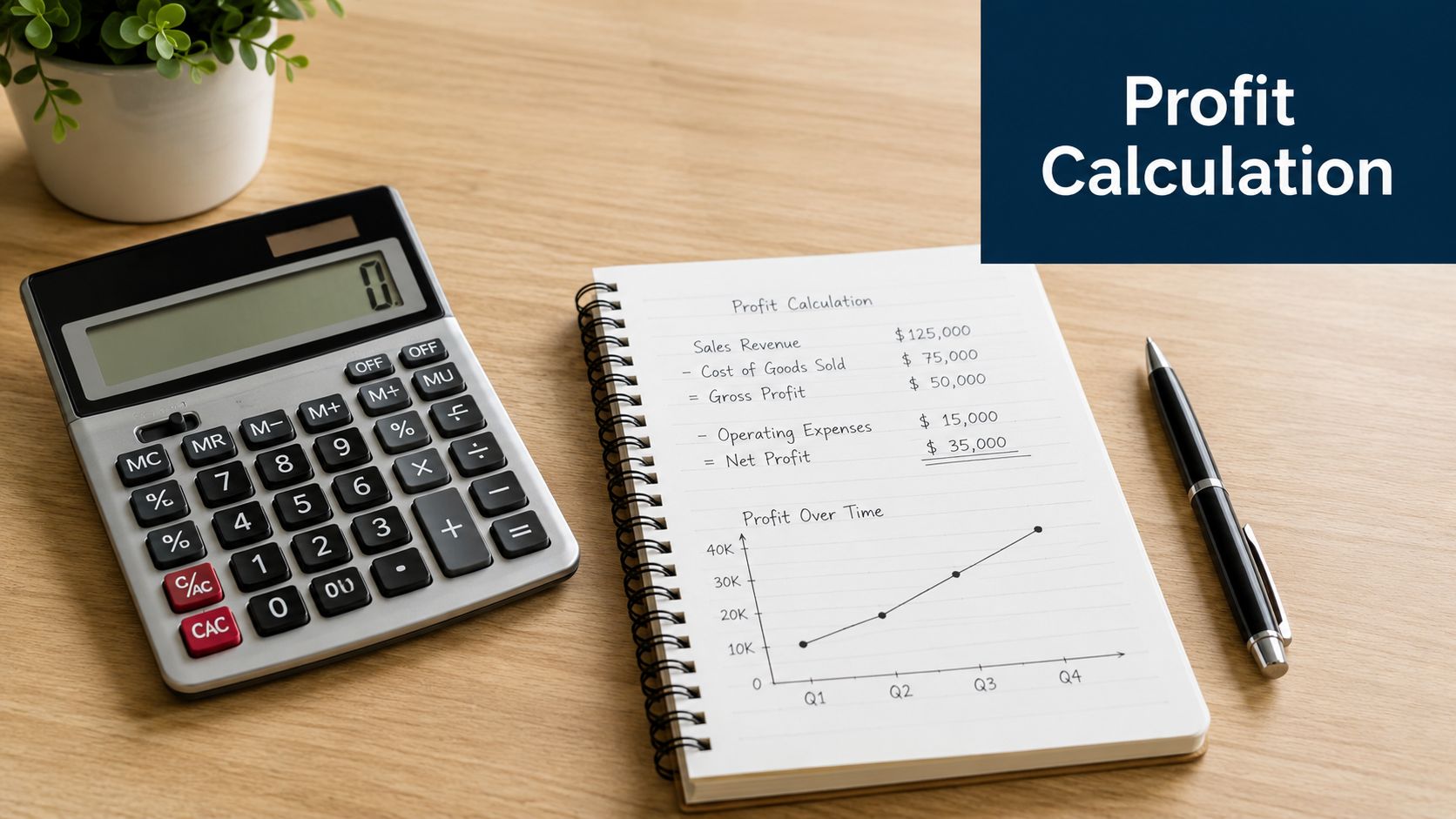
Use this formula:
Net Profit Margin = (Net Profit / Total Revenue) × 100
A simple example: if your business keeps $10,000 in net profit on $100,000 in revenue, your net profit margin is 10%. You kept 10 cents of every dollar.
Here is the process small business owners should follow.
Pull total revenue from your income statement
Use one period only, monthly, quarterly, or annually. Do not mix them.Subtract direct costs
These are costs tied to delivering the work. In a service business, that could be contractor pay or billable labor. In healthcare, it may include clinical labor and medical supplies. In construction, it usually includes job materials, subcontractors, and field labor.Subtract operating expenses
This is the overhead that keeps the business running: office payroll, rent, software, insurance, marketing, admin support, and similar costs.Subtract interest and taxes
Owners miss this step all the time. If you leave these out, you are not calculating net profit margin. You are calculating something less useful.Divide net profit by total revenue, then multiply by 100
The result is your net profit margin percentage.
A plain-English example
Say your firm brings in $250,000 for the quarter. Direct service delivery costs are $90,000. Operating expenses are $120,000. Interest and taxes add up to $15,000.
Your net profit is $25,000.
Now divide $25,000 by $250,000. Your net profit margin is 10%.
That number is what matters. It tells you what stayed in the business after the full cost of running it.
Use your income statement, not your bank balance
Your bank account shows cash. It does not show profitability clearly enough to manage the business well.
Use your profit and loss statement instead. If you are not fully confident about which numbers belong where, review this guide on how to read an income statement. Get that part right first, because a bad margin calculation leads to bad decisions on pricing, hiring, and spending.
If you also sell products online, this breakdown of profitability for eCommerce businesses is useful because inventory, fulfillment, and shipping costs can distort margins quickly.
What Is a Good Net Profit Margin for Your Industry
You close the month with solid sales, the phone is still ringing, and the calendar looks full. Then you review the numbers and realize there is barely any money left over. That is the trap. Revenue can make a business look healthy long before the margin shows you the truth.
A good net profit margin depends on your industry. If you use the wrong benchmark, you will either tolerate weak performance or chase a target that does not fit your business model.
Start with the right comparison
For broad context, the average net profit margin across all U.S. industries is 8.54%. That same industry summary shows why broad averages can mislead. Some sectors run extremely high margins, while others operate on much thinner spreads or even post losses.
For the small and midsize businesses MyOfficeOps typically serves, these sector averages are more useful:
| Industry | Average Net Profit Margin |
|---|---|
| Business & Consumer Services | 5.45% |
| Hospitals/Healthcare Facilities | 5.12% |
| Engineering/Construction | 1.67% |
| Real Estate (General/Diversified) | 16.91% |
Read that table carefully. A 5% margin can be ordinary in one business and a warning sign in another.
What those benchmarks mean in the real world
Service businesses usually have the most room to improve, and the most excuses for not doing it. Owners often accept thin margins because payroll is high, clients push back on pricing, or growth feels strong. That is sloppy thinking. Scoop Analytics points out that many service firms need 10% to 20% margins to stay healthy, and anything below 5% for two straight quarters signals a serious pricing or cost problem.
If you run a law firm, marketing agency, accounting practice, IT consultancy, or similar service company, do not settle for “profitable enough” if almost nothing sticks after payroll and overhead. A busy service firm with weak margins usually has a pricing issue, a utilization issue, or both.
Construction is a different animal. Margins are naturally tighter because labor overruns, material volatility, scheduling delays, rework, and bad estimating all hit the bottom line fast. A contractor does not need vague motivation about profitability. A contractor needs disciplined job costing, tighter change-order control, and overhead that matches actual project volume.
Healthcare has its own pressure points. Reimbursement shifts, staffing costs, financing costs, and admin burden can erode margin quickly even when patient volume looks steady. KFF's hospital finance overview found that rural hospital operating margins fell from 8.9% to 2.7% from 2022 to 2023. That is a sharp drop in a short period, and it shows how fast outside pressure can squeeze a healthcare operation.
If your margin is weak, stop asking whether the business is busy. Ask where the money leaks out.
The point is simple. Benchmarks matter, but only if you use the ones that match how your business operates. A service firm should focus on pricing discipline and labor efficiency. A healthcare group should separate clinical performance from admin overhead. A construction company should track margin by job, not just by month. That is how financial advisory stops being a reporting exercise and starts driving growth.
Five Practical Ways to Improve Your Profit Margin
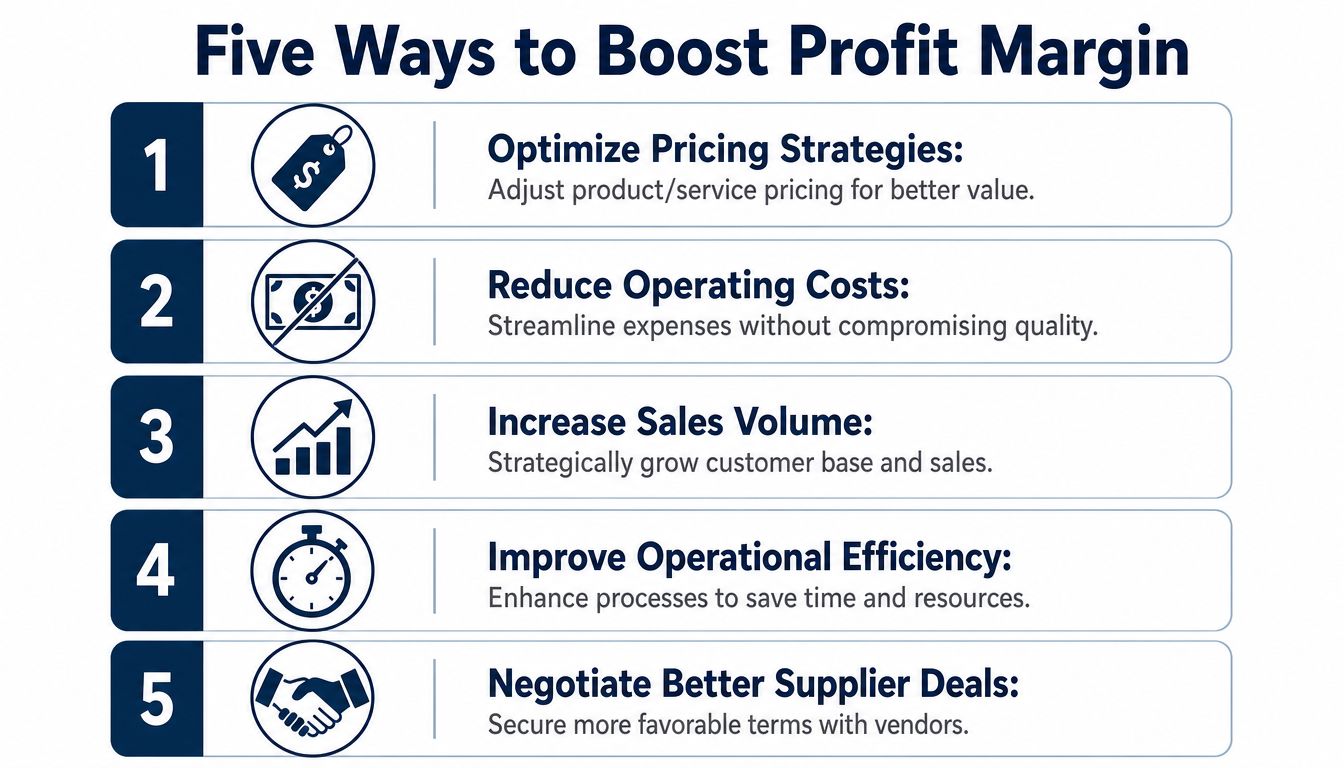
Most margin problems come from a few repeat offenders. Bad pricing. Bloated payroll. Weak job costing. Overhead that grew faster than revenue. Systems that waste labor.
You don't fix that with motivation. You fix it by changing operations.
Fix pricing before you cut too deep
A lot of owners try to save their way to profitability when the underlying issue is underpricing.
If your team is busy and the margin is still weak, your prices may be wrong. Raise prices where the value is clear. Rework packages. Add minimums. Stop discounting to close shaky work. A service firm with a margin problem usually needs better pricing discipline before it needs another expense freeze.
Track profit by job, client, or service line
You need to know where profit comes from and where it dies.
- For contractors use job costing on every project. If materials, labor, change orders, and rework aren't tracked tightly, your margin gets destroyed one job at a time.
- For healthcare groups separate provider productivity from admin overhead so you can see whether the care side is carrying the back office.
- For service firms review client profitability, not just revenue. Some clients buy a lot and still drain your team.
Get serious about payroll efficiency
Payroll is usually the largest expense, and owners often manage it with feelings instead of data.
That doesn't mean “cut staff.” It means match labor to profitable work. Watch utilization in service businesses. Watch overtime and crew mix in construction. Watch scheduling, collections, and front-desk workload in healthcare. If payroll rises faster than profitable output, your net profit margin gets squeezed.
Owner check: Don't hire because people feel busy. Hire when the numbers show profitable capacity is full.
Cut overhead that no longer earns its keep
Overhead creeps. Software stacks grow. Subscriptions pile up. Office costs stay fixed while work patterns change.
Do a blunt review of recurring expenses. Keep the tools that save time, improve reporting, or support revenue. Cut the rest. If you need a starting point, this resource on how to improve gross profit margin can help you separate direct cost problems from overhead problems.
In healthcare, revenue cycle issues can also wreck margin because delayed or denied claims raise admin cost and slow cash flow. For practice owners trying to reduce denials and costs, tightening billing operations can make a real difference.
Build systems that waste less time
Operational drag kills profit subtly.
Look for repeat work, manual handoffs, bad approvals, poor scheduling, weak collections, and unclear scopes. Every avoidable hour your team burns is an expense line in disguise. Good systems protect margin because they let the same team produce more cleanly.
One practical setup many owners use is a mix of bookkeeping, reporting, payroll integration, and advisory support. For example, MyOfficeOps provides Core Accounting, Profit Optimization, and CFO advisory services that help owners clean up books, analyze profitability, and act on what the numbers say.
Turn Your Financial Data Into a Growth Engine
Knowing your net profit margin is a start. Using it to run the business is where its ultimate value shows up.
Most owners don't need more reports. They need reports they can trust, and someone to help them turn the numbers into decisions. Should you raise prices? Add a hire? Cut a service line? Change payment terms? Without clean books and useful analysis, those choices turn into guesswork.

What owners should do next
Start with the basics. Make sure your books are current. Review your income statement monthly. Watch margin by service line, job, or department. Don't wait for year-end to find out you worked hard for too little profit.
Then go one step further. Build reporting that helps you act, not just react. A solid business intelligence reporting process can help you spot margin pressure early, before it turns into a cash problem.
My view as an advisor
If you don't know your net profit margin, you're driving with a dirty windshield.
If you know it but don't act on it, you're still stuck.
Owners who improve margin usually do the same few things well. They keep clean books. They review numbers regularly. They price with confidence. They control labor. They stop tolerating waste. That's how financial data becomes a growth tool instead of a stack of reports no one uses.
If you want a clearer view of what your business is keeping, talk to MyOfficeOps. They help small and midsize businesses clean up financial reporting, track profitability, and turn the numbers into decisions on pricing, hiring, cash flow, and growth.