
If you're like most owners I talk to, your business is both your job and your biggest asset. That's the good news. The hard part is this: a lot of that value is trapped inside the company, and when owners finally ask how to turn it into retirement money, family security, or a clean next chapter, they realize they don't have a real plan.
That usually shows up in ordinary ways. The books are good enough for taxes but not clean enough for a buyer. Key customers still call you first. Your team can run the week, but maybe not the month. You know the business has value, but you couldn't say what that value is, how transferable it is, or what happens if you want out sooner than expected.
That's where exit planning comes in. Not as a last-minute sale checklist, but as a practical way to run the business now so you have choices later.
What Exit Planning Really Means
A lot of owners hear exit planning and think it means paperwork you deal with right before retirement. That's too small.
What is exit planning, really? It's a roadmap for getting the value out of your business in a way that works for your money, your family, your team, and your life after the business. It's less like filling out a form and more like preparing for a long road trip. You don't just grab the keys and hope the car makes it. You check the engine, plan the route, decide where you're headed, and make sure someone else can drive if needed.
I've seen owners build solid companies over decades, then hit a strange wall. On paper, they're successful. In practice, they're stuck. The business depends on them for sales, decisions, hiring, and even customer trust. That kind of company can produce income, but it can be hard to transfer.
It's a way of running the business now
A real exit plan starts long before a sale. Guidance from the International Exit Planning Association says the process is a structured roadmap across business, personal, financial, legal, and tax issues, with measurable benchmarks and backup paths rather than a one-time event (IEPA on what the exit planning process involves).
That matters because buyers don't purchase your effort. They purchase a company they believe will keep working after you're gone.
Practical rule: If the business stops acting like a business when you step away, you don't have an asset yet. You have a demanding job.
The simple definition that actually helps
In plain English, exit planning means building a business that is:
- Valuable: The financials are clear, margins make sense, and the company has real market appeal.
- Transferable: Customers, systems, and employees don't disappear when the owner exits.
- Aligned with your goals: The plan fits whether you want retirement income, a family handoff, a sale, or a phased step-back.
The most useful way to think about it is this. Exit planning isn't about leaving. It's about making the business strong enough that leaving is an option.
Why Planning Your Exit Is Not Optional
Most owners don't avoid exit planning because they think it's unimportant. They avoid it because the business is busy right now. Clients need attention. Payroll hits every cycle. Fires pop up every week. So the exit gets pushed into the vague future.
That's understandable. It's also risky.
Waiting creates a weaker business
A planned exit is like building a house with blueprints. A forced exit is like throwing plywood over the windows when a storm is already here. Owners who wait usually run into the same problems:
- Owner dependence: The company revolves around one person.
- Messy records: Financials answer tax questions, not buyer questions.
- Thin bench: No second layer of leadership exists.
- Reactive timing: Health, burnout, family issues, or market pressure dictate the move.
When that happens, owners lose their bargaining power. Buyers can sense urgency. They ask harder questions, demand more proof, and push on price and terms.
The failure rate is the warning sign
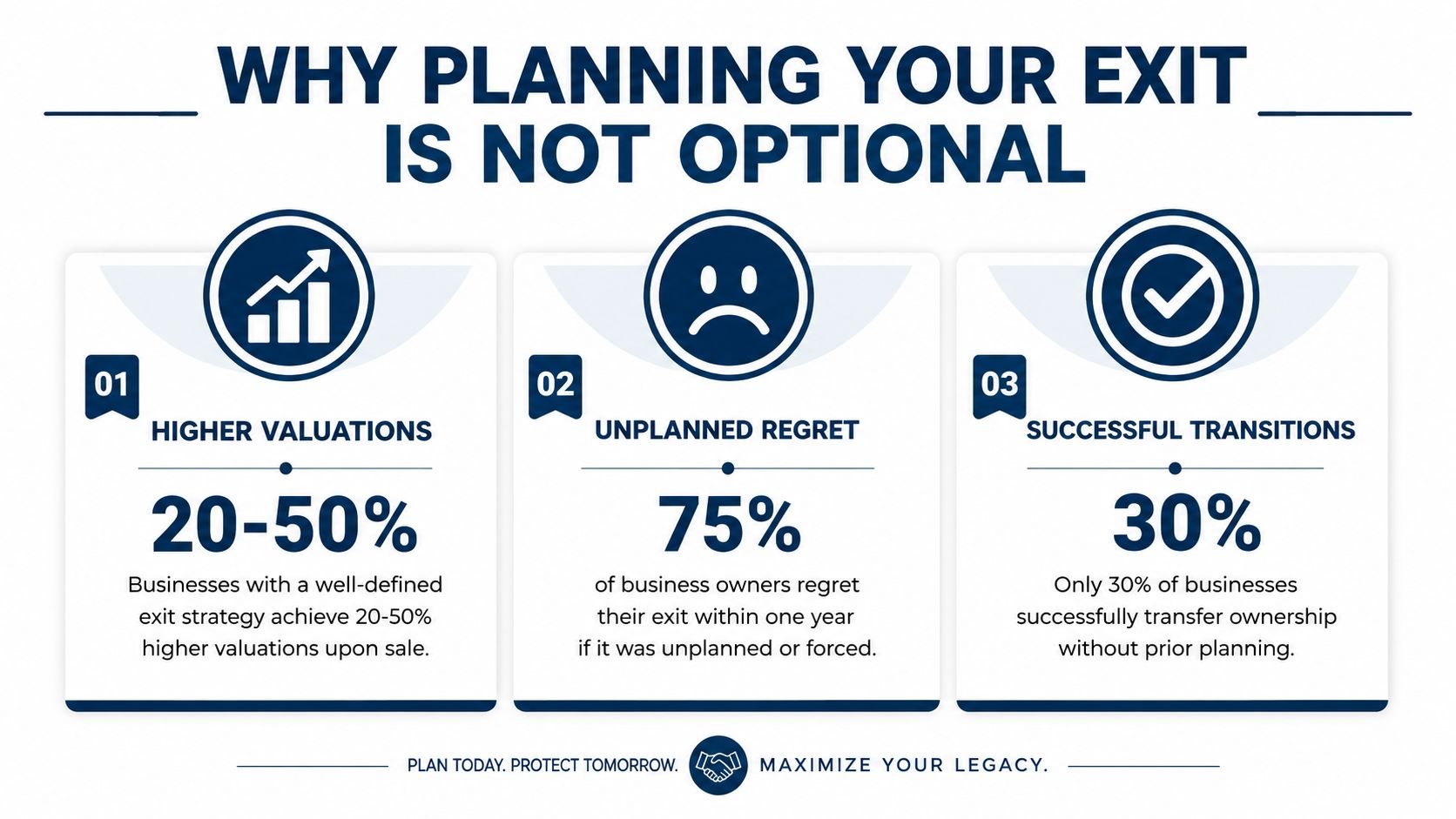
This is the stat I wish more owners took seriously. Only approximately 33% of small business owners have a documented exit plan, and roughly 80% of businesses that try to sell without adequate preparation fail to close a transaction, according to CT Acquisitions' succession statistics guide.
That tells you something important. A business can be profitable and still not be sellable.
Those failed deals usually don't collapse because the owner didn't work hard enough. They collapse because the business goes to market before it's ready. The financial story is unclear. The owner is still too central. Contracts aren't organized. Revenue may look fine, but the structure underneath it isn't clean.
Hope is not a strategy. Buyers pay for proof.
Why early work pays off
A proper exit plan gives you time to fix what suppresses value. It lets you reduce the owner's role, train managers, tighten systems, and make the company easier to understand from the outside. That's what turns a business from "good local company" into "transferable asset."
You also get more options. You can sell when timing is favorable. You can choose between internal and external paths. You can say no to a weak offer because you aren't cornered.
A lot of owners think no plan means "I'll decide later." In practice, no plan means the future will decide for you.
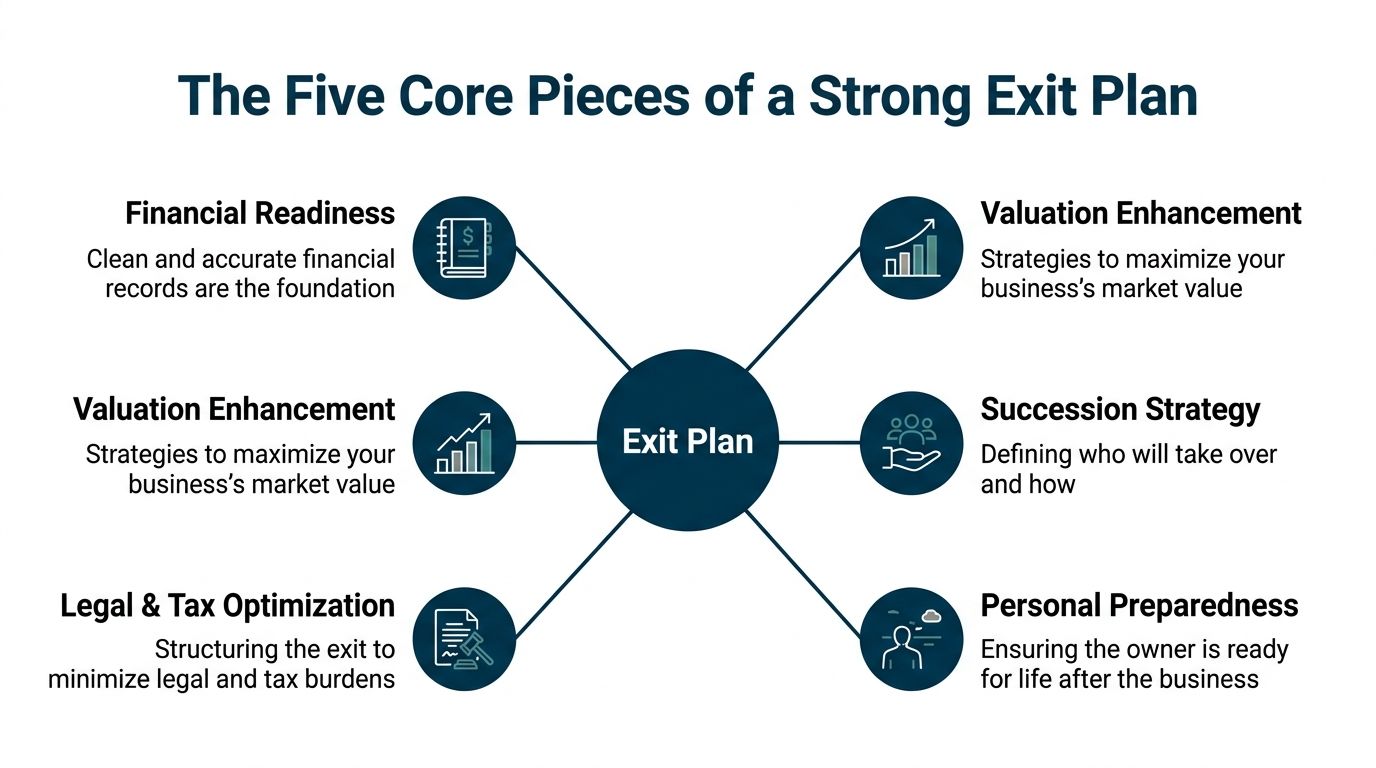
The Five Core Pieces of a Strong Exit Plan
A strong exit plan doesn't need to feel mysterious. It has a few core parts, and each one solves a problem buyers care about.
Financial readiness
If your books are inconsistent, everything else gets harder. Buyers want clean financial statements, understandable margins, and a clear picture of how the business makes money.
Think of a contractor whose job costs live partly in software, partly in spreadsheets, and partly in someone's head. That owner might know the business is healthy, but proving it is another matter. Exit planning starts by cleaning that up.
Valuation and value drivers
You need to know what the company is worth now, and why. That usually starts with an objective valuation, then moves into improving the things that drive transferability and price.
If you want a plain-language starting point, this guide to enterprise value calculation helps frame how owners think about value beyond simple revenue.
A formal plan should also look beyond income alone. The Exit Planning Institute describes exit planning as a value management system that strengthens Human, Structural, Customer, and Social capital to build transferability (Exit Planning Institute methodology overview). In everyday terms, that means buyers care about your people, your systems, your customer relationships, and your reputation, not just your profit line.
Legal and tax structure
This part isn't glamorous, but it's where owners often lose money or invite delays. Ownership documents, contracts, buy-sell terms, and tax planning all need attention before a deal is live.
The mistake is waiting until the sale process starts. By then, you're trying to fix old paperwork under pressure.
The cheapest time to solve a legal or tax issue is before it becomes a deal issue.
Operations and people
Many exits rise or fall based on factors like these: Can the business run without the founder making every decision? Are processes documented? Can a key manager handle client issues, hiring, and day-to-day execution?
A consulting firm is a good example. If every major client stays because they trust the founder personally, the firm has a transfer problem. If a second-tier leadership team can retain clients and manage delivery, the business becomes much more attractive.
Succession and personal preparedness
The last piece has two sides. One is deciding who takes over. Family member, partner, employees, outside buyer, or some mix. The other is harder and often ignored. Are you personally ready to stop being the center of the business?
A lot of plans look complete on paper and still fail in real life because the owner hasn't answered a basic question: what am I walking toward, not just away from?
Common Exit Routes and Who They Are For
There isn't one right way to exit. The best route depends on what you care about most. Price matters, of course, but so do legacy, employee stability, timing, control, and your own comfort with letting go.
Family succession
This route makes sense when preserving the business inside the family matters more than squeezing out the highest sale price. It can work very well, but only if the next generation is willing, capable, and trusted by the team.
The emotional trade-off is obvious. Family succession can protect legacy, but it can also blur business and personal dynamics. If one child is active in the company and another isn't, fairness becomes a real issue.
Sale to a third party
If your main goal is liquidity, an outside sale may be the better fit. That buyer might be a strategic company, an investor, or another operator looking to expand.
This path usually demands the most proof. Buyers want clear systems, clean numbers, and low owner dependence. The upside is that it can create a clean break. The downside is that you may have less control over what the business becomes afterward.
For owners weighing different paths, this practical exit strategy example can help make the trade-offs more concrete.
Management or employee transition
Some owners care a great deal about keeping the culture intact. In those cases, a management buyout or employee-led transition can be a strong option. The people who know the business best already understand customers, operations, and team dynamics.
This route often requires patience. Internal buyers may need time, financing support, or a phased handoff.
ESOP or structured employee ownership
An employee ownership path can appeal to owners who want continuity and care about rewarding the people who helped build the company. It can preserve culture and create a long runway for transition.
But it isn't just a feel-good decision. It requires planning, structure, and the right company profile.
Liquidation
Sometimes liquidation is the realistic path. That's usually the least attractive option when the goal is maximizing enterprise value, but it can still be the right answer if there is little transferable goodwill or no practical buyer path.
One more thing belongs in this conversation. Most exit planning content ignores the owner's identity shift, yet 45% of business owners delay selling because they fear losing their professional identity, according to the Orange County Community Foundation's exit planning guidance. That's why the right route isn't just about mechanics. It's about whether you can live with the choice after the deal closes.
A clean transaction can still feel like a bad outcome if the owner has no plan for who they are next.
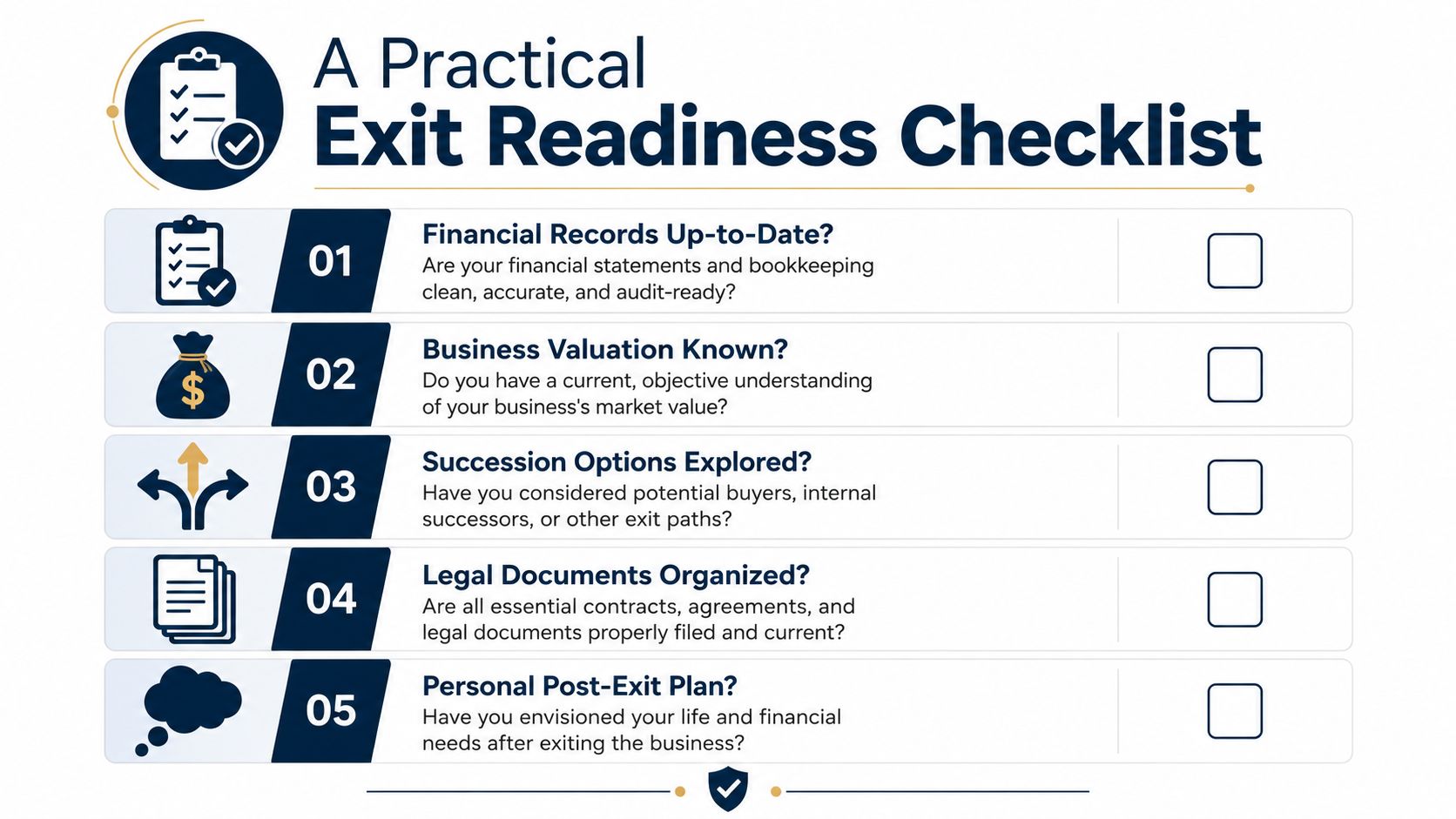
A Practical Exit Readiness Checklist
Most owners don't need a giant binder to get started. They need a short, honest check. If you can answer these questions clearly, you're moving in the right direction. If not, you've found your first gaps.
Start with the business itself
Use this as a working checklist, not a test you need to pass perfectly.
- Financials clean enough for scrutiny: Are your bookkeeping, payroll records, and financial statements current, organized, and easy for an outside party to follow?
- Current value understood: Have you had a professional third-party valuation done, or at least started that process?
- Owner role reduced: Could the company run for two weeks without you stepping in on daily issues?
- Leadership depth present: Do you have managers or key employees who can handle clients, operations, and staff questions without waiting on you?
- Customer relationships spread out: Do major clients trust the company, or mostly trust you?
Guidance from Wise notes that exit planning should start at least 2 to 3 years before the actual exit, and early steps include getting a professional third-party valuation and preparing a Power of Attorney for unexpected situations (Wise on when to start exit planning).
Then check your legal and personal side
A lot of owners do decent business prep and skip the personal prep. That's a mistake.
- Key documents organized: Are contracts, ownership records, and major agreements easy to find and up to date?
- Contingency planning handled: If illness or an emergency forced your hand, could someone step in with authority?
- Personal finances mapped out: Do you know what you need from the exit to support the life you want?
- Post-exit role considered: Do you want to leave completely, stay for a transition, or move into an advisory seat?
- Next chapter defined: What will fill your time, energy, and sense of purpose when the business no longer does?
What to do with the gaps
Don't try to solve everything at once. Pick the two biggest risks and work there first. For many owners, that's the books and owner dependence.
If your financials aren't buyer-ready, fix that. If the team can't operate without you, start transferring decisions, relationships, and process knowledge now. Progress on those two fronts tends to make every other part of exit planning easier.
How an Advisory Partner Prepares You for a Successful Exit
Most owners shouldn't try to do this alone. Exit planning touches accounting, operations, valuation, tax, legal structure, and personal decision-making. One advisor may not cover every specialty, but a good advisory partner can coordinate the work, keep the plan grounded in real numbers, and help you act before deadlines force bad decisions.
Good advice starts with clean numbers
If the books are unclear, valuation work is shaky. If valuation is shaky, the whole exit discussion turns into guesswork. That's why the first real job is often basic but important. Clean up bookkeeping, tighten reporting, separate personal and business noise, and make profitability visible by client, service line, or job.
Then the work moves up a level. Which customers are sticky? Where is margin leaking? What happens to cash flow if one major account leaves? Those are the questions buyers and successors care about.
The right partner connects daily finance to long-term value
An advisory firm can help owners bridge the gap between bookkeeping and exit outcomes. For example, financial advisory services often include forecasting, profitability analysis, scenario planning, and decision support that make a business easier to run now and easier to transfer later.
MyOfficeOps is one example of that kind of partner. Its model spans core accounting, profit optimization, and exit strategy work, which lines up with the way owners usually need help in practice. First the numbers get reliable. Then the business gets more efficient. Then the owner can prepare for valuation, transition, and sale readiness with fewer blind spots.
What works and what doesn't
What works is steady preparation over time. Owners who give themselves room can improve systems, delegate customer relationships, and present a cleaner business when it's time to transition.
What doesn't work is trying to compress years of value-building into the final stretch. According to Your Exit Value's guide for small business owners, an owner who waits until the year they want to sell will likely miss the chance to increase business value by 20% to 40% compared with an owner who follows a planned process over 3 to 5 years.
That gap is why advisory support matters. Not because owners lack drive, but because exit planning asks you to work on the business in a disciplined way while still running it every day.
The best exit usually starts as better day-to-day management, long before anyone goes to market.
If you want a practical starting point, MyOfficeOps helps business owners clean up financials, improve profitability visibility, and prepare for transition decisions with bookkeeping, advisory support, and exit-focused planning.