
The night before a hiring decision, many owners are staring at a profit-and-loss report and hoping it will tell them what to do. It won't, not by itself. A clean set of books can still leave you unsure whether you can afford another employee, whether payroll will get tight in six weeks, or whether the business is supporting your household in a way that will break later.
That's where small business financial planning comes in. It's not a stack of reports. It's a decision system that helps you protect cash, price work correctly, time spending, and keep your personal finances from getting dragged around by the business.
What Small Business Financial Planning Actually Means
A contractor in West Chester can have tidy books and still feel stuck. The invoices are sent, the accountant is happy, and the P&L looks decent. Then a supplier bill lands, a customer pays late, and the owner is back to guessing.
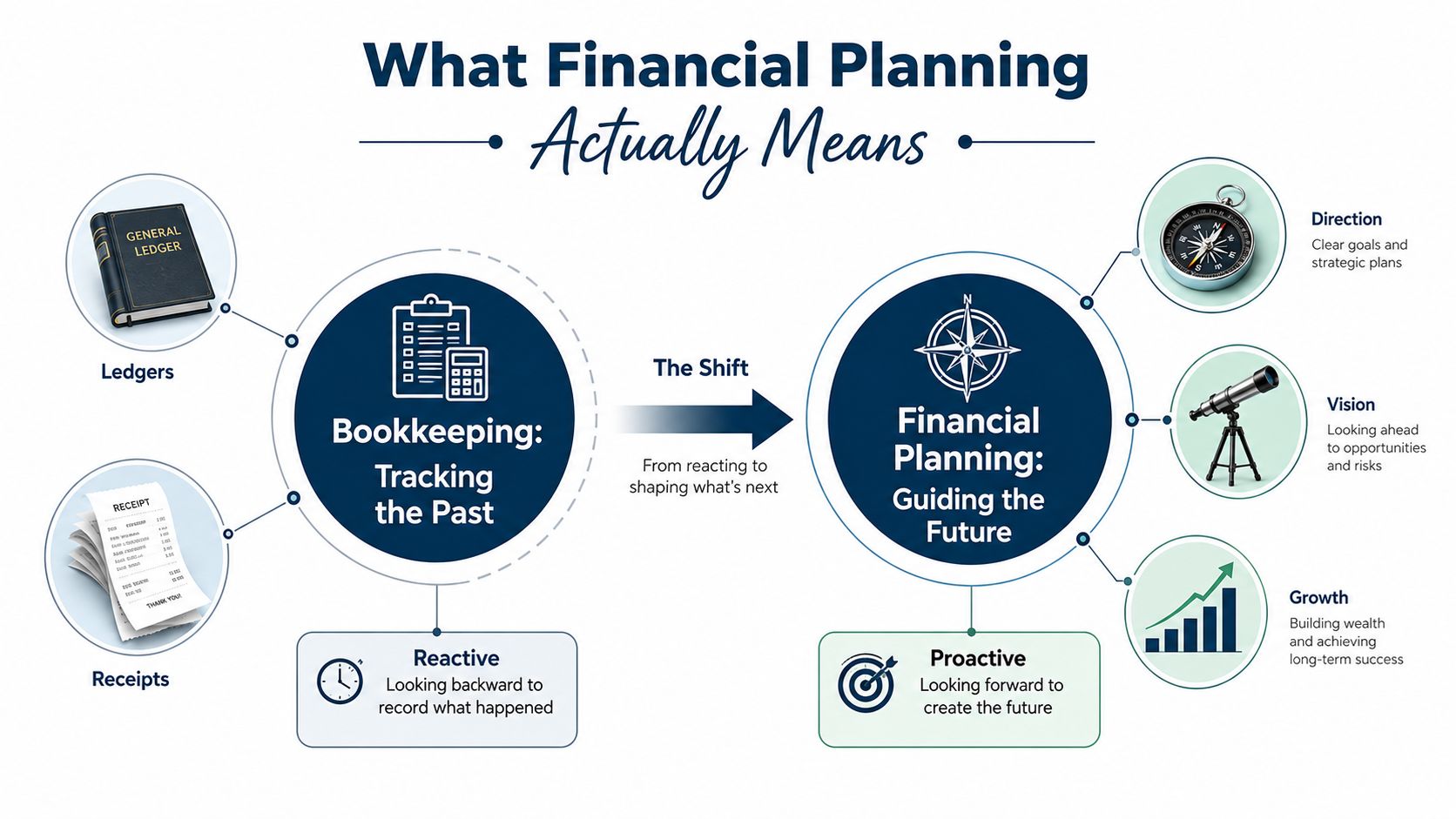
Bookkeeping tells you what happened, planning tells you what to do next
Bookkeeping records transactions. Accounting groups and reports them. Financial planning uses that information to make choices before the money leaves the bank. That difference matters because the question changes from “What happened last month?” to “Can I hire, borrow, delay, or raise prices without breaking the business?”
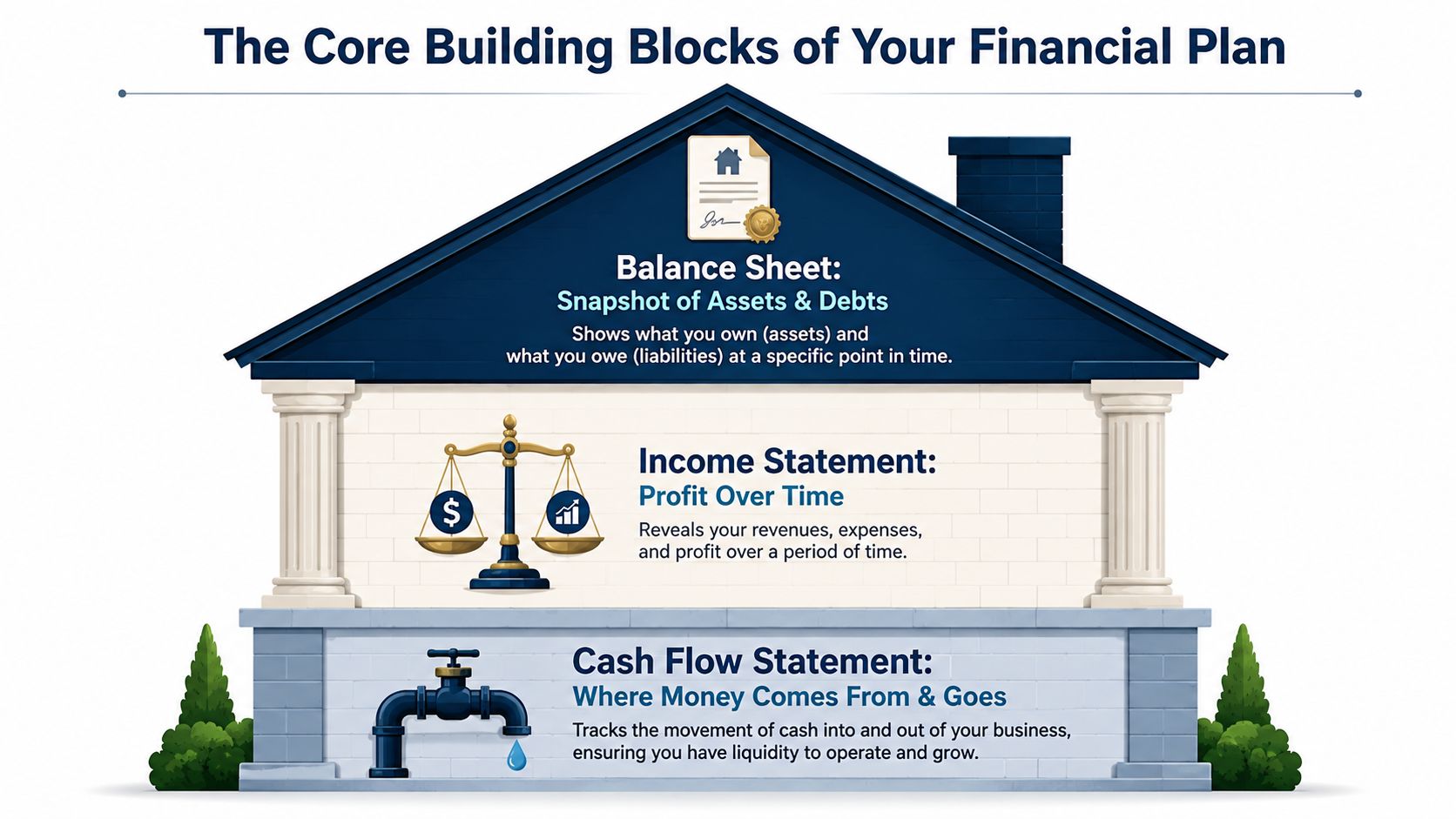
A useful plan starts with the three core financial statements, the income statement, the cash flow statement, and the balance sheet. The income statement shows whether the business is making money, the cash flow statement tracks actual money moving in and out, and the balance sheet shows assets, liabilities, and equity. Many owners look only at profit and miss cash trouble, which is how a business can look fine on paper and still miss payroll.
Practical rule: If you can't answer what cash will be doing in the next few weeks, you don't have a plan yet. You have records.
The deeper point is that this is not just a business exercise. Owners often tie their household income, retirement hopes, and personal stability to the firm. A plan that ignores that connection is incomplete from day one.
The real job of the plan
A working plan helps you answer plain questions. Can you keep a cushion in the bank? Should owner pay be fixed or variable? Which service line deserves more sales effort? What happens if a big client slows down?
It also helps separate the business from the owner. That separation is hard, especially in family businesses and founder-led firms across Greater Philadelphia, but it's the difference between a business that supports a life and a business that consumes one.
How to create a budget is one useful starting point if you want the spending side of the plan to stop living in your head.
The core purpose of the plan
A solid plan starts with the pressure points that decide whether the business stays healthy or starts leaking cash. A law firm in Center City, a medical practice in Bala Cynwyd, and a contractor working around Greater Philadelphia all face the same basic problem. Work can look strong while the cash position gets tighter.
The first job is to separate cash, profit, and net worth, because each one answers a different question. Cash shows whether bills can be paid on time. Profit shows whether the work itself is producing a return after wages, materials, and overhead. Net worth shows what remains after obligations are taken out of the picture. Owners who blur those three often make decisions based on hope instead of facts.
What Small Business Financial Planning Means
The cash flow statement comes first because payroll, rent, vendor bills, and tax deposits all clear in cash, not on paper. A professional services firm may show healthy revenue and still run short if client collections slow down. A healthcare practice can be full on the schedule and still feel strain if reimbursement arrives late. A contractor can have work in hand and still hit a wall if draws do not match the pace of labor and materials.
The income statement shows whether the business is profitable over time. That matters because busy does not always mean profitable. A firm can book a lot of work, keep the phones ringing, and still end up with too little left after wages, direct costs, and overhead.
The balance sheet shows what the business owns, what it owes, and what equity is left. Owners often push this aside because sales feel more urgent, but debt, equipment, receivables, and retained earnings shape what the business can safely do next. If the balance sheet is ignored, the plan may look strong while aging obligations narrow the options.
The structure that keeps the plan usable
Budgeting and forecasting give the plan its shape. Budgeting sets the spending intent. Forecasting shows what is likely if current patterns hold. A budget that never changes leaves owners reacting too late, while a forecast that never gets compared to reality creates false confidence.
Useful habit: build the budget around decisions, not just bills. It should tell you when to hire, when to wait, and when to cut back.
If you need a place to start on that side of the work, a practical budgeting guide for small businesses helps turn the spending plan from something you carry in your head into something you can review with your team.
KPI dashboards act like the windows in the structure. They show quickly whether something is off. For a professional services firm, that may mean utilization and backlog. For a healthcare practice, it may mean collections and payroll timing. For a contractor, it may mean job margin and billing progress. The point is not to collect metrics for their own sake. The point is to see where the business is gaining ground and where it is slipping.
Profitability analysis keeps the roof on the building. It forces a hard look at which service lines, client types, or project types are paying their way and which ones are draining time, labor, or follow-up. A line of work can produce revenue and still pull the firm down if the work is hard to staff, hard to bill, or too thin after overhead.
Tax planning, compliance, scenario planning, and exit preparation sit inside the structure. They are part of how the business stays functional when conditions change. Owners in Greater Philadelphia feel this in different ways. A healthcare group may need tighter tax reserves because collections move unevenly. A construction firm may need scenario planning because one delayed project can ripple through the rest of the schedule. A consulting firm may need exit planning early because too much of the firm's value sits in the owner's head.
One common mistake is to build the plan from last year's numbers and then act surprised when this year follows a different pattern. That approach gives the business a rearview mirror when it needs a working map.
The plan works when each piece answers a decision the owner has to make. Cash, profit, balance sheet strength, budget, forecasting, dashboards, profitability, tax, and scenario planning all serve that purpose. If those pieces do not point to real choices, the plan is just paperwork.
A Practical Weekly Monthly and Quarterly Rhythm
Plans fail when they sit in a drawer. The best ones show up on the calendar in short blocks that busy owners can keep. A five-person agency in Center City doesn't need a giant finance retreat every week. A West Chester contractor doesn't need to spend all Friday on spreadsheets either.
Weekly checks that keep you out of trouble
Once a week, look at cash first. Then scan what's owed to you, what you owe others, and which jobs or projects are carrying their weight. That's the level where you catch a bad month before it becomes a bad quarter.
A marketing agency might see one client running behind on payment and decide to hold off on extra contractor spend. A construction crew might notice a project is burning through labor faster than billed progress and slow the next purchase order.
Monthly reviews that force decisions
Once a month, compare actual results with the budget, review the KPI dashboard, and decide on owner compensation. This is also the point where a lot of owners need to stop pretending “I'll just take money when I need it” is a strategy. It isn't.
If the monthly review shows your plan is drifting, make one concrete move. Raise prices, delay hiring, tighten collections, or shift spending. Don't just label the gap and move on.
Quarterly resets that keep the plan honest
Every quarter, refresh the forecast, set aside tax money, and run a simple stress test. Ask what happens if a client leaves, a lender tightens, or a project gets delayed. That kind of thinking is useful for owners who need more than wishful planning.
If you only have two hours a week, use one hour for cash, one hour for the forecast. Everything else comes after that.
A basic routine can still work if it's consistent. The point isn't to do more finance. The point is to make better decisions before the month gets away from you.
How Real Businesses in Philadelphia Put This to Work
The patterns are different by industry, but the logic is the same. Once owners can see where the money pressure comes from, they stop blaming every problem on “slow season” or “just how business is.”
A professional services firm in West Chester
A six-person firm in West Chester was bringing in work, but not all of it was worth the effort. Once the owner started using job costing and a simple KPI dashboard, two service lines stood out as weak. They looked busy, but they weren't paying for the time they consumed.
The change wasn't dramatic. The owner just started asking which work should be kept, fixed, or dropped. That habit turned a vague feeling into a decision.
A two-doctor healthcare practice
A small healthcare practice kept running into payroll stress even when the schedule looked full. The issue wasn't demand. It was timing. Reimbursement follow-up was too loose, and owner draws were hitting at the wrong moments.
The fix was a tighter draw schedule and better follow-up on insurance payments. That created a cleaner cash rhythm and made payroll less chaotic. The planning habit was simple, track reimbursement like it matters, because it does.
A residential construction contractor
A contractor was building forecasts off gut feel and hoping the next job would cover the current one. That worked until it didn't. The better move was to rebuild the forecast around job milestones instead of rough optimism.
That shifted the conversation. The owner stopped taking on projects that looked good on paper but strained cash flow in real life. The planning habit was to tie every major commitment to timing, not just total revenue.
Why Your Personal Finances Belong in the Plan
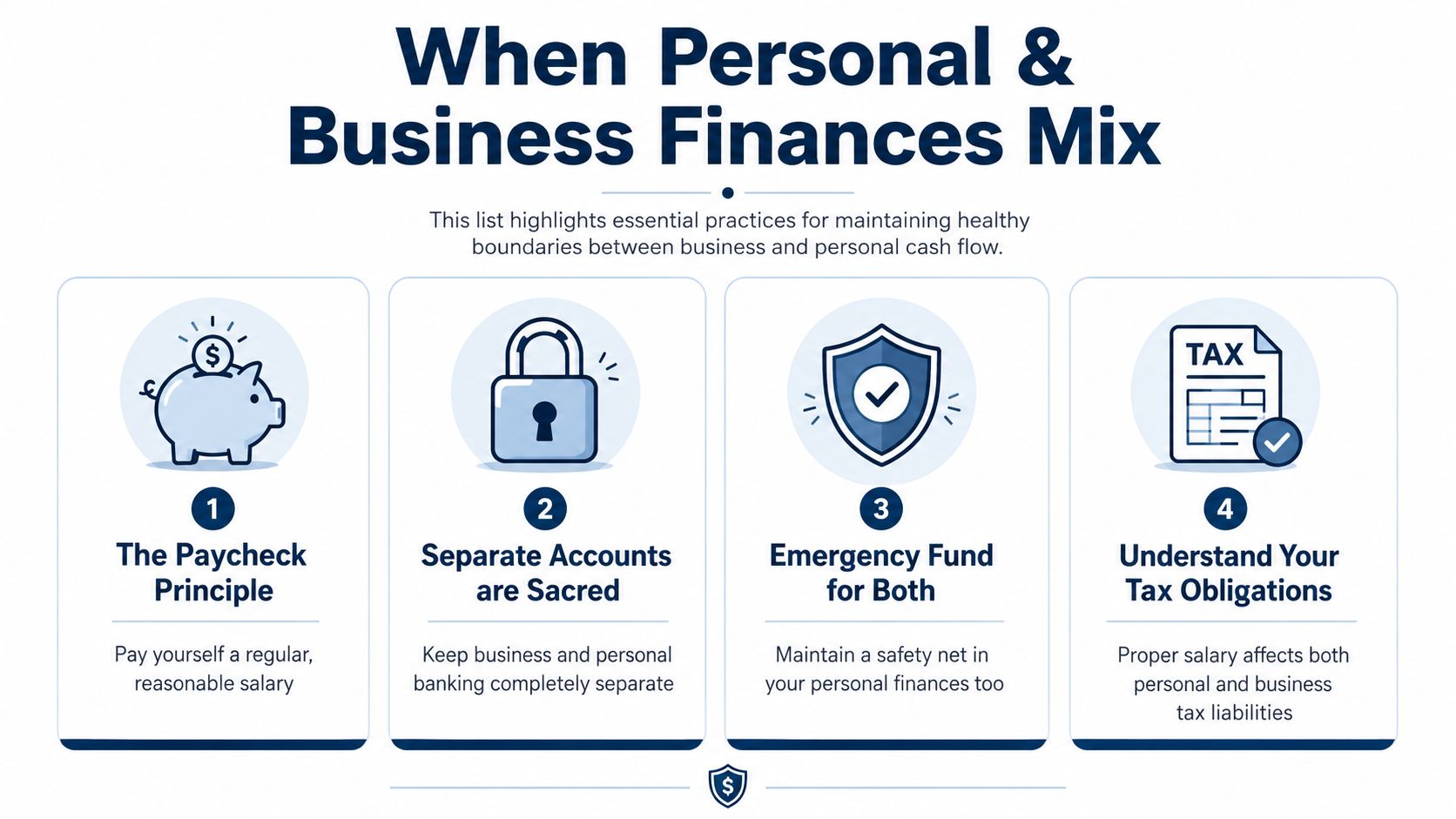
The mistake I see most often is owners treating business money and personal money like separate worlds. They are tied together the moment your household depends on the company for rent, groceries, payroll, or college bills. A practical small business financial planning process protects the business and the family at the same time.
Owner pay, reserves, and the risk of mixing money
The U.S. Consumer Financial Protection Bureau found that small-business owners were nearly twice as likely to report month-to-month income variation as non-owners, and they were over 20 percentage points more likely to have experienced an income drop. That is why owner pay cannot be random. If income swings, personal budgeting has to be built around a steady draw or salary plan, not whatever is left at the end of the month. CFPB research on the financial security of small business owners
Reserves need the same treatment. Keep business reserves for operating shocks and personal reserves for family shocks. If both accounts run thin at the same time, one problem quickly becomes two, and the pressure lands on the same owner who is trying to keep payroll current and keep the household stable.
Exit thinking starts before you want to leave
Owners also need to know what happens if they cannot work for a while, or if they decide to sell later. That means disability coverage, emergency reserves, and transition planning even when an exit feels far away. In Philadelphia, I see this come up with solo professionals, healthcare owners, and contractors who assume the business will always throw off cash. That assumption is risky.
Many owners also underestimate their real personal income needs and leave too much wealth trapped in the company. That creates concentration risk. If the business takes a hit, personal security takes a hit too, and there may be less flexibility than the owner expected.
The U.S. Treasury report on small-business financing describes how underserved owners often face limited connections to capital sources, fewer personal resources, and cultural barriers to financial services, while CDFIs and SSBCI have been used to expand access. U.S. Treasury financing landscape report In that kind of environment, cleaner books and realistic forecasts matter even more, because the family balance sheet and the business balance sheet are both part of the decision.
For tax planning that touches both sides of the house, tax preparation for families can be a useful resource when the owner and household returns need to be thought through together.
A healthy plan asks a few personal questions every time:
- What does the household need every month? That number should shape owner compensation.
- How much cash stays outside the business? If the answer is “not much,” the risk is too high.
- What happens if the owner is out for 90 days? Families need a real answer, not a hope.
- Where will retirement money come from? If the answer is only the business, the plan is fragile.
That is the part many generic guides miss. Business survival planning and owner financial security are linked, so they need to be managed together. If the company is strong but the household is exposed, the plan is incomplete. If the household is covered but the company is undercapitalized, the same risk shows up from another angle.
For owners who want a clearer operating rhythm, outsourced accounting for small business can help turn both sets of numbers into decisions instead of guesswork.
When DIY Planning Stops Working and Outsourced Help Makes Sense
DIY planning works for a while, especially when the business is small and the owner is disciplined. Then the numbers get more layered than one person can track well while also running the company. That's when outside help stops being a luxury and starts being a control system.
Signs you've outgrown the current setup
Sales can look fine while cash keeps slipping through the cracks. Tax season can turn into a yearly fire drill. If you cannot tell which customers, jobs, or service lines make money, part of the dashboard is still dark.
That pressure shows up fast when financing is part of the plan. The U.S. Treasury financing landscape report notes that underserved business owners often face limited connections to capital sources, fewer personal resources, and cultural barriers to financial services, while CDFIs and SSBCI have been used to expand access. In that setting, clean books and forecasts that reflect reality matter even more.
What outsourced help actually does
A good advisor does more than review transactions. They help build a forecast, watch margins, catch cash problems early, and turn numbers into decisions the owner can use. That can mean a bookkeeper with advisory support, or a fractional CFO when the business needs deeper planning.
Tools matter too, but only when they fit the way the business runs. If you are comparing software, the top features in planning tools are a useful guide for what a useful platform should cover, especially around forecasts, dashboards, and planning workflows.
MyOfficeOps is one example of a local partner that combines bookkeeping, financial reporting, and CFO-level advisory for small businesses that need more than clean transaction coding. The right fit depends on whether you need basic order, better reporting, or a full decision partner. Learn more about outsourced accounting for small businesses.
A good engagement should make meetings shorter and decisions clearer, not create more reports nobody reads.
If you are in Philadelphia or West Chester and the business keeps outgrowing your current process, the next move is usually to bring in help before the next quarter gets more expensive.
Your First Three Steps and a Simple Planning Checklist
A contractor in Philadelphia is waiting on receivables, a medical practice in West Chester has payroll due, and a professional services firm in Center City is trying to decide whether to hire or hold. In each case, the next move is the same. Start this week, not next quarter. Pull the last three months of bank and credit card statements, build a simple 13-week cash flow forecast, and schedule a 60-minute planning session with yourself or an advisor. That alone will show you where the pressure points are.
Then use this checklist to keep the work grounded.
| Component | What to do | How often | Simplest first version |
|---|---|---|---|
| Income statement | Review profit and cost patterns | Monthly | Export the P&L from your accounting software |
| Cash flow statement | Track money coming in and going out | Weekly | Use a simple spreadsheet |
| Balance sheet | Check assets, debt, and equity | Monthly | Review the latest accounting report |
| Budget | Set spending guardrails | Monthly | Build a one-page budget |
| Forecast | Predict the next few months | Quarterly | Update the next 13 weeks only |
| KPI dashboard | Watch the few numbers that drive results | Weekly or monthly | Use 3 to 5 metrics, not 20 |
| Tax set-asides | Move money before it gets spent | Quarterly | Open a separate savings account |
| Owner compensation | Set a steady draw or salary | Monthly | Pick a fixed amount and stick to it |
The point is not to build a perfect finance system on day one. The point is to create a decision routine that tells you when the business can absorb a delay, when it needs cash protection, and when the owner has room to pay themselves without starving operations. A clean forecast and a short checklist do that better than a stack of reports no one uses.
If you run a business in Greater Philadelphia or West Chester, the smartest first move is often a short discovery call with someone who can tell you whether your books, cash flow, and planning rhythm are working. The cost of that conversation is usually less than another quarter of guessing.
If you want a cleaner planning system, MyOfficeOps helps small businesses build books, cash flow visibility, and advisory support that turns numbers into decisions. If you're trying to separate business survival from personal financial stress, visit MyOfficeOps and see how a practical planning process can fit your company.