

An owner in West Chester calls after a profitable month and says, “I don't understand where the cash went.” Sales look healthy. The team is busy. Yet the bank balance barely moves because payroll, software, rent, insurance, outside vendors, and small recurring charges keep taking their share.
That's the operating expense problem. Operating expenses are the day-to-day costs required to keep a business running, separate from the direct cost of making or delivering what you sell. Operating expense reduction means lowering those costs without weakening service, overloading staff, or cutting the work that creates future revenue.
The first place I look isn't usually marketing or payroll. It's the quiet recurring spend nobody owns. An unused software seat, a duplicate reporting tool, or five vendors doing work one vendor could handle can drain cash month after month. Those leaks are different from a one-time invoice, and they need a different response.
The useful target is not “spend less at any cost.” It's better unit economics, longer cash runway, and more capacity to serve customers. A practical 90-day process can help you find quick savings, then build lasting improvements. Owners who want another perspective on software and vendor cleanup can also review this Zendesk cost optimization playbook for ideas to compare against their own audit.
Introduction to Operating Expense Reduction That Protects Growth
A broad freeze can make the income statement look better for a short time. It can also delay sales work, remove tools people rely on, and push important maintenance into a more expensive future. I've seen owners pause marketing before checking whether the leak was a renewal nobody remembered or a vendor bill coded to the wrong place.
Good operating expense reduction protects the engine of the business. That means keeping customer response times, quality checks, revenue-producing work, and essential employee support intact. It also means separating a real recurring saving from a temporary drop caused by timing, a delayed bill, or a one-time credit.
Start with a plain question: what does the company pay every month to operate? Include administrative payroll, rent, utilities, software, insurance, office costs, professional services, repairs, and other overhead. Then compare the spending with the revenue it supports. The aim isn't to make every category smaller. Some expenses create capacity or protect revenue, so removing them can make the business weaker.
The difference between a leak and a useful investment
A leak has three traits. It repeats, usage is low or unclear, and no specific person is responsible for reviewing it. A useful investment has a clear owner, a clear business purpose, and a way to check whether the value continues.
For example, a customer relationship management system may be essential for a sales team. Ten unused seats on that system aren't essential. A bookkeeper may need accounting software, while three separate tools that store the same vendor and payment data may be wasteful.
The same logic applies to people. Cutting a role can reduce payroll, but it may increase missed deadlines, overtime, errors, or customer complaints. Redesigning a slow approval process may lower the work required without removing the person who handles important customer needs.
Practical rule: Cut waste before you cut capacity. Waste is difficult to defend. Capacity deserves a business case.
The sections ahead focus on evidence. You'll map the spending, prove which charges are idle, rank the risks, negotiate with vendors, and measure recurring savings against a realistic run rate. That approach gives you a cleaner answer than asking where the next cut can come from.
How to Audit Your Spending and Find Hidden Leaks
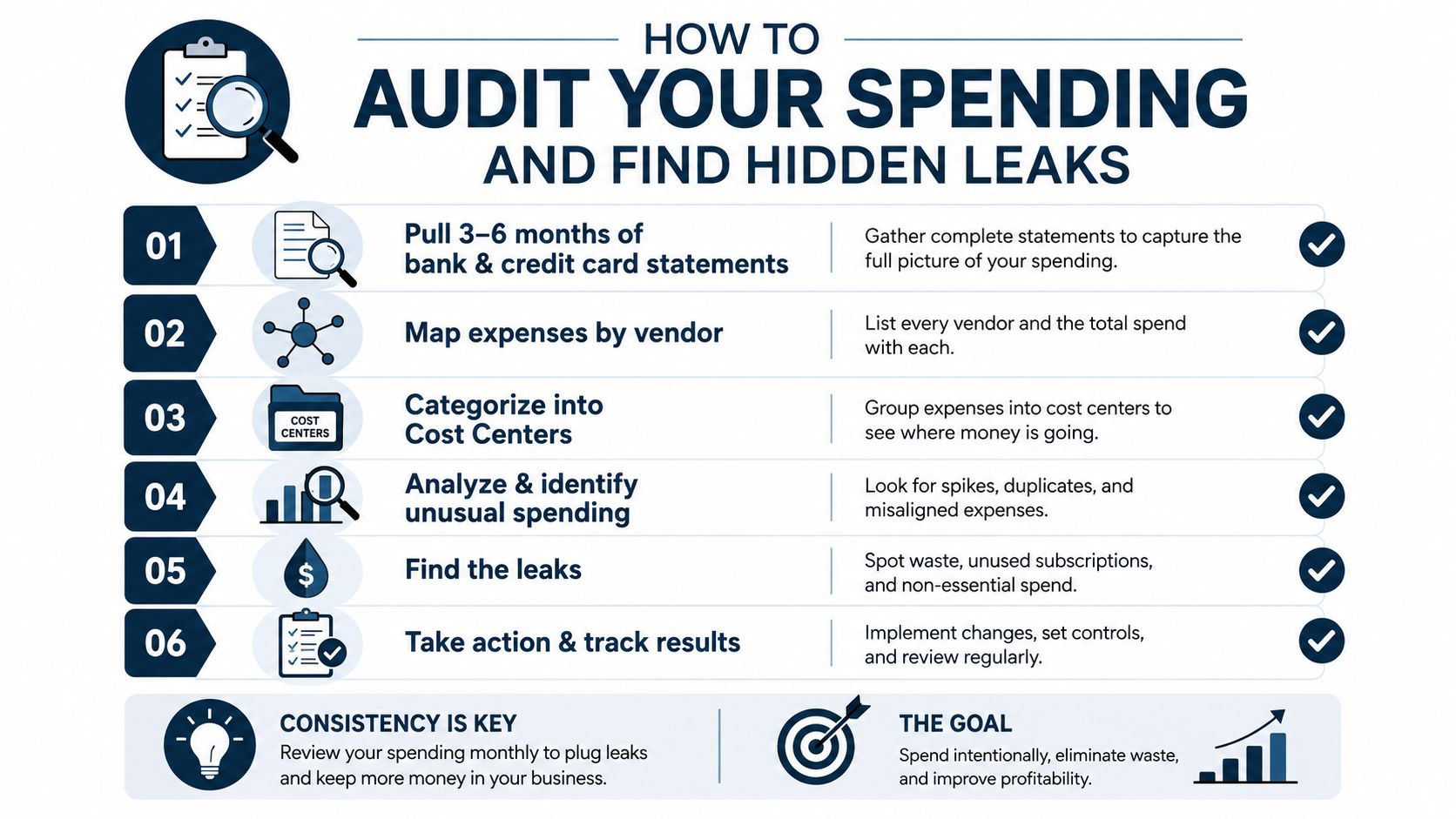
An audit works best when it starts with records, not guesses. Pull the last 3-6 months of bank and credit card statements, accounts payable reports, payroll summaries, and recurring payment schedules. A shorter view can miss annual renewals or seasonal charges, while a longer view can add work before you've found the obvious problems.
Use a spreadsheet or accounting platform and give every transaction three labels:
- Vendor: Name the company that receives the payment. Clean up spelling differences so the same vendor doesn't appear under several names.
- Cost center: Assign the expense to sales, operations, administration, delivery, or another part of the business.
- Category: Use a useful group such as software, insurance, rent, outside services, travel, or supplies.
This mapping shows patterns that a general profit and loss report can hide. A business may appear to spend a reasonable amount on software, but the vendor list may reveal several tools purchased by different departments for similar work.
Freeze new noise while you investigate
Pause nonessential new subscriptions, equipment purchases, and outside services during the review. This isn't a permanent spending ban. It keeps the list from growing while you decide what the business already owns and uses.
Next, flag the top recurring items. For each one, record the payment amount, renewal date, contract term, department, business purpose, and owner. Don't accept “the team uses it” as proof. Ask for login activity, active seats, completed work, tickets handled, reports produced, or another usage signal that fits the tool.
A license with no active user is a strong cancellation candidate. A tool with low activity may be downgraded rather than removed. Two tools with overlapping features need a short comparison by workflow, not a debate based on who bought them.
The same process applies to scattered vendors. Group payments for similar services, then ask whether consolidation would reduce administration or improve negotiating power. Assign a cancellation date and a named owner to every proposed action. “Finance will handle it” often means nobody handles it.
For a simple reference on organizing transaction records, use this guide to track business expenses. Keep the cleanup list ranked by expected recurring value, ease of cancellation, contract risk, and effect on customers or staff.
The proof should fit on one line: vendor, recurring charge, evidence of low use, owner, action, and date.
This method follows the often-missed problem identified in coverage of hidden operating expense leaks. Idle licenses, duplicate subscriptions, scattered vendors, and unused fixed costs can offer more immediate opportunities than headline cuts. The goal is to show exactly where money leaves each month and why the proposed action won't damage the business.
Sorting Costs and Choosing What to Cut First
Not every expense responds to the same decision. Fixed costs don't change with production volume, and common examples include rent, property taxes, and utilities, as explained by Yale's overview of non-wage fixed-cost relief for small businesses. Variable costs move more closely with activity, such as transaction fees, contractor work, shipping, or supplies tied to customer demand.
Fixed costs usually take longer to change because leases, service agreements, and property obligations have terms. Variable costs may offer faster choices, but a careless cut can slow delivery or lower service quality. Sort each expense by how quickly you can change it, not just by its size.
A practical ranking test
Give every proposed action three ratings:
- Financial impact: How much recurring spend could it remove or prevent?
- Reversibility: Can you restore the service quickly if the decision hurts operations?
- Growth risk: Could the action reduce sales, customer care, compliance, or employee productivity?
An unused subscription often ranks high on impact, high on reversibility, and low on growth risk. Removing a customer support role may rank high on impact but low on reversibility and high on growth risk. That difference should determine the order.
The operating expense ratio gives you a simple health check. Calculate it by dividing operating expenses by total revenue. One benchmark source says aiming for a ratio below 60% is generally advisable, as described in this operating expense ratio guide.
If revenue is $100,000 and operating expenses are $60,000, the ratio is 60%. That means $60 of every $100 in revenue goes toward running the business before profit is counted. The ratio isn't a universal answer because industries and growth plans differ, but it helps you watch direction month by month.
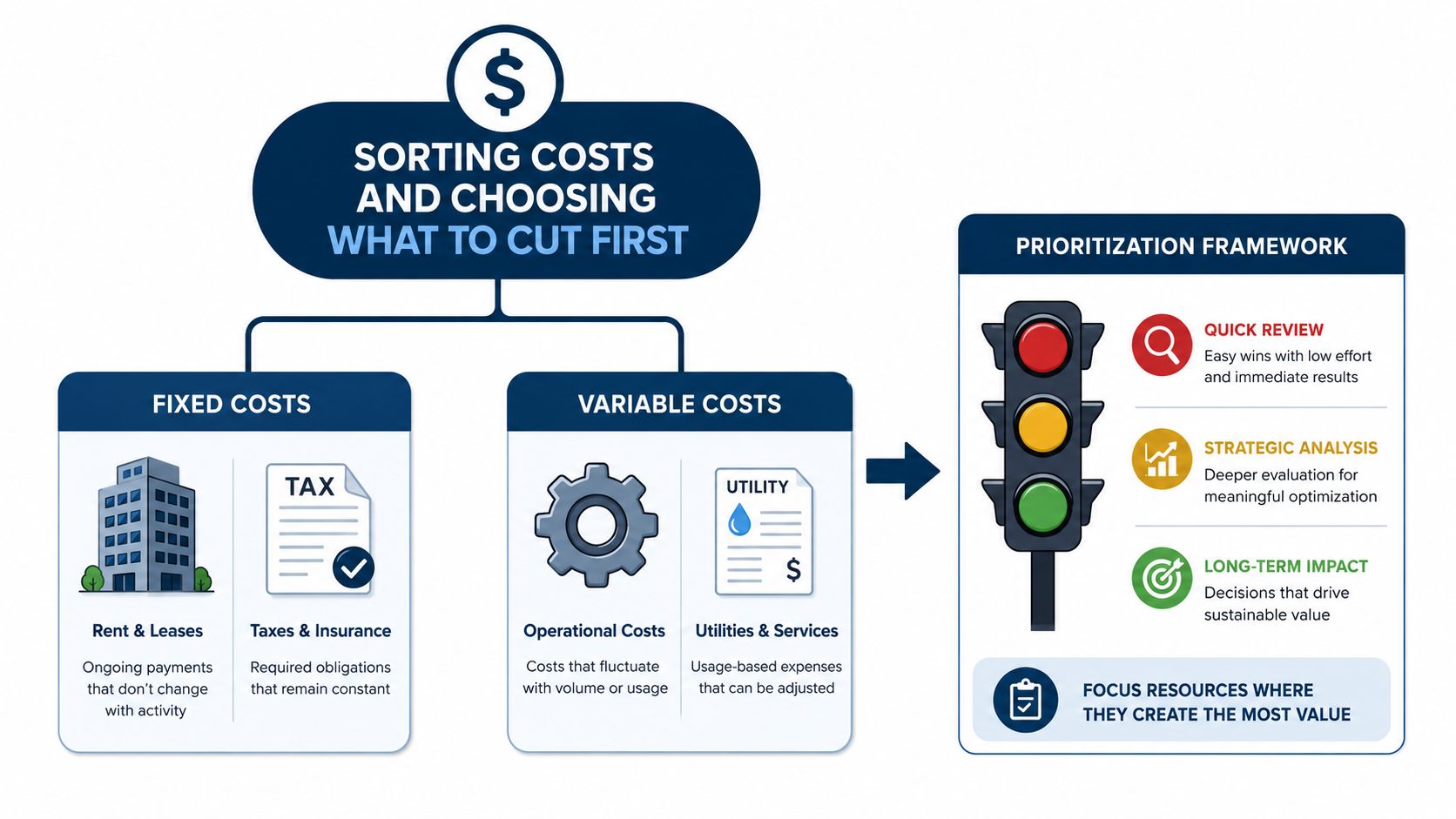
Create three lists: remove now, investigate, and protect. “Remove now” holds proven waste. “Investigate” holds costs with unclear usage or contract limits. “Protect” holds expenses tied directly to customer delivery, safety, compliance, revenue generation, or critical staff capacity.
Zero-based budgeting can support this review because it asks each cost to earn its place rather than automatically carrying forward last year's budget. This resource on zero-based budgeting can help you frame that discussion. For businesses with recoverable materials or other offset opportunities, it may also help to browse cost recovery strategies before treating every expense as a pure cost.
Quick Wins Versus Strategic Initiatives That Last
Quick wins and lasting improvements serve different purposes. A quick win improves cash flow soon, often by removing something the business no longer needs. A strategic initiative changes how work gets done, so the business needs fewer resources for the same output or gains more output from the resources it keeps.
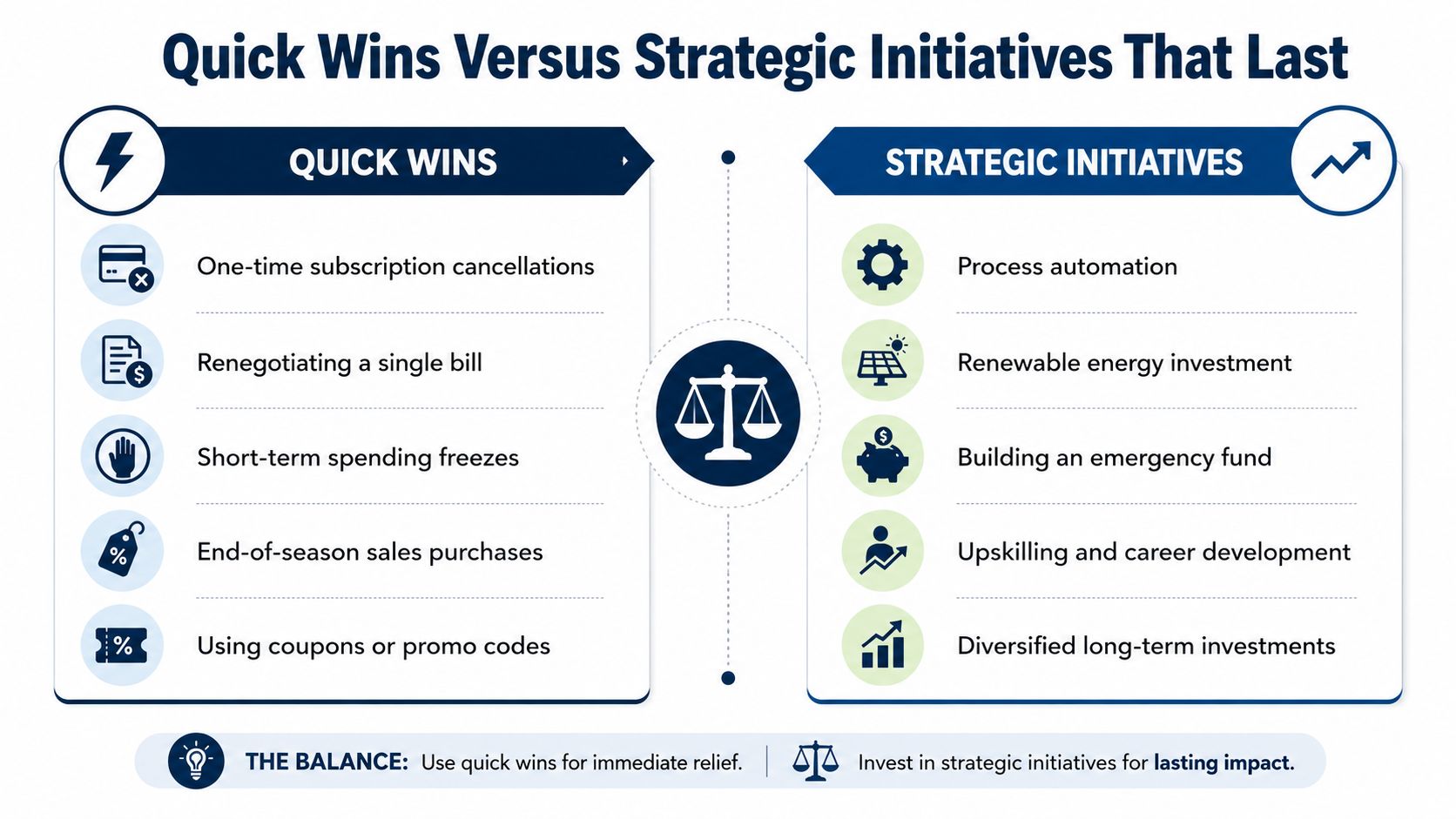
| Quick wins | Strategic initiatives |
|---|---|
| Cancel an unused subscription | Redesign a manual approval process |
| Remove duplicate tools | Automate repetitive finance workflows |
| Renegotiate one renewal | Right-size cloud resources |
| Tighten purchase approvals | Consolidate vendors and ownership |
A quick win is useful when the evidence is strong. Canceling an idle license doesn't require a major transformation. Tightening approvals for nonessential purchases can stop new waste while leaders review the wider budget. Moving bill dates may help cash timing, but it isn't a true saving unless the total cost changes.
Strategic work takes more thought. A team may spend time collecting invoices because the process has too many handoffs. Automating invoice intake, approval routing, and payment records can reduce manual work, but only if someone designs the workflow and checks the results. Cloud rightsizing follows the same rule. Turning off unused resources or matching capacity to actual demand can improve cost control, but a rushed change can affect service reliability.
The case for targeted work is stronger in the current cost environment. Recent CFO-focused coverage describes pressure to reduce SG&A while protecting growth, with cloud waste moving back toward roughly 29% and 42% of CFOs expecting some AI-driven headcount reduction, mostly 1 to 5%, according to this operating expense reduction analysis. Those figures point toward selective automation, cloud rightsizing, and process redesign rather than automatic layoffs.
Why savings snap back
A department may cancel a tool, then buy a replacement without telling finance. A vendor may offer a discount that expires, leaving the old cost in place later. A team may reduce staff without removing the work, causing overtime or outside contractor bills to return.
McKinsey reported that two-thirds of companies met their cost-reduction targets, while four in ten executives said at least some costs would return within 12 to 18 months, as documented in its global cost-cutting survey. Track each saving after implementation, assign a renewal owner, and check whether the process still works.
The best sequence is simple. Capture low-risk waste first, then fund strategic improvements with the cash and attention you've freed. Don't call a one-time cancellation a permanent efficiency gain until the next renewal cycle passes without the charge returning.
Renegotiating Vendors and Optimizing People and Productivity
Vendor conversations go better when you bring facts. Before a renewal call, gather the contract, invoices, usage records, service issues, payment history, and comparable options. Ask for a lower rate, better terms, removal of unused features, or a plan that matches actual volume. A vendor needs to understand what you value and what you're prepared to change.
Vendor script: “We're reviewing recurring spend against actual usage. We want to keep the relationship, but this plan includes capacity we aren't using. What can you offer that matches our current needs?”
Consolidation can strengthen your position. If several suppliers provide similar services, compare total cost, response time, quality, contract risk, and switching effort. Don't choose a single vendor only because the price is lower. A cheap supplier that misses deadlines can create costs elsewhere.
Peer comparison can make the conversation more objective. Bain's utility cost-reduction analysis describes peer comparison and open-book benchmark studies as ways to compare cost and performance with similar organizations. It also identifies four useful levers: improving frontline productivity, reducing external spending, streamlining the organization, and pruning the asset portfolio.
Improve output before reducing headcount
Payroll is often the largest operating expense, but that doesn't make layoffs the first answer. Start by clarifying roles, removing duplicate approvals, checking workload, and measuring utilization. If a skilled employee spends hours entering data or chasing invoices, automation or a better process may create more value than removing the role.
Outsourcing can also fit when the work is important but not a core advantage. Bookkeeping, bill pay, reporting, and some administrative support can be handled by specialists, while the owner keeps decision rights. If you're comparing staffing options, you can Hire Virtual Assistants for defined administrative work, then document the handoffs and quality checks before shifting responsibility.
Use a basic checkpoint for every people-related change:
- Workload: Who owns the work after the change?
- Quality: How will you know errors or delays haven't increased?
- Capacity: Can the team still handle expected customer demand?
- Review date: When will leadership decide whether the change worked?
A bookkeeping and advisory partner such as MyOfficeOps can handle bookkeeping, bill pay, payroll integration, financial reporting, forecasting, and KPI dashboards as part of a defined finance operating model. Its vendor management best practices also provide a useful checklist for renewals, owners, approvals, and performance reviews.
Your 90 Day Roadmap and How to Track Savings That Stick
A cost plan needs dates and owners. Without both, the business may find waste but fail to remove it. The practical workflow below separates discovery from action, then tests whether the saving remains real.
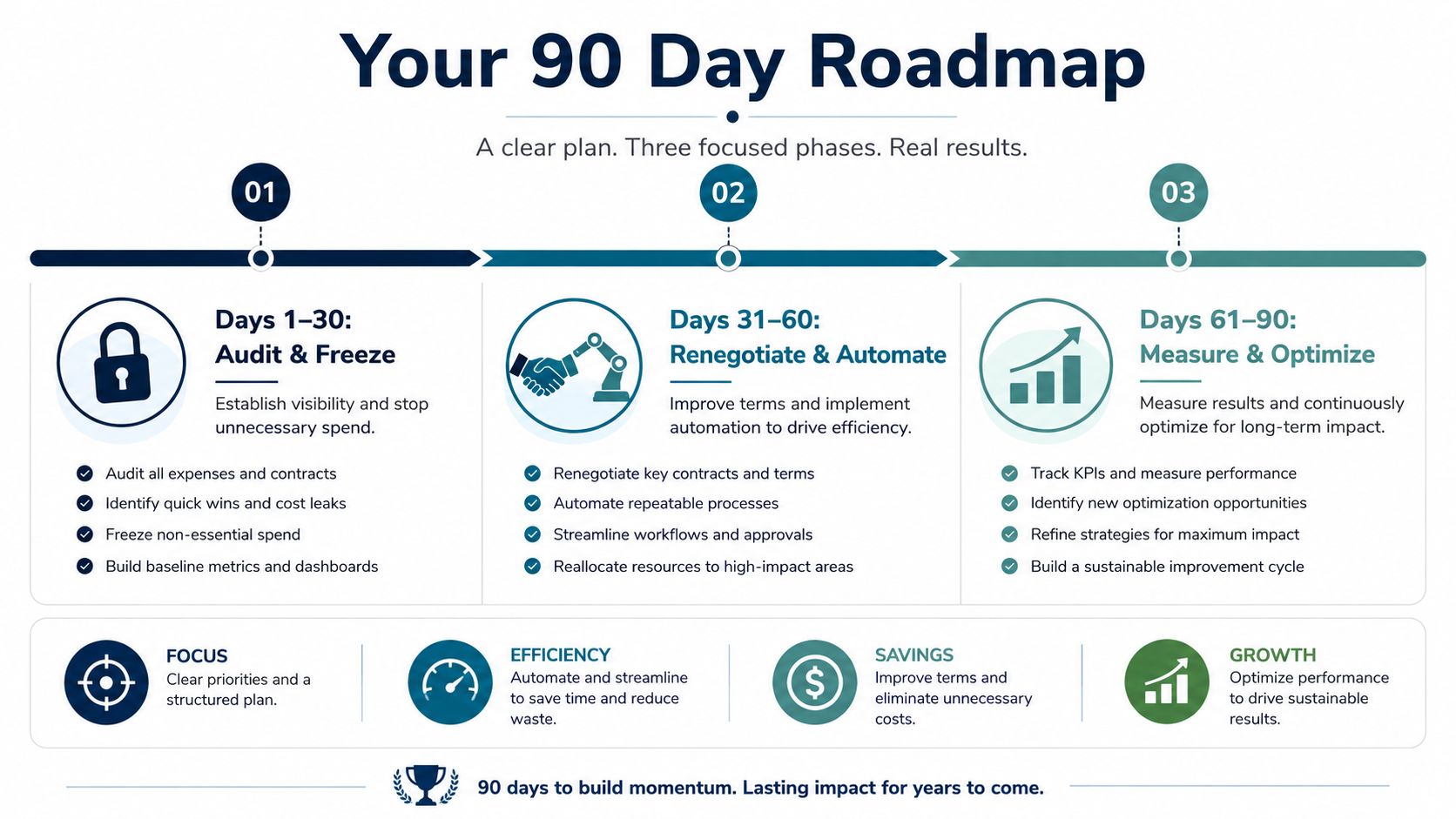
Days 1 to 30 map and freeze
Map spending by vendor, cost center, and category. Freeze nonessential new spend. Flag the largest recurring charges, then collect usage evidence and renewal dates. Build the ranked list of proven waste, uncertain costs, and protected capacity.
Don't announce broad cuts before managers understand the list. Ask department owners to confirm what each tool or service does, who uses it, and what would break if it disappeared.
Days 31 to 60 renegotiate and automate
Renegotiate contracts, remove duplicate tools, tighten approvals, and automate repetitive workflows. Document the decision for each item, including the old recurring cost, the new cost, the effective date, and the person responsible for checking the next invoice.
A lower invoice isn't enough if the business adds another unapproved service later. Keep one shared register for subscriptions, vendors, renewals, and savings actions.
Days 61 to 90 measure and assign
Validate savings against a three-month run rate, refresh the forecast, and assign an owner to every recurring saving. The 90-day method and these three phases are outlined in this operating expense reduction workflow.
Track the operating expense ratio monthly, along with spending by major category, recurring vendor cost, payroll load, and service measures that matter to your business. Compare actual results with the forecast, not just the previous invoice. A delayed bill can make one month look better while creating a larger payment later.
Poor project selection, weak leadership, poor communication, and resistance to change are common failure factors in cost programs. Prevent them by giving every action a business reason, a decision owner, a review date, and a clear message about what the company is protecting.
Savings stick when someone owns the next invoice, not just the first cancellation.
Start with one working session this week. Pull the statements, list the recurring charges, and mark every item with no clear owner. Then take the first low-risk action and schedule the review that proves whether it stayed gone.
MyOfficeOps helps small and midsize businesses clean up bookkeeping, manage bills, build forecasts, and track the KPIs behind operating expense reduction. Visit MyOfficeOps to schedule a Discovery Call and discuss a practical plan for finding leaks without starving growth.